- Apr 25, 2011
- 19,848
- 28,296
Introduction

Back when I wrote the last guide (Building and ranking sites in 2017 - https://www.blackhatworld.com/seo/seo-guide-for-2017-building-and-ranking-sites.959735/) SEO was hard. Well, it certainly hasn't got any easier today and if you are looking for a quick way to make money online, or a way of turning your $50 investment into $500 within two weeks and without doing any work, look elsewhere.
SEO definitely isn't for the feint-hearted among us; it requires lots of work, it requires lots of testing and it requires that you are perfectly comfortable with failing over and over again until you get it right... And then failing again because you just cracked it right before Google released a new update and nulified everything that you had previously discovered about ranking your site.
You only have to read through this form and look at a few of the existing case studies, guides or journeys to see how much work people are putting in to this stuff - and the crucial thing is this; whatever anyone tells you on a public forum (This guide included) is only scratching at the surface. There is always more to it when you are actually doing it yourself and there are always things that people will do, and not tell anyone about, in order to make their own website successful.
You have to put in the work - and lots of it
That being said, if you want your niche site or your amazon affiliate site or your adsense site to be successful then you need to take what you've read online and apply it to the extreme - that means everytihng you do, you need to take how well you think others are doing it and then add about 50% on top of that so as to ensure you are doing it better than they are - not just better than it appears they're doing it, but way way better than you can even imagine that they're doing it. That way, you'll surely beat the competition.
You have to have patience - and lots of it
As well as effort you also need patience if you want to build a successful website and make money from it. There is no quick fix for this, it takes lots of hard work over an extended period of time. Not only does it require time because there is so much work to be done, you also need time because it takes Google and the other search engines a long time to trust your website as an authority.
You simply can't rush the process, so don't get over-exciting and think you've read or come up with the perfect strategy for link building and then start firing links all over the place then get inpatient when you don't see results and fire even more links at it. Do this and before you know it, you will have destroyed your website before you've even got started.
Building and ranking a website is a bit like going on a diet - you aren't going to get thin, or ripped in 2 months. You probably won't even notice the change as its happening because it is slow. It requires that you follow a set strategy and routine day in day out for months and months and months. Then gradually, slowly and without you even noticing, you start to notice a change in your body - this is what SEO is like. You need to have a strategy in place, you need to have a long term plan for your website and you need to stick to it. Don't be swayed away from your strategy because you aren't seeing any immediate results. Follow your strategy and the results will come. Trust me.
Planning out your project is crucial

I can say with certainty that the level of planning you carry out before starting your project will dictate whether you succeed or fail. There are so many elements that you need in order to build a successful website, rank it and make money from it. If you don't think about all of those elements in detail before you get started, then you are destined to fail.
Key factors that you need to include in your plan (And the reasons why they're important)
OK I get the picture, and hopefully you get the picture as well in terms of what you are in for as far as this post is concerned . Without further adue, lets get into it.
Niche Selection

This is worth spending some time on. Choosing a niche is like chosing the material that you use to build your house - you could build the absolute best designed house in the world but if you use polystyrene blocks then its quite possibly going to fall down as soon as the wind picks up. Its the same with your niche selection; it will dictate all remaining factors about your site, so it needs to be right.
Some of the things we are looking for with our niche selection are as follows
Interest – We want a niche that people are interested in and one that people search for information on regularly. This means there is a potential audience for our website
Value – We want a niche with buyers because ultimately we want to make money from this site. So we need to have an idea of what we can sell to our website visitors.
Size – We want a niche that has the right size – we don’t want to run out of decent keywords to target but equally we don’t want to take on a mega niche that we can never realistically cover.
Competition – We want a niche that we can realistically compete in – of course we need the niche to be competitive to some extent otherwise it likely wouldn’t be worth our while, but we want to have a chance of getting our site to rank on the first page (preferably the top 3) without having to compete against the corporate giants of this world.
Finding a broad niche
We need to start somewhere, so lets find a broad niche. There are lots of different niches that you could target – think of broad categories like camping, cooking, cleaning, sport or travel. People always say, go with something that interests you. I would agree to an extent, but be careful, this is about making money and not necessarily just writing about your passion. In fact, think of it this way; the project itself is your passion, the content is dictated purely by what will make you money and doesn't neccesarily need to be something that you enjoy. As long as you are comfortable enough with it that you can spend time researching it and learning about it, thats fine. In fact its possibly even better because writing about a topic unknown to you, means you HAVE to spend time researching, learning and understanding it and that is what will add value to your website and to your visitors.
Lots of people in our industry will choose technology for example, because we can all write about that all day long, but as a result this is an extremely competitive niche and not necessarily the best one to go for. Its more likely the ones that nobody really wants to write about, that will have lower competition. So keep that in mind and try to find the right balance.
For the purpose of this guide, lets say that we are going to target the broad niche of Food and Drink. This is a huge niche of course. If you want to start an authority site in the Food and Drink niche, be my guest, but make sure your budget runs into the hundreds of thousands. Otherwise, lets drill down a few levels.
Finding a smaller sub-niche
Now that we have a broad niche, we need to find a smaller area within that niche, something that is a little more targeted. There are lots of different ways that we can do this, but I find the easiest way is to simply brain storm ideas. Think about all of the different things that would come under this broad niche.
Lets think of a few sub-niches of Food and Drink
Research these sub-niches on Google
Now we have something to work with. These niches might still be too broad, or they might be total crap. But we can start digging a little deeper into each idea. To do this, simply take each of the keywords about and start searching on Google to see what comes up. You can put the keywords in as they are, or you can add things like "Best XYZ". For example lets look up "best kitchen knives".

What to look for in the search results
When we look up each niche in the search results we are looking for a few different things in order to determine whether or not this would be a lucrative and/or viable niche to target. In addition, we are still in the information gathering stage so we can look for additional data to help our search as well.
We can do a few things with this information. First of all, if we search for our term and we find lots of niche sites then we know that this might be a worthwhile term to target. In this case we can start noting down all of these niche sites - these are going to be our competition so we want to gather as much information from them as possible during our information gathering stage.
If we only find mini authority websites then we can make use of those as well. We can note them down as they might be valuable sources of information if we do end up targeting this niche. Equally, we can also gather additional keywords from these sites. Because these sites are probably covering a large part of the broad niche that we chose originally (Food and drink) we can grab some of their categories to add to our brain storming list. We might find a better sub-niche to target as a result.
I am not going to name any of the niche sites that I find because I don't want to inadvertently publisise someones website, but I will show you some additional sub-niches that I added to my brainstorming based on a mini authority site that I found during researching this post.
This just adds to our list of potential sub-niches and once again we can create phrase permutations with these keywords and then search on Google to try and find a sub-niche that fits all of our requirements.
Competitor research using ahrefs keyword explorer
Once you have a list of niche websites that are covering a small sub-niche only, head over to ahrefs and plug the sites into the keyword research tool one at a time. Initially we want to search the entire site, so make sure that the scope operator is set to *.domain.com/* - this means we'll get data for the entire domain and all of its sub-pages.

It is normally helpful to put a few filters in place - typically you can filter keywords that have a minimum of 250 search volume, keywords that are ranking in the top 30 or so and optionally you can also add a word related to your niche into the "include" field if you want to narrow things down further.
You might keep these metrics broad or fine tune them depending what stage of the research you are at. In this case we are looking at a niche site in order to find a really good seed keyword. So we keep things quite broad. As this is a niche site, one that can feasibly be outranked, we'll look for keywords that have good traffic numbers and that this site is already ranking at least somewhere for. That means its likely to be an acheivable keyword but also a lucrative one thats worth building our site around.
You should end up with a list of 5-10 decent keywords in your sub-niche, after you have repeated this process for each of the competitors websites that you've found so far. Once you have this list, plug them back in to Google and look for the sites that are ranking in the number 1 spot for them. Then we can find the really laser targeted niche sites that we'll be competing against. We can then further gauge whether this niche is feasible to rank in and if so, we can gather lots of really juicy keywords and general information about the niche and all of our competitors.

Boom: This is what we are looking for
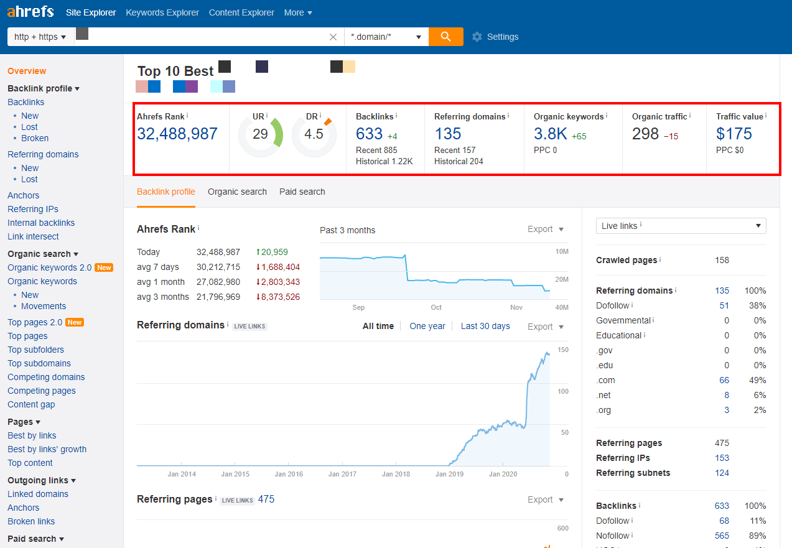
This is exactly what we are looking for - this is the summary page in ahrefs for a website that we found as a result of the above research. This site is definitely a niche website targeting a very small topic. As you can see from the above screenshot its a relatively new site, it doesn't have that impressive stats - its ranked 32 million by ahrefs, it only has UR29 and DR4.5 with 633 backlinks (To the entire site) and 135 referring domains. Thats not to say its a walk in the park, we don't know what TYPE of backlinks it has, or if it has any hidden backlinks. However, it is ranking for 3.8K organic terms (thats terms for which the site is somewhere in the top 100 results) and thats just what we're looking for; a site that isn't AMAZINGLY POWERFUL but is RANKING SOMEWHERE for quite a lot of keywords.
Further more, we found this site without leaving page one, so as well as having a lot of exposure in the top 100, it has some page 1 keyword rankings.
Fleshing out our target keywords list
So, lets look for the keywords that we are actually going to target. We can look at each of the chosen competitor websites in ahrefs keyword explorer, order the results by search volume and current rank (We want to target keywords that have for example 1000+ search volume and are ranking top 50 for the competitor website).
We can once again search for these keywords on Google and note any sites ranking in the top ten that are of interest - mainly we want to note down other niche and mini authority sites and ignore the larger sites such as brands and newspapers. By this stage we should be seeing the same few sites cropping up again and again because we are looking at a micro niche now and so there should be a smaller amount of competition with the best sites appearing for many of the keyword variations that we are looking at.
Make sure you note down all of these sites and keep them in a separate document - these are the sites we'll refer back to all the time for gathering new keywords, backlink sources and other data such as article length, content, products and styling ideas.
Finding LSI keywords to go with our primary keywords
Each time we find a decent primary keyword to target - one that meets the above metric requirements - we then want to find LSI and related keywords to target along side it. These keywords serve two purposes - firstly they give us additional keywords to target and rank for with each peice of content (We don't want to target 1 keyword for each article because we're missing out on lots of value, so we'll aim to rank each article for 10 or more keywords which massively increases the traffic and earnings potential for each peice of content). Secondly, we want to be covering each keyword comprehensively so we need to be tlaking about all of the topics that Google considers relevant to our primary keyword.
The easiest way to do this is to take the top 10 results on Google for each primary keyword, grab the niche sites (the ones that we can realistically compete with) and then paste the actual ranking page URLs into ahrefs keyword explorer. This time we want the URL scope set as "Prefix" which means that we'll see results pertaining to the exact page rather than the entire site.

We can then look for decent LSI keywords that the top sites are also ranking for. These are perfect because we know they're closely related to our target term, we know that a similar site to the one we are going to create is able to rank for them and we also know that Google considers them to be relevant to our primary keyword because they're ranking the same page of content for all of these terms.
Repeat this process until we have at least 10 primary keywords, each with 5-10 LSI keywords. This is minimum, you can go for more than this if you want to, but as long as you can see more potential then you can also expand on this data at a later stage. Then we have our basic plan for the websites content, niche and structure. Our keyword research stage is complete.
A few other things to think about at this stage
There are lots of keyword research services available from the marketplace. The first service that are would recommend are @Niche Captain - https://www.blackhatworld.com/seo/l...golden-ratio-packs-rank-and-dominate.1180546/
the second service is this one from - @RealDaddy - https://www.blackhatworld.com/seo/i...ition-keyword-pack-from-8-dwivedi-co.1316202/
Domain purchase and Hosting setup

The next step is to purchase a domain and set up hosting. You can go for an expired domain if you want to, but I personally tend to use a newly registered domain and one that I can brand specifically for the project.
Some people like to go for a micro niche domain like bestcoffeemaker.com but once again, I prefer to go for a brandable domain – one of the reasons is this – you can use a brand name as well as the domain itself for anchor text diversification whereas it can appear more spammy, and be harder to diversify anchor text, if both your brand and your naked URL anchors have your target keywords in them.
Don't over think the domain name too much. As long as its not too long, easy to type of and not easily confused like bobssandwichmakers.com then it should be fine. Have a little think about the brand as well; you want something that you can easily create a nice logo for and you want the site to look professional and not too corny. After all, you're going to have thousands of visitors coming to this site and seeing your branding skills right?
As for hosting, there are plenty of providers on blackhatworld who offer hosting services. Check out the marketplace and find one that has decent reviews - https://www.blackhatworld.com/forums/hosting.196/
You don't want to break the bank here, but you do want a decent package that is going to provide you with fast hosting - this is an important factor not only for SEO but also for user experience so its worth giving some thought to. Most common hosts will come with Cpanel and with that comes one-click WordPress installation as well as LetsEncrypt free SSL certificates - both a must for your new website as they make these parts super easy to deploy and manage.
Web hosting providers
I would recommend @HostStage for web hosting as I have used them for many years and they offer fantastic support and affordable hosting plans - https://www.blackhatworld.com/seo/h...ws-vps-seo-tools-ready-from-6-71-only.531723/
Expired domains
If you want to go for an expired domain then of course look no further than the authority for this here on BHW - @Nargil - https://www.blackhatworld.com/seo/n...domains-tf-da-referring-domains-based.833397/
Theme choice, installation and setup

Install your preferred theme and set everything up so that your website can be nicely organised. Themeforest (https://themeforest.net/) is a great place to look for a decent theme and if you are starting a review based website then ReHub (https://themeforest.net/search/rehub) is a decent theme to use. But there are plenty of other options as well. Just make sure you are comfortable with the styles of the theme, make sure it has good reviews and also check out the demo and make sure its loads nice and fast (Some themes can be a real hog on resources and that puts you in a bad place right from the start).
With a bigger site you can use a SILO type system whereby you segregate each category into its own mini website, linking between closely related categories only, but in the case of a micro niche website there is no need to do this in my opinion.
Instead, organise your site into several categories, for example in the case of our niche you can create a category for blenders, juicers, how to guides and recipes.
You can then add your content into the appropriate categories. The good thing about having this structure is that it helps to reinforce the subject matter of your articles using the menu system and site hierarchy and also it allows you to create internal link tiers with link juice flowing from your homepage to category pages and your category pages to your content pages.
If you are doing a very small and focused site you can add your main piece of content on the homepage but personally I would avoid it and rather have your primary content on sub-pages then link to the content from the homepage. This allows you to build links to the homepage and have them flow through to your most important articles, as well as building links to category pages and direct to the articles themselves as well as supporting content in your other categories.
Outsourcing the theme and its setup
If you need access to all of the themes that you can imagine, check out the WordPress themes vault from @Festinger - https://www.blackhatworld.com/seo/m...es-and-plugins-from-festingers-vault.1095237/
For setup of your theme, I would recommend @NitroCan - https://www.blackhatworld.com/seo/w...pages-logos-banners-custom-php-50-off.515531/
Content Writing

Now for the really important part; the content. You can either write the content yourself or you can outsource it, but you want to keep some things in mind either way.
When writing best of guides you need to add as much value as possible for the reader as well as making sure to cover the topic comprehensively. You can style your “best of” articles in the following way:
Introduction – Make an engaging introduction to your article, explain the pain point that you are going to solve for your reader, and how you are going to do that. Include your main keyword or a close variation of it in this opening text.
Comparison table – Add a comparison table showing all of the products that you are going to review in the article – these products should be well researched in the brain storming stage and you should have a list of what truly are the most useful and high quality products. You should also have an idea of the key features for this type of product and have each one detailed in the product comparison table.
Individual product reviews – you can then review each product individually explaining a little information about the product, its key features along with its pros and cons. It is also a good idea to use one of your LSI keywords for each product – for example “best blender for making smoothies”.
Buyers guide – explain to buyers how to choose between the top rated products and what features to look for in different scenarios.
Where to buy – explain to the reader where they can buy the product and any other “red herrings” to look out for.
Conclusion – final words on the product and closing statement for the article.
Outsourcing your content writing
If you need to outsource your content writing I would recommend the following writers -
@The_Magician - https://www.blackhatworld.com/seo/u...-quality-content-just-0-99-500-words.1226655/
@L33T - https://www.blackhatworld.com/seo/s...n-bhw-5-years-free-reviews-available.1152875/
@nightflower - https://www.blackhatworld.com/seo/e...tive-canadian-writers-4-00-100-words.1171745/
Offsite SEO - Link Building

Once the site has been build, let it be for 2-3 months. This allows time for the content to get indexed and any keywords to show up in the serps. Once you have waited for 2-3 months you can also see where the keywords are sitting naturally, without any backlinks. After this time you can start building backlinks.
Focus on these types of backlinks

Keep your anchor text as diverse as possible. You can look at the competitors and replicate what they are doing but as a rule you want to keep exact match anchors to an absolute minimum.
In fact, for the first 6 months or so of link building you don’t want to use even partial match anchors. Instead you want to build links using your brand name, naked URL, generic anchors and very broadly related anchors.
Don’t think about using low quality links for the above and then saving the high value links for when you are adding in exact match anchors either You can use the above generic anchors for your most valuable links. The link will provide the power and your on-page SEO will do the rest.
After 6 months or so of link building you can look at where your keywords are sitting and then decide whether to drop in a couple of close match or exact match anchors if needed.
But when you do get to that point, make sure those links are powerful. A good tip to achieve this is to build a guest post for example, with exact match anchor, and then build some high quality PBN links to that guest post (Like the ones you would be happy building direct to your money site). The only reason you aren’t building them direct is so that you can have an exact match anchor with the power of 10 HQ PBN links BUT without having 10 links using the same anchor.
Link building Consistency
Don’t build too many links at once and run out of time/effort/motivation/budget. Instead, think about the long term with your link building.
Put together a 6-12 month plan noting down the links you are going to build each month for the entire period, along with your pages, anchor text and so on. This way you can build links consistently over the period.
Keep a note of all the links that you build so that you have a record of them and so that you can also build t2 and t3 links to those existing links as and when required.
Make sure you also have a strategy in place for distributing links throughout your website. You want links being built to your homepage, your category pages and your content pages so that a) everything looks natural and b) you have link juice flowing through your site in a systematic way.
You can also include partial match anchors as part of your internal linking strategy and then build links to the linking pages in order to “power up” those internal links.
Outsourcing your link building
Guest posts - @liveforseo - https://www.blackhatworld.com/seo/r...st-post-service-starts-at-40-per-post.987142/
Guest posts - @MisterF - https://www.blackhatworld.com/seo/p...h-youll-ever-invest-in-the-real-deal.1238555/
Web 2.0s - @Mebn - https://www.blackhatworld.com/seo/f...00-articles-affordable-prices-20-off.1224387/
Link drops - @SEOSPERM - https://www.blackhatworld.com/seo/n...re-than-300-rds-money-back-guarantee.1140090/
PBN Links - @tiiberius - https://www.blackhatworld.com/seo/t...st-update-5-years-service-15-discount.907735/
Forum and QA Links - @Stan Fox - https://www.blackhatworld.com/seo/d...-crowdo-links-from-7-link-free-trial.1062927/
Results: What to expect if you follow this guide
If you follow this guide step by step, do all of the required planning and perhaps add a few twists to make the project your own, you will surely succeed. Make sure you plan everything out fully and then stick to it. Don't worry about quick results, they will come with time. The important thing is planning and consistency as well as doing your research and finding a suitable niche along with suitable keywords for targeting. Do all of these things and your project will definitely be a success.
To give you some inspiration, here is a site that I built recently. I pretty much followed this guide exactly - in fact the guide has sort of been created based on this project rather than the other way around.
Timeline for this website
Details of ranking keywords
Keyword #1: This was a KGR keyword, provided by a member who has since been banned from the forum unfortunately (You can find a few sellers of KGR keywords in the marketplace and there is some information about them on this forum I am sure - if anyone knows of any decent guides relating to this let me know and I will add them to this post). UPDATE: Shout out to member @SEOWhizz for looking up some KGR and general keyword guides - see below for the links. The content for this page was written by @FBM.
Keywords #2, #3 and #4: These keywords are all targeted via a single article and the article was created specifically following the keyword research strategies that I outlined in this guide, as you can see the article already has 3 fairly decent search terms on page 1 and thats only 5 months after indexing and with literally just a handful of links built to the websites homepage only - note that the web 2.0s I built to inner pages were not built to the page thats ranking for these 3 terms so it has no links pointing direct to the page (!). The member who wrote the content for this article has since been banned unfortunately so I won't mention their name here.

Other references
KGR and general keyword guides from blackhatworld.com - researched and compiled by @SEOWhizz -
https://www.blackhatworld.com/seo/u...analyse-serp-and-keyword-competition.1118710/
https://www.blackhatworld.com/seo/the-keyword-golden-ratio-technique-kgr-how-to-do-it.999613/
https://www.blackhatworld.com/seo/j...-get-rich-or-die-trying.1165015/post-12475393
https://www.blackhatworld.com/seo/finding-keyword-golden-ratio-with-ahrefs.1242759/
Back when I wrote the last guide (Building and ranking sites in 2017 - https://www.blackhatworld.com/seo/seo-guide-for-2017-building-and-ranking-sites.959735/) SEO was hard. Well, it certainly hasn't got any easier today and if you are looking for a quick way to make money online, or a way of turning your $50 investment into $500 within two weeks and without doing any work, look elsewhere.
SEO definitely isn't for the feint-hearted among us; it requires lots of work, it requires lots of testing and it requires that you are perfectly comfortable with failing over and over again until you get it right... And then failing again because you just cracked it right before Google released a new update and nulified everything that you had previously discovered about ranking your site.
You only have to read through this form and look at a few of the existing case studies, guides or journeys to see how much work people are putting in to this stuff - and the crucial thing is this; whatever anyone tells you on a public forum (This guide included) is only scratching at the surface. There is always more to it when you are actually doing it yourself and there are always things that people will do, and not tell anyone about, in order to make their own website successful.
You have to put in the work - and lots of it
That being said, if you want your niche site or your amazon affiliate site or your adsense site to be successful then you need to take what you've read online and apply it to the extreme - that means everytihng you do, you need to take how well you think others are doing it and then add about 50% on top of that so as to ensure you are doing it better than they are - not just better than it appears they're doing it, but way way better than you can even imagine that they're doing it. That way, you'll surely beat the competition.
You have to have patience - and lots of it
As well as effort you also need patience if you want to build a successful website and make money from it. There is no quick fix for this, it takes lots of hard work over an extended period of time. Not only does it require time because there is so much work to be done, you also need time because it takes Google and the other search engines a long time to trust your website as an authority.
You simply can't rush the process, so don't get over-exciting and think you've read or come up with the perfect strategy for link building and then start firing links all over the place then get inpatient when you don't see results and fire even more links at it. Do this and before you know it, you will have destroyed your website before you've even got started.
Building and ranking a website is a bit like going on a diet - you aren't going to get thin, or ripped in 2 months. You probably won't even notice the change as its happening because it is slow. It requires that you follow a set strategy and routine day in day out for months and months and months. Then gradually, slowly and without you even noticing, you start to notice a change in your body - this is what SEO is like. You need to have a strategy in place, you need to have a long term plan for your website and you need to stick to it. Don't be swayed away from your strategy because you aren't seeing any immediate results. Follow your strategy and the results will come. Trust me.
Planning out your project is crucial
I can say with certainty that the level of planning you carry out before starting your project will dictate whether you succeed or fail. There are so many elements that you need in order to build a successful website, rank it and make money from it. If you don't think about all of those elements in detail before you get started, then you are destined to fail.
Key factors that you need to include in your plan (And the reasons why they're important)
- Your niche - This is very important because your website is going to be based around this. The niche will dictate the subject matter that you can cover, the keywords that you can target and the competiton that you are going to come up against. This is pretty much the foundation that your entire project will be built on and if you hash this together using matchsticks then the entire thing will fall down as soon as it rains.
- The scope of your project - This is a big one, it ties in to your niche selection but also to everything else - including your SEO plan. You need to be realistic about the scope of your project - not just the website you are going to build right now, but rather think about what you want it to be and what it will realistically take to get there. If you are building a food authority site, can you really get it to where you want it to be? How much will it cost, how much time will it take? You really want to visualise the finished product and make sure you can afford to build that version of your project, not the version you are starting out with.
- The Competition - You need to seriously consider the competition and whether or not you are in a position to compete with them. If you're not, then maybe the keywords and the niche you have chosen are too difficult and you should reconsider.
- Monetisation - Do you have a clear strategy in mind for monetisation? You need that in order to make money from your project. Its no good getting traffic and then thinking about monetisation later on. You need to be certain that you can promote a product, a service or encorage advertisers to make use of the platform that you are building. You need to also be certain there is a demand from your target audience for something that they will actually spend money on. If you don't plan this part fully then all of your subsiquent efforts will be wasted.
- Keywords and topics - Of course you also need to have enough decent keywords in your chosen niche to write about. Its no good if you find an absolute golden nugget of a keyword, spend ages writing content about that, write a few supporting articles and then all of a sudden realise that you have exhausted this micro niche and you can't expand your website any further.
- Link building strategy - You need this, its absolutely crucial. You want a solid plan to follow as well and like I mentioned above, you need to understand the scope of this link building and how much time and money you need to actually impliment it. Be realistic here as well; you could be facing months and months of steady link-building before you start to make any money, can you support that effort?
OK I get the picture, and hopefully you get the picture as well in terms of what you are in for as far as this post is concerned
. Without further adue, lets get into it.Niche Selection
This is worth spending some time on. Choosing a niche is like chosing the material that you use to build your house - you could build the absolute best designed house in the world but if you use polystyrene blocks then its quite possibly going to fall down as soon as the wind picks up. Its the same with your niche selection; it will dictate all remaining factors about your site, so it needs to be right.
Some of the things we are looking for with our niche selection are as follows
Interest – We want a niche that people are interested in and one that people search for information on regularly. This means there is a potential audience for our website
Value – We want a niche with buyers because ultimately we want to make money from this site. So we need to have an idea of what we can sell to our website visitors.
Size – We want a niche that has the right size – we don’t want to run out of decent keywords to target but equally we don’t want to take on a mega niche that we can never realistically cover.
Competition – We want a niche that we can realistically compete in – of course we need the niche to be competitive to some extent otherwise it likely wouldn’t be worth our while, but we want to have a chance of getting our site to rank on the first page (preferably the top 3) without having to compete against the corporate giants of this world.
Finding a broad niche
We need to start somewhere, so lets find a broad niche. There are lots of different niches that you could target – think of broad categories like camping, cooking, cleaning, sport or travel. People always say, go with something that interests you. I would agree to an extent, but be careful, this is about making money and not necessarily just writing about your passion. In fact, think of it this way; the project itself is your passion, the content is dictated purely by what will make you money and doesn't neccesarily need to be something that you enjoy. As long as you are comfortable enough with it that you can spend time researching it and learning about it, thats fine. In fact its possibly even better because writing about a topic unknown to you, means you HAVE to spend time researching, learning and understanding it and that is what will add value to your website and to your visitors.
Lots of people in our industry will choose technology for example, because we can all write about that all day long, but as a result this is an extremely competitive niche and not necessarily the best one to go for. Its more likely the ones that nobody really wants to write about, that will have lower competition. So keep that in mind and try to find the right balance.
For the purpose of this guide, lets say that we are going to target the broad niche of Food and Drink. This is a huge niche of course. If you want to start an authority site in the Food and Drink niche, be my guest, but make sure your budget runs into the hundreds of thousands. Otherwise, lets drill down a few levels.
Finding a smaller sub-niche
Now that we have a broad niche, we need to find a smaller area within that niche, something that is a little more targeted. There are lots of different ways that we can do this, but I find the easiest way is to simply brain storm ideas. Think about all of the different things that would come under this broad niche.
Lets think of a few sub-niches of Food and Drink
|
|
|
|
Research these sub-niches on Google
Now we have something to work with. These niches might still be too broad, or they might be total crap. But we can start digging a little deeper into each idea. To do this, simply take each of the keywords about and start searching on Google to see what comes up. You can put the keywords in as they are, or you can add things like "Best XYZ". For example lets look up "best kitchen knives".
What to look for in the search results
When we look up each niche in the search results we are looking for a few different things in order to determine whether or not this would be a lucrative and/or viable niche to target. In addition, we are still in the information gathering stage so we can look for additional data to help our search as well.
- Authority sites - If there are lots of authority sites showing up for the keyword then its a potential red flag. By authority sites I mean Brands, Media outlets, national newsapers, big ecommerce sites and also websites that are covering a large broad niche that our sub-niche is just a small part of. All of these types of sites are likely to be unbeatable so if the top 10 results are DOMINATED by these sites, then forget it and either search for something a little more specific, or move on to the next keyword.
- Types of content - this is important as well. You want to look at what types of content are ranking on page 1. For example, if you are searching for "best formal dresses" and all of the results are ecommerce sites then its probably one to avoid (Unless you are building an ecomerce site and focusing on products rather than content). Equally, if you look up "best apple crumble recipe" and the top 10 results are all recipe sites then you need to be building a recipe site if you want to have a chance of ranking for that term.
- Mini authority sites - These are sites that cover a mid-sized niche. For example, if you search for "best kitchen knives" then you might come across a website that covers kitchen cutlery, or even kitchenware. This is what I would consider a mini authority site as it is covering a reasonably large niche, but its still not an authority site in the broader niche (Food and drink). You may or may not find it hard to compete with this site (it requires further research). It may be the case that they are dominating the wider niche that covers your sub-niche, in which case you'll have to work around them. But it may be the case that your sub-niche is on their perifery and that they're not too much of a problem for you. How do you recognise these sites? Sometimes they will have your keyword, or the broader niche, in their domain name. Sometimes you'll have to visit the site and then you can determine how broad a niche they are covering by their menu structure.
- Existing niche sites - This is the jackpot. If you find other existing niche sites in the results then you know that you've found a term that can potentially be targeted for your project. How do you know if you come across a niche site? Well, you can often tell straight away because these sites tend to have the keyword in the domain name. They also tend to be heavily optimized for the specific keyword - like the page title will be an exact match for the keyword. If you don't see those obvious signs then visit the site; if it is a niche site then it will be covering that specific topic only.
We can do a few things with this information. First of all, if we search for our term and we find lots of niche sites then we know that this might be a worthwhile term to target. In this case we can start noting down all of these niche sites - these are going to be our competition so we want to gather as much information from them as possible during our information gathering stage.
If we only find mini authority websites then we can make use of those as well. We can note them down as they might be valuable sources of information if we do end up targeting this niche. Equally, we can also gather additional keywords from these sites. Because these sites are probably covering a large part of the broad niche that we chose originally (Food and drink) we can grab some of their categories to add to our brain storming list. We might find a better sub-niche to target as a result.
I am not going to name any of the niche sites that I find because I don't want to inadvertently publisise someones website, but I will show you some additional sub-niches that I added to my brainstorming based on a mini authority site that I found during researching this post.
|
|
|
|
This just adds to our list of potential sub-niches and once again we can create phrase permutations with these keywords and then search on Google to try and find a sub-niche that fits all of our requirements.
Competitor research using ahrefs keyword explorer
Once you have a list of niche websites that are covering a small sub-niche only, head over to ahrefs and plug the sites into the keyword research tool one at a time. Initially we want to search the entire site, so make sure that the scope operator is set to *.domain.com/* - this means we'll get data for the entire domain and all of its sub-pages.
It is normally helpful to put a few filters in place - typically you can filter keywords that have a minimum of 250 search volume, keywords that are ranking in the top 30 or so and optionally you can also add a word related to your niche into the "include" field if you want to narrow things down further.
You might keep these metrics broad or fine tune them depending what stage of the research you are at. In this case we are looking at a niche site in order to find a really good seed keyword. So we keep things quite broad. As this is a niche site, one that can feasibly be outranked, we'll look for keywords that have good traffic numbers and that this site is already ranking at least somewhere for. That means its likely to be an acheivable keyword but also a lucrative one thats worth building our site around.
You should end up with a list of 5-10 decent keywords in your sub-niche, after you have repeated this process for each of the competitors websites that you've found so far. Once you have this list, plug them back in to Google and look for the sites that are ranking in the number 1 spot for them. Then we can find the really laser targeted niche sites that we'll be competing against. We can then further gauge whether this niche is feasible to rank in and if so, we can gather lots of really juicy keywords and general information about the niche and all of our competitors.
Boom: This is what we are looking for
This is exactly what we are looking for - this is the summary page in ahrefs for a website that we found as a result of the above research. This site is definitely a niche website targeting a very small topic. As you can see from the above screenshot its a relatively new site, it doesn't have that impressive stats - its ranked 32 million by ahrefs, it only has UR29 and DR4.5 with 633 backlinks (To the entire site) and 135 referring domains. Thats not to say its a walk in the park, we don't know what TYPE of backlinks it has, or if it has any hidden backlinks. However, it is ranking for 3.8K organic terms (thats terms for which the site is somewhere in the top 100 results) and thats just what we're looking for; a site that isn't AMAZINGLY POWERFUL but is RANKING SOMEWHERE for quite a lot of keywords.
Further more, we found this site without leaving page one, so as well as having a lot of exposure in the top 100, it has some page 1 keyword rankings.
Fleshing out our target keywords list
So, lets look for the keywords that we are actually going to target. We can look at each of the chosen competitor websites in ahrefs keyword explorer, order the results by search volume and current rank (We want to target keywords that have for example 1000+ search volume and are ranking top 50 for the competitor website).
We can once again search for these keywords on Google and note any sites ranking in the top ten that are of interest - mainly we want to note down other niche and mini authority sites and ignore the larger sites such as brands and newspapers. By this stage we should be seeing the same few sites cropping up again and again because we are looking at a micro niche now and so there should be a smaller amount of competition with the best sites appearing for many of the keyword variations that we are looking at.
Make sure you note down all of these sites and keep them in a separate document - these are the sites we'll refer back to all the time for gathering new keywords, backlink sources and other data such as article length, content, products and styling ideas.
Finding LSI keywords to go with our primary keywords
Each time we find a decent primary keyword to target - one that meets the above metric requirements - we then want to find LSI and related keywords to target along side it. These keywords serve two purposes - firstly they give us additional keywords to target and rank for with each peice of content (We don't want to target 1 keyword for each article because we're missing out on lots of value, so we'll aim to rank each article for 10 or more keywords which massively increases the traffic and earnings potential for each peice of content). Secondly, we want to be covering each keyword comprehensively so we need to be tlaking about all of the topics that Google considers relevant to our primary keyword.
The easiest way to do this is to take the top 10 results on Google for each primary keyword, grab the niche sites (the ones that we can realistically compete with) and then paste the actual ranking page URLs into ahrefs keyword explorer. This time we want the URL scope set as "Prefix" which means that we'll see results pertaining to the exact page rather than the entire site.
We can then look for decent LSI keywords that the top sites are also ranking for. These are perfect because we know they're closely related to our target term, we know that a similar site to the one we are going to create is able to rank for them and we also know that Google considers them to be relevant to our primary keyword because they're ranking the same page of content for all of these terms.
Repeat this process until we have at least 10 primary keywords, each with 5-10 LSI keywords. This is minimum, you can go for more than this if you want to, but as long as you can see more potential then you can also expand on this data at a later stage. Then we have our basic plan for the websites content, niche and structure. Our keyword research stage is complete.
| Primary Keyword | Search Volume | LSI Keyword #1 | Search Vol | LSI Keyword #2 | Search Vol | LSI Keyword #3 | Search Vol | LSI Keyword #4 | Search Vol |
| best coffee maker | 2000 | best coffee maker for a low budget | 500 | best small coffee maker | 300 | best coffee maker for home office | 200 | best coffee maker brands | 100 |
| best delongi coffee maker | 1500 | best delongi coffee maker under $500 | 100 | best delongi coffee maker for a small kitchen | 150 | delongi coffee maker with milk throther | 180 | how to clean your delongi coffee maker | 50 |
| bean to cup vs coffee pods | 1000 | what is the difference between coffee beans and pods | 50 | does a bean to cup machine make better coffee than a coffee pod machine? | 20 | why are bean to cup coffee machines more expensive? | 30 | are bean to cup machines harder to clean than coffee pod machines? | 90 |
A few other things to think about at this stage
- Look at a decent search volume for the main keyword (1000+) and for the secondary keywords look at a range between 50 – 500 – that way we have a range of competitiveness for our target keywords.
- Look for keywords that complement each other – if we take the LSI keywords from the specific pages that are ranking for the main keyword then we know the keywords will be closely related and that Google considers them all part of the same topic – that is great.
- Also, look to have the 7-10 primary target keywords relatively close in relation to each other and start thinking now about how the content might be interlinked – as this interlinking of content will become important at later stages of the project. For a larger niche site we could create silos, linking only among closely related articles, but for a micro niche site we’ll interlink between content wherever it is suitable to do so.
- Think about the type of content that will be required for each keyword – for example “best XYZ” normally means a “best of” style article where 10 or so products are reviewed and compared against each other whereas “how to make soup with a blender” is going to be an informative piece. We want an equal mix of these different types of content.
There are lots of keyword research services available from the marketplace. The first service that are would recommend are @Niche Captain - https://www.blackhatworld.com/seo/l...golden-ratio-packs-rank-and-dominate.1180546/
the second service is this one from - @RealDaddy - https://www.blackhatworld.com/seo/i...ition-keyword-pack-from-8-dwivedi-co.1316202/
Domain purchase and Hosting setup
The next step is to purchase a domain and set up hosting. You can go for an expired domain if you want to, but I personally tend to use a newly registered domain and one that I can brand specifically for the project.
Some people like to go for a micro niche domain like bestcoffeemaker.com but once again, I prefer to go for a brandable domain – one of the reasons is this – you can use a brand name as well as the domain itself for anchor text diversification whereas it can appear more spammy, and be harder to diversify anchor text, if both your brand and your naked URL anchors have your target keywords in them.
Don't over think the domain name too much. As long as its not too long, easy to type of and not easily confused like bobssandwichmakers.com then it should be fine. Have a little think about the brand as well; you want something that you can easily create a nice logo for and you want the site to look professional and not too corny. After all, you're going to have thousands of visitors coming to this site and seeing your branding skills right?
As for hosting, there are plenty of providers on blackhatworld who offer hosting services. Check out the marketplace and find one that has decent reviews - https://www.blackhatworld.com/forums/hosting.196/
You don't want to break the bank here, but you do want a decent package that is going to provide you with fast hosting - this is an important factor not only for SEO but also for user experience so its worth giving some thought to. Most common hosts will come with Cpanel and with that comes one-click WordPress installation as well as LetsEncrypt free SSL certificates - both a must for your new website as they make these parts super easy to deploy and manage.
Web hosting providers
I would recommend @HostStage for web hosting as I have used them for many years and they offer fantastic support and affordable hosting plans - https://www.blackhatworld.com/seo/h...ws-vps-seo-tools-ready-from-6-71-only.531723/
Expired domains
If you want to go for an expired domain then of course look no further than the authority for this here on BHW - @Nargil - https://www.blackhatworld.com/seo/n...domains-tf-da-referring-domains-based.833397/
Theme choice, installation and setup
Install your preferred theme and set everything up so that your website can be nicely organised. Themeforest (https://themeforest.net/) is a great place to look for a decent theme and if you are starting a review based website then ReHub (https://themeforest.net/search/rehub) is a decent theme to use. But there are plenty of other options as well. Just make sure you are comfortable with the styles of the theme, make sure it has good reviews and also check out the demo and make sure its loads nice and fast (Some themes can be a real hog on resources and that puts you in a bad place right from the start).
With a bigger site you can use a SILO type system whereby you segregate each category into its own mini website, linking between closely related categories only, but in the case of a micro niche website there is no need to do this in my opinion.
Instead, organise your site into several categories, for example in the case of our niche you can create a category for blenders, juicers, how to guides and recipes.
You can then add your content into the appropriate categories. The good thing about having this structure is that it helps to reinforce the subject matter of your articles using the menu system and site hierarchy and also it allows you to create internal link tiers with link juice flowing from your homepage to category pages and your category pages to your content pages.
If you are doing a very small and focused site you can add your main piece of content on the homepage but personally I would avoid it and rather have your primary content on sub-pages then link to the content from the homepage. This allows you to build links to the homepage and have them flow through to your most important articles, as well as building links to category pages and direct to the articles themselves as well as supporting content in your other categories.
Outsourcing the theme and its setup
If you need access to all of the themes that you can imagine, check out the WordPress themes vault from @Festinger - https://www.blackhatworld.com/seo/m...es-and-plugins-from-festingers-vault.1095237/
For setup of your theme, I would recommend @NitroCan - https://www.blackhatworld.com/seo/w...pages-logos-banners-custom-php-50-off.515531/
Content Writing
Now for the really important part; the content. You can either write the content yourself or you can outsource it, but you want to keep some things in mind either way.
- Brainstorm your content first – look at the results for your main keyword and then visit the sites of the top 10 results. Make notes on the content they have in terms of length and popular keywords and sub-topics that are mentioned. You want to be covering your topic comprehensively and this will help to ensure that you do so.
- Look at products related to the article – you want to find products related to the article so that you know how to monetise the content. This is especially true if you are writing “best of” content as you’ll want to link out to each of the products that are being reviewed in your content.
- Keyword inclusion - Be sure to include your primary keyword, your secondary keywords and any other LSI keywords that you can find (You can use this tool to generate additional LSI keywords - https://lsigraph.com/).
- Organise and break up your content - you can use headings, sub-headings, lists and images – this makes it easier to read and more engaging for your visitors as well as making it easier for Google to understand the topics being covered in the content.
- Include internal and external links - Make sure that you include internal links in your article, to other content pieces on the site wherever possible, if this is the first article, come back after each subsequent article and add internal links. Linking out to external authorities within your niche is also important.
When writing best of guides you need to add as much value as possible for the reader as well as making sure to cover the topic comprehensively. You can style your “best of” articles in the following way:
Introduction – Make an engaging introduction to your article, explain the pain point that you are going to solve for your reader, and how you are going to do that. Include your main keyword or a close variation of it in this opening text.
Comparison table – Add a comparison table showing all of the products that you are going to review in the article – these products should be well researched in the brain storming stage and you should have a list of what truly are the most useful and high quality products. You should also have an idea of the key features for this type of product and have each one detailed in the product comparison table.
Individual product reviews – you can then review each product individually explaining a little information about the product, its key features along with its pros and cons. It is also a good idea to use one of your LSI keywords for each product – for example “best blender for making smoothies”.
Buyers guide – explain to buyers how to choose between the top rated products and what features to look for in different scenarios.
Where to buy – explain to the reader where they can buy the product and any other “red herrings” to look out for.
Conclusion – final words on the product and closing statement for the article.
Outsourcing your content writing
If you need to outsource your content writing I would recommend the following writers -
@The_Magician - https://www.blackhatworld.com/seo/u...-quality-content-just-0-99-500-words.1226655/
@L33T - https://www.blackhatworld.com/seo/s...n-bhw-5-years-free-reviews-available.1152875/
@nightflower - https://www.blackhatworld.com/seo/e...tive-canadian-writers-4-00-100-words.1171745/
Offsite SEO - Link Building
Once the site has been build, let it be for 2-3 months. This allows time for the content to get indexed and any keywords to show up in the serps. Once you have waited for 2-3 months you can also see where the keywords are sitting naturally, without any backlinks. After this time you can start building backlinks.
Focus on these types of backlinks
- Web 2.0s + tiered links – keep these web 2s as high quality as possible; lots of content, images and multiple pages. These can act as long term T1 links to your site that you have full control over and can send lower quality links to in order to power them up. Think of these like your own mini PBNs.
- Guest posts – you can create guest posts pointing to your website, these are very high quality links. Look for guest post opportunities and/or providers who offer guest posts with traffic – this is very important. You can also power up your guest posts with backlinks – but treat those guest posts like your money site and only send decent links to them, keeping in mind quality over quantity.
- Link drops - these are similar to guest posts in that they're posted on legitimate websites, but unlike guest posts, these links are inserted into existing aged content.
- PBN links – you can create your own PBN and use links from that, or use the best providers – think private rental based PBN links.
- Forums and Q&A sites – these are great links to add diversity to your backlink profile, again with these links look for them being contextual, surrounded by content related to your niche and on sites with high traffic.
Keep your anchor text as diverse as possible. You can look at the competitors and replicate what they are doing but as a rule you want to keep exact match anchors to an absolute minimum.
In fact, for the first 6 months or so of link building you don’t want to use even partial match anchors. Instead you want to build links using your brand name, naked URL, generic anchors and very broadly related anchors.
Don’t think about using low quality links for the above and then saving the high value links for when you are adding in exact match anchors either You can use the above generic anchors for your most valuable links. The link will provide the power and your on-page SEO will do the rest.
After 6 months or so of link building you can look at where your keywords are sitting and then decide whether to drop in a couple of close match or exact match anchors if needed.
But when you do get to that point, make sure those links are powerful. A good tip to achieve this is to build a guest post for example, with exact match anchor, and then build some high quality PBN links to that guest post (Like the ones you would be happy building direct to your money site). The only reason you aren’t building them direct is so that you can have an exact match anchor with the power of 10 HQ PBN links BUT without having 10 links using the same anchor.
Link building Consistency
Don’t build too many links at once and run out of time/effort/motivation/budget. Instead, think about the long term with your link building.
Put together a 6-12 month plan noting down the links you are going to build each month for the entire period, along with your pages, anchor text and so on. This way you can build links consistently over the period.
Keep a note of all the links that you build so that you have a record of them and so that you can also build t2 and t3 links to those existing links as and when required.
Make sure you also have a strategy in place for distributing links throughout your website. You want links being built to your homepage, your category pages and your content pages so that a) everything looks natural and b) you have link juice flowing through your site in a systematic way.
You can also include partial match anchors as part of your internal linking strategy and then build links to the linking pages in order to “power up” those internal links.
Outsourcing your link building
Guest posts - @liveforseo - https://www.blackhatworld.com/seo/r...st-post-service-starts-at-40-per-post.987142/
Guest posts - @MisterF - https://www.blackhatworld.com/seo/p...h-youll-ever-invest-in-the-real-deal.1238555/
Web 2.0s - @Mebn - https://www.blackhatworld.com/seo/f...00-articles-affordable-prices-20-off.1224387/
Link drops - @SEOSPERM - https://www.blackhatworld.com/seo/n...re-than-300-rds-money-back-guarantee.1140090/
PBN Links - @tiiberius - https://www.blackhatworld.com/seo/t...st-update-5-years-service-15-discount.907735/
Forum and QA Links - @Stan Fox - https://www.blackhatworld.com/seo/d...-crowdo-links-from-7-link-free-trial.1062927/
Results: What to expect if you follow this guide
If you follow this guide step by step, do all of the required planning and perhaps add a few twists to make the project your own, you will surely succeed. Make sure you plan everything out fully and then stick to it. Don't worry about quick results, they will come with time. The important thing is planning and consistency as well as doing your research and finding a suitable niche along with suitable keywords for targeting. Do all of these things and your project will definitely be a success.
To give you some inspiration, here is a site that I built recently. I pretty much followed this guide exactly - in fact the guide has sort of been created based on this project rather than the other way around.
Timeline for this website
- Pushed live and allowed to index in May 2020
- Left to sit for 3 months
- 5 Web 2.0s with tiers built in August 2020 (Homepage and several sub-pages) - Branded anchors only
- 3 Guest posts built in October (All directed at homepage) - Naked URL, brand and generic anchors
- Ranking screenshot taken today (November 28th 2020)
Details of ranking keywords
Keyword #1: This was a KGR keyword, provided by a member who has since been banned from the forum unfortunately (You can find a few sellers of KGR keywords in the marketplace and there is some information about them on this forum I am sure - if anyone knows of any decent guides relating to this let me know and I will add them to this post). UPDATE: Shout out to member @SEOWhizz for looking up some KGR and general keyword guides - see below for the links. The content for this page was written by @FBM.
Keywords #2, #3 and #4: These keywords are all targeted via a single article and the article was created specifically following the keyword research strategies that I outlined in this guide, as you can see the article already has 3 fairly decent search terms on page 1 and thats only 5 months after indexing and with literally just a handful of links built to the websites homepage only - note that the web 2.0s I built to inner pages were not built to the page thats ranking for these 3 terms so it has no links pointing direct to the page (!). The member who wrote the content for this article has since been banned unfortunately so I won't mention their name here.
Other references
KGR and general keyword guides from blackhatworld.com - researched and compiled by @SEOWhizz -
https://www.blackhatworld.com/seo/u...analyse-serp-and-keyword-competition.1118710/
https://www.blackhatworld.com/seo/the-keyword-golden-ratio-technique-kgr-how-to-do-it.999613/
https://www.blackhatworld.com/seo/j...-get-rich-or-die-trying.1165015/post-12475393
https://www.blackhatworld.com/seo/finding-keyword-golden-ratio-with-ahrefs.1242759/
Last edited: