

- Nov 29, 2022
- 2,474
- 284

When working with Meta (Facebook) Ads, affiliate marketers constantly have to adapt: duplicating ad sets, testing new creatives, trying alternative launch schemes, and restarting campaigns. This flexibility is essential to stay competitive in a crowded niche.
How to Use Campaign Restarts Effectively
Within the affiliate marketing community, the real mechanics behind Meta’s algorithms are often underestimated. As a result, many decisions are made intuitively rather than based on data, which often leads to wasted budgets in situations where a more analytical approach could have generated profit.Occasional “storms” on the platform, when ad disapprovals come in waves, are well known. However, in most cases, the problem lies not with Meta itself but in how campaigns are managed. The algorithm is not random—it’s a data-driven system that reacts to numerous behavioral triggers.
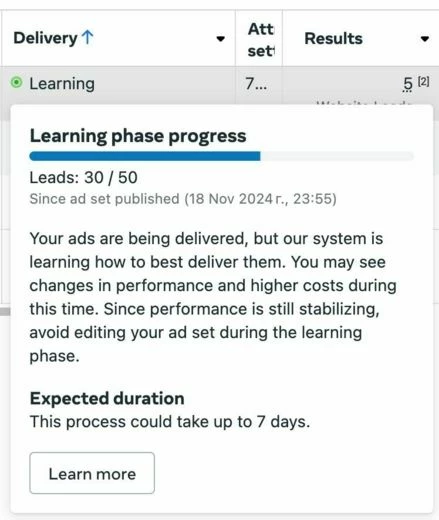
Consider a typical situation: a campaign performs steadily for some time and then suddenly stops bringing in leads. The most common reaction is to duplicate or restart it. Yet it is essential to remember that Meta Ads has a learning phase, during which the algorithm gathers data on user interactions. Each restart resets that learning process, which generally lasts up to seven days.
Restarts can sometimes lead to improvements, but they are not a universal fix. When applied strategically, however, they can still contribute to better results and more stable performance.
The Role of Meta’s Updated Learning Model
In late 2024, Meta began implementing an updated learning system called “Andromeda.” The algorithm now learns more effectively from user behavior while maintaining a strong focus on creative quality. The key change is that it filters out highly similar creatives, meaning that minor edits or simple duplicates no longer provide meaningful learning opportunities.Under this new system, simple restarts without creative or structural changes are ineffective and only waste budget. On the other hand, when a restart introduces new creative concepts or a reworked campaign structure, it provides Meta with fresh learning data and can significantly improve outcomes.
Case Study: When Restarts Fail to Deliver
In one campaign series targeting tier-3 GEOs, advertisers relied exclusively on a webview funnel that stopped performing after an initial testing phase. Instead of experimenting with new approaches—such as progressive web apps (PWA), multi-link flows, or messenger redirects—the team repeatedly duplicated and restarted the same campaigns.More than 90 restarts were launched, but no alternative funnels were tested. Nearly $6,000 in traffic produced only 10 purchases, showing that repetition alone cannot achieve profitability.
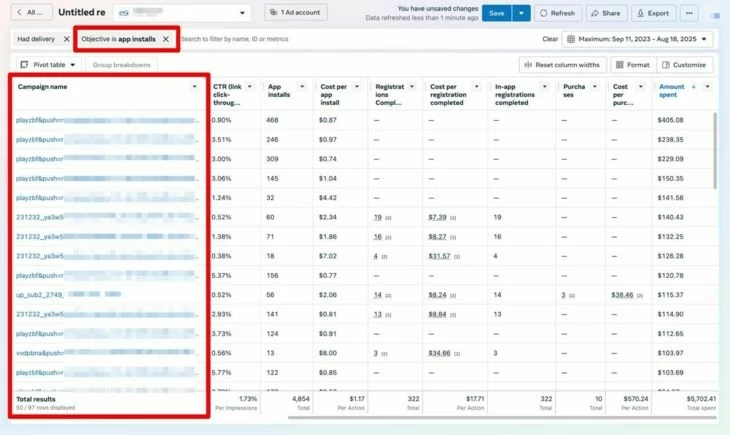
Even when campaigns are tied to specific formats such as webview, it is more effective to test multiple designs, replace underperforming creatives, and run several iterations. The same structured approach can then be applied to other funnel types like PWA to determine which performs best. Step-by-step testing—changing elements within the funnel such as account setup, creative, app, or offer—helps identify patterns that can be scaled once performance starts improving.
Key Insights for Affiliate Marketers
If there is no traction soon after launch, constant reboots rarely bring meaningful results. Instead of blaming Meta for weak performance, it is better to focus on analytics, testing, and optimizing specific funnel elements rather than repeating the same strategy.When restarts fail to improve performance, it is usually a sign that the campaign structure, targeting, or creative direction needs to change. Testing new placements, creatives, or offers is far more effective than repeating what already proved unprofitable.
It is also important to balance formats. Many marketers now split traffic between PWA and iOS, as relying heavily on webview has become less effective due to stricter moderation and lower conversion rates.
The main takeaway is clear: do not continue spending on what does not work. Use those resources to test new approaches or explore alternative GEOs. Restarting a campaign that previously failed without addressing the underlying issues will almost always lead to the same outcome.