

imustbebored
Regular Member
- Jul 4, 2013
- 233
- 302
Have you ever hear of Harry’s? Whether your answer is yes or no is somewhat irrelevant, as the company itself is the poster boy of successful ecommerce. Long story short, Harry's sells razors and they do one hell of a job at doing that. The company was founded in 2013, and since then, co-founders Jeff Raider and Andy Katz-Mayfield have turned their relatively simple shaving subscription service into a globally dominating conglomeration.
Here are Harry's numbers (astounding, right?):
Harry’s Marketing Method: 3 Strategies You Need to Replicate ASAP
1. Leverage brand advocates by using emotionally driven stories
Harry’s takes advantage of and leverages two basic storytelling archetypes in their marketing:
The Helpful Prophet
People know razor blades are expensive, yet few companies rose to the occasion and outright stated this in their marketing strategies. Harry’s knows that good marketing is a result of saying things to buyers that reinforce and confirm what they already believe.
The underdog
In 2013, Harry's launched and entered an overly dominated razor industry with Gillette owning the majority of (66.3%) the market. Harry’s accepted and assumed/make clearly evident the role of David to Gillette’s Goliath, and they ran with it:


So how did this strategy of playing the underdog against giant corp benefit Harry's? Because if consumers feel like they are a part of something greater than themselves, they’re invested in you before the brand.
2. Win New Business with Word of Mouth Referrals
One week before their ecommerce site went live, Harry’s acquired 100,000 emails for their list through a 1 week pre launch campaign.
Cofounder and CEO Jeff Raider states: “The idea for our campaign was built around our belief that the most powerful and effective way to be introduced to our new company was through a credible referral. Thus, we focused on building a campaign that helped people to spread the word to their friends.”
- Use Email Outreach to Notify Your Friends and Family
In the beginning, each of Harry's 12 employees wrote a personal email to everyone in their network notifying them of the launch and inviting them to opt in through a landing page.
- Drive traffic to a Dedicated Landing Page
On the homepage, Harry’s invited users to leave their email address to be notified when the site launched.
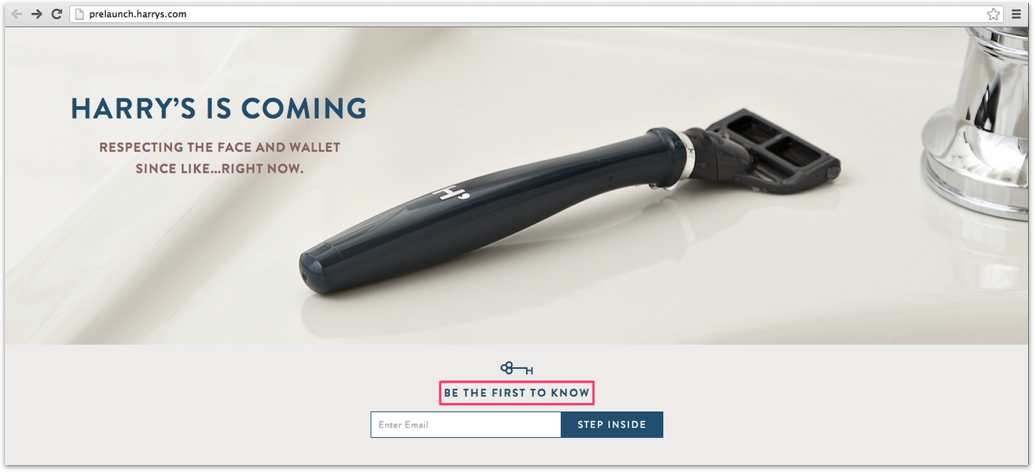
- Invite Users to Share on Social (different tiered prizes/discounts depending on reach)
After opting in, Harry’s invited users to refer others on social in exchange for freebies/discounts.

The takeaway: A whopping 77% of the emails came from referrals. This means that around 20,000 people referred around 65,000 friends.
3. Convert Sales By Using 3 Unique Ad Angles
Harry's ad campaigns targeted 3 tried and tested ad angles:
Harry's marketing uses storytelling throughout their Facebook ad campaigns. The reinforce the pain that buyers experience from razors being too expensive and let their landing page position themselves as the solution to this issue.
The Facebook ad:

The landing page:

Objection Handling:
Note: this method works magnificently with a form of abandoned cart recovery software (email abandoned cart open rates are extremely low nowadays ~10%-15%, I highly recommend going the Facebook Messenger abandoned cart recovery route. Messenger abandoned cart open rates are at about 85%-90% and are shown to convert at a much higher rate).
Anyway, here is how Harry's strategy works.
A user visits Harry’s site either organically from searching online or by clicking an ad, maybe from Facebook. They reach a product page, are interested, and even add the product to their cart, but they leave the site before completing their order. They showed that they were obviously interested and very close to completing the purchase, but something prevented them from moving forward and sealing the deal.
This is where our Facebook Messenger abandoned cart recovery comes into play. It tracks these users on a product's page, and anytime a user clicks the "Add to Cart" button, but does not actually purchase, they receive follow up message via Facebook Messenger with the product's image, title, description, a call to action button, and often with discounts if they purchase right then and there.
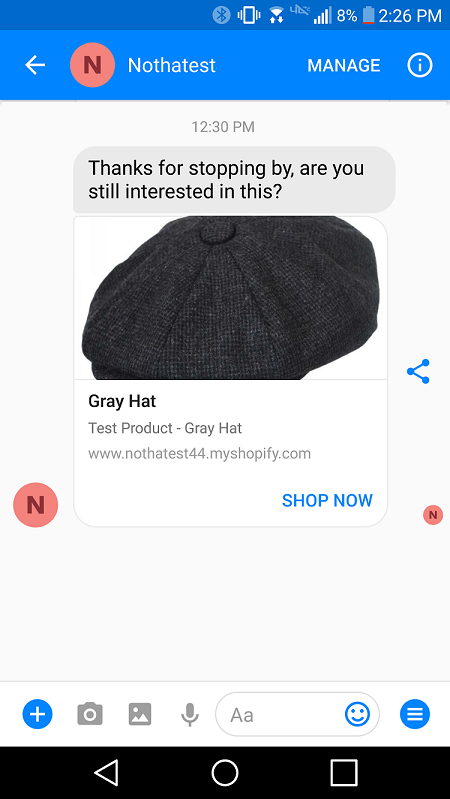
A retargeting ad like the above works well because:
It’s heavily personalized. It addresses the fact that reader is already thinking about buying. The user visited the site before, they got very close to completing their purchase, and most likely just need a tiny nudge. Adding an additional discount to the message (Get 15% off if you buy now) generally will convert most "fence sitters" into sales. In the screenshot above, changing the "SHOP NOW" call to action button to "GET 15% OFF" would be a great way of doing this.
The main takeaway from this should be that in order to achieve results, you have to take action. I've outlined some very solid strategies here that are proven to work time and again, now the rest is up to you.
Here are Harry's numbers (astounding, right?):
- $250 million in venture capital (Inc)
- $200 million in revenue in 2017 alone (Adweek)
- 3 million monthly recurring customers and counting (LinkedIn)
Harry’s Marketing Method: 3 Strategies You Need to Replicate ASAP
1. Leverage brand advocates by using emotionally driven stories
Harry’s takes advantage of and leverages two basic storytelling archetypes in their marketing:
- The helpful prophet
- The underdog
The Helpful Prophet
People know razor blades are expensive, yet few companies rose to the occasion and outright stated this in their marketing strategies. Harry’s knows that good marketing is a result of saying things to buyers that reinforce and confirm what they already believe.
The underdog
In 2013, Harry's launched and entered an overly dominated razor industry with Gillette owning the majority of (66.3%) the market. Harry’s accepted and assumed/make clearly evident the role of David to Gillette’s Goliath, and they ran with it:
So how did this strategy of playing the underdog against giant corp benefit Harry's? Because if consumers feel like they are a part of something greater than themselves, they’re invested in you before the brand.
2. Win New Business with Word of Mouth Referrals
One week before their ecommerce site went live, Harry’s acquired 100,000 emails for their list through a 1 week pre launch campaign.
Cofounder and CEO Jeff Raider states: “The idea for our campaign was built around our belief that the most powerful and effective way to be introduced to our new company was through a credible referral. Thus, we focused on building a campaign that helped people to spread the word to their friends.”
- Use Email Outreach to Notify Your Friends and Family
In the beginning, each of Harry's 12 employees wrote a personal email to everyone in their network notifying them of the launch and inviting them to opt in through a landing page.
- Drive traffic to a Dedicated Landing Page
On the homepage, Harry’s invited users to leave their email address to be notified when the site launched.
- Invite Users to Share on Social (different tiered prizes/discounts depending on reach)
After opting in, Harry’s invited users to refer others on social in exchange for freebies/discounts.
The takeaway: A whopping 77% of the emails came from referrals. This means that around 20,000 people referred around 65,000 friends.
3. Convert Sales By Using 3 Unique Ad Angles
Harry's ad campaigns targeted 3 tried and tested ad angles:
- Positioning
- Objection handling
- Damage mitigation
Harry's marketing uses storytelling throughout their Facebook ad campaigns. The reinforce the pain that buyers experience from razors being too expensive and let their landing page position themselves as the solution to this issue.
The Facebook ad:
The landing page:
Objection Handling:
Note: this method works magnificently with a form of abandoned cart recovery software (email abandoned cart open rates are extremely low nowadays ~10%-15%, I highly recommend going the Facebook Messenger abandoned cart recovery route. Messenger abandoned cart open rates are at about 85%-90% and are shown to convert at a much higher rate).
Anyway, here is how Harry's strategy works.
A user visits Harry’s site either organically from searching online or by clicking an ad, maybe from Facebook. They reach a product page, are interested, and even add the product to their cart, but they leave the site before completing their order. They showed that they were obviously interested and very close to completing the purchase, but something prevented them from moving forward and sealing the deal.
This is where our Facebook Messenger abandoned cart recovery comes into play. It tracks these users on a product's page, and anytime a user clicks the "Add to Cart" button, but does not actually purchase, they receive follow up message via Facebook Messenger with the product's image, title, description, a call to action button, and often with discounts if they purchase right then and there.
It’s heavily personalized. It addresses the fact that reader is already thinking about buying. The user visited the site before, they got very close to completing their purchase, and most likely just need a tiny nudge. Adding an additional discount to the message (Get 15% off if you buy now) generally will convert most "fence sitters" into sales. In the screenshot above, changing the "SHOP NOW" call to action button to "GET 15% OFF" would be a great way of doing this.
The main takeaway from this should be that in order to achieve results, you have to take action. I've outlined some very solid strategies here that are proven to work time and again, now the rest is up to you.
Last edited:

