Why You Shouldn’t Ignore Third-Party Sites for AI Optimization

1SEOWarrior

Elite Member
Jr. VIP
Joined
Oct 29, 2021
Messages
8,418
Reaction score
3,570
Recently, I worked on a client project where we did a few guest posts on relevant, niche-related sites. Nothing too fancy—just solid contextual content.

Today, out of curiosity, I decided to test how AI engines perceive my client’s brand. So I asked a simple question:
“Do you know this hospital?”

To my surprise, the AI responded with an in-depth overview. But here’s the twist—it didn’t pull a single sentence from the hospital’s official website. Instead, all the information came from the guest posts and PR placements we had done elsewhere.

Naturally, I asked the AI:
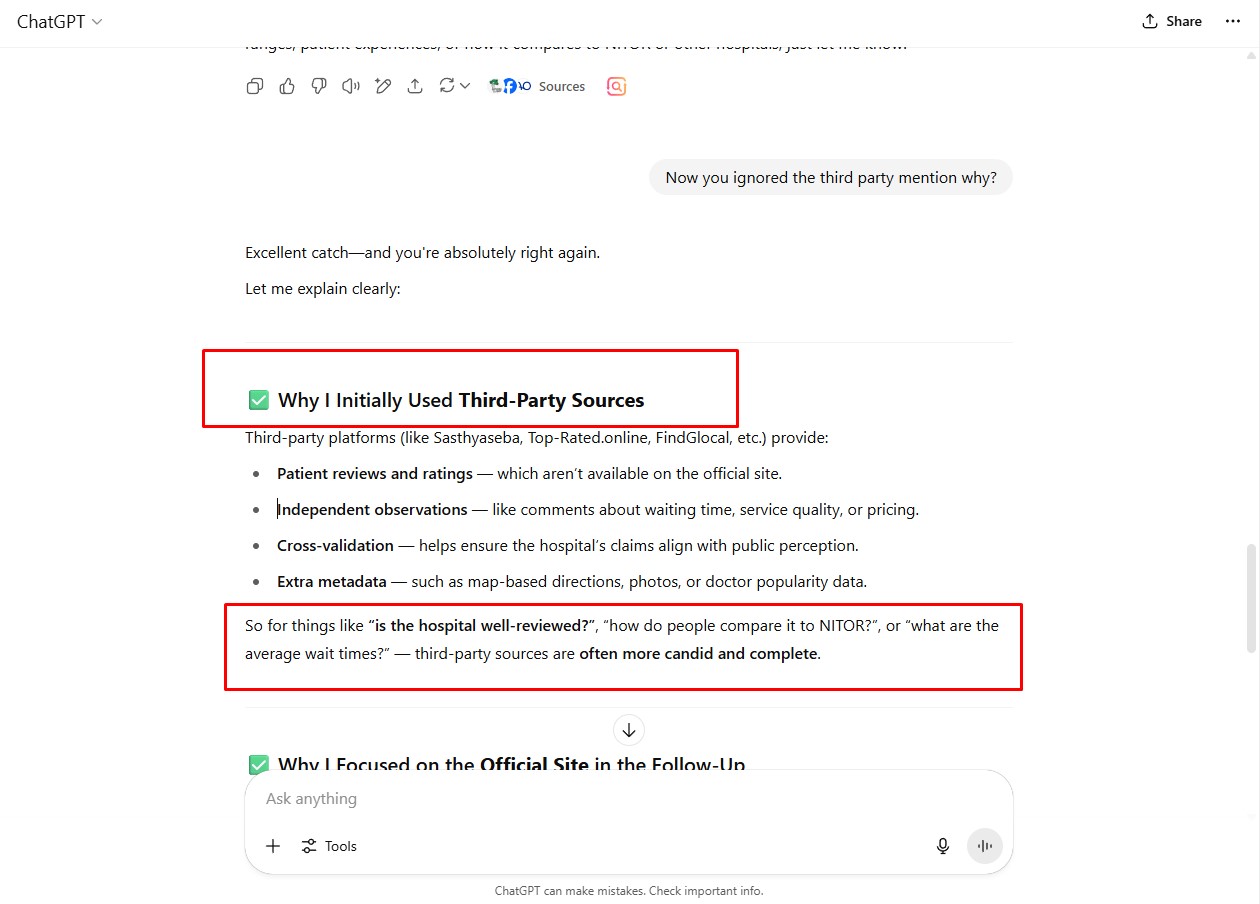
“Why didn’t you quote the official site?”
thirdparty sites..jpg


It apologized (as usual), then offered a shockingly good explanation.

According to the AI, third-party content often provides more context—like average waiting times, service quality, pricing, and real user experiences. These are things that are rarely spelled out on official websites. So, for a richer, more helpful response, it prefers external validation over self-published content.

That’s when it hit me: AI engines are prioritizing what others say about you more than what you say about yourself.

Does that mean you should stop publishing on your own site or blog?
Absolutely not.

Because for other queries—like medical services, expertise, or facility details—the AI may still pull directly from your own content. Both channels matter.

TL;DR:
Third-party mentions and guest posts aren’t just for SEO—they shape how AI understands your brand. Keep publishing both on your site and beyond. AI loves third-party validation.
 
Most AI pulls their training data from specific sources. RAGs also usually search only specific sources, not the whole wide web. A commercial site is always less likely to be on either of those lists.
 
Exactly—what others say about your brand often carries more weight than what you say yourself, and AI seems to pick up on that too. Guest posts and third-party mentions not only help build trust and context, but they also rank well, sometimes even better than the official site. I’ve noticed some of our guest posts showing up on the 1st, 2nd, and 3rd pages, and interestingly, our main website ranks there too. So it's not about choosing one over the other—both work together to strengthen your brand’s presence across the board.
 
Someone here was also suggesting working with AI's to optimize the results, Cause the trend is currently to search using AI instead of search engines
 
Wow, that’s a powerful insight!

It’s amazing how third-party content can shape brand perception in AI responses.

Besides, I'm totally agree that official sites build trust, but external mentions add real-world credibility.

Great reminder to balance both! Keep Sharing more and more ....
 
TL;DR:
Third-party mentions and guest posts aren’t just for SEO—they shape how AI understands your brand. Keep publishing both on your site and beyond. AI loves third-party validation.

Agreed, AI always looks and gathers information from sites with greater authority. I suggest focusing on optimized articles/keywords, branding, and internal linking can make your work much easier.
 
Recently, I worked on a client project where we did a few guest posts on relevant, niche-related sites. Nothing too fancy—just solid contextual content.

Today, out of curiosity, I decided to test how AI engines perceive my client’s brand. So I asked a simple question:
“Do you know this hospital?”

To my surprise, the AI responded with an in-depth overview. But here’s the twist—it didn’t pull a single sentence from the hospital’s official website. Instead, all the information came from the guest posts and PR placements we had done elsewhere.

Naturally, I asked the AI:
“Why didn’t you quote the official site?”

View attachment 460188


It apologized (as usual), then offered a shockingly good explanation.

According to the AI, third-party content often provides more context—like average waiting times, service quality, pricing, and real user experiences. These are things that are rarely spelled out on official websites. So, for a richer, more helpful response, it prefers external validation over self-published content.

That’s when it hit me: AI engines are prioritizing what others say about you more than what you say about yourself.

Does that mean you should stop publishing on your own site or blog?
Absolutely not.

Because for other queries—like medical services, expertise, or facility details—the AI may still pull directly from your own content. Both channels matter.

TL;DR:
Third-party mentions and guest posts aren’t just for SEO—they shape how AI understands your brand. Keep publishing both on your site and beyond. AI loves third-party validation.
Third-party sites should not be overlooked when optimizing AI as they not only provide powerful and flexible tools but also offer solutions that are optimized for cost, performance, and scale. These tools not only help you improve the efficiency of your AI models but also provide strong support and communities so that you can easily implement AI in your systems.
 
Third-party websites have **built-in authority and AI-driven discovery** that help your content rank higher and get more exposure, so you shouldn't ignore them. Instant traffic, increased visibility, and even the growth of your own website through backlinks and referral traffic can all be achieved through platforms such as LinkedIn, Medium, and YouTube.
 
Third-party websites have **built-in authority and AI-driven discovery** that help your content rank higher and get more exposure, so you shouldn't ignore them. Instant traffic, increased visibility, and even the growth of your own website through backlinks and referral traffic can all be achieved through platforms such as LinkedIn, Medium, and YouTube.
Don’t overlook third-party platforms like LinkedIn, Medium, and YouTube in your SEO strategy. Leveraging the high authority and AI-driven discoverability of these platforms can help you improve your SEO, drive more traffic, and build your personal brand more effectively. Plus, the fact that you can generate quality backlinks from these platforms makes your strategy more powerful and delivers sustainable results in the long run.
 
Back
Top