

tony_d
Elite Member
- Jun 22, 2013
- 2,673
- 3,294
If governments tax people at 0%, the government obviously won't get any money.
If governments tax people at 100%, the government also won't get any money, because there's no incentive to work.
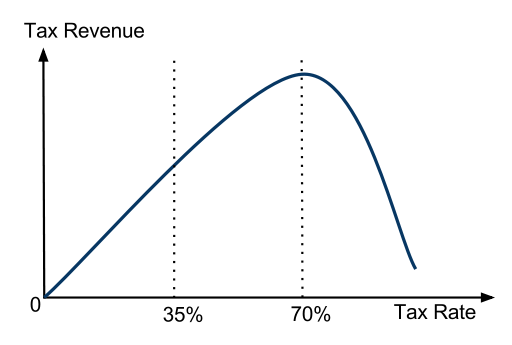
So if government revenue is at $0 at 0%, and also at $0 at 100%, there's a drop-off that happens as it gets higher and higher.
It's called the Laffer curve, and I was most interested to read about it, and in more detail.
It's interesting to note that by government reducing tax by a few points, they could stand to increase collections, and that there are always two tax rates that yield exactly the same tax revenues.
If governments tax people at 100%, the government also won't get any money, because there's no incentive to work.
So if government revenue is at $0 at 0%, and also at $0 at 100%, there's a drop-off that happens as it gets higher and higher.
It's called the Laffer curve, and I was most interested to read about it, and in more detail.
It's interesting to note that by government reducing tax by a few points, they could stand to increase collections, and that there are always two tax rates that yield exactly the same tax revenues.
Last edited:


