Taxation.

tony_d

Elite Member
Joined
Jun 22, 2013
Messages
2,673
Reaction score
3,294
If governments tax people at 0%, the government obviously won't get any money.
If governments tax people at 100%, the government also won't get any money, because there's no incentive to work.
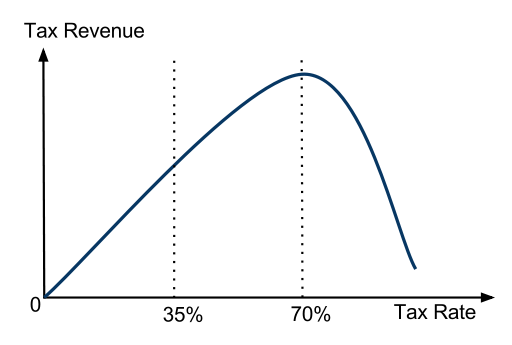
512px-LafferCurve.svg.png


So if government revenue is at $0 at 0%, and also at $0 at 100%, there's a drop-off that happens as it gets higher and higher.
It's called the Laffer curve, and I was most interested to read about it, and in more detail.

It's interesting to note that by government reducing tax by a few points, they could stand to increase collections, and that there are always two tax rates that yield exactly the same tax revenues.
 
Last edited:
Tell that to the UK.

I've read repeatedly that each year the UK has a new high for businesses and entrepreneurs leaving the country due to stiffing taxation. It's a downloads spiral: raise taxes, drive more rich away, panic about loss of taxes, rinse and repeat.

The highest paid 3,000 people in the UK pay more income tax than the bottom nine million.

Not only does UK suffer paralyzing taxation but the media insists on running a 'hate the rich' crusade. No wonder the wealthy are leaving in record numbers.

It's interesting that Japan, Dubai, Monaco etc all have extremely low taxation (Monaco and Dubai even offer 0% income tax) and these economies are flourishing.
 
Tell that to the UK.

I've read repeatedly that each year the UK has a new high for businesses and entrepreneurs leaving the country due to stiffing taxation. It's a downloads spiral: raise taxes, drive more rich away, panic about loss of taxes, rinse and repeat.

The highest paid 3,000 people in the UK pay more income tax than the bottom nine million.

Not only does UK suffer paralyzing taxation but the media insists on running a 'hate the rich' crusade. No wonder the wealthy are leaving in record numbers.

It's interesting that Japan, Dubai, Monaco etc all have extremely low taxation (Monaco and Dubai even offer 0% income tax) and these economies are flourishing.

I am moving to Dubai in that case! :D
 
Well, the newer modified Laffer curve (based on some Swedish data I believe) has the point of maximal revenue at 70%. Are you being taxed at 70%? If not, you just argued that the government should be taxing you more, not less.
 
IMHO the assumptions behind that curve are wrong. The peak of 70% is too far from the logical numbers.
The market becomes flooded with black money far below that theoretical peak, e.q. somewhere between 35% and 45%.
 
If governments tax people at 0%, the government obviously won't get any money.
If governments tax people at 100%, the government also won't get any money, because there's no incentive to work.

512px-LafferCurve.svg.png


So if government revenue is at $0 at 0%, and also at $0 at 100%, there's a drop-off that happens as it gets higher and higher.
It's called the Laffer curve, and I was most interested to https://en.wikipedia.org/wiki/Laffer_curve, and in http://www.nber.org/papers/w15343.pdf.

It's interesting to note that by government reducing tax by a few points, they could stand to increase collections, and that there are always two tax rates that yield exactly the same tax revenues.

EDIT:My bad, it is mentioned but I would add that theoretically that curve could skewed by a governments ability to turn a blind eye to tax avoidance schemes and indeed is. In theory you could have a country with 100% taxation while willful ignorance to tax avoidance makes the actual tax much lower, obviously that's an extreme example.

Even the UK which other people are commenting on isn't as black and white as this curve would suggest, with blatant tax havens like the Isle of Man and places like Gibraltar (hold on to your hats on that one). I would go as far as to say this curve only effects the majority of the population that don't have access to tax accountants and avoidance schemes which lower the tax rate to almost negligible in real terms.
 
Last edited:
Well, the newer modified Laffer curve (based on some Swedish data I believe) has the point of maximal revenue at 70%. Are you being taxed at 70%? If not, you just argued that the government should be taxing you more, not less.

IMHO the assumptions behind that curve are wrong. The peak of 70% is too far from the logical numbers.
The market becomes flooded with black money far below that theoretical peak, e.q. somewhere between 35% and 45%.

I think it's cultural.

In very broad terms, Scandinavians don't mind paying higher taxes. They have a highly developed sense of social equality, and don't mind paying for it.
On the other hand, look at Greece. Their culture is to evade it entirely, because they think any tax is too much tax.

So the optimal number I'm sure would be different everywhere.
I certainly agree that 70% seems exceedingly high - my uninformed guess says something like low to mid 30's would be more appropriate.
 
Scandinavia seems counter intuitive but they they swear by their system (public teachers earn like doctors).
I don't mind being taxed if the Government uses the money efficiently and invests in the future with infrastructure, education and reform.
However investing in a better base of tax payers in 10-20 years doesn't win elections. Nowadays it seems only FEAR and being Murdoch's best mate can keep you in power.
 
But why would you prefer a higher tax rate than a lower tax rate and get the same thing for a fraction of what you save on the private sector. Sweden doesn't have free healthcare nor free education they really have prepaid healthcare and prepaid education.
 
Ehm, exactly why is the maximization of theft a concern? Silly me thought the concern was the maximization of wealth (i.e. maximization of production in the economy, i.e. maximization of economic growth).
 
Ehm, exactly why is the maximization of theft a concern? Silly me thought the concern was the maximization of wealth (i.e. maximization of production in the economy, i.e. maximization of economic growth).

The Laffer Curve evaluation, although not in the basic diagram, does consider those too. The Brain Drain, (highly skilled professionals moving to areas with lower tax rates) as a result of the disincentive effect caused by an increase in the tax rate being on such example.
 
Link to paper or it didn't happen.

I was just passing through so can't link a paper but there are various papers that discuss the possible reason for fall beyond t*. Have a look at the old counter-argument Trickle Down Economics supported by Reagan that explicitly speaks about economic growth. Compare the two and you'll see the link to production and economic growth.
 
Tell that to the UK.

I've read repeatedly that each year the UK has a new high for businesses and entrepreneurs leaving the country due to stiffing taxation. It's a downloads spiral: raise taxes, drive more rich away, panic about loss of taxes, rinse and repeat.

The highest paid 3,000 people in the UK pay more income tax than the bottom nine million.

Not only does UK suffer paralyzing taxation but the media insists on running a 'hate the rich' crusade. No wonder the wealthy are leaving in record numbers.

It's interesting that Japan, Dubai, Monaco etc all have extremely low taxation (Monaco and Dubai even offer 0% income tax) and these economies are flourishing.

And that is why I left the UK.
 
Thanks for the share. That's actually pretty interesting; I'll go look more into it now.
 
I was just passing through so can't link a paper but there are various papers that discuss the possible reason for fall beyond t*. Have a look at the old counter-argument Trickle Down Economics supported by Reagan that explicitly speaks about economic growth. Compare the two and you'll see the link to production and economic growth.

Lesson of the day: if you don't know what you're talking about in science, chew a gum instead.
 
Lesson of the day: if you don't know what you're talking about in science, chew a gum instead.
Come on Jazz, how did you get to me not knowing what I was talking about? Quite a jump. Usually I like a discussion with you because you don't stoop to personally going at the person.
 
Come on Jazz, how did you get to me not knowing what I was talking about? Quite a jump.

You already know what needs to be done to prove me wrong and force me to eat a big chunk of humble pie.

Usually I like a discussion with you because you don't stoop to personally going at the person.

I like the discussion with you too. I am just pointy when it comes to science because it's binary - something either is or it is not.
 
You already know what needs to be done to prove me wrong and force me to eat a big chunk of humble pie.

Fair enough, if I have a proper break tomorrow I'll find something, if you're genuinely interested. I have no reason to lie about papers existing.

I like the discussion with you too. I am just pointy when it comes to science because it's binary - something either is or it is not.

Keynes (and Smith too actually) always said that Economics couldn't be looked at solely as a science. To me, it's more a humanity based subject supported by science. Keynes and Smith had reasons for both.
As a MOD you'll be able to see I even edited my post, correcting from "analysis" to "evaluation" where suggestions are made that COULD be, rather than 'are or aren't'.
 
Back
Top