Boosting Spend in Google Ads Without Risk.

SpyLead

Elite Member
Jr. VIP
Marketplace seller
Premium Member
Joined
Nov 29, 2022
Messages
2,467
Reaction score
284
taRlJj.jpg


Many affiliate marketers are accustomed to challenges related to ad platform restrictions. While some platforms are often highlighted for their unpredictability, Google Ads also presents a distinct set of rules and risks that require a thoughtful approach. Over time, its advertising ecosystem has evolved significantly, introducing stricter fraud-prevention mechanisms that can impact campaign scalability.
This article explores how Google Ads’ algorithms operate and outlines practical strategies for scaling campaigns efficiently while minimizing the risk of account suspensions.


Understanding Google Ads' Anti-Fraud Mechanisms

Launched in 2000, Google Ads has become one of the primary sources of traffic acquisition for digital marketers. Unlike some platforms with more reactive moderation systems, Google has long prioritized algorithmic assessments that measure advertiser quality and behavior.
Key components such as cloaking methods, pre-landing pages, and keyword targeting certainly matter. However, the cornerstone of sustainable performance lies in managing spending limits with precision. Rapid increases in budget can trigger internal flags and result in account freezes or suspensions.
Google’s anti-fraud algorithms are specifically designed to identify and mitigate patterns that resemble fraudulent behavior. These include sudden changes in payment methods, abrupt spending increases, or policy violations in creatives — all of which can lead to the termination of active campaigns.


Suspensions Triggered by Payment Irregularities

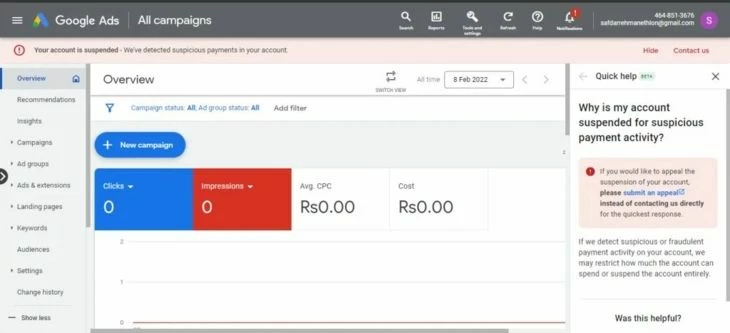
A common cause of account bans is the detection of suspicious payments. Whether due to mismatched billing information or inconsistencies in transaction behavior, such issues often result in immediate suspension. The challenge is exacerbated when combined with aggressive budget scaling or non-compliant ad content.
39eebf67b8aa14e07b30c04352ac388396332314.webp


Scaling Budgets Without Triggering Suspensions
Affiliate marketers typically operate through either self-registered or agency-managed accounts. While agency accounts offer a degree of credibility and can support higher spend thresholds, they are not immune to platform scrutiny.
Given the variability of Google’s internal checks, a universal formula does not exist. Nonetheless, several best practices can improve the likelihood of maintaining active campaigns while scaling spend:

  • Start with a conservative daily budget, such as $100
  • Gradually increase spend by $10–20 per day, avoiding jumps greater than 20%
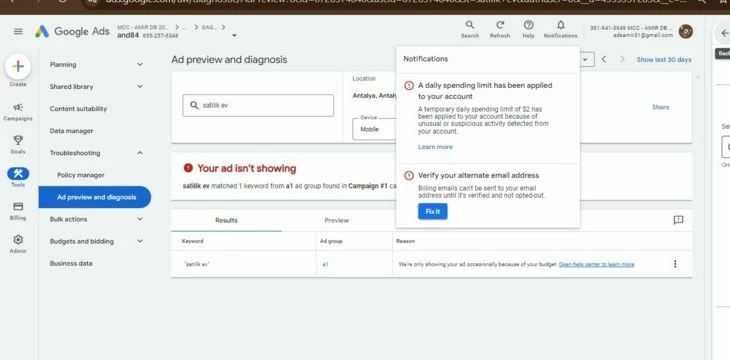
  • Expect additional verification checks at key thresholds like $200 and $600; during these periods, refrain from modifying campaigns or landing pages
  • If performance is stable, set up automation rules to incrementally raise daily spend by up to 20%
  • Avoid responding to Google’s automated prompts to double or triple the budget — these are algorithmic suggestions, not tailored advice
0063c420ce816e45d5f6d5279a5c9fb615276f9d.webp


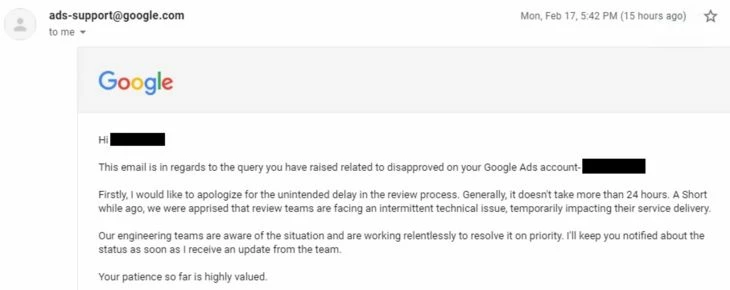
In many cases, ignoring these automated recommendations is a safer long-term strategy. Reports suggest that even a single increase of 30–50% can provoke manual reviews or account holds, while more aggressive boosts (e.g., 300%) almost guarantee disruption.
fe4a559004e3d768a88c35d7ed73446920d70a85.webp


Balancing Spend and Performance

For campaigns encountering issues with delivery despite sufficient budgets, one solution is to temporarily raise the cost-per-click (CPC) significantly. Once impressions stabilize and performance improves, CPC levels can be adjusted back to optimize profitability.
It is also advisable to use "budget holding" techniques early in a campaign’s life cycle. For example, with an initial daily cap of $10, attempting to jump directly to $100 the following day may result in restrictions. A slow, methodical pace is often more effective than short-term aggression.


Conclusion

Working with Google Ads as an affiliate marketer requires patience, consistency, and a long-term mindset. While agency accounts can reduce friction, many professionals continue to rely on self-registered profiles, which demand stricter control over scaling behavior.
By understanding how Google’s algorithms operate and implementing careful budget management strategies, affiliate marketers can reduce risks and build more resilient advertising workflows.
 
taRlJj.jpg


Many affiliate marketers are accustomed to challenges related to ad platform restrictions. While some platforms are often highlighted for their unpredictability, Google Ads also presents a distinct set of rules and risks that require a thoughtful approach. Over time, its advertising ecosystem has evolved significantly, introducing stricter fraud-prevention mechanisms that can impact campaign scalability.
This article explores how Google Ads’ algorithms operate and outlines practical strategies for scaling campaigns efficiently while minimizing the risk of account suspensions.


Understanding Google Ads' Anti-Fraud Mechanisms

Launched in 2000, Google Ads has become one of the primary sources of traffic acquisition for digital marketers. Unlike some platforms with more reactive moderation systems, Google has long prioritized algorithmic assessments that measure advertiser quality and behavior.
Key components such as cloaking methods, pre-landing pages, and keyword targeting certainly matter. However, the cornerstone of sustainable performance lies in managing spending limits with precision. Rapid increases in budget can trigger internal flags and result in account freezes or suspensions.
Google’s anti-fraud algorithms are specifically designed to identify and mitigate patterns that resemble fraudulent behavior. These include sudden changes in payment methods, abrupt spending increases, or policy violations in creatives — all of which can lead to the termination of active campaigns.


Suspensions Triggered by Payment Irregularities

A common cause of account bans is the detection of suspicious payments. Whether due to mismatched billing information or inconsistencies in transaction behavior, such issues often result in immediate suspension. The challenge is exacerbated when combined with aggressive budget scaling or non-compliant ad content.
39eebf67b8aa14e07b30c04352ac388396332314.webp


Scaling Budgets Without Triggering Suspensions
Affiliate marketers typically operate through either self-registered or agency-managed accounts. While agency accounts offer a degree of credibility and can support higher spend thresholds, they are not immune to platform scrutiny.
Given the variability of Google’s internal checks, a universal formula does not exist. Nonetheless, several best practices can improve the likelihood of maintaining active campaigns while scaling spend:

  • Start with a conservative daily budget, such as $100
  • Gradually increase spend by $10–20 per day, avoiding jumps greater than 20%
  • Expect additional verification checks at key thresholds like $200 and $600; during these periods, refrain from modifying campaigns or landing pages
  • If performance is stable, set up automation rules to incrementally raise daily spend by up to 20%
  • Avoid responding to Google’s automated prompts to double or triple the budget — these are algorithmic suggestions, not tailored advice
0063c420ce816e45d5f6d5279a5c9fb615276f9d.webp


In many cases, ignoring these automated recommendations is a safer long-term strategy. Reports suggest that even a single increase of 30–50% can provoke manual reviews or account holds, while more aggressive boosts (e.g., 300%) almost guarantee disruption.
fe4a559004e3d768a88c35d7ed73446920d70a85.webp


Balancing Spend and Performance

For campaigns encountering issues with delivery despite sufficient budgets, one solution is to temporarily raise the cost-per-click (CPC) significantly. Once impressions stabilize and performance improves, CPC levels can be adjusted back to optimize profitability.
It is also advisable to use "budget holding" techniques early in a campaign’s life cycle. For example, with an initial daily cap of $10, attempting to jump directly to $100 the following day may result in restrictions. A slow, methodical pace is often more effective than short-term aggression.


Conclusion

Working with Google Ads as an affiliate marketer requires patience, consistency, and a long-term mindset. While agency accounts can reduce friction, many professionals continue to rely on self-registered profiles, which demand stricter control over scaling behavior.
By understanding how Google’s algorithms operate and implementing careful budget management strategies, affiliate marketers can reduce risks and build more resilient advertising workflows.
Thank you for informing me about this, I will definitely keep this in mind.
 
Back
Top