
mandroid999
Junior Member
- Jan 23, 2020
- 127
- 38
Totally new to me. Will try this time. Thanks for the great share.


The image is the audit report of Google's Wikipedia page. The numbers in the image are identifiers for those entities. Each entity has a unique identifier. Other tools don't use it as it's not necessary. You can check the report of Surfer SEO.i ment this: ⟨1600 Amphitheatre Pkwy, Mountain View, CA⟩12 what does the 12 means? it doesn't appear 12 times in the text

Do you think you can do a quick demo or something like that, maybe on 200 word paragraph? Some guys I know also share the "name" of the tactic and this API, they use that to rank better.You should apply them. I have tested some pages and it improves ranking.

I used a method to rank my pages. I hope it works for you too.Do you think you can do a quick demo or something like that, maybe on 200 word paragraph? Some guys I know also share the "name" of the tactic and this API, they use that to rank better.
But not sure 100% how did he/they use to rank better? That's the reason I couldn't apply it
Jesus, your 1st point actually is the thing that makes it different.I used a method to rank my pages. I hope it works for you too.
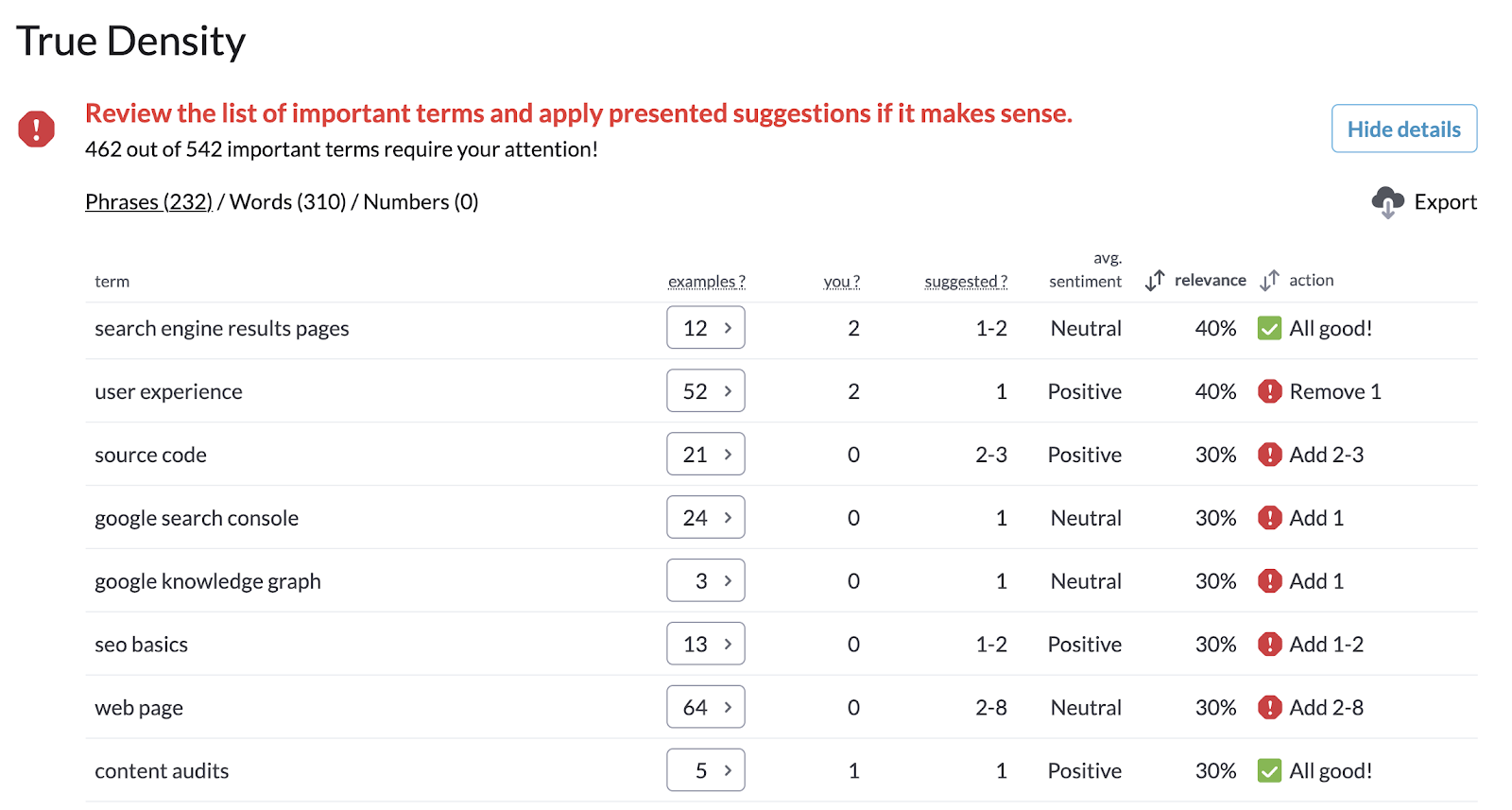
You can get these ranges from Google NLP, inlinks, Surfer SEO and many tools. It's just like using keywords in your content.
- I searched for my keyword and checked first 10 pages looking for a weak competitor (low authority site).
- I copied their URLs and run them through my inlinks.net account (free/trial version).
- I've found the range (min-max) of entities. Manually listed the ones that are relevant to my niche/topic.
- I rewrote my entire article and fit the entities wherever I can within exact range.

Yes but tje order is not clear. It is not by the order on the text. Maybe it has some importanceThe numbers in the image are identifiers for those entities
Yes, it's based on salience. The first 4 entities are listed below along with their salience.Yes but tje order is not clear. It is not by the order on the text. Maybe it has some importance

A good case study about this would be great to see how fast ranking also take place


This is all new to me so very helpful. More Please Sir?This is my 2000th message in the forum. So, I've decided to post something useful. Although entities are popular, we don't discuss much about them. When I search for entities in BHW, half of the page is filled with my messages. Moreover, some members don't even know what they are. This post will give an introduction and explain why they are important for your ranking.
Entities have been around for years but we rarely talk about them. It's partly because Google doesn't talk about them except for their ambiguous patents and there is no solid information to understand them. An entity is defined by Google as:
“An entity is a thing or concept that is singular, unique, well-defined, and distinguishable. For example, an entity may be a person, place, item, idea, abstract concept, concrete element, another suitable thing, or any combination thereof. Generally, entities include things or concepts represented linguistically by nouns. For example, the color "Blue," the city "San Francisco," and the imaginary animal "Unicorn" may each be entities.”
View attachment 178345
Image Source: https://www.searchenginejournal.com/entity-seo/277231/
Definition of Entities and Links
Every statement has entities and links. For example, in the statement, "Dr. Fernandez loves apples," there are 2 entities "Dr. Fernandez" and "apple," and there is a link that connects both "love." If you're worried that your spun content is no longer ranking on Google, then it's because it messes up the entities and their links. You should also remember that your anchor text is a link between your site/page and the referring domain. So the topic of your backlinking site establishes a direct relationship with your site. For example, if I have a "Keto Diet" site, any backlinks from "weight loss" sites will help better instead of "Affiliate Marketing" sites or some other niches.
Entity and relation extraction is a standard task in text mining or natural language processing (NLP). Google understands content based on entities and their relationships.
History of Entities
One of the first patents on entities is "Ranking Search Results Based On Entity Metrics" which was granted to Google in 2015. According to the patent, the entities are ranked in search based on four factors.
A 2016 patent covers the following details:
- Relatedness: Relatedness is determined based on the co-occurrence entities. If 2 entities occur repeatedly together, then Google establishes a relationship between them. For example, if "Weight Loss" and "Keto Diet" occur in several articles together, then they are related.
- Notability: It's the value of an entity in the category. For example, I can rank on top for search results of "Top contributing member of BHW" with a few hundred links, but I need millions of links if I want to rank for "President of the United States."
- Contribution: It's a measure of an entity's contribution to a topic and is determined by external signals like links and reviews. If I create a new weight loss diet "Blackhat diet for Weight Loss," it will have little contribution to the topic "weight loss." On the contrary, the "Keto Diet" has a greater contribution because it was supported by external signals.
- Prizes: It's exactly what it sounds like. The prizes like Academy Award, Nobel Prize, Best Employee Award, etc. determines an entity's weight, and a higher value is attached to the entity. For example, if you search for the "Best Indian Actor in 2020," an actor who received a National Award will get priority over one who received a Vimal Pan Masala Award.
A 2018 patent is titled, "Related Entities." It covers the following details:
- Each entity is assigned a unique identifier.
- A recurring entity in the top 10 search results is preferred for the knowledge panel.
- There is an entity database with entities and their connections.
- Entities are ranked by a quality score.
- Google determines the relevance of entities for search results & knowledge panels.
- Google chooses entities based on context if there are multiple entities with the same name.
- The entity database not just contains entities but their relations with other entities. For example, an entity "Joe Biden" would contain Date of birth, Height, Education, Party, Spouse, Children, etc.
- Some entities have more priority over others. For example, Joe Biden's date of starting a Twitter account will have a lower priority over his date of birth.
- Authority sites like Wikipedia establish a stronger relationship between entities. For example, Wikipedia calling Joe Biden a President will establish a strong relationship between entities "Joe Biden" and "President" in comparison to this article which is for SEO.
Growing Entity Database
Google extracts entities from reliable sites like Wikipedia & IMDB. But these sites don't update frequently, so they go out in search of entities to find new ones. For example, if there is a rumor that Chris Pratt acts in a film titled "Xenomorph Outbreak," then Wikipedia & IMDB will wait for an official announcement but fans won't. They will discuss Chris Pratt and Xenomorph Outbreak on social media and forums. So, Google creates a new entity "Xenomorph Outbreak" and links it to the existing entity "Chris Pratt" because they appear together several times. Then Google will follow the standard procedure to understand if the Xenomorph Outbreak is a person, place, movie, or thing. When there is an official announcement, they'll have enough information to create a knowledge panel.
Using entities in your content to rank better
By this time, you should already have some understanding of how Google reads your content and its relevance. If your content doesn't have the entities of top-ranking content on SERPs, it may not rank even after taking care of everything else. You can extract entities from your competitors using Google's Natural Language AI.
https://cloud.google.com/natural-language/
View attachment 178346
Entity analysis is free for up to 5k units per month where each unit is 1k characters (including white space). So, a regular 500 words article may cost you 2-3 units. This should be enough for beginners.
Conclusion
SEO is evolving super-fast and we don't follow everything at the same pace. You should get into entities and follow along before it's too late.
I used a method to rank my pages. I hope it works for you too.
You can get these ranges from Google NLP, inlinks, Surfer SEO and many tools. It's just like using keywords in your content.
- I searched for my keyword and checked first 10 pages looking for a weak competitor (low authority site).
- I copied their URLs and run them through my inlinks.net account (free/trial version).
- I've found the range (min-max) of entities. Manually listed the ones that are relevant to my niche/topic.
- I rewrote my entire article and fit the entities wherever I can within exact range.


