Don´t get me wrong, it´s a great place to start but, you need to take them with a grain of salt.
All SEO tools have different ways to measure keyword difficulty.
But, in general, keyword difficulty scores are nothing but weighted averages of your likelihood to rank in the top 10 of Google for any given keyword.
I am a big fan of Ahrefs for example and, I´ve seen it over and over again many times with running keyword research and performing SERP analysis.
I´ve seen keywords with a KD of 40 to be easier to rank in the top 10 of Google than keywords with a KD of 20.
Let me ask you this, haven´t you seen sites with a low DA/PA with just a handful of links ranking above sites with a much higher DA/PA and even thousands of links from hundreds of referring domains?
Why is this?
The main issue is the way those tools measure KD. Since, as I mention, they are in essence "weighted averages", If there are a couple of huge authoritative sites ranking in the top 10 for any given keywords they are going to skew the KD metric, making it look a hell lot harder to rank for.
I don´t have access to Ahrefs at the moment but I am sure, if you have done keyword research enough times, you know what I am talking about.
Also, KD's scores don´t take into account the following...
- Your competitor´s Technical SEO
- Your competitor´s On-Page SEO
- Your competitor's keyword relevancy
- Your competitor´s links/referring domains relevancy
This is why is ALWAYS best to dive deeper into the SERP and run your own keyword difficulty analysis.
I think Nathan Gotch explains it great on this video...
(I think I paste it on the right time stamp - Start watching it at 5:50min mark)
Nathan mentions something called "Signs" you need to be on the look for when running SERP analysis in order to determine your "true" chances of ranking for any keyword.
Also,
@Holzr wrote
a great guide last year about how to manually run a keyword difficulty analysis. He touches on a couple of metrics/variables Nathan doesn´t and I believe they´re important and need to be added into our analysis.
So, if you don´t want to go through the video nor want to check the above thread, that´s ok.
I will sum it up for you....
GOOD SIGNS
- Low # of high authoritative sites
- YouTube Videos
- Subdomains or Web 2.0s properties - We all know what we use these for.
- Forums or Q&A threads (Reddit, Quora, Yahoo Answers, etc) - Also take this with a grain of salt. Many have stated since Google´s last update, these pages have gained a lot more weight in the SERP. Meaning, they aren´t as "easy" to outrank as before. Personally, I´ve always thought they should get more merits as I´ve seen answers on Quora to be a lot more in-depth and fulfill user´s search intent far better than many of Google's top 10 ranking results.
- Social media results - Whenever you see a page from Pinterest or Instagram, you know, that´s a good sign.
- Article submission websites (eHow, ezinearticles, medium, etc.)
- Few # of SERP features (Snippet, Also Ask, Knowledge Card, Carousel, etc) - The presence of many SERP feature is NOT perse a sign of higher competition but is because these SERP features push organic results further down and your result´s CTR will drastically drop.
- Google Ads results - If you see Ads present on any given SERP it means advertisers are willing to invest money to show for that keyword so, you know it was market value and, therefore, higher competition.
- Low allintitle results - This isn´t a measure of the level of the competition but the SIZE of it. It´s NOT the same going up against 100,000+ other pages on the internet that are also targeting the same keyword as me. But, this doesn´t mean whenever you run an allintitle and you get 20 results you should be happy because all those 20 results could be filled with large number of all the signs I just mentioned above and, therefore, making it nearly impossible to rank.
- Technical and On-Page SEO - In regards to these, there are tools where you can run your competitors URL that will give you a detailed report of their overall SEO "health".
- Content Analysis - This is something I recently started doing. I know this might fall into On-Page SEO but, I like to keep it as a separate thing. What I like to check here is basically all elements or factors that make content great or for us to label it as a "quality" content.
For me personally, I check for:
a) Content length - If an authority site has an article with 1,000 words on it (or even smaller), I usually take it as a good sign.
c) Scannability - This is something very important nowadays, whenever I see results ranking in Google´s top 10 that are NOT optimized for this, I also take it as a good sign. We need to optimize content to make it more "scannable". Users like to scan through the content without reading it entirely. For this, I check for stuff like bolded and italic key phrases, subheadings, content boxes (quotation, tips, summaries, etc.), custom images, infographics, bullet points, tables (benefits, features, pros and cons, etc.), charts (showing a stat or something), and many other you can think of that will help the reader understand the main point of your article without having to read it all.
- Competitors backlink profile analysis - Mostly check what type of sites and links are pointing to your competitor´s page. I´ve seen competitors ranking for a keyword with a PA of 60 with 2,000+ links and when I go check their backlink profile I see most of that PA authority and links come from Web 2.0 properties, .edu links, and other crappy and unrelated sources. This is the main reason why you see sites with a much smaller DA/PA ranking above them and, you can do it as well. If you want to dive deeper into the backlink profile analysis check out this guide (Also from Nathan).
And lastly, I intentionally left one of the most important factors for the end...
RELEVANCY!!!
This is nothing but determining whether or not all the ranking pages on the SERP are actually matching Google user´s search intent....THAT´S IT!
@Holzr makes a reference about
an amazing article by Backlinko about Rank Brain. Make sure to read it as well.
If you´re using Ahrefs, that´s great.
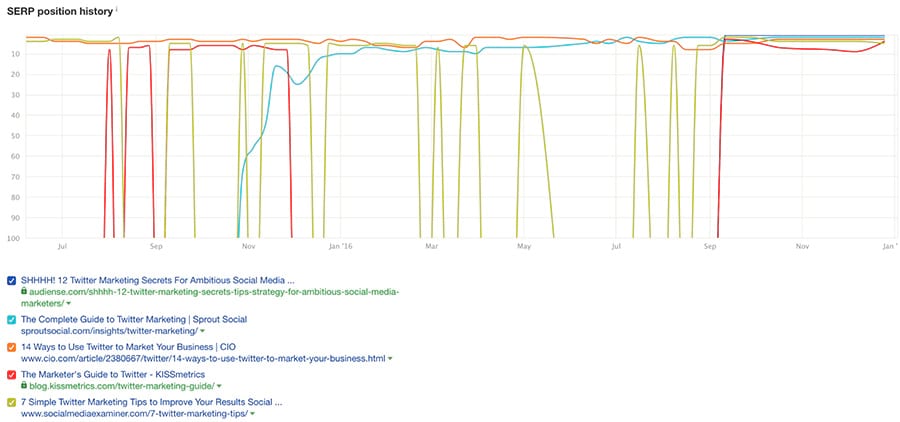
Ahrefs has a built-in feature called "SERP Position History" and it denotes how "satisfied" is Google with the current SERP structure.
The bottom line, if you see low volatility in a SERP History Position graph it means the top-ranking results in SERP are matching the user´s search intent but, on the other hand, if you see something like this...
SOURCE: TAKEN FROM HOLZR GUIDE
It means there´s still a window of opportunity for you.
And that´s pretty much it!
I hope this makes sense.
Cheers!!