Why Do I Not Rank At All

C45HC0W

Regular Member
Joined
Jan 30, 2019
Messages
430
Reaction score
142
I am trying to rank for some keyword but my website is not even showing up in the top 100 for any country for these keywords.
My website has DA 8 and PA 11 and is about 9 months old.
The keyword difficulty is:
Semrush: 85
Keywordrevealer: 44
Ahrefs: 5
Ubersuggest: 13

Average Backlinks is about 359 but there are some with only 9 or 15 backlinks in the top 10.
The website which are ranking for it do not have the keyword in the title neither in the URL not in the description and not in H1
The average word count is about 74 words.

Now the comparision; the average values of the top 10 websites according to keywordrevealer:
average DA: 74 > my DA: 8
average PA: 43 > my PA: 11
min DA: 37 > my DA: 8
min PA: 24 > my PA: 11
average word count: 74 < my words ~1200 ✅
average backlinks: 359 > my backlinks 32 from 8 different sites (google search console)
min backlink 9 < my backlinks 32 ✅

Some of the backlinks are from two services I bought here at BHW the other ones are made bymyself and mostly reddit.

keywords in URL✅
keywords in title ✅
keyword in H1 ✅

I used the text from a youtubevideo. So, at the beginning the text was actually plagarism according to the plagarism checker from smallseotools but I rewrote the text so that it passes the smallseotools checker. other plagarism checkers like quetext didnt find any plagarism.

Why do I not even rank among the top 100?
 
Something is clearly problematic. Word count is one problem. But nonetheless some post should rank in Google for sure.
I suggest, that you will send your website link to some dude, who would check it. Maybe some MOD or JR.VIP who you can trust more than regular members in here.
"they don't copy the content or steal something". But i don't know if people are up to that challenge.
5 min check = 5 min tips and tricks..
 
firstly you did not research keywords properly.
2nd did not optimize on-page SEO & off-page SEO.
so my recommendation when you research keyword follows your competitor's backlink and page score. if their backlink and page authority is low then take that keyword.
 
I am trying to rank for some keyword but my website is not even showing up in the top 100 for any country for these keywords.
My website has DA 8 and PA 11 and is about 9 months old.
The keyword difficulty is:
Semrush: 85
Keywordrevealer: 44
Ahrefs: 5
Ubersuggest: 13

Average Backlinks is about 359 but there are some with only 9 or 15 backlinks in the top 10.
The website which are ranking for it do not have the keyword in the title neither in the URL not in the description and not in H1
The average word count is about 74 words.

Now the comparision; the average values of the top 10 websites according to keywordrevealer:
average DA: 74 > my DA: 8
average PA: 43 > my PA: 11
min DA: 37 > my DA: 8
min PA: 24 > my PA: 11
average word count: 74 < my words ~1200 ✅
average backlinks: 359 > my backlinks 32 from 8 different sites (google search console)
min backlink 9 < my backlinks 32 ✅

Some of the backlinks are from two services I bought here at BHW the other ones are made bymyself and mostly reddit.

keywords in URL✅
keywords in title ✅
keyword in H1 ✅

I used the text from a youtubevideo. So, at the beginning the text was actually plagarism according to the plagarism checker from smallseotools but I rewrote the text so that it passes the smallseotools checker. other plagarism checkers like quetext didnt find any plagarism.

Why do I not even rank among the top 100?


Mby google love thin content for that keyword :)
 
You checked on way back machine this domain? If there was something before?

You need more links with good anchor ratio
 
sheer BS.

Who told you that you need initial traffic in order to rank?
I see a lot of SEO course but no one talk about use traffic to rank so much, but I test and see extreme result, I got top 1 some category in google after spend $ in Adwords and optimize page (actually spam a little keyword in H tag ), before my site not got single traffic and empty in social media, I see it rank #1 above top 4 big commerce in my country, and yes it got volume only 2000, I think may be it easy but I don't have so much $ to test
 
My website has DA 8 and PA 11 and is about 9 months old.
This can be a reason.
The keyword difficulty is:
Semrush: 85
Keywordrevealer: 44
Ahrefs: 5
Ubersuggest: 13
Forget about any keyword difficulty scores provided by ANY SEO tool...DO YOUR OWN SERP ANALYSIS TO DETERMINE THIS!!
Average Backlinks is about 359 but there are some with only 9 or 15 backlinks in the top 10.
It´s NOT about so much about the number of links or referring domains pointing to a site. Nowadays relevancy plays a major role.
The website which are ranking for it do not have the keyword in the title neither in the URL not in the description and not in H1
The average word count is about 74 words.
When you have authority and/or have build topical relevance Google is a bit more flexible with that you offer their users.
Now the comparision; the average values of the top 10 websites according to keywordrevealer:
average DA: 74 > my DA: 8
average PA: 43 > my PA: 11
min DA: 37 > my DA: 8
min PA: 24 > my PA: 11
average word count: 74 < my words ~1200 ✅
average backlinks: 359 > my backlinks 32 from 8 different sites (google search console)
min backlink 9 < my backlinks 32 ✅
You´re into SEO tools WAAAY too much. Highly advice to go over stuff manually. I am NOT stating they are a waste of time but I believe you need to change your perspective on things.

For example and in regards to....
  • Keyword difficulty scores - DO YOUR OWN SERP ANALYSIS! I am sure you´ve seen small sites outranking high authoritative ones. So, ALL keyword difficulty scores need to be taken with a grain of salt and you MUST run your own manual SERP analysis to truly determining your chances of ranking in the top 10 for any given keyword.
  • DA & PA - Let´s get something out in the open. Google rank pages NOT domains. Again, I am NOT stating DA is a worthless metric, I am just saying you need to pay more attention to PA. Obviously, a site with a higher DA will have on average a much stronger backlink profile and, therefore, will have the ability to publish and index new content faster than well, let´s say, your site. But you need to go beyond what their metrics say.
Some of the backlinks are from two services I bought here at BHW the other ones are made bymyself and mostly reddit.

keywords in URL✅
keywords in title ✅
keyword in H1 ✅
Without going into your top competitor's backlinks profiles nor analyzing the quality of the links you acquire from BHW it will be hard to outrank sites with DA between 50-70 with links from social media regardless of how well optimize you think they are in terms of on-page factors.

Yes, they surely help but they don´t carry enough weight or the "link juice" you need in order to outrank those other results.
I used the text from a youtubevideo. So, at the beginning the text was actually plagarism according to the plagarism checker from smallseotools but I rewrote the text so that it passes the smallseotools checker. other plagarism checkers like quetext didnt find any plagarism.
So, you´re pretty much rewriting stuff from the web and publishing it on your money site and expect Google will put your site on the top of the SERP just because some random plagiarism checker told you it was unique?
Why do I not even rank among the top 100?
Hard to pinpoint why you´re not raking better on SERP but, generally, it can be a particular thing from the list below or a combination of several of them...
  • Technical issues
  • On-Page issues
  • Not targeting the right keywords
  • Page title/headline not optimized to increase CTR
  • Content is NOT fulfilling user´s search intent
  • Content is NOT appealing to readers
  • A higher competition that you anticipated
  • The links you´re building are either from a) Low-quality sites or, b) Not relevant to your site.
 
Something is clearly problematic. Word count is one problem. But nonetheless some post should rank in Google for sure.
I suggest, that you will send your website link to some dude, who would check it. Maybe some MOD or JR.VIP who you can trust more than regular members in here.
"they don't copy the content or steal something". But i don't know if people are up to that challenge.
5 min check = 5 min tips and tricks..
Thank you. Can you suggest any person who you think would like to help?


firstly you did not research keywords properly.
2nd did not optimize on-page SEO & off-page SEO.
so my recommendation when you research keyword follows your competitor's backlink and page score. if their backlink and page authority is low then take that keyword.

so how does a proper keyword research look like to you?


how about people enjoy your page, time on site, bounce rate, return rate
That only if he is ranking and has some visitors.

Another page with a different keyword is ranking on 3rd place. According to Google Analytics the Bounce Rate was 34.93% and the Session Duration about 2m 18s for the last 28 days.

You checked on way back machine this domain? If there was something before?

You need more links with good anchor ratio

I think I did and I didnt find anything. and I forgot to say that other pages are actually ranking for other keywords. So, it is not a google penalty on the whole website.

This can be a reason.

Forget about any keyword difficulty scores provided by ANY SEO tool...DO YOUR OWN SERP ANALYSIS TO DETERMINE THIS!!

It´s NOT about so much about the number of links or referring domains pointing to a site. Nowadays relevancy plays a major role.

When you have authority and/or have build topical relevance Google is a bit more flexible with that you offer their users.

You´re into SEO tools WAAAY too much. Highly advice to go over stuff manually. I am NOT stating they are a waste of time but I believe you need to change your perspective on things.

For example and in regards to....
  • Keyword difficulty scores - DO YOUR OWN SERP ANALYSIS! I am sure you´ve seen small sites outranking high authoritative ones. So, ALL keyword difficulty scores need to be taken with a grain of salt and you MUST run your own manual SERP analysis to truly determining your chances of ranking in the top 10 for any given keyword.
  • DA & PA - Let´s get something out in the open. Google rank pages NOT domains. Again, I am NOT stating DA is a worthless metric, I am just saying you need to pay more attention to PA. Obviously, a site with a higher DA will have on average a much stronger backlink profile and, therefore, will have the ability to publish and index new content faster than well, let´s say, your site. But you need to go beyond what their metrics say.

Without going into your top competitor's backlinks profiles nor analyzing the quality of the links you acquire from BHW it will be hard to outrank sites with DA between 50-70 with links from social media regardless of how well optimize you think they are in terms of on-page factors.

Yes, they surely help but they don´t carry enough weight or the "link juice" you need in order to outrank those other results.

So, you´re pretty much rewriting stuff from the web and publishing it on your money site and expect Google will put your site on the top of the SERP just because some random plagiarism checker told you it was unique?

Hard to pinpoint why you´re not raking better on SERP but, generally, it can be a particular thing from the list below or a combination of several of them...
  • Technical issues
  • On-Page issues
  • Not targeting the right keywords
  • Page title/headline not optimized to increase CTR
  • Content is NOT fulfilling user´s search intent
  • Content is NOT appealing to readers
  • A higher competition that you anticipated
  • The links you´re building are either from a) Low-quality sites or, b) Not relevant to your site.

So how do you do your own SERP Analysis? I thought if I use different SEO tools they would give me a proper overview of the difficulty.
Regarding the rewritten content: I am not expecting to rank on the first place with this but that I do not rank at all is just weird.

By the way I forgot to mention that I am trying my luck with a quiz site. I have other quizzes which are ranking. One is on the third place for almost every country and I didnt build any backlinks towards this website. So, I would understand that this quiz is not ranking too good because the competition is too strong but that I am not ranking at all is just weird.
 
I thought if I use different SEO tools they would give me a proper overview of the difficulty.
Don´t get me wrong, it´s a great place to start but, you need to take them with a grain of salt.

All SEO tools have different ways to measure keyword difficulty.

But, in general, keyword difficulty scores are nothing but weighted averages of your likelihood to rank in the top 10 of Google for any given keyword.

I am a big fan of Ahrefs for example and, I´ve seen it over and over again many times with running keyword research and performing SERP analysis.

I´ve seen keywords with a KD of 40 to be easier to rank in the top 10 of Google than keywords with a KD of 20.

Let me ask you this, haven´t you seen sites with a low DA/PA with just a handful of links ranking above sites with a much higher DA/PA and even thousands of links from hundreds of referring domains?

Why is this?

The main issue is the way those tools measure KD. Since, as I mention, they are in essence "weighted averages", If there are a couple of huge authoritative sites ranking in the top 10 for any given keywords they are going to skew the KD metric, making it look a hell lot harder to rank for.

I don´t have access to Ahrefs at the moment but I am sure, if you have done keyword research enough times, you know what I am talking about.

Also, KD's scores don´t take into account the following...
  • Your competitor´s Technical SEO
  • Your competitor´s On-Page SEO
  • Your competitor's keyword relevancy
  • Your competitor´s links/referring domains relevancy
This is why is ALWAYS best to dive deeper into the SERP and run your own keyword difficulty analysis.
So how do you do your own SERP Analysis?
I think Nathan Gotch explains it great on this video...

(I think I paste it on the right time stamp - Start watching it at 5:50min mark)

Nathan mentions something called "Signs" you need to be on the look for when running SERP analysis in order to determine your "true" chances of ranking for any keyword.

Also, @Holzr wrote a great guide last year about how to manually run a keyword difficulty analysis. He touches on a couple of metrics/variables Nathan doesn´t and I believe they´re important and need to be added into our analysis.

So, if you don´t want to go through the video nor want to check the above thread, that´s ok.

I will sum it up for you....

GOOD SIGNS
  • Low # of high authoritative sites
  • YouTube Videos
  • Subdomains or Web 2.0s properties - We all know what we use these for.
  • Forums or Q&A threads (Reddit, Quora, Yahoo Answers, etc) - Also take this with a grain of salt. Many have stated since Google´s last update, these pages have gained a lot more weight in the SERP. Meaning, they aren´t as "easy" to outrank as before. Personally, I´ve always thought they should get more merits as I´ve seen answers on Quora to be a lot more in-depth and fulfill user´s search intent far better than many of Google's top 10 ranking results.
  • Social media results - Whenever you see a page from Pinterest or Instagram, you know, that´s a good sign.
  • Article submission websites (eHow, ezinearticles, medium, etc.)
  • Few # of SERP features (Snippet, Also Ask, Knowledge Card, Carousel, etc) - The presence of many SERP feature is NOT perse a sign of higher competition but is because these SERP features push organic results further down and your result´s CTR will drastically drop.
  • Google Ads results - If you see Ads present on any given SERP it means advertisers are willing to invest money to show for that keyword so, you know it was market value and, therefore, higher competition.
  • Low allintitle results - This isn´t a measure of the level of the competition but the SIZE of it. It´s NOT the same going up against 100,000+ other pages on the internet that are also targeting the same keyword as me. But, this doesn´t mean whenever you run an allintitle and you get 20 results you should be happy because all those 20 results could be filled with large number of all the signs I just mentioned above and, therefore, making it nearly impossible to rank.
  • Technical and On-Page SEO - In regards to these, there are tools where you can run your competitors URL that will give you a detailed report of their overall SEO "health".
  • Content Analysis - This is something I recently started doing. I know this might fall into On-Page SEO but, I like to keep it as a separate thing. What I like to check here is basically all elements or factors that make content great or for us to label it as a "quality" content.
For me personally, I check for:
a) Content length - If an authority site has an article with 1,000 words on it (or even smaller), I usually take it as a good sign.
c) Scannability - This is something very important nowadays, whenever I see results ranking in Google´s top 10 that are NOT optimized for this, I also take it as a good sign. We need to optimize content to make it more "scannable". Users like to scan through the content without reading it entirely. For this, I check for stuff like bolded and italic key phrases, subheadings, content boxes (quotation, tips, summaries, etc.), custom images, infographics, bullet points, tables (benefits, features, pros and cons, etc.), charts (showing a stat or something), and many other you can think of that will help the reader understand the main point of your article without having to read it all.
  • Competitors backlink profile analysis - Mostly check what type of sites and links are pointing to your competitor´s page. I´ve seen competitors ranking for a keyword with a PA of 60 with 2,000+ links and when I go check their backlink profile I see most of that PA authority and links come from Web 2.0 properties, .edu links, and other crappy and unrelated sources. This is the main reason why you see sites with a much smaller DA/PA ranking above them and, you can do it as well. If you want to dive deeper into the backlink profile analysis check out this guide (Also from Nathan).
And lastly, I intentionally left one of the most important factors for the end...RELEVANCY!!!

This is nothing but determining whether or not all the ranking pages on the SERP are actually matching Google user´s search intent....THAT´S IT!

@Holzr makes a reference about an amazing article by Backlinko about Rank Brain. Make sure to read it as well.

If you´re using Ahrefs, that´s great.

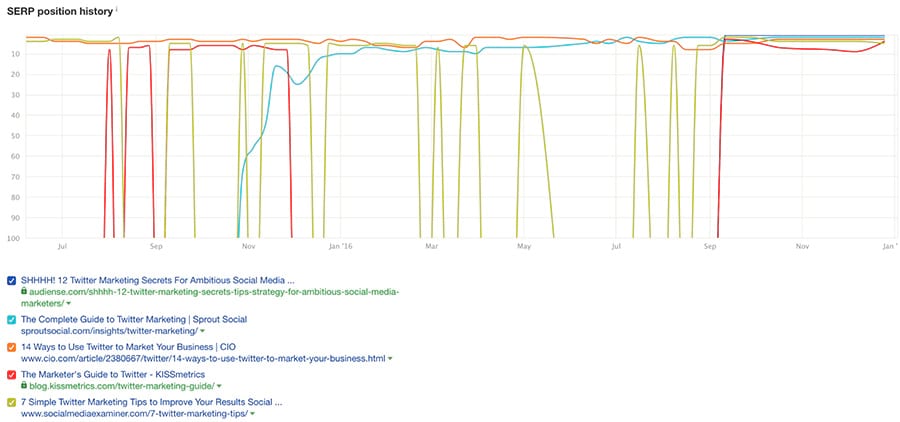
Ahrefs has a built-in feature called "SERP Position History" and it denotes how "satisfied" is Google with the current SERP structure.

The bottom line, if you see low volatility in a SERP History Position graph it means the top-ranking results in SERP are matching the user´s search intent but, on the other hand, if you see something like this...
12-SERP-difficulty.jpg

SOURCE: TAKEN FROM HOLZR GUIDE
It means there´s still a window of opportunity for you.

And that´s pretty much it!

I hope this makes sense.

Cheers!!
 
Right now it's hard to tell since Google is just ads and spam.

Their system is completely broken. Can't give any SEO advice right now, because 100% generated text is ranking #1 while comprehensive clean content is nowhere.

Google has gone to shit.
 
Don´t get me wrong, it´s a great place to start but, you need to take them with a grain of salt.

All SEO tools have different ways to measure keyword difficulty.

But, in general, keyword difficulty scores are nothing but weighted averages of your likelihood to rank in the top 10 of Google for any given keyword.

I am a big fan of Ahrefs for example and, I´ve seen it over and over again many times with running keyword research and performing SERP analysis.

I´ve seen keywords with a KD of 40 to be easier to rank in the top 10 of Google than keywords with a KD of 20.

Let me ask you this, haven´t you seen sites with a low DA/PA with just a handful of links ranking above sites with a much higher DA/PA and even thousands of links from hundreds of referring domains?

Why is this?

The main issue is the way those tools measure KD. Since, as I mention, they are in essence "weighted averages", If there are a couple of huge authoritative sites ranking in the top 10 for any given keywords they are going to skew the KD metric, making it look a hell lot harder to rank for.

I don´t have access to Ahrefs at the moment but I am sure, if you have done keyword research enough times, you know what I am talking about.

Also, KD's scores don´t take into account the following...
  • Your competitor´s Technical SEO
  • Your competitor´s On-Page SEO
  • Your competitor's keyword relevancy
  • Your competitor´s links/referring domains relevancy
This is why is ALWAYS best to dive deeper into the SERP and run your own keyword difficulty analysis.

I think Nathan Gotch explains it great on this video...

(I think I paste it on the right time stamp - Start watching it at 5:50min mark)

Nathan mentions something called "Signs" you need to be on the look for when running SERP analysis in order to determine your "true" chances of ranking for any keyword.

Also, @Holzr wrote a great guide last year about how to manually run a keyword difficulty analysis. He touches on a couple of metrics/variables Nathan doesn´t and I believe they´re important and need to be added into our analysis.

So, if you don´t want to go through the video nor want to check the above thread, that´s ok.

I will sum it up for you....

GOOD SIGNS
  • Low # of high authoritative sites
  • YouTube Videos
  • Subdomains or Web 2.0s properties - We all know what we use these for.
  • Forums or Q&A threads (Reddit, Quora, Yahoo Answers, etc) - Also take this with a grain of salt. Many have stated since Google´s last update, these pages have gained a lot more weight in the SERP. Meaning, they aren´t as "easy" to outrank as before. Personally, I´ve always thought they should get more merits as I´ve seen answers on Quora to be a lot more in-depth and fulfill user´s search intent far better than many of Google's top 10 ranking results.
  • Social media results - Whenever you see a page from Pinterest or Instagram, you know, that´s a good sign.
  • Article submission websites (eHow, ezinearticles, medium, etc.)
  • Few # of SERP features (Snippet, Also Ask, Knowledge Card, Carousel, etc) - The presence of many SERP feature is NOT perse a sign of higher competition but is because these SERP features push organic results further down and your result´s CTR will drastically drop.
  • Google Ads results - If you see Ads present on any given SERP it means advertisers are willing to invest money to show for that keyword so, you know it was market value and, therefore, higher competition.
  • Low allintitle results - This isn´t a measure of the level of the competition but the SIZE of it. It´s NOT the same going up against 100,000+ other pages on the internet that are also targeting the same keyword as me. But, this doesn´t mean whenever you run an allintitle and you get 20 results you should be happy because all those 20 results could be filled with large number of all the signs I just mentioned above and, therefore, making it nearly impossible to rank.
  • Technical and On-Page SEO - In regards to these, there are tools where you can run your competitors URL that will give you a detailed report of their overall SEO "health".
  • Content Analysis - This is something I recently started doing. I know this might fall into On-Page SEO but, I like to keep it as a separate thing. What I like to check here is basically all elements or factors that make content great or for us to label it as a "quality" content.
For me personally, I check for:
a) Content length - If an authority site has an article with 1,000 words on it (or even smaller), I usually take it as a good sign.
c) Scannability - This is something very important nowadays, whenever I see results ranking in Google´s top 10 that are NOT optimized for this, I also take it as a good sign. We need to optimize content to make it more "scannable". Users like to scan through the content without reading it entirely. For this, I check for stuff like bolded and italic key phrases, subheadings, content boxes (quotation, tips, summaries, etc.), custom images, infographics, bullet points, tables (benefits, features, pros and cons, etc.), charts (showing a stat or something), and many other you can think of that will help the reader understand the main point of your article without having to read it all.
  • Competitors backlink profile analysis - Mostly check what type of sites and links are pointing to your competitor´s page. I´ve seen competitors ranking for a keyword with a PA of 60 with 2,000+ links and when I go check their backlink profile I see most of that PA authority and links come from Web 2.0 properties, .edu links, and other crappy and unrelated sources. This is the main reason why you see sites with a much smaller DA/PA ranking above them and, you can do it as well. If you want to dive deeper into the backlink profile analysis check out this guide (Also from Nathan).
And lastly, I intentionally left one of the most important factors for the end...RELEVANCY!!!

This is nothing but determining whether or not all the ranking pages on the SERP are actually matching Google user´s search intent....THAT´S IT!

@Holzr makes a reference about an amazing article by Backlinko about Rank Brain. Make sure to read it as well.

If you´re using Ahrefs, that´s great.

Ahrefs has a built-in feature called "SERP Position History" and it denotes how "satisfied" is Google with the current SERP structure.

The bottom line, if you see low volatility in a SERP History Position graph it means the top-ranking results in SERP are matching the user´s search intent but, on the other hand, if you see something like this...
12-SERP-difficulty.jpg

SOURCE: TAKEN FROM HOLZR GUIDE
It means there´s still a window of opportunity for you.

And that´s pretty much it!

I hope this makes sense.

Cheers!!
WOW thank you very much! haha I will read this when I have time ;)
 
without traffic hard to rank, so better spend some $$ in ads, or share social media and forums

Wow, do you mean if traffic he is getting now may affect his website to rank? And if he starts to get more traffic google will rank him better? And the only way is to get traffic is to advertise? But wouldn’t that affect his site when google starts seeing money coming from him as an advertiser, they will never let him rank organically?
 
Wow, do you mean if traffic he is getting now may affect his website to rank? And if he starts to get more traffic google will rank him better? And the only way is to get traffic is to advertise? But wouldn’t that affect his site when google starts seeing money coming from him as an advertiser, they will never let him rank organically?
no I don't think google bother with penny $$$ from you, they need traffic from realy people to count your page is good enough to rank, if don't have paid traffic, fine but slowly for new website
 
  • Like
Reactions: AAW
Back
Top