

uxdrug
Junior Member
- Jul 1, 2020
- 110
- 168
Hey Guys,
One of the blogs that I ignored for a while had 2.85K backlinks from 882 domains.
And I have built each link via outreach + guest posts. So link quality is also good but I've seen many websites with half the links but better ranking & traffic.
Then I thought there might be some problem with content, but I checked in fact my content was best in the SERPs. In-depth & explained beautifully.
So I started analyzing my backlinks, I'd a good overall authority of 26 DR. I had many links from DR 40-50 even 70-80.
I was confused even after having high DR domains pointing to my site why I'm not ranking higher. When I started checking 40 DR links I was a bit shocked.
Many were not having traffic, some had to decline traffic, too many backlinks.
Then I stopped outreaching and started finding which how to Identify High-Quality Backlinks.
And after doing a lot of research on this topic I created a checklist now I use to make sure I'm putting my efforts & money into a quality link.
DISCLAIMER: I've made this process as per my best SEO understanding, however, I'm not claiming this process to be 100% accurate. The purpose is to get more information about a website to decide whether it's high quality.
Every blog I read focused on a relevant niche, links from the same niche will have more link juice in comparison to the non-relevant niches.
Eg: suppose I have a website called SEOrocks that published content on SEO
And I want to get a link on SEOrocks
And there are 2 options
a) Neilpatel
b) Mybaby
Which one will be more effective. You know the answer.
Pretty basic but very few do it.
News or general websites are a perfect example, If you want to link from these types of websites the content or page should be related to your niche.
3) Does the website has the authority?
Simple means DR or DA. But don't consider DR as the only metric to determine authority. in fact, it's a starting point.
Use it to qualify domains.
For eg you downloaded your competitor backlinks, now filter it to the 30-60 DR range.
Now from 1000 domains, you will get the best 100-150 domains. Now use the next steps to check out of this 150 which are really high quality.
4) Is the website having constant traffic?
if a website is not getting traffic or traffic is declining, something is wrong.
Some common reasons
Hit by an algorithm update or manually penalty.
Using spammy links.
PBNs
Structure change
Technical Errors
I prefer to go for websites that have an upward trend over 2 years, it means they are doing something right.
This is optional.
I like to check if the page linked is getting traffic, so it means they are ranking for keywords. Ahrefs only shows Organic traffic.
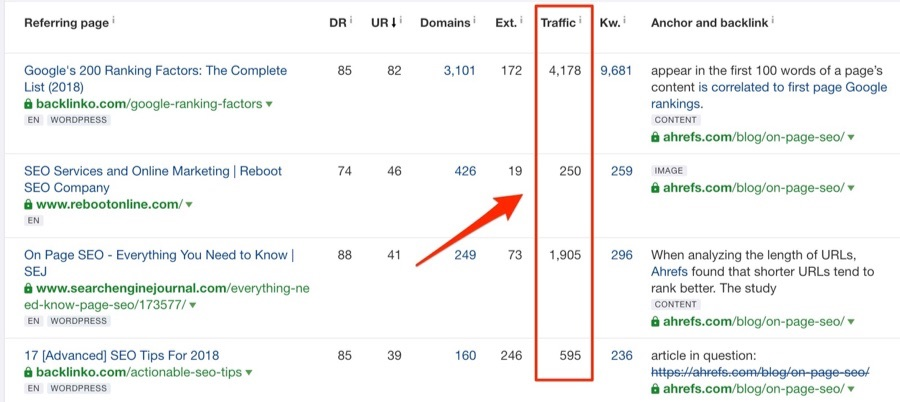
source: ahrefs
6) Healthy Anchor Text.
Check websites anchor text, the most common is branded and it's one of the sign of a healthy domain.
If you see exact match products or services name, you need to investigate deeper..
I use this checklist to decide which links to acquire.
And this is my take & of course, this can't be totally accurate but a method to get more information about a link.
Hope this helps to SEOs.
One of the blogs that I ignored for a while had 2.85K backlinks from 882 domains.
And I have built each link via outreach + guest posts. So link quality is also good but I've seen many websites with half the links but better ranking & traffic.
Then I thought there might be some problem with content, but I checked in fact my content was best in the SERPs. In-depth & explained beautifully.
So I started analyzing my backlinks, I'd a good overall authority of 26 DR. I had many links from DR 40-50 even 70-80.
I was confused even after having high DR domains pointing to my site why I'm not ranking higher. When I started checking 40 DR links I was a bit shocked.
Many were not having traffic, some had to decline traffic, too many backlinks.
Then I stopped outreaching and started finding which how to Identify High-Quality Backlinks.
And after doing a lot of research on this topic I created a checklist now I use to make sure I'm putting my efforts & money into a quality link.
DISCLAIMER: I've made this process as per my best SEO understanding, however, I'm not claiming this process to be 100% accurate. The purpose is to get more information about a website to decide whether it's high quality.
Identify High-Quality Backlinks[Checklist]
1) Relevant to my niche?
Every blog I read focused on a relevant niche, links from the same niche will have more link juice in comparison to the non-relevant niches.
Eg: suppose I have a website called SEOrocks that published content on SEO
And I want to get a link on SEOrocks
And there are 2 options
a) Neilpatel
b) Mybaby
Which one will be more effective. You know the answer.
Pretty basic but very few do it.
2) Is the page relevant to my niche or my content?
News or general websites are a perfect example, If you want to link from these types of websites the content or page should be related to your niche.
3) Does the website has the authority?
Simple means DR or DA. But don't consider DR as the only metric to determine authority. in fact, it's a starting point.
Use it to qualify domains.
For eg you downloaded your competitor backlinks, now filter it to the 30-60 DR range.
Now from 1000 domains, you will get the best 100-150 domains. Now use the next steps to check out of this 150 which are really high quality.
4) Is the website having constant traffic?
if a website is not getting traffic or traffic is declining, something is wrong.
Some common reasons
Hit by an algorithm update or manually penalty.
Using spammy links.
PBNs
Structure change
Technical Errors
I prefer to go for websites that have an upward trend over 2 years, it means they are doing something right.
5) Does the linking page get search traffic.
This is optional.
I like to check if the page linked is getting traffic, so it means they are ranking for keywords. Ahrefs only shows Organic traffic.
source: ahrefs
6) Healthy Anchor Text.
Check websites anchor text, the most common is branded and it's one of the sign of a healthy domain.
If you see exact match products or services name, you need to investigate deeper..
I use this checklist to decide which links to acquire.
And this is my take & of course, this can't be totally accurate but a method to get more information about a link.
Hope this helps to SEOs.


