The Ultimate Guide To Ranking A Website Without Building Backlinks

Thank you so much for taking the time out to write this! I Have applied some of your strategy tips and have seen some success! Thank you again!
You're welcome! It's nice to hear that someone has seen some success from my strategies! :cool:
 
Great guide, but I have some questions to ask for helping. I do a 'heartburn' niche. I scraped a lot of keywords on this niche. But with every keyword, still have the authoritative site ranking on the 1st page. Can I still have chance to do this niche? Thanks
 
Really a helpful posts..
I am also ranking my websites without backlinks, all the backlinks till now are from various giveaways on bhw.
Its true that we can rank websites without backlinks..
Good share..
 
I am newbie and have few questions:

1. Why do you focus on keywords that have less than 1000 searches? What is the keyword has low competition and high search volume? What does that mean ? If I am in between two keywords, one has 500 monthly searches and another has 1500 monthly searches and both have low competition, then why don't I go for the higher searching volume keyword?

2. Do I make a keyword for the whole website which has to be a long tail word, example
ways to train dogs
Then, for each post I should have the same keyword but more specific , examples
best ways to train dogs
10 ways to train dogs
ways to train dogs fast

3. Do I put the main keyword of the site in the tagline ? I also understand that I include the keywords for each post in the title and mention it in the first paragraph of the article. Is that correct?

4. How do you cloak your keywords while the SEO plugin recommends that you include them in the posts titles?

5. How many articles should my site contain and how many words per article?
 
I am newbie and have few questions:

1. Why do you focus on keywords that have less than 1000 searches? What is the keyword has low competition and high search volume? What does that mean ? If I am in between two keywords, one has 500 monthly searches and another has 1500 monthly searches and both have low competition, then why don't I go for the higher searching volume keyword?

2. Do I make a keyword for the whole website which has to be a long tail word, example
ways to train dogs
Then, for each post I should have the same keyword but more specific , examples
best ways to train dogs
10 ways to train dogs
ways to train dogs fast

3. Do I put the main keyword of the site in the tagline ? I also understand that I include the keywords for each post in the title and mention it in the first paragraph of the article. Is that correct?

4. How do you cloak your keywords while the SEO plugin recommends that you include them in the posts titles?

5. How many articles should my site contain and how many words per article?
Hey!
1. I focus on smaller keywords to "snowball" my way to bigger keywords; as my site gains more potential to rank, I choose more difficult keyword. It just depends on what you find for the topic you want to write about. However, I try my best to rank for many LSI variants in one article. Assuming I did everything right and with a bit of luck, I can receive traffic to that one article from my primary keyword and its numerous LSI variants. Most people don't think of this and decide to focus on just their primary keyword's searches (1,500 monthly searches doesn't mean you'll receive 1,500 monthly visitors; even in the top 3, if your headline doesn't catch their attention, you could receive far less).

2. If by the "Whole website", you mean the main page, then most of the sites I do any SEO on are businesses, so I just focus on targeting their business name on the main page. However, if you mean you want to target that keyword on every page, you'll just end up dealing with a keyword cannibalisation issue causing your pages to compete with each other in the SERPs.

3. I'm actually not sure about this. I suppose you can, although I've never tried that before (it might look repetitive and like you're just stuffing keyword).

4. I don't cloak anything. You can put an LSI keyword in the title instead if you want, especially if you're doing what I mentioned in my first answer.

5. As many quality articles as you can create. There is no exact words-per-article you should be targeting, so just find out how long your competitors, especially the bigger competitors, are creating their articles and try to write at about that length as they usually keep their target audience in mind while creating those articles.
Great guide, but I have some questions to ask for helping. I do a 'heartburn' niche. I scraped a lot of keywords on this niche. But with every keyword, still have the authoritative site ranking on the 1st page. Can I still have chance to do this niche? Thanks
Depending on the rest of the SERPs, it may still be worth it. It really depends on how much traffic the authority site is receiving from that keyword, how competitive your own site is, and how well you can write a eye-catching headline.

For example, let's say you go through with it and get to position #2 for a keyword that receives 10,000 searches a month. There's a chance you'll only get 500 visitors each month from the keyword because the site in position #1 is receiving 90% of the clicks and the other sites (position 3 and lower) are getting 5% of the clicks spread between all of them. However, it's important to remember that this is just an example.
 
Last edited:
One more question:

Should the keyword of any post/page be in the title of that post and also in the first paragraph of the article?
 
How to correctly chose a keyword?

Lets say that I found a keyword that has very low competition of 0.02 with 4,000 monthly searches and high CPC, but this keyword appears in 130k URL results.

Will it be easy to rank this keyword or I should look for another which appears in less number of URLs ?
 
I guess the low competition is with regards to the advertisers and not comp in serps
 
One more question:

Should the keyword of any post/page be in the title of that post and also in the first paragraph of the article?
That's something that Yoast plugin mentions, but I personally haven't had any issues with excluding the primary keyword from the first paragraph. However, I would need to test this specific detail out before I could provide a definitive 'yes or no' answer.
How to correctly chose a keyword?

Lets say that I found a keyword that has very low competition of 0.02 with 4,000 monthly searches and high CPC, but this keyword appears in 130k URL results.

Will it be easy to rank this keyword or I should look for another which appears in less number of URLs ?
That depends on if those are 130,000 broad matches or 130,000 exact matches. It also depends on how many of those websites are actually targeting the keyword, as well as several other factors.
I guess the low competition is with regards to the advertisers and not comp in serps
Please read the guide next time instead of looking at the pictures; I highlighted the part of the guide that goes over how I estimated SERP competition at the time (as I don't use the Moz toolbar as much any more) as well as another response in this thread where I stated the difference between PPC competition level and SEO competition level.
Part 2: Choosing A Keyword Using The Google Keyword Planner

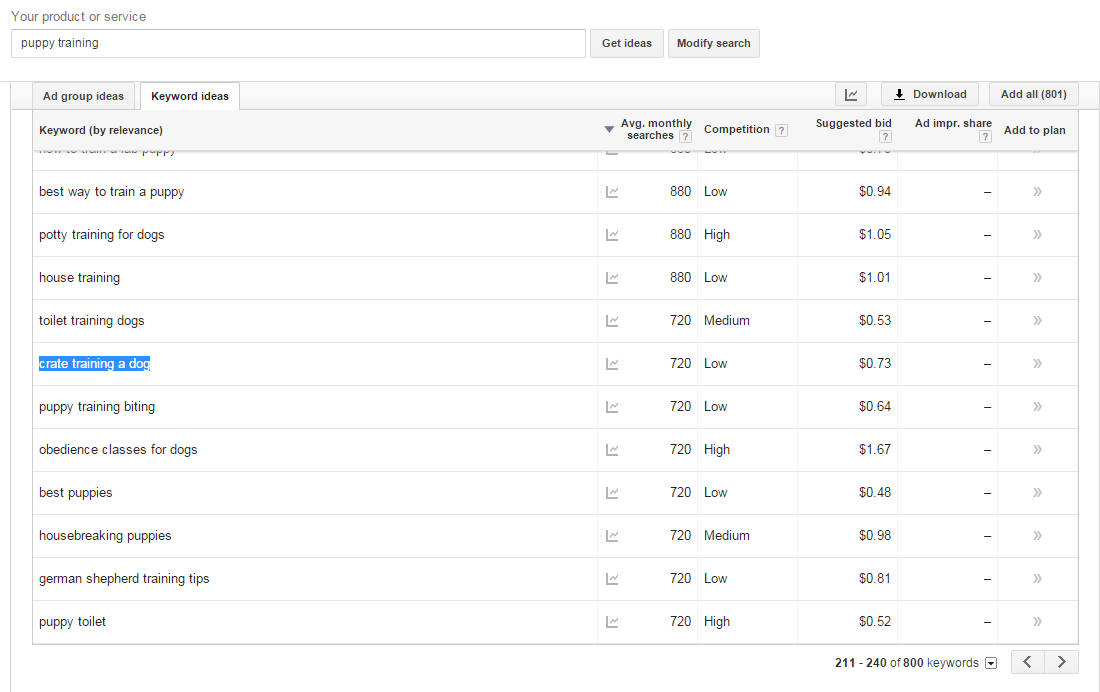
The first step to choosing a keyword is to open the Google Keyword Planner and enter any keyword related to your article (or any keyword you think would be a good match based on what your competitors are using). We're going to be looking for low competition keywords that receive a decent number of searches per month for their competition level. To help you understand this, I'm going to be using a fictitious puppy training website that needs new keywords. Now, what I prefer to do to find low competition keywords by sorting the results by "average monthly searches" and then go through the pages until I find the keywords that receive under 1,000 searches per month.

For the sake of this post, I'm going to select a variation of the keyword "crate training a dog" in the image below called "how to crate train a puppy fast".
ZRLC6LR

Now, when deciding on which keyword is the best option, I initially look at 4 things to help me quickly sort through keywords (because you'll be sorting through a lot of keywords): The Moz Toolbar, the number of authority sites appearing in the SERPs, how many times the exact keyword appears in the SERPs, and my own intuition.
YEy7YJT

(Notice how those relatively unknown sites do not target the exact keyword anywhere. That's a good sign!)

The Moz Toolbar is useful for quickly glancing over pages and determining how many authority sites with Domain Authority (DA) and Page Authority (PA) over 70 appear in the SERPs (as shown in the image above). As for the part about using my intuition, even if the websites in the SERPs have low a DA and PA and the exact keyword doesn't show up much, if I think I can't compete with the sites, I usually avoid the keyword or use it as a Latent semantic indexing (LSI) keyword instead.

Hello, feelfreeto!

To answer your question, "low competition" in this guide means low competition in the Search engine results pages (SERPs), not in Adwords or Adsense.

The keyword competition in the Google Keyword Planner (which is for PPC advertisers on Adwords and publishers on Adsense) is not the same as the keyword competition in the SERPs (this is SEO competition or "ranking competition"). Here is Google's explanation of what the competition level in the Keyword Planner means:

So it's just the number of advertisers who are targeting that keyword in their ads.

As far as if there is any correlation between PPC competition level and SEO competition level, I honestly do not pay attention to the PPC competition level when I'm selecting the keyword as the factors mentioned in part 2 of the guide are what's important (something I omitted from the guide was checking the backlink profile of the sites in the SERPs, although I only do this if glancing over the keyword is not enough), although the keywords I look for tend to be more obscure (under 1,500 searches/month), so most of them have a low Adwords competition level.

With that said, I've seen many keywords with a low Adwords competition levels that are difficult to rank in the SERPs.
 
definitely one of the best guides of this year
thanks Op for sharing
 
That's looks like solid post. I'm totally agree with you, if you create the unique meta tittle and tags also write the unique content you're website will rank faster without creating too much backlinks.
 
That depends on if those are 130,000 broad matches or 130,000 exact matches. It also depends on how many of those websites are actually targeting the keyword, as well as several other factors.


How do I know if the other sites are ranked for this keyword on broad and not exact?

Maybe if I can try to rank to the exact keyword I would pass them. Is that correct?
 
How do I know if the other sites are ranked for this keyword on broad and not exact?

Maybe if I can try to rank to the exact keyword I would pass them. Is that correct?
Sorry, I used PPC terminology in my last post, but what I meant by a broad match is the regular search you would do when you find a keyword (e.g., searching for 'how to skii' in Google without the quotes). An exact match search is an advanced search that allows you to see how many websites have that exact keyword on their pages (e.g., "how to skii" with the quotes).

Most people do not use advanced search operators, so even if you appear on the first page when someone uses an exact-match search operator, this won't matter much.

On a side note, there are other search operators you can use in Google as well (the first few are for Gmail searches, but most of the others work in Google): https://support.google.com/mail/answer/7190?hl=en
 
Last edited:
Back
Top