bout that life
Newbie
- Dec 14, 2014
- 32
- 2
Great guide, I'll definitely use some of these tips for my new website.


I mentioned how I determine keyword competition level in Part 2 of this guide and I also answered a similar question on page 2 of this thread where I clearly stated that, "The keyword competition in the Google Keyword Planner (which is for PPC advertisers on Adwords and publishers on Adsense) is not the same as the keyword competition in the SERPs (this is SEO competition or "ranking competition").", and then I subsequently provided a link where Google also defined the competition level in Adwords to show that it has no bearing on the competition level in the SERPs. I highlighted both of my quotes in lime green to make them a little easier for you to notice this time.OP not sure on how exactly you determine keyword competition level, I understand it as you are using the competition level showed by adwords planner, but that competiton level is only for adwords bidding and not serp.
I am only pointing this out since I have heard alot of selfproclaimed "seo gurus" make that exact mistake, funny thing is G's adwords planner even tells you this and with just a little research you'd easily find out that kw planner and serp competition does in no way relate
Hello, feelfreeto!
To answer your question, "low competition" in this guide means low competition in the Search engine results pages (SERPs), not in Adwords or Adsense.
The keyword competition in the Google Keyword Planner (which is for PPC advertisers on Adwords and publishers on Adsense) is not the same as the keyword competition in the SERPs (this is SEO competition or "ranking competition"). Here is Google's explanation of what the competition level in the Keyword Planner means:
So it's just the number of advertisers who are targeting that keyword in their ads.
As far as if there is any correlation between PPC competition level and SEO competition level, I honestly do not pay attention to the PPC competition level when I'm selecting the keyword as the factors mentioned in part 2 of the guide are what's important (something I omitted from the guide was checking the backlink profile of the sites in the SERPs, although I only do this if glancing over the keyword is not enough), although the keywords I look for tend to be more obscure (under 1,500 searches/month), so most of them have a low Adwords competition level.
With that said, I've seen many keywords with a low Adwords competition levels that are difficult to rank in the SERPs.
Part 2: Choosing A Keyword Using The Google Keyword Planner
The first step to choosing a keyword is to open the Google Keyword Planner and enter any keyword related to your article (or any keyword you think would be a good match based on what your competitors are using). We're going to be looking for low competition keywords that receive a decent number of searches per month for their competition level. To help you understand this, I'm going to be using a fictitious puppy training website that needs new keywords. Now, what I prefer to do to find low competition keywords by sorting the results by "average monthly searches" and then go through the pages until I find the keywords that receive under 1,000 searches per month.
For the sake of this post, I'm going to select a variation of the keyword "crate training a dog" in the image below called "how to crate train a puppy fast".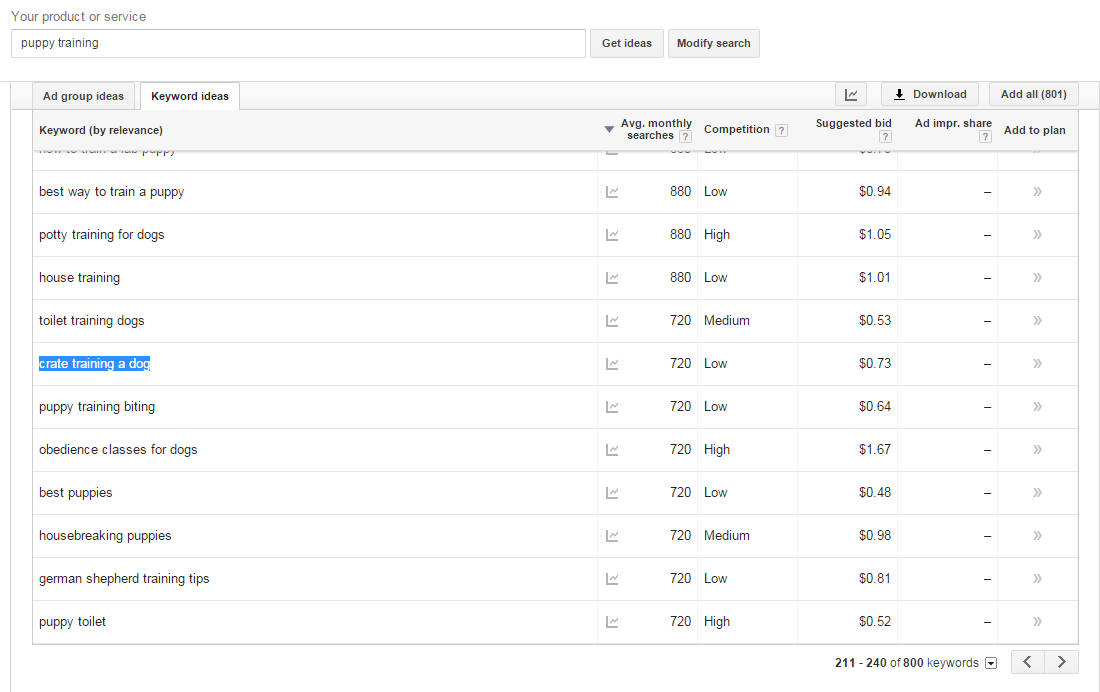
Now, when deciding on which keyword is the best option, I initially look at 4 things to help me quickly sort through keywords (because you'll be sorting through a lot of keywords): The Moz Toolbar, the number of authority sites appearing in the SERPs, how many times the exact keyword appears in the SERPs, and my own intuition.The Moz Toolbar is useful for quickly glancing over pages and determining how many authority sites with Domain Authority (DA) and Page Authority (PA) over 70 appear in the SERPs (as shown in the image above). As for the part about using my intuition, even if the websites in the SERPs have low a DA and PA and the exact keyword doesn't show up much, if I think I can't compete with the sites, I usually avoid the keyword or use it as a Latent semantic indexing (LSI) keyword instead.
(Notice how those relatively unknown sites do not target the exact keyword anywhere. That's a good sign!)


Hey, jhakasseo!This is indeed solid guide. But I suspect without backlinks how keywords will get ranked on search engine?
Hello everyone!
Something I'm seeing a lot of confusion about is how this method can even work without you building backlinks. A few people (definitely not most of you) are coming here after reading Tommy's "Stop Believing These 10 SEO Lies Right Now! The Truth Will Set You Free..." thread believing that the purpose of this guide (ranking without building backlinks yourself) contradicts Tommy's thread, but I'm here to tell you that it doesn't contradict his thread and that there is always more than one way to reach the goal.
You see, the way this method works is simple: you create your content, do on-page optimisation using low competition (often also low-search) keywords, and wait for your page to receive its initial rank (notice how I said "initial". I'll get to that in a moment). But one thing I didn't mention in the original post is the other purpose of this guide, which is something I vaguely mentioned in another post I created on this thread.
You guessed it, the other purpose of this guide is to get backlinks without building them yourself, or as Tommy mentions in his thread, "content is a means to get links". This method relies on finding low-competition, low-search (under 1,000/month) keywords at the start to get a decent initial ranking, and then waiting for people who like the content to link back to it ("natural backlinks"), that way you can rank even higher for your primary keyword and for the variations (LSI keywords) of that keyword. This way, you aren't actually building the backlinks yourself and you can focus more on putting out high quality content (which is why this guide is great for someone who doesn't like actively building backlinks).
With everything considered, if you haven't tried ranking using this method or you couldn't figure out what I explained above about how you could procure backlinks with it, then I don't want to hear you criticise this method by saying "you can't rank without building backlinks"; to each his own.
I hope this cleared up any confusion that any of you may have had about this thread.
I would say that some of the best rankings I've achieved using this system were for an article that I wrote for one of my sites at the beginning of the year. I'm not going to post the keywords or too much information about the keywords that the article is ranking for, but the keyword group (primary and LSI) receives about 9,000 searches per month (not a whole lot, but this is only for 1 article on a small site). In case you're curious, here are some of the current rankings for the LSI keywords:

The primary keyword is ranking in position 2-3 on average. Of course, these current rankings have been boosted a bit by people who have naturally linked to the article, but I was still ranking on the first page for this keyword group before. This whole system is basically just pure on-page SEO with good keyword research added in, so it's nothing spectacular and can be complimented with excellent off-page SEO (I don't have a guide for that yet) if you're dubious about doing this guide without it.
Now, if you want to go by best rankings and disregard the number of searches per month, then these are the best rankings I've achieved using this method (these keywords receive between 70-700 searches per month):


