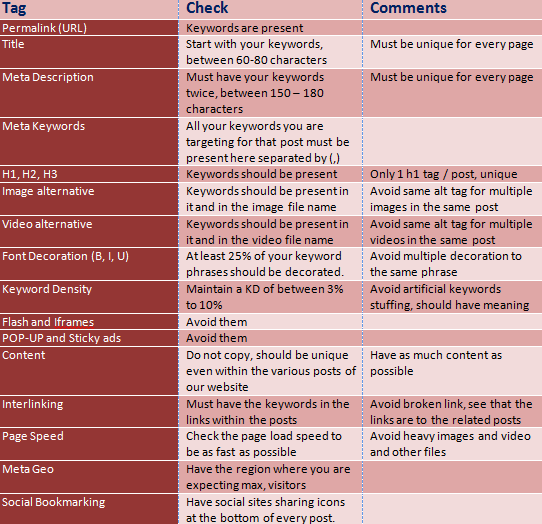
Important Information Checklist for On-page Optimization

A legend

Power Member
Joined
Sep 8, 2017
Messages
535
Reaction score
181
Today I am sharing important information, who don't know about onpage optimization this is for them

upload_2017-10-31_3-49-48.png


I don't know i should post this information in this section or not if it is a wrong section so i am sorry.

I hope this information will help to people who are making new website onpage

Thank you regards
(A legend)​
 
Is "meta keywords" still a thing on checklists o_O

Meta Keywords only thing it does is it allows competitors to see what keywords you are trying to target.:)
 
Now it is better to have KW density less than 1% to rank well.
 
So, in other words, either dont fill it out - or fill it out with complete rubbish ;)
 
So, in other words, either dont fill it out - or fill it out with complete rubbish ;)

Okay this is my own information it's not a copy past work, you want to learn you can otherwise you don't learn
 
Okay this is my own information it's not a copy past work, you want to learn you can otherwise you don't learn
I fail to see what there is to learn? there is no reason to give your competitors your keywords, and no reason in search engines, to fill them out. Meta keywords has no use today. Sorry. But thanks for trying.
 
List looks old to me, you missed few points.
 
Thanks mate,

some of your info is a decent starting point for someone new to SEO, however most of your mentioned criteria depend on industry and type of website as well as many other factors. Moreover suggesting keyword density to be always between 3-10% is completely bonkers. While this overused criteria is long overvalued nowadays due to increase in importance of contextually meaningful content, long-tails, optimization towards search intent and less on keyword placement, you should not go any higher than 2.5-3% in my opinion. Again depends on many more factors but I'd take it as a rough starting point in order to write interesting articles that give value to the user.

Kind regards

Ensili
 
"Important Information Checklist for On-page Overoptimization"

There, I fixed the thread title for you.

It might work in a foreign Google version or with some spammier niches, but overall, trying to site optimised like this nowadays would be very hard.

Density should be significantly lower. No keyword decoration is necessary. Your keyword doesn't (and shouldn't!) be in every h1-3 tag. Your keyword doesn't necessarily have to be one nor twice in first paragraph. With density of 10%, if my keyword were "best food for diabetic dogs", then 500 word content would have that phrase there 10 times. Even if you were to rank that, the keyword stuffing and terrible readability would not help the conversions.
 
Disclaimer: I don't care what is or isn't a factor... just so long as there is data to support it either way. So in that spirit I will share some data.

Meta Keywords Factor Overview

Myth 1: Fear the competitors

First, I have seen the argument "Don't use meta keywords because competitors can see what you target" many times. This argument is BS in my mind because if what you are trying to rank for isn't obvious on the page already I bet your rankings really suck for it. Sure there are black hat ways of sculpting anchor text to rank for a term that is not on page but that isn't the usual whitehat case. So if you have a whitehat site I can't see any competitive disadvantage to using meta keywords... it is at worst harmless.

Example: If your webpage is about cats I will still know it is about cats if you don't use the meta keywords otherwise you probably won't rank for cats.

Myth 2: Everybody knows it doesn't do anything

Really? These websites must have missed the memo.

Walmart
<meta name="keywords" content="online shopping, shop online, electronics, home furnishings, baby gear, toys, video games, walmart, walmart.com"/>

Amazon
<meta name="keywords" content="Amazon, Amazon.com, Books, Online Shopping, Book Store, Magazine, Subscription, Music, CDs, DVDs, Videos, Electronics, Video Games, Computers, Cell Phones, Toys, Games, Apparel, Accessories, Shoes, Jewelry, Watches, Office Products, Sports & Outdoors, Sporting Goods, Baby Products, Health, Personal Care, Beauty, Home, Garden, Bed & Bath, Furniture, Tools, Hardware, Vacuums, Outdoor Living, Automotive Parts, Pet Supplies, Broadband, DSL">

Overstock
<meta name="keywords" content="best price, wholesale, discounts, deals, cheap, online store, online shopping, name brand, merchandise, liquidate, liquidator, sale, lowest prices, low prices, savings, free, bargains, values, bedding, furniture, electronics, jewelry, watches, apparel, overstock, overstock.com, o.co, o.com">

QVC
<meta name="keywords" content="qvc,qvc.com,www.qvc.com,online shopping,qvc shopping"/>

Safeway
<meta name="keywords" content="Safeway, ingredients for life, weekly specials, recipes, pharmacy, eating right, store card, print coupon, diet recipes, signature cafe, about us, quick links, services, company info, our brands, shop online, low prices">

All these websites have the budget and the rankings to suggest they have best in class SEOs helping them. Maybe they know something you don't.

Myth 3: It doesn't work anymore.

upload_2017-10-31_13-20-47.png


It still correlates with rank position frequently. It isn't the strongest signal. I suspect it still counts as extra matches on page and affects your search relevance slightly with those extra matches. Go read about TF-IDF on wikipedia to see how the math works.

I certainly invite everyone to show data that it doesn't work. Please let it not be quotes of other bloggers opinions. Real data please.

Myth 4: There is no benefit to using it

Besides the fact that there is certainly no harm in using it ... besides the correlations with rankings that appear frequently for it... you absolutely can use it to stay organized and track which pages are targeting which terms. Then when you run your SEO robots output a column for URL and Meta Keyword and you have your rank tracking list for intentional SEO (the SEO you do on purpose versus the SEO you get by accident which is what most people find in their rank tracking). So even without a ranking boost there still may be advantageous ways of using it.

Conclusion

I don't care if it is or isn't a factor but based on the data I would still use it. It is easy to implement. It is at a minimum harmless. Likely correlates with rankings for adding extra keyword matches on page. If you practice intentional SEO it is a great tool for staying organized. Finally, massive online retailers still use it. Maybe they know something you don't.


P.S. If you like the spirit of this factor overview let me know and maybe I will write more. :-)
 
Disclaimer: I don't care what is or isn't a factor... just so long as there is data to support it either way. So in that spirit I will share some data.

Meta Keywords Factor Overview

Myth 1: Fear the competitors

First, I have seen the argument "Don't use meta keywords because competitors can see what you target" many times. This argument is BS in my mind because if what you are trying to rank for isn't obvious on the page already I bet your rankings really suck for it. Sure there are black hat ways of sculpting anchor text to rank for a term that is not on page but that isn't the usual whitehat case. So if you have a whitehat site I can't see any competitive disadvantage to using meta keywords... it is at worst harmless.

Example: If your webpage is about cats I will still know it is about cats if you don't use the meta keywords otherwise you probably won't rank for cats.

Myth 2: Everybody knows it doesn't do anything

Really? These websites must have missed the memo.

Walmart
<meta name="keywords" content="online shopping, shop online, electronics, home furnishings, baby gear, toys, video games, walmart, walmart.com"/>

Amazon
<meta name="keywords" content="Amazon, Amazon.com, Books, Online Shopping, Book Store, Magazine, Subscription, Music, CDs, DVDs, Videos, Electronics, Video Games, Computers, Cell Phones, Toys, Games, Apparel, Accessories, Shoes, Jewelry, Watches, Office Products, Sports & Outdoors, Sporting Goods, Baby Products, Health, Personal Care, Beauty, Home, Garden, Bed & Bath, Furniture, Tools, Hardware, Vacuums, Outdoor Living, Automotive Parts, Pet Supplies, Broadband, DSL">

Overstock
<meta name="keywords" content="best price, wholesale, discounts, deals, cheap, online store, online shopping, name brand, merchandise, liquidate, liquidator, sale, lowest prices, low prices, savings, free, bargains, values, bedding, furniture, electronics, jewelry, watches, apparel, overstock, overstock.com, o.co, o.com">

QVC
<meta name="keywords" content="qvc,qvc.com,www.qvc.com,online shopping,qvc shopping"/>

Safeway
<meta name="keywords" content="Safeway, ingredients for life, weekly specials, recipes, pharmacy, eating right, store card, print coupon, diet recipes, signature cafe, about us, quick links, services, company info, our brands, shop online, low prices">

All these websites have the budget and the rankings to suggest they have best in class SEOs helping them. Maybe they know something you don't.

Myth 3: It doesn't work anymore.

View attachment 96952

It still correlates with rank position frequently. It isn't the strongest signal. I suspect it still counts as extra matches on page and affects your search relevance slightly with those extra matches. Go read about TF-IDF on wikipedia to see how the math works.

I certainly invite everyone to show data that it doesn't work. Please let it not be quotes of other bloggers opinions. Real data please.

Myth 4: There is no benefit to using it

Besides the fact that there is certainly no harm in using it ... besides the correlations with rankings that appear frequently for it... you absolutely can use it to stay organized and track which pages are targeting which terms. Then when you run your SEO robots output a column for URL and Meta Keyword and you have your rank tracking list for intentional SEO (the SEO you do on purpose versus the SEO you get by accident which is what most people find in their rank tracking). So even without a ranking boost there still may be advantageous ways of using it.

Conclusion

I don't care if it is or isn't a factor but based on the data I would still use it. It is easy to implement. It is at a minimum harmless. Likely correlates with rankings for adding extra keyword matches on page. If you practice intentional SEO it is a great tool for staying organized. Finally, massive online retailers still use it. Maybe they know something you don't.


P.S. If you like the spirit of this factor overview let me know and maybe I will write more. :)

MOAR!
 
Back
Top