

hekke
Senior Member
- Jan 31, 2014
- 1,085
- 2,462
Over the years, I have written multiple guides on topics related to building and ranking websites. I have been getting a lot of questions (try my best to reply to each of them) but sometimes I tend to miss a few due to lack of time. This is why I decided to make an end to end guide for building and ranking authority websites, most of the answers to the unanswered questions can be found within this guide. Let’s get started with the guide without further ado!

The guide is divided into the following sections:
1. Setting up the site
2. Niche selection
3. Keyword Research
4. Keyword Sorting
5. Word Counting
6. Site Structure
7. SEO-Optimized Content
8. Uploading content
1. Setting up the Site
This is something you will have to learn yourself, I will not be discussing setting up a Wordpress site here. There are amazing setup guides and I am sure Google will help you here. Ensure that the theme you choose is SEO-friendly and you are good to go.
2. Niche Selection

How many times have we heard that the first step in having a successful website is identifying an easy niche or a niche you are passionate about. Fast forward to 2019, I don’t believe in this principle anymore.
Because of the following reasons:
You can determine the niche of the auctioned domain by checking the URL on archive.org, the aim is to have content related to the niche. If the auctioned domain belonged to a carpenter, then it would make sense to have a site around furniture for example.
This method of using auctioned domains to find the niche helps me save both time and resources, but you may have to set aside $300-1000 for a good auctioned domain.
3. Keyword Research

This is probably the most important part of building an affiliate website, finding keywords with buyer intent. There are many tools which you can use to this part, I personally use Ahrefs for this.
The process is straight forward, you first have to come up with few seed keywords related to your niche. Based on these seed keywords, you can find a set of related keywords. It is easy to come up with seed keywords, just imagine you are buying the product and what you would search to find it.
For example, if you are planning to buy a laptop, then you would search for “best + laptop(s)”, “top + laptop(s)” and “laptop + reviews” and these would be the seed keywords.
The best and top keywords can be used for the main content while the ‘reviews’ can be great for support content. Review keywords tend to be low competition bringing in a few extra dollars when you rank those articles.
You can find a lot of keywords this way, it should include a mix of low competition, high competition, long tail keywords, etc. I generally do not look into the competition of the keywords, my aim to pull as many keywords as possible, group them and then build content around it.
Note: Do not ignore keywords with low search volume, I target keywords with an MS volume of 50-100 or more. Adding such keywords can bring in some easy traffic leading to more clicks. Also, Ahrefs data is not always accurate and some 50-100 searches a month keywords could actually result in a few hundred extras in income each month.
4. Keyword Sorting

Keyword sorting is something which I do immediately after keyword research, the aim here is to group keywords with similar intent together. Thus, after I have sorted out the keywords on my data sheet, I would have groups of keywords with the same intent.
This ensures that there will not be multiple articles targeting keywords with the same intent, thereby reducing chances of keyword cannibalization (and you’d also have saved some cost on unwanted content).
The intent of some keywords are straight-forward (“best laptop” and “best laptop 2019” can be inside the same article) and they can be grouped easily. In case you are confused about a particular keyword, I’d advise you to Google the keyword and analyze the top SERPs, this should give you an idea of the search intent behind the keyword.
By the end of this activity, you should be having groups of closely related keywords for which you can develop content in the form of buyer guides, reviews or informational articles.
5. Word Counting
I did not talk about keyword competition in the keyword research section because my aim there was to find as many keywords as possible and not only ‘low-comp’ keywords. The competition aspect is checked under the section of word counting.
Simply put, word counting is a process by which you determine how many words your article needs to have for a particular keyword/keyword group. The number must be greater than the word count of the pages ranking for those keywords on top 10.
There are a few ways to do this, I will discuss one free and one paid method. I have used both the methods but I now use the free method because my VA does it for me.
The free method first, for this we will make use of a plugin called ‘Word Count’. Here is the link to the chrome plugin: https://chrome.google.com/webstore/detail/word-count/pnngehidikgomgfjbpffonkeimgbpjlh?hl=en (not affiliated with it whatsoever).
Install the plugin, simply go to the article for which you need the word count for, select the content, right click and then choose ‘count words’. You will have to do this for all the results and then find the page with the maximum number of words. Then record the data on the sheet and ensure you write 100-500 words more than the top competitor does.
The second method is easier but you will have to spend some money for the plugin. I’d advise you to use this only if you are someone who builds sites frequently.
The paid plugin is ‘SerpWorx’, it is an all in one SEO plugin but we will be making use of it to find the word count. Go to their website and install the plugin. Once installed, perform a search for the main keyword. You will see that all the top ten results will have a small box below it.
Among the data being shown, you will find something called ‘WC’ which is nothing but the word count of the article. It’s a quicker way to see the word count, but they include elements such as the comments, menu structure and whatever content is visible site-wide, thus making it less accurate.
6. Site Structure
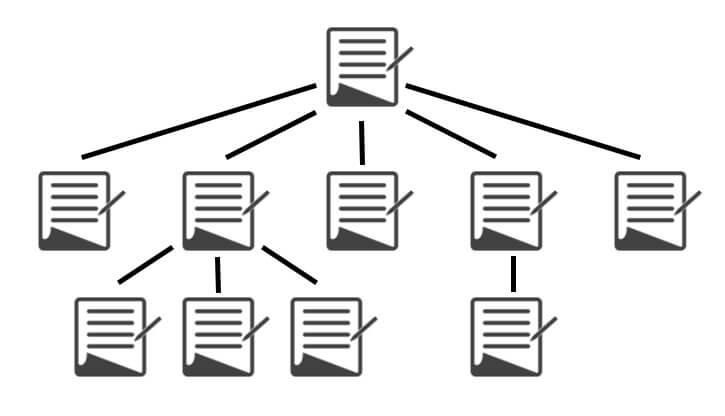
Having a structured site is very important, everyone tends to ignore this part when they begin building sites. Partly because they feel it is confusing to figure out the site structure. While I agree that deciding on the site structure is not easy but it is certainly doable.
I will explain my approach to deciding the site structure. Before that, keep in mind that there is no ‘one size fits all’ for site structure, I am just telling you my way of doing it. It has worked for the sites I have built so far and I don’t see any reason why it wouldn’t work for you.
Let’s assume you found an auctioned domain related to saws. You have done the keyword research, keyword sorting and also found the no of words that go into each article. Now, you will have to decide on the structure of the site.
The most common approach would be to have a long homepage article targeting ‘best saws’ and then have sub-pages for other saws. Then have individual product reviews on the different saw models.
While this is not a wrong structure, it just limits your scope of broadening the website. As per my tests, I have seen that when a homepage is targeted for a specific keyword, it tends to get “locked down” for that keyword. In case you decide to write on other power tools like drills, air compressors, the chances of ranking for these terms is remote.
Which is why I recommend having a broader structure in the beginning. You can start writing on saws but your homepage must be optimized for ‘power tools’ (if you want to be able to expand to this later). Then we can have sub-pages targeting different types of power tools.
We can build two different structures based on each product category:
First structure:
yourdomain.com/best-saws/ <- where we list the best saws, and then add sub-pages like
/best-saws/table/ to rank for “best table saws”. This is usually the best method if you are into a rather small niche such as power tools.
However, if you want to focus on every niche (such as 10beasts or TheWirecutter has done), I recommend the following structure.
Second structure:
yourdomain.com/fitness/ <- where we list all posts related to fitness,
yourdomain.com/fitness/wearables/ <- sub-category where we list all related to fitness wearables, and then under this sub-category,
yourdomain.com/fitness/wearables/best-fitbits/ <- where we post the best fitbits article we want to rank
This allows us to rank for many different types of niches with one domain. By categorizing each post within a super-relevant category we show to Google that, we are very good at writing about saws, but we have also a deep category within fitness - allowing us to rank one site for tens of thousands of different keywords within a wide vertical.
7. SEO Optimized content
We have done all the hard work so far, now the task is to create content which is SEO optimized. There are many guides online and on BHW on on-page SEO, I highly recommend you to read them, if you are doing this for the first time. If you running low on budget, you can write the articles yourself.
If you have the budget to spend on articles, hire a good writer who has basic knowledge about SEO optimized content. You can create a template which the writer can follow so that they understand what you need.
Few additional Tips from my side
8. Uploading Content
Now comes the final task, which is uploading the content. I use a VA for this as the task is repetitive and it is pretty much the same process every time. Here are a few tips to increase conversion rate.
Conversion rate optimization tips
Building an authority website is not easy but it is certainly doable with the right approach, determination, and focus.
Put all comments below and I will make sure to answer all of them!

The guide is divided into the following sections:
1. Setting up the site
2. Niche selection
3. Keyword Research
4. Keyword Sorting
5. Word Counting
6. Site Structure
7. SEO-Optimized Content
8. Uploading content
1. Setting up the Site
This is something you will have to learn yourself, I will not be discussing setting up a Wordpress site here. There are amazing setup guides and I am sure Google will help you here. Ensure that the theme you choose is SEO-friendly and you are good to go.
2. Niche Selection
How many times have we heard that the first step in having a successful website is identifying an easy niche or a niche you are passionate about. Fast forward to 2019, I don’t believe in this principle anymore.
Because of the following reasons:
- You may end up wasting a lot of time and resources trying to find that ‘easy’ niche to get started.
- The niche which you are passionate about maybe ‘bitcoins’ but that’s a competitive niche. Not saying you cannot be successful here but this certainly wouldn’t be my first affiliate site. Because ranking this would need a lot of money.
You can determine the niche of the auctioned domain by checking the URL on archive.org, the aim is to have content related to the niche. If the auctioned domain belonged to a carpenter, then it would make sense to have a site around furniture for example.
This method of using auctioned domains to find the niche helps me save both time and resources, but you may have to set aside $300-1000 for a good auctioned domain.
3. Keyword Research
This is probably the most important part of building an affiliate website, finding keywords with buyer intent. There are many tools which you can use to this part, I personally use Ahrefs for this.
The process is straight forward, you first have to come up with few seed keywords related to your niche. Based on these seed keywords, you can find a set of related keywords. It is easy to come up with seed keywords, just imagine you are buying the product and what you would search to find it.
For example, if you are planning to buy a laptop, then you would search for “best + laptop(s)”, “top + laptop(s)” and “laptop + reviews” and these would be the seed keywords.
The best and top keywords can be used for the main content while the ‘reviews’ can be great for support content. Review keywords tend to be low competition bringing in a few extra dollars when you rank those articles.
You can find a lot of keywords this way, it should include a mix of low competition, high competition, long tail keywords, etc. I generally do not look into the competition of the keywords, my aim to pull as many keywords as possible, group them and then build content around it.
Note: Do not ignore keywords with low search volume, I target keywords with an MS volume of 50-100 or more. Adding such keywords can bring in some easy traffic leading to more clicks. Also, Ahrefs data is not always accurate and some 50-100 searches a month keywords could actually result in a few hundred extras in income each month.
4. Keyword Sorting
Keyword sorting is something which I do immediately after keyword research, the aim here is to group keywords with similar intent together. Thus, after I have sorted out the keywords on my data sheet, I would have groups of keywords with the same intent.
This ensures that there will not be multiple articles targeting keywords with the same intent, thereby reducing chances of keyword cannibalization (and you’d also have saved some cost on unwanted content).
The intent of some keywords are straight-forward (“best laptop” and “best laptop 2019” can be inside the same article) and they can be grouped easily. In case you are confused about a particular keyword, I’d advise you to Google the keyword and analyze the top SERPs, this should give you an idea of the search intent behind the keyword.
By the end of this activity, you should be having groups of closely related keywords for which you can develop content in the form of buyer guides, reviews or informational articles.
5. Word Counting
I did not talk about keyword competition in the keyword research section because my aim there was to find as many keywords as possible and not only ‘low-comp’ keywords. The competition aspect is checked under the section of word counting.
Simply put, word counting is a process by which you determine how many words your article needs to have for a particular keyword/keyword group. The number must be greater than the word count of the pages ranking for those keywords on top 10.
There are a few ways to do this, I will discuss one free and one paid method. I have used both the methods but I now use the free method because my VA does it for me.
The free method first, for this we will make use of a plugin called ‘Word Count’. Here is the link to the chrome plugin: https://chrome.google.com/webstore/detail/word-count/pnngehidikgomgfjbpffonkeimgbpjlh?hl=en (not affiliated with it whatsoever).
Install the plugin, simply go to the article for which you need the word count for, select the content, right click and then choose ‘count words’. You will have to do this for all the results and then find the page with the maximum number of words. Then record the data on the sheet and ensure you write 100-500 words more than the top competitor does.
The second method is easier but you will have to spend some money for the plugin. I’d advise you to use this only if you are someone who builds sites frequently.
The paid plugin is ‘SerpWorx’, it is an all in one SEO plugin but we will be making use of it to find the word count. Go to their website and install the plugin. Once installed, perform a search for the main keyword. You will see that all the top ten results will have a small box below it.
Among the data being shown, you will find something called ‘WC’ which is nothing but the word count of the article. It’s a quicker way to see the word count, but they include elements such as the comments, menu structure and whatever content is visible site-wide, thus making it less accurate.
6. Site Structure
Having a structured site is very important, everyone tends to ignore this part when they begin building sites. Partly because they feel it is confusing to figure out the site structure. While I agree that deciding on the site structure is not easy but it is certainly doable.
I will explain my approach to deciding the site structure. Before that, keep in mind that there is no ‘one size fits all’ for site structure, I am just telling you my way of doing it. It has worked for the sites I have built so far and I don’t see any reason why it wouldn’t work for you.
Let’s assume you found an auctioned domain related to saws. You have done the keyword research, keyword sorting and also found the no of words that go into each article. Now, you will have to decide on the structure of the site.
The most common approach would be to have a long homepage article targeting ‘best saws’ and then have sub-pages for other saws. Then have individual product reviews on the different saw models.
While this is not a wrong structure, it just limits your scope of broadening the website. As per my tests, I have seen that when a homepage is targeted for a specific keyword, it tends to get “locked down” for that keyword. In case you decide to write on other power tools like drills, air compressors, the chances of ranking for these terms is remote.
Which is why I recommend having a broader structure in the beginning. You can start writing on saws but your homepage must be optimized for ‘power tools’ (if you want to be able to expand to this later). Then we can have sub-pages targeting different types of power tools.
We can build two different structures based on each product category:
First structure:
yourdomain.com/best-saws/ <- where we list the best saws, and then add sub-pages like
/best-saws/table/ to rank for “best table saws”. This is usually the best method if you are into a rather small niche such as power tools.
However, if you want to focus on every niche (such as 10beasts or TheWirecutter has done), I recommend the following structure.
Second structure:
yourdomain.com/fitness/ <- where we list all posts related to fitness,
yourdomain.com/fitness/wearables/ <- sub-category where we list all related to fitness wearables, and then under this sub-category,
yourdomain.com/fitness/wearables/best-fitbits/ <- where we post the best fitbits article we want to rank
This allows us to rank for many different types of niches with one domain. By categorizing each post within a super-relevant category we show to Google that, we are very good at writing about saws, but we have also a deep category within fitness - allowing us to rank one site for tens of thousands of different keywords within a wide vertical.
7. SEO Optimized content
We have done all the hard work so far, now the task is to create content which is SEO optimized. There are many guides online and on BHW on on-page SEO, I highly recommend you to read them, if you are doing this for the first time. If you running low on budget, you can write the articles yourself.
If you have the budget to spend on articles, hire a good writer who has basic knowledge about SEO optimized content. You can create a template which the writer can follow so that they understand what you need.
Few additional Tips from my side
- Don’t focus on keyword density, aim to target many keywords within the article.
- Make use of alt-tags for the images
- Have a FAQ section in the article
- Keyword should be included in the text, H1, and title of the page
8. Uploading Content
Now comes the final task, which is uploading the content. I use a VA for this as the task is repetitive and it is pretty much the same process every time. Here are a few tips to increase conversion rate.
Conversion rate optimization tips
- Add a table or a list above the fold
- Add affiliate links to Images
- Have buttons for CTAs
- Ensure the content is readable and renderable
- Add meta like meta description to optimize SERP CTR
Building an authority website is not easy but it is certainly doable with the right approach, determination, and focus.
Put all comments below and I will make sure to answer all of them!


