So is it better to have one big blog , Like instead of a blog that talks about all camera, is it better to just have different blogs for different camera brands like one for sony, one for fuji etc? And do you think it's impossible to build a blog equivalent of magazine these days?

You are using an out of date browser. It may not display this or other websites correctly.
You should upgrade or use an alternative browser.
You should upgrade or use an alternative browser.
[GUIDE] Reverse Squared Virtual Silos - New Technique
- Thread starter TomBelfort
- Start date

Zooker
Regular Member
- Jan 13, 2010
- 358
- 119
@splishsplash how do you think this method would (if it does) apply to money pages such as "best x for y" type pages where it's fairly typical to have more in-depth reviews on each item? it would seem that this method would link out to those more detailed review pages but then there wouldn't be one from those pages to the main money page then?

- Oct 9, 2013
- 3,510
- 14,561
@splishsplash how do you think this method would (if it does) apply to money pages such as "best x for y" type pages where it's fairly typical to have more in-depth reviews on each item? it would seem that this method would link out to those more detailed review pages but then there wouldn't be one from those pages to the main money page then?
You don't really build "topical authority" for reviews. You build topical authority in the thing you're reviewing.
If I google "best surf board", the number 1 site is divein.com
It doesn't have topical authority for "reviews". It has topical authority for water sports, surfing, diving etc.

KHer0
Elite Member
- Mar 22, 2011
- 2,465
- 2,913
Looks like the same old silo for me. Broad Pillar and supporting articles.
I agree this how you build authourity in any Niche, by covering more user searches and solve all the user problems.
However, I still believe for backlinking, links determine how the juice flow.
I think all they did was just decreasing the power of backlinks as a factor for the Topical Authority favour.
In the past, a micro Niche website would beat the crap of huge website if it had better backlinks is it was seen as specialized in this Niche.
Now its the other way around, you need to build authority for your backlinks to count and enter the competition with the big guys
I agree this how you build authourity in any Niche, by covering more user searches and solve all the user problems.
However, I still believe for backlinking, links determine how the juice flow.
I think all they did was just decreasing the power of backlinks as a factor for the Topical Authority favour.
In the past, a micro Niche website would beat the crap of huge website if it had better backlinks is it was seen as specialized in this Niche.
Now its the other way around, you need to build authority for your backlinks to count and enter the competition with the big guys
- Oct 9, 2013
- 3,510
- 14,561
Looks like the same old silo for me. Broad Pillar and supporting articles.
I agree this how you build authourity in any Niche, by covering more user searches and solve all the user problems.
However, I still believe for backlinking, links determine how the juice flow.
I think all they did was just decreasing the power of backlinks as a factor for the Topical Authority favour.
In the past, a micro Niche website would beat the crap of huge website if it had better backlinks is it was seen as specialized in this Niche.
Now its the other way around, you need to build authority for your backlinks to count and enter the competition with the big guys
It's not..

Re-read it a couple of times. It's a COMPLETELY different approach.
It's the "same old silo" in the sense that you are linking in a similar way, but the way you plan it is completely different.
The most simplied way I can explain is this :-
Think of it more like rabbits multiplying.
You start with 1 article, and AS your writer is writing, you have him write out on the side new topical ideas based on what he's writing about, that he will then write an article about AND link from that original article.
So you have 1 article, as the writer is writing, he comes up with 5 other articles he could write to develop the ideas DEEPER that are in this article. That's 5 links. You now have 1 + 5 articles.
Repeat. You now have
1 + 5 + 25.
Repeat. You now have
1 + 5 + 25 + 125
You see?
You don't need to pre-plan or work out what to link to. The very way you do this, you have the internal links and the connected topics.
No one has ever talked about this before online that I've seen of. It's an entirely new way of approaching content plans.
So is it better to have one big blog , Like instead of a blog that talks about all camera, is it better to just have different blogs for different camera brands like one for sony, one for fuji etc? And do you think it's impossible to build a blog equivalent of magazine these days?
No, you would never have a blog for each brand. That wouldn't work today. For brands.. No. It depends on the niche. You want stuff between low-med and medium. Ie, you can do persian cats. Cats is too big. Persian cats is small, but it's enough.
A site on just 1 brand of camera though is just weird.
Sure you can build a magazine if you have a large budget.
Last edited:
IMMFROMPORTUGAL
Regular Member
- Nov 9, 2020
- 208
- 87
thanks for your post.Here's a new technique that will help you build more topical authority and is in line with how the Google algorithm works in 2023.
Traditionally you have something called the reverse virtual silo.
This worked really well in the past because of the way juice flowed.
In the past there was just 1 way for pages to get more "power" and this was through PageRank flow.
In the distance past PR flowed through pages through internal links. Any link passed PR. It would lose some with each link otherwise we'd have infinite PR.
Simple enough.. This was the original purpose of siloing. (Siloing works today, but for different reasons than in the past. In the past it was for PR sculpting, not creating topical clusters for topical authority)
Then Google changed things and the more related 2 pages were the more juice would flow. We don't know how they did this. I'm not sure when it started either. It was probably before AI and they would do some simple comparisons to check the relevance between 2 pages.
So if you link internally from your dog to cat page, a little PR flows, but if you link from your dog to dog page, more flows.
Because of this, a technique was created called the reverse virtual silo.
It worked like this.
You have your pillar article P, and you create support articles, A, B, C, D and E.
A-E link to P.
A links to B, B to C, C to D, D to E, E to A.
You then send a backlink to P, A, B, C, D and E and everything moves up.
But, there's another, more potent way that pages increase in rank now.
That's topical authority.
1 way to increase it is by creating more content within the topical clusters, and those clusters move up.
However, you also increase the rank of all pages within the clusters as you link to articles within those clusters.
Which makes sense.. Think about it. If an article like "How to train your bulldog" gets strong links, why would google not raise the rank of a page "How to groom your bulldog" ?
Instead of just simple PR flow through pages, they are likely causing PR to flow into clusters no matter how they're linked.
This would make much more sense from an engineering standpoint rather than simply causing PR to flow through internal links alone and it's in line with observations of how things work today.
We just don't know the technical details of the clustering other than that they'll need a very fast way to do it.
This means it's probably not super complicated. It'll be some fast sentence transformer model and then a clustering algorithm. New pages will have their distance measured from each cluster and be placed into a cluster accordingly. How they decide on new clusters is unknown.
What this means for us at a practical level is we want to be creating pages that have a distance in vector space close to the page we're most interested in ranking.
What's vector space?
Vectors are what machine learning uses. Vector space is the space that vectors exist in. A dense vector is a representation in vector space of some object, an object being text from a page.
This leads to the thought:
"What's the easiest way to decide on other topics that are going to be close in vector space to my original article?"
You can use tools and look up various questions/keywords and try to find ones close, but..
A much more natural and reliable way is to simply DEEPEN the topics that you're already talking about on the page.
When you write, you might take a couple of paragraphs to discuss a topic. But, many of these topics you are lightly going into could be deepened and have their own article created.
So let me give you an example.
Let's imagine, this article I'm writing here is the very page I want to deepen.
First topic I discussed: "Traditionally you have something called the reverse virtual silo."
So here's an opportunity. I could write another page about reverse virtual silos.
I would then link off to that. Not that it's NEEDED for juice flow, but this helps Google crawl all the related pages and probably makes it easier to cluster. You want to make things as easy as possible for the crawler. This is technical SEO. (Oh there we go, technical SEO, crawling. I can create more pages about these. Juice flow.. Another one )
Next I talk about "Then Google changed things and the more related 2 pages were the more juice would flow. We don't know how they did this. I'm not sure when it started either. It was probably before AI and they would do some simple comparisons to check the relevance between 2 pages."
So from this I could create another article about how google would send more PR between relevant pages.
Then I say "1 way to increase it is by creating more content within the topical clusters, and those clusters move up."
I could create another article talking about topical clusters. What are they, how do they work, how might google cluster"
You see? I'm barely 2-3 paragraphs into my article and already I have another 5-6 article ideas, that are BY DEFINITION close to the original article in vector space. They are by definition close because they are topics within the article, that me, as a human, can see are related. It's not arbitrary keywords I'm trying to write about and create an artificial relation. It's a REAL and DEEP relation. I am DEEPENING my content.
And what about those 6 articles I'd create? I'd do exactly the same in those. What about if I already have covered something? Great, I just link. Eventually I'll have covered a HUGE amount, filling in every little gap that google will see me as an ultra authority within this cluster, and everything within it will move up in rankings.
THEN, when I send some strong links anywhere into this cluster, the ENTIRE CLUSTER moves up.
And as I naturally expand this cluster, the cluster grows, and mini-clusters within the big cluster appear until I have a giant cluster, with sub clusters and sub-sub clusters and I'm a topical authority on everything SEO.
So the Reverse Reverse Virtual Silo, or Reverse Squared Virtual Silo is this
Start with a pillar article, and deepen it, creating related articles going deeper about all the topics, and link to those articles from your pillar.
So it's your PILLAR that links out to the "support" articles.
Note. It doesn't need to be a pillar. It's just a starting article of some sort, but ideally it's a slightly broader one so it has many topics within you can expand on.
Your support articles will then link to other support articles, but not artificially in some A->B->C->A pattern, but rather filling out gaps and deepening the topics it's already discussing.
In summary:
Rather than create a pillar, then artificially create support articles that link to the pillar.
Create a pillar, then deepen the topics within the pillar by writing articles that cover those sub-topics in depth, link to those from the pillar, and then backlink those articles, and your pillar will become stronger and stronger.
Does anyone remember the "YANDEX EXPERT" that was always talking about his special method to rank sites? I think he was into something but people mostly dismissed what he had to say... his strategy was mostly about backlinks though if i remember.
- Oct 9, 2013
- 3,510
- 14,561
thanks for your post.
Does anyone remember the "YANDEX EXPERT" that was always talking about his special method to rank sites? I think he was into something but people mostly dismissed what he had to say... his strategy was mostly about backlinks though if i remember.
This isn't a "special trick".
It's just an approach to building out the content on your site that is more in line with how google's machine learning understands the connections between your content and builds up a picture of what you have topical authority in.
Rather than plan out articles ahead of time, THEN go through them looking for connections to internally link, you start with a few articles. ANY. It doesn't matter which. From those, you naturally devleop other topics to dive into, and from those more topics.
If you're able to write 2000-3000 quality articles then this doesn't matter much. Go ahead and plan out all 2000-3000 and you're golden.
But, if you're building 5-10 articles per day, and you want to rank FASTER, then this approach will do that. Why? Because your very first articles are immediately getting topical deepening, and those in turn are getting deepening, so you rank FASTER due to having tighter topical hubs.
This isn't some magic trick. It's just a novel way to approach doing content plans for a site that's more efficient for most people.
And I do huge sites with my AI content and I'm going to be developing some AI models to do the very thing I'm talking about here. It is just *better*. I would rather have my AI do this rather than my current approach which is to export keywords from semrush keyword magic, run my AI cluster model to group them, then run my outline tool to build the outlines.
I don't quite think anyone has really understood what it is I've shared here or the implications. It's really subtle. It's easy for me to understand because it's my idea, but I can understand why it might not click straight away. But that's why I'm re-phrasing and trying to help you guys understand why this approach is more powerful than the traditional "out to in" approach. This is an "in to out" content strategy. Ie, you don't start with a big content plan with 1000's of articles. You start with just 5 to 10, and from there, the rest are self-generating.

krishnacode360
Supreme Member
- May 30, 2012
- 1,360
- 416
So from what i understood.,
P links to the support articles A to. E.
Then all A to E may not link to P.
Build backlinks to A to E . This strengthens P & moves up every hing.
Am I right ?
P links to the support articles A to. E.
Then all A to E may not link to P.
Build backlinks to A to E . This strengthens P & moves up every hing.
Am I right ?
- Oct 9, 2013
- 3,510
- 14,561
So from what i understood.,
P links to the support articles A to. E.
Then all A to E may not link to P.
Build backlinks to A to E . This strengthens P & moves up every hing.
Am I right ?
Not really.. Sort of, but the way you describe it is making it sound like a standard sort of linking scheme or something mundane. This is maybe why people are focusing on the wrong thing.
This isn't about the linking. The linking is not important. You can do this without ANY linking and you'll still rank. Google doesn't actually *require* you to internally link. It just helps the crawler make the connections and causes juice to flow more effectively, but the way you internally link is just the iceing on the cake.
P is not P.
It's not a pillar.
However.. The misunderstanding is my fault.
I shouldn't have used the word "pillar", and I definitely shouldn't have said "support articles". I think I did this because I started off describing the old "virutual silo" and how this was a sort of "reverse virtual silo". I focused too much on the fancy name, and that's lead me to use bad terminology.
Note, that I did say
Note. It doesn't need to be a pillar. It's just a starting article of some sort, but ideally it's a slightly broader one so it has many topics within you can expand on.
I shouldn't have said this after though
Your support articles will then link to other support articles, but not artificially in some A->B->C->A pattern, but rather filling out gaps and deepening the topics it's already discussing.
I can see why this is confusing.
Let me clear this up.
Forget the concept of a pillar article.
Your starting article should just be something that's going to allow you to write 2000+ words and really go deep. Don't pick a very long tail for this since it's not going to start your chain off enough.
Let's call our starting articles "deep articles". Instead of "pillar".
So you pick multiple "deep articles" as your starting point.
As you write these, you identify other topical ideas you can go deeper on and thus create an article out of. You note in your article where this is so you can later come back and make the internal link as a bonus, since as you are going to develop the topic deeper, it makes sense to internally link, right?
Completely forget the word 'support'. I hate this word in fact. It's artificial and old school. There are no "support articles". There are TOPICAL HUBS of varying sizes, that contain smaller TOPICAL HUBS. There is no pillars and no support.
The only time I will keep the word "pillar" is if you are going to implement my silo structure. In these cases the "pillar" has a much more specific definition, and that is that it's the primary/core article for a silo, that aims to rank for the broadest keyword that covers that entire silo. (Applying this new reverse squared virtual silo technique. I really don't like that name. I might even create another thread, give this another name, and give it a better explanation. Maybe something like the "The SEO Chain Method".
Support implies the article is weak/useless. Articles aren't really supporting other articles. They're all pieces in a puzzle and the more pieces you lay the closer you get to topical authority (Completing the puzzle)
One of the other unique things about The SEO Chain Method (*smile*) is that you don't actually need to do much keyword research.
Do we really need to do keyword research in 2023? I don't know.. In the past why did we do it? We did it because Google ranked pages for keywords. People searched based on keywords.
Today, in 2023, people don't search for keywords much. They talk to the search engine more, and the search engine tries to figure out what they want and serve content that answers them.
So because of that, it seems better to me we move away from traditional keyword research and more into using a technique like The SEO Chain Method that allows us to cover a topic really well and then let Google just decide what to rank us for based on what people want. There are so many new searches every day anyway. It seems a bit futile trying to stick to old methods of matching "keyword searches" with content.
The exceptions here would be, you still want to research out broad keywords to get "entry points" for your content. Those entry points being your "broad starting articles".
You still need keywords when it comes to ecommerce, services and products for sale, but for informational queries it really seems to be a dying thing.
My gut says the best approach is probably this :-
Do broad keyword research to find your entry points.
Start your SEO Chain Method with those entry points and go as deep as you can.
Then gather all the questions related to your niche and use an AI tool to cluster them, identify an intent, and then look at your own site to see what you're missing.
Or, an easier way, but one that requires more patience is just checking your ranking for all those questions. Any you are not on page 1-2 for, you separate out as potentially missing information from your site, or at least questions you haven't covered in enough depth, OR, you might rank on page 3-4 for a specific question that's covered on another page, but the pages that rank in the top 10 are actually covering it more directly, so you find out you need to create a standalone article in order to rank for that question, and then you have that opportunity to link from your current page that covers it, but only ranks on page 3-4 and link to the new one.
This also doesn't create cannibalization btw. cannibalization is something a bit different and you have to be VERY direct to do it.
so an example might be, you have an article title
"SEO Anchor Text Guide for Beginners".
You have an H2 like
"Should I use exact match anchors?"
And you have a couple paragraphs on this.
You rank page 3 for "are exact match anchors safe" or something similar..
You notice that on page 1 the type of pages that rank are like
"Exact Match Anchor Text Guide for 2023"
"How to use Exact Anchors in 2023"
"Why Exact Anchors Are Dangerous"
and so on..
So yes, you answered the question in your anchor text tutorial, but google wants to rank different types of pages for this and related questions.
So you go ahead and create a new article "Guide to Staying Safe with Exact Anchors in 2023"
Then you go back and edit your anchor text guide and in the section on exacts, you link off to your new article.
And boom, you start ranking on page 1-2 now for the exact anchor related questions.
This also is kind of the premise of The SEO Chain Method. Let's say you were just writing your broad article which is the anchor text tutorial. You start writing about exacts, and then realize "Ok, there we go, I can make an entire article about exacts". That's why this method is actually so good and negates the NEED to start with huge keyword lists, although as I talked about above I still think at a later stage it's a good idea to look for any holes you have with question keyword lists.
Basically you want us to create knowledge graphs?Not really.. Sort of, but the way you describe it is making it sound like a standard sort of linking scheme or something mundane. This is maybe why people are focusing on the wrong thing.
This isn't about the linking. The linking is not important. You can do this without ANY linking and you'll still rank. Google doesn't actually *require* you to internally link. It just helps the crawler make the connections and causes juice to flow more effectively, but the way you internally link is just the iceing on the cake.
P is not P.
It's not a pillar.
However.. The misunderstanding is my fault.
I shouldn't have used the word "pillar", and I definitely shouldn't have said "support articles". I think I did this because I started off describing the old "virutual silo" and how this was a sort of "reverse virtual silo". I focused too much on the fancy name, and that's lead me to use bad terminology.
Note, that I did say
I shouldn't have said this after though
I can see why this is confusing.
Let me clear this up.
Forget the concept of a pillar article.
Your starting article should just be something that's going to allow you to write 2000+ words and really go deep. Don't pick a very long tail for this since it's not going to start your chain off enough.
Let's call our starting articles "deep articles". Instead of "pillar".
So you pick multiple "deep articles" as your starting point.
As you write these, you identify other topical ideas you can go deeper on and thus create an article out of. You note in your article where this is so you can later come back and make the internal link as a bonus, since as you are going to develop the topic deeper, it makes sense to internally link, right?
Completely forget the word 'support'. I hate this word in fact. It's artificial and old school. There are no "support articles". There are TOPICAL HUBS of varying sizes, that contain smaller TOPICAL HUBS. There is no pillars and no support.
The only time I will keep the word "pillar" is if you are going to implement my silo structure. In these cases the "pillar" has a much more specific definition, and that is that it's the primary/core article for a silo, that aims to rank for the broadest keyword that covers that entire silo. (Applying this new reverse squared virtual silo technique. I really don't like that name. I might even create another thread, give this another name, and give it a better explanation. Maybe something like the "The SEO Chain Method".
Support implies the article is weak/useless. Articles aren't really supporting other articles. They're all pieces in a puzzle and the more pieces you lay the closer you get to topical authority (Completing the puzzle)
One of the other unique things about The SEO Chain Method (*smile*) is that you don't actually need to do much keyword research.
Do we really need to do keyword research in 2023? I don't know.. In the past why did we do it? We did it because Google ranked pages for keywords. People searched based on keywords.
Today, in 2023, people don't search for keywords much. They talk to the search engine more, and the search engine tries to figure out what they want and serve content that answers them.
So because of that, it seems better to me we move away from traditional keyword research and more into using a technique like The SEO Chain Method that allows us to cover a topic really well and then let Google just decide what to rank us for based on what people want. There are so many new searches every day anyway. It seems a bit futile trying to stick to old methods of matching "keyword searches" with content.
The exceptions here would be, you still want to research out broad keywords to get "entry points" for your content. Those entry points being your "broad starting articles".
You still need keywords when it comes to ecommerce, services and products for sale, but for informational queries it really seems to be a dying thing.
My gut says the best approach is probably this :-
Do broad keyword research to find your entry points.
Start your SEO Chain Method with those entry points and go as deep as you can.
Then gather all the questions related to your niche and use an AI tool to cluster them, identify an intent, and then look at your own site to see what you're missing.
Or, an easier way, but one that requires more patience is just checking your ranking for all those questions. Any you are not on page 1-2 for, you separate out as potentially missing information from your site, or at least questions you haven't covered in enough depth, OR, you might rank on page 3-4 for a specific question that's covered on another page, but the pages that rank in the top 10 are actually covering it more directly, so you find out you need to create a standalone article in order to rank for that question, and then you have that opportunity to link from your current page that covers it, but only ranks on page 3-4 and link to the new one.
This also doesn't create cannibalization btw. cannibalization is something a bit different and you have to be VERY direct to do it.
so an example might be, you have an article title
"SEO Anchor Text Guide for Beginners".
You have an H2 like
"Should I use exact match anchors?"
And you have a couple paragraphs on this.
You rank page 3 for "are exact match anchors safe" or something similar..
You notice that on page 1 the type of pages that rank are like
"Exact Match Anchor Text Guide for 2023"
"How to use Exact Anchors in 2023"
"Why Exact Anchors Are Dangerous"
and so on..
So yes, you answered the question in your anchor text tutorial, but google wants to rank different types of pages for this and related questions.
So you go ahead and create a new article "Guide to Staying Safe with Exact Anchors in 2023"
Then you go back and edit your anchor text guide and in the section on exacts, you link off to your new article.
And boom, you start ranking on page 1-2 now for the exact anchor related questions.
This also is kind of the premise of The SEO Chain Method. Let's say you were just writing your broad article which is the anchor text tutorial. You start writing about exacts, and then realize "Ok, there we go, I can make an entire article about exacts". That's why this method is actually so good and negates the NEED to start with huge keyword lists, although as I talked about above I still think at a later stage it's a good idea to look for any holes you have with question keyword lists.

SOCOM
Elite Member
- Jul 21, 2010
- 4,320
- 3,200
Thanks for the write up.
So if we do this on a local SEO scale, you would have the services listed on the website. Then the service names would link to the actual service page. That would kind of act as a pillar. In that article, you then link to topics related to that service. As you're writing the article, you get ideas of what the next article will be about and so forth.
Correct?
So if we do this on a local SEO scale, you would have the services listed on the website. Then the service names would link to the actual service page. That would kind of act as a pillar. In that article, you then link to topics related to that service. As you're writing the article, you get ideas of what the next article will be about and so forth.
Correct?
- Oct 9, 2013
- 3,510
- 14,561
Basically you want us to create knowledge graphs?
No, knowledge graphs are something completely separate. It isn't directly related to topical authority. The google knowledge graph is entities about people, places, businesses and other "entities". It's not topics. It is entities. Topics do use entities to increase understanding, which is why I say it's not *directly* related.
But I'm not sure how you think applying the above is creating a knowledge graph. We don't create them. Google does.
Thanks for the write up.
So if we do this on a local SEO scale, you would have the services listed on the website. Then the service names would link to the actual service page. That would kind of act as a pillar. In that article, you then link to topics related to that service. As you're writing the article, you get ideas of what the next article will be about and so forth.
Correct?
Don't apply this kind of stuff to local SEO. If you want, you can build up topical authority. It works in some niches, but not all. Local is a different beast and is more dependent on links and other factors. You definitely don't want to mix in services with what I'm talking about. It's not helpful. For local business I'm more a fan of focusing on marketing overall than just SEO. It's much easier to grow a local business with media buys and branding.
I meant what you are saying to us, it kind of looks like a tree graph, right? You have this article, a node from which you talk about other topics in the article, branching off into other nodes and thus into a tree graph giving topical authority to each individual node, right? This is a visual analogy I am using to better understand what you are sayingNo, knowledge graphs are something completely separate. It isn't directly related to topical authority. The google knowledge graph is entities about people, places, businesses and other "entities". It's not topics. It is entities. Topics do use entities to increase understanding, which is why I say it's not *directly* related.
But I'm not sure how you think applying the above is creating a knowledge graph. We don't create them. Google does.
Don't apply this kind of stuff to local SEO. If you want, you can build up topical authority. It works in some niches, but not all. Local is a different beast and is more dependent on links and other factors. You definitely don't want to mix in services with what I'm talking about. It's not helpful. For local business I'm more a fan of focusing on marketing overall than just SEO. It's much easier to grow a local business with media buys and branding.
- Oct 9, 2013
- 3,510
- 14,561
I meant what you are saying to us, it kind of looks like a tree graph, right? You have this article, a node from which you talk about other topics in the article, branching off into other nodes and thus into a tree graph giving topical authority to each individual node, right? This is a visual analogy I am using to better understand what you are saying
It's not a super complicated thing..
Let me try and break things down another way.
The key with google ranking for info sites in 2023 is building topical authority.
We all know this..
But the question is, how does google determine topical authority?
They do it with machine learning. It started with BERT, but they have better models now which understand content better, which lets them figure out relations between topics/articles.
Now if you just create vaguely related content, you are not going to increase your topical authority score very well.
How do we determine what's tightly related? This is the problem..
The more closely related the content we create, the more we fill in these "topical clusters" that google's machine learning models are dealing with. That's how machine learning works. It's topical clusters. There isn't "topical authority in cats", or "topical authority in persian cats". This as a concept DOES NOT exist. I can tell you that as a machine learning engineer. That's how I'm able to figure out things well because I am approaching things from an engineering perspective, rather than an SEO perspective.
They don't have "categories" for topical authority. They don't have "names" for clusters. That's why there's no set way to build "topical authority" for persian cats.
Instead, the models understand various sub-clusters and how close they exist to each other in vector space.
The more sub-clusters you can create that are really close in vector space, the more you strengthen your ability to rank for everything close in vector space to those sub-clusters.
So your goal is to create articles that are as close as possible in vector space. Close enough for google to form clusters.
How do we do that?
1) We can just export huge lists of keywords and try to group them.
or, my way here, which is going to more naturally cause you to create articles in close cluster groups
2) To start with just 1 article, and then determine your next articles from the topics within that article.
Ie, you have an article "How safe are sun creams?"
In that article, you might be talking about how chemicals in sun creams interact with your skin.
You can then create another article about skin interactions between chemicals.
Now, imagine you were instead taking keywords on "sun cream", or "sunbathing". You just wouldn't even have a keyword about chemical interactions on the skin. Topically close connections aren't obvious from keyword lists.
Yet, an article talking about how the chemicals in sun cream interact with your skin, IS close in vector space to an article about "how safe are sun creams".
You actually end up building very tight topical clusters with this method, because you are naturally identifying all the related concepts, through your own human NLP skills, rather than relying on exporting big lists of keywords.
Yeah I had gotten a hazy explanation of it by my graph analogy, but you have cleared my doubts!! Thank you very much!!It's not a super complicated thing..
Let me try and break things down another way.
The key with google ranking for info sites in 2023 is building topical authority.
We all know this..
But the question is, how does google determine topical authority?
They do it with machine learning. It started with BERT, but they have better models now which understand content better, which lets them figure out relations between topics/articles.
Now if you just create vaguely related content, you are not going to increase your topical authority score very well.
How do we determine what's tightly related? This is the problem..
The more closely related the content we create, the more we fill in these "topical clusters" that google's machine learning models are dealing with. That's how machine learning works. It's topical clusters. There isn't "topical authority in cats", or "topical authority in persian cats". This as a concept DOES NOT exist. I can tell you that as a machine learning engineer. That's how I'm able to figure out things well because I am approaching things from an engineering perspective, rather than an SEO perspective.
They don't have "categories" for topical authority. They don't have "names" for clusters. That's why there's no set way to build "topical authority" for persian cats.
Instead, the models understand various sub-clusters and how close they exist to each other in vector space.
The more sub-clusters you can create that are really close in vector space, the more you strengthen your ability to rank for everything close in vector space to those sub-clusters.
So your goal is to create articles that are as close as possible in vector space. Close enough for google to form clusters.
How do we do that?
1) We can just export huge lists of keywords and try to group them.
or, my way here, which is going to more naturally cause you to create articles in close cluster groups
2) To start with just 1 article, and then determine your next articles from the topics within that article.
Ie, you have an article "How safe are sun creams?"
In that article, you might be talking about how chemicals in sun creams interact with your skin.
You can then create another article about skin interactions between chemicals.
Now, imagine you were instead taking keywords on "sun cream", or "sunbathing". You just wouldn't even have a keyword about chemical interactions on the skin. Topically close connections aren't obvious from keyword lists.
Yet, an article talking about how the chemicals in sun cream interact with your skin, IS close in vector space to an article about "how safe are sun creams".
You actually end up building very tight topical clusters with this method, because you are naturally identifying all the related concepts, through your own human NLP skills, rather than relying on exporting big lists of keywords.
Is your approach in anyways different from what koray tugberk's teachings? Both of you seem to have almost same ideasIt's not a super complicated thing..
Let me try and break things down another way.
The key with google ranking for info sites in 2023 is building topical authority.
We all know this..
But the question is, how does google determine topical authority?
They do it with machine learning. It started with BERT, but they have better models now which understand content better, which lets them figure out relations between topics/articles.
Now if you just create vaguely related content, you are not going to increase your topical authority score very well.
How do we determine what's tightly related? This is the problem..
The more closely related the content we create, the more we fill in these "topical clusters" that google's machine learning models are dealing with. That's how machine learning works. It's topical clusters. There isn't "topical authority in cats", or "topical authority in persian cats". This as a concept DOES NOT exist. I can tell you that as a machine learning engineer. That's how I'm able to figure out things well because I am approaching things from an engineering perspective, rather than an SEO perspective.
They don't have "categories" for topical authority. They don't have "names" for clusters. That's why there's no set way to build "topical authority" for persian cats.
Instead, the models understand various sub-clusters and how close they exist to each other in vector space.
The more sub-clusters you can create that are really close in vector space, the more you strengthen your ability to rank for everything close in vector space to those sub-clusters.
So your goal is to create articles that are as close as possible in vector space. Close enough for google to form clusters.
How do we do that?
1) We can just export huge lists of keywords and try to group them.
or, my way here, which is going to more naturally cause you to create articles in close cluster groups
2) To start with just 1 article, and then determine your next articles from the topics within that article.
Ie, you have an article "How safe are sun creams?"
In that article, you might be talking about how chemicals in sun creams interact with your skin.
You can then create another article about skin interactions between chemicals.
Now, imagine you were instead taking keywords on "sun cream", or "sunbathing". You just wouldn't even have a keyword about chemical interactions on the skin. Topically close connections aren't obvious from keyword lists.
Yet, an article talking about how the chemicals in sun cream interact with your skin, IS close in vector space to an article about "how safe are sun creams".
You actually end up building very tight topical clusters with this method, because you are naturally identifying all the related concepts, through your own human NLP skills, rather than relying on exporting big lists of keywords.
- Oct 9, 2013
- 3,510
- 14,561
Is your approach in anyways different from what koray tugberk's teachings? Both of you seem to have almost same ideas
Koray is a scammer who doesn't know much about SEO.
I could do a complete exposé on him, but it's not worth the time.
His ideas are actually complete nonsense. He says for example :-
If you want to rank for "germany visas"
He says you build topical authority by creating content on everything about germany, like culture, history, locations and so on, then you "bridge" the topics together and that magically gets you topical authority in visas.
It's complete and utter nonsense.
I could take you through every one of his so called "success stories" and show you the nonsense. It's all fake, but it looks wonderful if you look at the traffic stats.
It's like these guys that DR pump their blogs and sell guest posts on "high DR blogs".
Just take a look at his main site: holisticaldigital.seo
Wow, 86.3k traffic. Looks amazing, right.
Even more than diggitymarketing.com which only has 60.8k
I mean just look at it

Wow.. The man must be some sort of SEO guru.
Let's give him our money to learn how to do this, right?
haha..
Let's take a closer look ;-)
First, you'll see his killer strategy in action, of "topical bridging".
Here's one of his articles - https://www.holisticseo.digital/theoretical-seo/content-writing/confused-words/learnt-vs-learned
If you scroll down to the bottom you'll see this "topical bridging"
He has H2's like

You see the magic? So he's connecting this to "content writers", hence content marketing.
https://www.holisticseo.digital/seo-research-study/topical-map
Here, you can see him talk about it. Sorry I got his term wrong. It's "contextual bridging". Sounds better though doesn't it?

But wait..
We also have, lexical relations, lexicosemantics for SEO, information responsiveness, cost-of-retrieval, source context AND contextual bridges. Phew. Advanced stuff.
The mere mortals can only hope to one day understand this advanced awesomeness.
Surely he must be ranking for some absolutely killer SEO keywords with all this contextual bridging, super responsive information technical techniquery. Wow. I'm getting the hang of this!
Let's see what he ranks for.

Wait.. what?
best regards means? What flag is that?
ps meaning in chat? In India.
learnt vs learned in the US.
"surprize"
"especially or speciallly"
"lul meaning"
"idk stand for" in Brazil.
Hm.. Where's the SEO keywords?
Surely this isn't just one of those spam-blogs that the guest post scammers like to build up by ranking for all these weird low comp keywords?
Let's list all the keywords that have 'seo' in them that he ranks for..
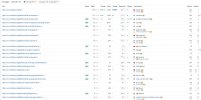
Oh look at that. "Total traffic: 947". So he has 947 traffic from keywords with "seo" in them. And his own brand in Turkey "holistic seo" has 300 searches. In the US it has 200. So over half of those are his site brand.
Well well well.
He can't even rank top 3 for "semantic seo" his core main keyword. Yet he wants you all to believe he's the king of SEO that can rank all your money sites.
And bear in mind his site is a monster. It's DR 48 with 1k RDs.
He has links from
Homepage link from seobythesea.com
ahrefs.com/blog/topical-authority
moz.com
searchenginejournal.com
seoroundtable.com
link-assistant.com
uxmatters.com
nealschaffer.com
sitechecker.pro
subkit.com
oncrawl.com
lumar.io
thetitl.com
sitebulb.com
ipullrank.com
All those are highly relevant, DR70+ industry sites.
Yet.. He still can't rank?
#12 for "seo theory" lol.
He has a page dedicated to that.
He's getting beaten by twitter.com/seo_theory?lang=en
And a dr 14 on page 1.
"seo brighton" rank 18 with a page dedicated to it.
Keyword difficulty on ahrefs? (not that it means much, but..) ONE. Yes, 1.
linkedin and instagram beat him here.
And uh, ti.to
Oh, and twitter and youtube.
He literally ranks for almost nothing. His own site. His oldest site. One that has the kind of SEO industry backlinks most SEO's only dream of.
But.. If you pay $997 for his course, you'll learn how to rank sites with no backlinks. Only using the power of contextual bridging and lexicosemantics.
Well, sort of. Once you sign up, you'll find out you have to pay $5k for his private lessons to get the "real stuff". Oh well.
Now, the thing about SEO is it's hard to call people out on bullshit terms because it's highly subjective.
"lexicosemantics" for example IS a "thing". And it's "sort of" related to SEO. So he can get away with that crap.
Although, if you understand modern search you'll see through that BS.
Lexicosemantics is the study of word meanings.
What the fuck has that got to do with Google?
Their aglorithm doesn't "study word meanings". Even when they were using BERT back in 2020 this would be meaningless. Transformer models don't study word meanings. They have nothing to do with "word meanings".
His nonsense about "lexical relations" is more likely to apply to search engines in the 2000's and early 2010's.
Machine learning has nothing to do with lexical relations or linguistics. It just understands context, meaning, connections, relations, sentinment, intention behind sentences and paragraphs.
Does he understand machine learning?

Well, I got this popup on his site. So he certainly claims to! Advanced SEO and AI!
He is a VERY strong marketer. He's the andrew tate of the SEO world. He knows how to shake things up. "Change Culture in SEO" LOL.
Let's take a look at one of his AI articles. Now we're in a realm of exact science, so you can't get away with BS.
Here's an article on BERT - https://www.holisticseo.digital/python-seo/summarize/
2nd paragraph :-

First he says "BERT sentence embeddings".
This is bullshit. Why?
sentence embeddings have nothing to do with BERT. Sentence embeddings are something you can create with many machine learning models, and we use it for vector search.
The BERT transformer machine learning model creates a word embedding matrix. Not sentence embeddings.
Ok, you can forgive him on that. It's pretty fucking advanced. Not many people are going to catch that one since almost no one understands transformer architecture.
But let's continue
"provide an extractive summarize method via the TextRank model and Lead3".
Say what now?
It doesn't provide any method.
But what? TextRank? VIA TextRank no less. So he's saying BERT works via TextRank?


Word embeddings you say gpt4? I didn't ask, but nice of you to confirm what I mentioned above.
There's your SEO and AI expert, folks.
Do I even need to go on?
BERT also uses Lead3 does it?
Do I even need to bother telling you that Lead-3 has nothing to do with anything? It's just some random term he's picked out his ass and made a big fancy sounding sentence to dupe you.
I love the bit where he says "BERT is used to understand human languages via RNN, attention mechanisms and transformers".
RNN stands for recurrent neural network and it's an ancient neural network architecture.
Attention mechanisms are part of transformers.
Transformers are the modern neural network architecture we use in all LLMs today.
Then he says "BERT is used for understanding an article's internal structure".
No, it's not. BERT doesn't understand structure like that. It's used to understand sentence meaning and sentence relation. It's trained using 2 methods. One is to remove words and have it guess the missing word. The other is with sentence pairs, AB, where it needs to determine of B comes after A. Hence the first is meaning, the second is relation. Nothing to do with internal article structure.
But this guy is beloved by many as being the almight SEO guru of the decade. That in its self should ilmuminate the true knowledge level of the broader SEO community and agency world.
I couldn't help myself here. Being compared to Koray really isn't something I'd like.
Attachments

I might be crazy but this seems like super intelligent white hat SEO to me. I realized you are taking advantage of how things work now, but you are doing it in a very natural way - at least it seems that way to me. Great stuff as usual, @splishsplash thanks!
- Oct 9, 2013
- 3,510
- 14,561
I might be crazy but this seems like super intelligent white hat SEO to me. I realized you are taking advantage of how things work now, but you are doing it in a very natural way - at least it seems that way to me. Great stuff as usual, @splishsplash thanks!
That's exactly what it is. It's not super complicated and doesn't require any stupid terms like "contextual bridging". Just a catchy name like "The SEO Chain Method"
to remember what it is and differentiate it from other things.