

- Oct 30, 2020
- 218
- 72
"Test everything” is bad advice
If you change the offer, the GEO and the creative all at once and thecampaign flops, you don’t know why. Maybe the offer is weak. Maybe the GEO is saturated. Maybethe creative doesn’t land. You spent money and learned nothing transferable to the next test. It’sworse if the campaign accidentally works, because you still don’t know why, so you can’t repeat it.A win you can’t explain is about as useful as a loss you can’t explain.On a small budget this gets brutal fast, because you can’t afford to test every combination withenough data behind each one.
You have to test one variable at a time, in a specific order, with a setbudget per test and a clear threshold for when you’re allowed to make a call. That’s the wholeframework below.
Step 0: before you spend a cent, lock the variables
Before any money moves, decide what’s fixed and what’s the one thing you’re testing. If you can’twrite that down in one sentence, you’re not ready to launch.Bad brief: “I’ll test a few sweeps offers in a couple of GEOs with some different creatives and seewhat works.
”Good brief: “Testing offer A, Germany, one creative, one traffic source, 150 dollars budget, goal isto find out if this offer converts in this GEO at all.” One unknown going in: the offer. Everything elselocked.The rule in one line: test one thing, keep everything else identical. Sounds obvious and it’s the mostbroken rule in the whole niche, because patience is harder than knowledge.
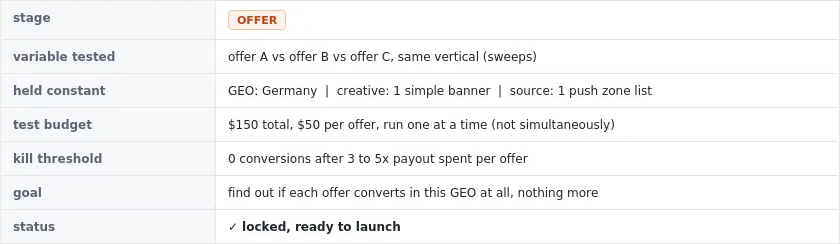
testing order: offer, then GEO, then creative, then final: placement
1. Offer
Always start here. If the offer is weak, no creative or placement saves it. It’s the biggest lever in thewhole funnel.How to test it: pick two or three offers in the same vertical (sweeps, dating, nutra, whatever yourlane is), same GEO, one simple creative, one single source or placement. Run them one at a timewith the same budget, say 100 to 150 dollars per offer, not side by side on the same source at thesame time, because then they compete for the same traffic and skew each other’s numbers.
What you’re looking at: not ROI yet, that number means almost nothing at this budget. Look atwhether the offer catches any conversions at all, and how EPC compares to your cost per click. Anoffer that burns 100 dollars with zero conversions is probably dead for this traffic segment, unlessit’s a genuinely high payout offer where rare conversions are expected.
2. GEO
Once an offer shows at least a minimal pulse, find out which country it actually performs in.How to test it: same offer, same creative, same placement, different GEOs, one at a time.
Start withcountries similar to the one where you already saw signal, similar buying power, similar language,similar ad culture. Randomly jumping between totally different markets (Germany, then thePhilippines, then Brazil) rarely makes sense, since each needs a different creative approach andyou’re supposed to be testing GEO only, not creative.

What you’re looking at: which GEO has the best EPC and the best conversion rate relative to clicks.You can start glancing at early ROI here, carefully, small numbers still lie easily.
3. creative
Only now, with a proven offer and a proven GEO, do you test creatives. Testing creative earliermade no sense because you didn’t yet know if there was anything worth advertising.
How to test it: same offer, same GEO, same placement, two or three creative variants differing inexactly one thing, the angle, the headline, the main image. Rotate them inside your tracker, not asseparate campaigns (this is exactly the topic of the split testing guide, same rules apply here).
What you’re looking at: creative CTR, and whether a higher CTR actually turns into moreconversions rather than just more curious clicks from people who were never going to convertanyway.
4. placement / source
Last, only once offer, GEO and creative are all proven, you hunt for the best placements or widensources. This is the most granular level and it only makes sense once everything above alreadyworks, otherwise you’re optimizing details for something that was never going to make moneyanyway.
How to test it: turn on a broad set of placements or zones within one source, let data build for a fewdays, then cut the weak ones and scale the strong ones. This is exactly where zone level tracking,covered in the tracking setup guide, earns its keep.
When to call a test inconclusive
This is where most beginners wreck the whole process, by drawing conclusions too early. A fewsimple, practical thresholds instead of statistics formulas:Under 300 to 500 clicks per variant. Below that, basically any result could be random. Don’t make akill or scale call on a sample that small, unless you’ve already spent 3 to 5x the offer’s payout withzero conversions (see below).
Zero conversions but also under 3 to 5x payout spent. No conversions at low spend doesn’t tell youmuch, you simply haven’t had enough statistical shots to land even one yet.
Uneven time coverage. A test that only ran Friday night and Saturday tells you nothing about how itbehaves midweek. If you can, stretch the test across a few different days before concludinganything.A result that’s “almost” positive or “almost” negative. ROI sitting around minus 10% to plus 10% ona small sample is not signal. Treat it as “inconclusive, needs more data,” not as “this works”or “this doesn’t work.”
When to actually kill a campaign
The second place people mess this up, this time in the opposite direction, keeping a dead campaignalive too long because they hate to admit the spend already went nowhere. That’s sunk costthinking, not a business argument.Concrete kill signals:
- Spent 3 to 5x the offer’s payout with zero conversions. At a 20 dollar payout that’s 60 to 100dollars with nothing. That’s enough signal to close this particular variable test and move on, notwait forever hoping “maybe it converts now.”
- ROI clearly and consistently negative for several days straight, not just one bad day. One rough dayis noise. Three rough days in a row on stable traffic is a trend.
- A zone or placement that has zero conversions at real volume (500+ clicks) while other zones inthe same campaign convert normally. Classic sign of a dead placement, sometimes bot traffic, notan offer or creative problem.
- Cost per click climbing while traffic quality (lander CTR, time on page) drops, even though nothingin the campaign changed. That usually means the source burned through its good inventory and isfeeding you the scraps now, time to cap the budget or switch sources.
simple spreadsheet for logging tests
Nothing fancy needed, one tab in Google Sheets with these columns: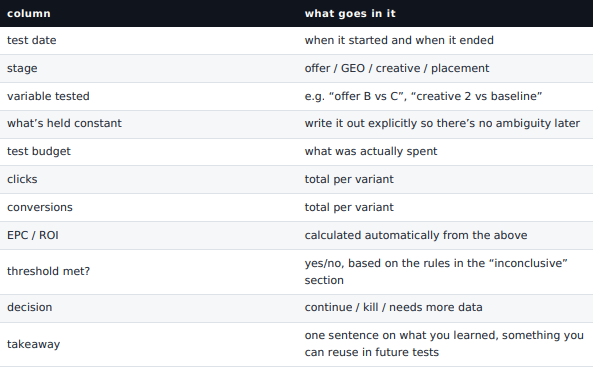
This framework isn’t flashy and it won’t promise you a fast miracle. What it does is stay repeatable,cheap to run, and most importantly on a small budget, it teaches you something with every dollarspent, whether the test wins or loses. Happy to help sketch out an actual test plan if you drop yourvertical and starting budget in the thread
