

- Nov 29, 2022
- 2,554
- 287

In recent months, the affiliate marketing community has been unusually tense. Comments like “Google’s lost its mind,” “Accounts are getting banned in waves,” and “Verification after verification!” have become increasingly common across chats and forums. Since spring 2025, Google Ads seems to be undergoing yet another wave of strict enforcement — especially targeting industries that operate in legal gray areas or slightly bend platform policies.
Even experienced marketers who’ve worked in the field for years admit they haven’t seen such turbulence in a long time. What used to be long-lasting agency accounts are now being disabled after just a few days — even during compliant warm-up campaigns.
This article examines why Google Ads has become more aggressive in its enforcement and outlines how affiliate marketers can adapt to reduce risk and stay competitive.
The New Reality: Endless Verifications and Sudden Bans
One of the biggest challenges in recent months has been the aggressive verification process. Google now demands frequent checks of business operations, legal documents, and account structures. Many advertisers have also received vague suspension reasons such as “Unacceptable Business Practices” or “Circumventing Systems,” even when promoting legitimate offers.A common trigger is “misuse of multiple accounts,” with suspensions affecting even agency setups. This happens despite the use of anti-detect browsers, clean proxies, and unique Gmail accounts. Some marketers suspect the issue lies deeper — possibly in the business entities or verification profiles used to access these accounts. If those entities are flagged, even the most careful setups can get caught in the crossfire.
In some cases, Google has blocked campaigns promoting simple whitehat products, such as flower delivery services. This suggests that current enforcement is not only stricter but also more systematic than before.
Why Google Is Tightening Its Rules
So why is Google suddenly cracking down on advertisers who are, ultimately, spending money on its platform? The answer lies in a mix of strategic and technical developments.First, Google continues to prioritize user safety and content quality. Eliminating questionable content is an expected evolution for any platform at scale. Second, Google seems to be shifting more attention toward major brands and enterprise clients — advertisers with million-dollar monthly budgets. Compared to these players, small and mid-sized marketers in riskier verticals are not a priority. Even $100,000 in monthly ad spend may be considered negligible from Google’s perspective.
Another factor is the growing use of artificial intelligence in Google’s enforcement mechanisms. What used to slip through moderation is now flagged in seconds. Cloaking, for example, has become far riskier. Google’s algorithms are now capable of scanning deep layers of content, including second- and third-level pages. Even if a landing page seems clean, any hidden or affiliate-linked content may put the entire campaign — or the account — at risk.
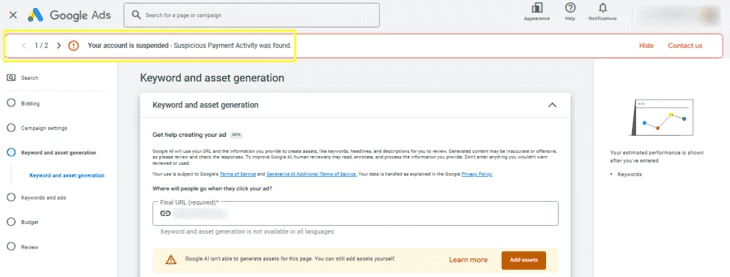
Automated systems and stricter manual reviews are now part of the advertising landscape. Periodic waves of bans are to be expected. In this environment, trustworthiness and platform compliance are more important than ever. Affiliate marketers must now focus on long-term stability instead of short-term hacks.
Lessons for Surviving and Adapting
While the situation is frustrating, it’s not hopeless. Periods of instability often present valuable learning opportunities and force marketers to evolve.Here are a few recommendations to help navigate this period:
- Invest in clean infrastructure. Verified domains, real business addresses, and full policy compliance are no longer optional. Affiliates report that appeals are processed more favorably when all business documents are properly prepared.
- Approach high-risk offers strategically. If you work with sensitive verticals, consider using pre-landers that require no cloaking. Or, if you must use cloaking, develop your own private scripts instead of relying on common solutions. Ultimately, the quality of your pre-lander and the perceived legitimacy of the campaign are still decisive factors.
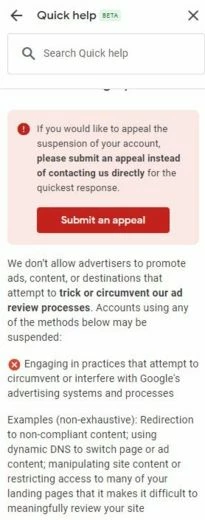
- Don’t give up on appeals. Many accounts are currently being banned without valid cause — even those running fully compliant campaigns. But up to 80% of such suspensions can be reversed through a well-crafted appeal. Sometimes, even random appeals get accepted. That tells you how chaotic the system is right now — and how persistence can pay off.
- Use aged accounts and trusted environments. Older accounts with a clean track record are more resilient. A consistent IP setup and reliable proxies also remain essential. For solo marketers or teams that want to avoid the complexity of managing their own ad infrastructure, it’s worth considering pre-approved, aged agency accounts with a proven track record.
- Stay flexible and test new formats. Affiliates should constantly monitor policy updates and experiment with new formats. In times of turbulence, it might make sense to slow down, test campaigns on safer platforms like YouTube, and reenter aggressive verticals once the environment stabilizes.
Conclusion
Google will continue tightening enforcement and expanding its AI moderation capabilities. In this environment, the most valuable skill for an affiliate marketer is the ability to operate in a compliant — or near-compliant — way, even within high-risk niches. Those who adapt will not only survive but also find new paths for growth.The future of affiliate marketing lies in quality: better creatives, compliant infrastructure, and more resilient systems. In the long run, this shift may lead to more stable campaign performance, even during times of increased scrutiny. Marketers who understand this will emerge stronger, with a more sustainable approach to traffic and performance.