Algorithm Bias Theory | Further Evidence that you can blow up with just a few videos | Grind uploading isn't "working smart", It's a waste of time

YoutubeScientist

Power Member
Jr. VIP
Joined
Feb 20, 2023
Messages
530
Reaction score
337
I've seen tons of such examples, however, this is just one of those channels i came across today, while watching a topic i was interested in.

Consistency may be the key to blow up "eventually" for channels that aren't favored at the beginning, but this example supplies evidence which suggests the reality of how the algorithm can be biased in some cases towards certain channels at early stages, and favor them whether or not the content is HQ, and regardless of the amount of time they’ve spent on the platform trying to prove that they are “consistent” or whatever.
Such channels have the "lottery luck" of blowing up from the very beginning, with just a few videos, without having to spam upload too many videos or grind for months, before they start seeing results.

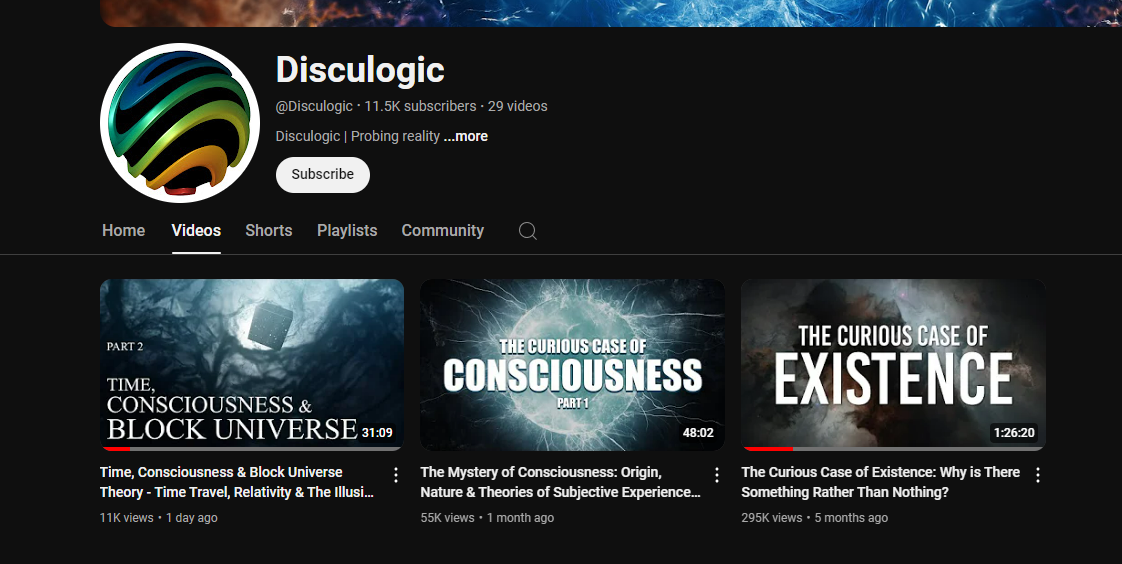
As you can see below, this channel has only uploaded 3 longform videos, and not too many shorts (maybe a bunch). The shorts themselves have very less views, but they mainly blew up from the longform videos, which was a mere 3 videos, and they gained 11k subs from that.
1723632537568.png


I myself have done similar tests with multiple channels and confirmed this "algorithm bias phenomenon" to be a real thing. Not all channels get equally favored, no matter how good your content is. Some channels get favored more, and others don't, and this is simply an undeniable fact based on observation and research. It simply cannot be denied once you have taken the time to research more about YouTube and conduct extensive tests.
Some channels can get buried in the algorithm for long periods before they even get "real results", and some keep growing at a "snail's pace" despite months of grinding, which I find pointless, and such channels barely make the kind of money we could consider "useful".

The people who understand the YouTube game well, know how to better increase their probability of success by working with multiple channels.
But those people who are romantically attracted to one channel and keep grinding on it, usually fail to see the early warning signs on how they are simply "working hard" but not "working smart".
They continue grinding despite evidently observing that their channel is growing at a "snail's pace", and they should consider such evidence as being something "sufficient enough" to ring some alarms for them.

But the issue here is, most people are so attached to their channels that they get blinded to the reality of how things work.
This is just like how a lover is blinded to the reality of their significant other, despite several warning signs that they might be bad, toxic, or cheating. This causes them to continue grinding in the hopes of some kind of eventual “success” (which may never even happen if their channel is stuck in limbo). They also do things such as, complain on forums about how their competitors are doing better than them, and how they have been grinding for years and mad that their results are bad.


WELL GUESS WHAT? WELCOME TO REALITY, AND I'M SORRY TO BREAK THIS TO YOU. YOU NEED TO LEARN HOW THE GAME WORKS FIRST, BEFORE EXECUTING. THE GUYS THAT UNDERSTAND HOW THE GAME WORKS WIN!

WHAT USE IS AN ENGINEER IF HE DOESN'T UNDERSTAND HOW THE MACHINE WORKS THEORETICALLY, AND WITHOUT HAVING A GRASP OR UNDERSTANDING OF THE PHYSICS BEHIND THE MACHINE HE IS TRYING TO BUILD?
WELL AN ENGINEER WHO GRINDS FOR MONTHS AND DOES SOME RANDOM STUFF WITH THE MACHINE HE IS TRYING TO BUILD, WHICH HE CANNOT FULLY COMPREHEND OR UNDERSTAND, WILL ONLY LEAD HIMSELF TO NONSENSE OR “NON WORKING” RESULTS.
HE MAY KEEP ON TRYING BUT CONSTANTLY END UP WITH PARTIALLY CREATED MACHINES THAT DON'T WORK.
THE SAME IS APPLICABLE WITH YOUTUBE. IF YOU DON'T UNDERSTAND HOW THINGS WORK ON YOUTUBE FIRST, AND KEEP ON GRINDING, YOU WILL END UP WASTING A LOT OF YOUR TIME AND GET “NON WORKING” RESULTS..

===============================================

THE EXPERIMENT:


So i'll give you an example of the kind of test i did and how i confirmed the "algorithm bias phenomenon" to be a real thing:

1. I First confirmed and made sure that the batch of content I ordered from my team was strategically planned based on the trends, and was of the type that was HQ and optimized enough for the algorithm to “blow up”.

2. Now i uploaded all the content to “channel A” (batch of 10 HQ videos) > waited for 2 months > barely any blow up (just 1k views in total after 2 months). Conclusion: Failure!

3. Since I didn't get results in step 2, in step 3 i decided to delete all the videos from channel A > And then delete channel A itself.

4. For step 4, I created a new channel "channel B" > uploaded the same batch of videos to “channel B” > came back after 2 months and BOOM!, one of the videos blew up to 2M views. Conclusion: Success!

(note that i have done this experiment multiple times and got similar results).

If it were truly the case that it’s all just about good HQ content, CTR and retention, then it doesn't explain how channel A failed, but channel B succeeded with the exact same content, in the above experiment. This is where the factor of randomness comes in. The algorithm will not be able to equally favor all channels despite the quality of content, because the available global views are limited. So out of 100 channels who make content of a similar quality level, the algorithm will be forced to pick a few channels at random and favor them. This is because the available global views are limited and not unlimited. More details on the “Views threshold theory” below:

Views Threshold Theory Discussion:
https://www.blackhatworld.com/seo/sudden-drop-in-views-threshold-theory-case-study.1416759/

Views Threshold Theory Main Post:
https://www.blackhatworld.com/seo/y...views-throttling-recovery-guide-2021.1379521/

===============================================

CONCLUSION (HOW TO SUCCEED):

The best way to increase the probability of success on YouTube, assuming the truth behind the “Algorithm Bias Theory”, is to work with multiple channels or keep testing the same content on multiple channels until you succeed.
And If you are sure from the get go, that your content is good, and is of the type that goes along with the trends, is optimized enough to blow up, but still doesn't blow up, then it’s time to switch channels.

Test with “channel A” > upload 10 trending HQ videos > wait for 1 to 2 months > if no results or poor results > delete “channel A” and it’s videos > create a new channel “channel B” > upload the same batch of videos again to “channel B” > wait for 1 to 2 months > if again, no results or poor results > delete “channel B” > create a new channel, rinse and repeat the exact same steps on at least 10 to 20 different channels, until you get the one that performs very well.

This is how the game works. Experienced guys on YT who have understood this method, use it to gain an unfair advantage over their competition.

===============================================

FINAL NOTES:

1. This is not to say that consistency does not work. It does work, but bear in mind that for some channels, it could take several months, while other channels might be stuck for multiple years. You must also remember that some channels get favored from the very start.
So do you want to be one of those channels that constantly keeps grinding, trying and hoping for results, and getting no results?
or do you want to be one of those channels that gets early results by understanding the game better?
This is the fundamental question you must ask yourself first before you take any action, or else it will be a lot of wasted months or years without results.

2. The best way to succeed is not always by working hard but by working smart. Working smart involves discovering shortcuts or more efficient and effective strategies to succeed. Such discoveries can usually come about through extensive research and observation.
This is not just true of YouTube, but is also a thing that is well understood within science and applies to other aspects of the universe as well. The universe works based on time flowing in one direction, so resource limitation and competition is subsequent by-product of time. Once you recognize this, you will see that the entities who “cheat” or take “shortcuts” get to their results or goals much quicker, while also utilizing “lesser energy”.

3. There is no such thing as “absolute success” or “guaranteed success”, there is only a thing such as “probabilistic success” or “increasing your probability of success”. Any guru or person who claims they can sell you a method which can guarantee your success is either lying to you or simply does not understand how reality works.
Quantum mechanics describes the fundamental nature of reality, and by definition everything is in a superposition of “probable states” until collapsed. Once collapsed and through a process called “quantum decoherence” it gives rise to all the macro scale events or structures you see in reality. Quantum decoherence is basically the process where the many possible quantum states of a system collapse into a single definite reality when the system interacts with its environment. This interaction causes all the various quantum probabilities to "average out", leading to a single classical outcome. At the macroscopic scale, where we live our everyday lives, these quantum probabilities have already averaged out, so we experience a single definite reality.
In conclusion, for every event that happens in reality, you can only assign a probability to it, but you never make a prediction that is 100% deterministic or absolute, as there is always a chance that even for a thing you are extremely certain of, it will always have a tiny probability of being different just due to the fundamental nature of randomness in quantum mechanics.
Quantum fields/Quantum fluctuations are the fundamental nature of reality, and its description “Quantum Field Theory” states that everything is random. Nobody can escape the randomness in quantum mechanics, not any guru, not mrbeast, not youtube, not the government, not you, not anyone. Every person, every object and every event depends on quantum fields and particles, and us humans are nothing more than a collection of quantum particles.

So when you attempt to succeed on YouTube using the method I have outlined above, you are drastically increasing your “probability” of success in comparison to others who don't fully understand the reality of how YouTube works.

__________________________________________________

Sources to support some of my claims below (EVIDENCE):

The success paradox (survivorship bias explained by Veritasium):

Survivorship bias:
https://en.wikipedia.org/wiki/Survivorship_bias

Quantum mechanics describes the fundamental nature of reality to be random:
https://en.wikipedia.org/wiki/Quantum_indeterminacy

You can only predict or know events this with probabilistic certainty according to quantum mechanics (you can never be 100% certain of anything):
https://en.wikipedia.org/wiki/Quantum_mechanics#:~:text=A fundamental feature of the,happen, but only give probabilities.
highlights:
“A fundamental feature of the theory is that it usually cannot predict with certainty what will happen, but only give probabilities.”

QFT (Quantum Field Theory)
https://en.wikipedia.org/wiki/Quantum_field_theory

===============================================
 
I've seen tons of such examples, however, this is just one of those channels i came across today, while watching a topic i was interested in.

Consistency may be the key to blow up "eventually" for channels that aren't favored at the beginning, but this example supplies evidence which suggests the reality of how the algorithm can be biased in some cases towards certain channels at early stages, and favor them whether or not the content is HQ, and regardless of the amount of time they’ve spent on the platform trying to prove that they are “consistent” or whatever.
Such channels have the "lottery luck" of blowing up from the very beginning, with just a few videos, without having to spam upload too many videos or grind for months, before they start seeing results.

As you can see below, this channel has only uploaded 3 longform videos, and not too many shorts (maybe a bunch). The shorts themselves have very less views, but they mainly blew up from the longform videos, which was a mere 3 videos, and they gained 11k subs from that.

View attachment 367565

I myself have done similar tests with multiple channels and confirmed this "algorithm bias phenomenon" to be a real thing. Not all channels get equally favored, no matter how good your content is. Some channels get favored more, and others don't, and this is simply an undeniable fact based on observation and research. It simply cannot be denied once you have taken the time to research more about YouTube and conduct extensive tests.
Some channels can get buried in the algorithm for long periods before they even get "real results", and some keep growing at a "snail's pace" despite months of grinding, which I find pointless, and such channels barely make the kind of money we could consider "useful".

The people who understand the YouTube game well, know how to better increase their probability of success by working with multiple channels.
But those people who are romantically attracted to one channel and keep grinding on it, usually fail to see the early warning signs on how they are simply "working hard" but not "working smart".
They continue grinding despite evidently observing that their channel is growing at a "snail's pace", and they should consider such evidence as being something "sufficient enough" to ring some alarms for them.

But the issue here is, most people are so attached to their channels that they get blinded to the reality of how things work.
This is just like how a lover is blinded to the reality of their significant other, despite several warning signs that they might be bad, toxic, or cheating. This causes them to continue grinding in the hopes of some kind of eventual “success” (which may never even happen if their channel is stuck in limbo). They also do things such as, complain on forums about how their competitors are doing better than them, and how they have been grinding for years and mad that their results are bad.


WELL GUESS WHAT? WELCOME TO REALITY, AND I'M SORRY TO BREAK THIS TO YOU. YOU NEED TO LEARN HOW THE GAME WORKS FIRST, BEFORE EXECUTING. THE GUYS THAT UNDERSTAND HOW THE GAME WORKS WIN!

WHAT USE IS AN ENGINEER IF HE DOESN'T UNDERSTAND HOW THE MACHINE WORKS THEORETICALLY, AND WITHOUT HAVING A GRASP OR UNDERSTANDING OF THE PHYSICS BEHIND THE MACHINE HE IS TRYING TO BUILD?
WELL AN ENGINEER WHO GRINDS FOR MONTHS AND DOES SOME RANDOM STUFF WITH THE MACHINE HE IS TRYING TO BUILD, WHICH HE CANNOT FULLY COMPREHEND OR UNDERSTAND, WILL ONLY LEAD HIMSELF TO NONSENSE OR “NON WORKING” RESULTS.
HE MAY KEEP ON TRYING BUT CONSTANTLY END UP WITH PARTIALLY CREATED MACHINES THAT DON'T WORK.
THE SAME IS APPLICABLE WITH YOUTUBE. IF YOU DON'T UNDERSTAND HOW THINGS WORK ON YOUTUBE FIRST, AND KEEP ON GRINDING, YOU WILL END UP WASTING A LOT OF YOUR TIME AND GET “NON WORKING” RESULTS..

===============================================

THE EXPERIMENT:


So i'll give you an example of the kind of test i did and how i confirmed the "algorithm bias phenomenon" to be a real thing:

1. I First confirmed and made sure that the batch of content I ordered from my team was strategically planned based on the trends, and was of the type that was HQ and optimized enough for the algorithm to “blow up”.

2. Now i uploaded all the content to “channel A” (batch of 10 HQ videos) > waited for 2 months > barely any blow up (just 1k views in total after 2 months). Conclusion: Failure!

3. Since I didn't get results in step 2, in step 3 i decided to delete all the videos from channel A > And then delete channel A itself.

4. For step 4, I created a new channel "channel B" > uploaded the same batch of videos to “channel B” > came back after 2 months and BOOM!, one of the videos blew up to 2M views. Conclusion: Success!

(note that i have done this experiment multiple times and got similar results).

If it were truly the case that it’s all just about good HQ content, CTR and retention, then it doesn't explain how channel A failed, but channel B succeeded with the exact same content, in the above experiment. This is where the factor of randomness comes in. The algorithm will not be able to equally favor all channels despite the quality of content, because the available global views are limited. So out of 100 channels who make content of a similar quality level, the algorithm will be forced to pick a few channels at random and favor them. This is because the available global views are limited and not unlimited. More details on the “Views threshold theory” below:

Views Threshold Theory Discussion:
https://www.blackhatworld.com/seo/sudden-drop-in-views-threshold-theory-case-study.1416759/

Views Threshold Theory Main Post:
https://www.blackhatworld.com/seo/y...views-throttling-recovery-guide-2021.1379521/

===============================================

CONCLUSION (HOW TO SUCCEED):

The best way to increase the probability of success on YouTube, assuming the truth behind the “Algorithm Bias Theory”, is to work with multiple channels or keep testing the same content on multiple channels until you succeed.
And If you are sure from the get go, that your content is good, and is of the type that goes along with the trends, is optimized enough to blow up, but still doesn't blow up, then it’s time to switch channels.

Test with “channel A” > upload 10 trending HQ videos > wait for 1 to 2 months > if no results or poor results > delete “channel A” and it’s videos > create a new channel “channel B” > upload the same batch of videos again to “channel B” > wait for 1 to 2 months > if again, no results or poor results > delete “channel B” > create a new channel, rinse and repeat the exact same steps on at least 10 to 20 different channels, until you get the one that performs very well.

This is how the game works. Experienced guys on YT who have understood this method, use it to gain an unfair advantage over their competition.

===============================================

FINAL NOTES:

1. This is not to say that consistency does not work. It does work, but bear in mind that for some channels, it could take several months, while other channels might be stuck for multiple years. You must also remember that some channels get favored from the very start.
So do you want to be one of those channels that constantly keeps grinding, trying and hoping for results, and getting no results?
or do you want to be one of those channels that gets early results by understanding the game better?
This is the fundamental question you must ask yourself first before you take any action, or else it will be a lot of wasted months or years without results.

2. The best way to succeed is not always by working hard but by working smart. Working smart involves discovering shortcuts or more efficient and effective strategies to succeed. Such discoveries can usually come about through extensive research and observation.
This is not just true of YouTube, but is also a thing that is well understood within science and applies to other aspects of the universe as well. The universe works based on time flowing in one direction, so resource limitation and competition is subsequent by-product of time. Once you recognize this, you will see that the entities who “cheat” or take “shortcuts” get to their results or goals much quicker, while also utilizing “lesser energy”.

3. There is no such thing as “absolute success” or “guaranteed success”, there is only a thing such as “probabilistic success” or “increasing your probability of success”. Any guru or person who claims they can sell you a method which can guarantee your success is either lying to you or simply does not understand how reality works.
Quantum mechanics describes the fundamental nature of reality, and by definition everything is in a superposition of “probable states” until collapsed. Once collapsed and through a process called “quantum decoherence” it gives rise to all the macro scale events or structures you see in reality. Quantum decoherence is basically the process where the many possible quantum states of a system collapse into a single definite reality when the system interacts with its environment. This interaction causes all the various quantum probabilities to "average out", leading to a single classical outcome. At the macroscopic scale, where we live our everyday lives, these quantum probabilities have already averaged out, so we experience a single definite reality.
In conclusion, for every event that happens in reality, you can only assign a probability to it, but you never make a prediction that is 100% deterministic or absolute, as there is always a chance that even for a thing you are extremely certain of, it will always have a tiny probability of being different just due to the fundamental nature of randomness in quantum mechanics.
Quantum fields/Quantum fluctuations are the fundamental nature of reality, and its description “Quantum Field Theory” states that everything is random. Nobody can escape the randomness in quantum mechanics, not any guru, not mrbeast, not youtube, not the government, not you, not anyone. Every person, every object and every event depends on quantum fields and particles, and us humans are nothing more than a collection of quantum particles.

So when you attempt to succeed on YouTube using the method I have outlined above, you are drastically increasing your “probability” of success in comparison to others who don't fully understand the reality of how YouTube works.

__________________________________________________

Sources to support some of my claims below (EVIDENCE):

The success paradox (survivorship bias explained by Veritasium):

Survivorship bias:
https://en.wikipedia.org/wiki/Survivorship_bias

Quantum mechanics describes the fundamental nature of reality to be random:
https://en.wikipedia.org/wiki/Quantum_indeterminacy

You can only predict or know events this with probabilistic certainty according to quantum mechanics (you can never be 100% certain of anything):
https://en.wikipedia.org/wiki/Quantum_mechanics#:~:text=A fundamental feature of the,happen, but only give probabilities.
highlights:
“A fundamental feature of the theory is that it usually cannot predict with certainty what will happen, but only give probabilities.”

QFT (Quantum Field Theory)
https://en.wikipedia.org/wiki/Quantum_field_theory

===============================================

Interesting, but how do you know it was changing the channel by itself, and not just how during these tests with the same batch of videos, a certain video blew up because it was released at the right moment/right time and just by the randomness of the right amount of people clicking on it made it blew up? which then sent recommended views into other videos (because in most channels, it's just a few videos pulling all the traffic)

Also, how would you keep the channels separate for such test? How do you get a phone number per channel? I assume you use VPS for each channel. How do you know the IP wasn't previously used? what if you used an IP that was previously used in some of the channels skewing the experiment? And what about the AdSense account? a different AdSense account per channel was used on this experiment? How relevant is this? And for most of us, we cannot share that we make money online, so asking other people to act as a proxy to receive the PIN to confirm the accounts is not an option. It was also not qualified if these were aged accounts (how much) or fresh accounts, because we don't know if this is or isn't relevant to this day.

So it's difficult to say. There's the difficulty in logistics, in keeping channels 100% separated to get a clean experiment, and then, it's difficult to say if it's just the channel having some sort of internal metric (based on what, if not the content itself??) or it was just that by luck a video blew up because the right amount of people at the right amount of time clicked making it have a good CPM, and then having a good retention as well by finding the right audience. I believe there is a lot of luck involved there. And to think that after uploading some videos, your channel may get a ranking of sorts, then that makes sense, but it was based on the videos from the beginning, not the channel having a predefined ranking or settings.

It's also difficult to argue if a new channel (as the one you mentioned) is 100% organic traffic or ran Ads on the YT ads system thing, or boosted with some views etc (even tho I think SMM panels are a scam basically)
 
Last edited:
Nice reading. I totally agree with your theory, and I think you explain it short very good in the last part:

Available views are limited. The algorithm can't equally treat every channel.

This is life itself.. Everything works the same. Some people work for years and don't seem to accomplish nothing, some other start working and see results right away. Its not always about the actions, sometimes you just get lucky to be picked.

In Youtube we say "the algorithm", in life some say "God" or "Luck".

Also good conclusion: Just learn to work on a couple channels at least, test your luck with the algo and pick your winner.
 
Nice reading. I totally agree with your theory, and I think you explain it short very good in the last part:

Available views are limited. The algorithm can't equally treat every channel.

This is life itself.. Everything works the same. Some people work for years and don't seem to accomplish nothing, some other start working and see results right away. Its not always about the actions, sometimes you just get lucky to be picked.

In Youtube we say "the algorithm", in life some say "God" or "Luck".

Also good conclusion: Just learn to work on a couple channels at least, test your luck with the algo and pick your winner.
The problem is a successful channel can stop being successful. You may be doing great with a channel, then videos stop performing for some reason. Or YouTube changes their policies and now you can no longer upload the content that was making the channel work, so now you've got a channel with a ton of views and subs, and if you upload something different it becomes a liability as these subs do not want to see anything different but what they are used to see.

So what do you do? you start a brand new channel? And how do you keep this channel separate from your existing channel? (as I described above, this is a problem for many, specially the AdSense part, because im not telling anyone I make money online, and there's no way around this, so you need an alternative, but there's no alternative, unless you create an LLC per AdSense account to get different locations for each and request the PIN which is nonsense)
 
Your post is interesting, but only half correct.

It's not that the algorithm pushes content in a biased way to channels; rather, it responds to the content that resonates with the channel's audience.

For example:
- The initial exposure group of Channel 1 might be more inclined to engage with fitness content.
- The initial exposure group of Channel 2 might be more inclined to engage with entertainment content.

These insights are based on my own experiences.

It's crucial to find content topics that align with the channel before the channel feedback loop that generates millions of views comes into play.
 
The problem is a successful channel can stop being successful. You may be doing great with a channel, then videos stop performing for some reason. Or YouTube changes their policies and now you can no longer upload the content that was making the channel work, so now you've got a channel with a ton of views and subs, and if you upload something different it becomes a liability as these subs do not want to see anything different but what they are used to see.

So what do you do? you start a brand new channel? And how do you keep this channel separate from your existing channel? (as I described above, this is a problem for many, specially the AdSense part, because im not telling anyone I make money online, and there's no way around this, so you need an alternative, but there's no alternative, unless you create an LLC per AdSense account to get different locations for each and request the PIN which is nonsense)
This is a common issue and some channels get stable views forever.
 
Excellent read Youtube Scientist. Thanks for sharing and taking time to put this content for us together. I learned a long time ago never put all your eggs in one basket(channel). I have probably like 11 youtube channels that I upload content to but only 2 of them get any major views. Its really a game of numbers in these youtube streets so I absolutely agree based on 15 years YT experience with Youtube Scientists theory.
 
Excellent read Youtube Scientist. Thanks for sharing and taking time to put this content for us together. I learned a long time ago never put all your eggs in one basket(channel). I have probably like 11 youtube channels that I upload content to but only 2 of them get any major views. Its really a game of numbers in these youtube streets so I absolutely agree based on 15 years YT experience with Youtube Scientists theory.
it is extremely important to diversify, in order to increase your probability of success even further.
 
You're speaking of proposed models / descriptions of how the reality works which isn't the reality itself.

The reality knows no words and symbols.

Understanding the reality doesn't happen through the use of words and symbols which are tools used mostly for survival.

To get the deeper understanding, ask questions to the whole reality, not to mind interacting with itself which is a thought loop ultimately leading to narrow views and analysis of a singular system as the whole reality.

You're the reality and you have the same characteristics as all of the objects within the reality. Your nervous system works in the same way all other systems work and interact with each other.

This is a narrow focus on an issue instead of understanding the reality as a whole and finding parameters applicable in every single area and for every single case. All great solutions are universal and work without a matter of application - this is called wisdom, not understanding and knowledge.

Reduce error in all thoughts and get original connection with the reality is what the reality proposes. People want to create their own realities and connect them with "selves", so they can get "the sense of ownership and power", but these are all falsehoods and traps ultimately leading to misery.
 
That's how YouTube deep learning systems analyze what's being published.
It's as intelligent as a group of 50 humans analyzing a video.
So if you publish junk, you'll get junk judgments and videos will be buried 10 levels deep under the ground -> hell -> extrapolation of feelings to "self" -> strong suffering and new theories of "hell" one is in.

Sample groups of params analyzed:

Content params
Audio params
Scene / vision params
- place
- objects
- game / movie shown in the scene / video
- things performed
- people
- time
- motion
- speed
Structure params
Freshness params
Environment params

https://research.google/pubs/deep-neural-networks-for-youtube-recommendations/

Google is a company that we've all created. It is an effect of a hive-mind that's building a giant system to save itself from natural disasters caused by overdoing extraction of natural resources. Hive-mind is an emergence of all collective intelligence and we've created Google in cooperation with bees and all beings, and solar system.

Common societal problems are that people cut reality into infinite number of pieces with their sharp mind which is akin to cutting everything with a knife. Once they cut it, they enter deep, clustered mind spaces on very deep levels that should not be explored for longer periods of time. They get stuck on very deep, cold levels where there's no big picture. Ultimately they figure out specialization is a definition of hell - narrow-mindedness.
1724162439734.png


This is the trick of reality. Since you're the reality, you're looking for a way out of that to raise your consciousness by watching videos about consciousness. These types of channels are popular because people have realized "specialization" will not work in the future. It will be something a simple robotic arm will be able to do within seconds.

The reality is now telling all beings to not do anything and listen cause if it doesn't listen to itself, it will break all beings and cause extinction of humanity which the reality has been building forever and now it's not willing to sacrifice it for few bucks.
 
Last edited:
I got two things to add to this.

1) I do believe what was said here is very likely to be true, but I've tried deleting and reuploading the same videos on the same channel about a month later and in some cases there was noticeable difference. I.e. one of the videos that I uploaded got 2k views and after deleting and reuploading it a month later it got 33k views. The same video, the same channel, but very different results. I've seen similar results with multiple videos.
2) This might be a little crazy, but that doesn't mean that it can't be true. Channels' preferential treatment might not be completely random. There's this thing called Diversity, Equity & Inclusion (DEI) and this is widely employed by most if not all S&P 500 companies and YouTube and it's parent company Alphabet Inc. is not an exeption. In DEI for the sake of "inclusion" you can get prefential treatment if you tick certain boxes (gender,race,sexuality,etc.). YouTube lately started pushing a questionaire that you can find in your YouTube studio where they ask these specific questions. According to YouTube it's for the sake of "fairness" to ensure that everyone is equally represented and treated fairly. This is pure speculation... but maybe if you tick "the right boxes" your might get preferencial treatment "for the sake of inclusivity". This hypothesis could be completely wrong... or it could be right.
 
very complete thread , here is all what I was looking for , thanks for share
 
Do you manage them from a single account ?
No, I use different gmail accounts with different verified phone numbers. I have verified accounts that date back to 2009. The majority unfortunately dont get too many views. One video on 1 of the lesser accounts went viral and resulted in substantial income for me. All you really need IMO is that 1 video from 1 of those accounts to go viral so its basically a game of numbers for me. It also appears to me that YT throttles views for accounts since 2 of my accounts never get past 3000 views per month each. But if you have like 10-12 accounts the views can accumulate. BTW all my accounts cover the same niche.
 
Last edited:
You're speaking of proposed models / descriptions of how the reality works which isn't the reality itself.

The reality knows no words and symbols.

Understanding the reality doesn't happen through the use of words and symbols which are tools used mostly for survival.

To get the deeper understanding, ask questions to the whole reality, not to mind interacting with itself which is a thought loop ultimately leading to narrow views and analysis of a singular system as the whole reality.

You're the reality and you have the same characteristics as all of the objects within the reality. Your nervous system works in the same way all other systems work and interact with each other.

This is a narrow focus on an issue instead of understanding the reality as a whole and finding parameters applicable in every single area and for every single case. All great solutions are universal and work without a matter of application - this is called wisdom, not understanding and knowledge.

Reduce error in all thoughts and get original connection with the reality is what the reality proposes. People want to create their own realities and connect them with "selves", so they can get "the sense of ownership and power", but these are all falsehoods and traps ultimately leading to misery.
===============================================

"You're speaking of proposed models / descriptions of how the reality works which isn't the reality itself."


Doesn't matter. Proposed models or descriptions of reality we create using the scientific method is currently the best and the closest approximation to the truth we have, about reality.
So we don’t currently have a better methodology than the scientific method to get closer to the truth, unless you can show me a better alternative.
The scientific method of inquiry and rigor leads us to highly accurate conclusions about reality.
People who try to make assumptions or guesses about reality without utilizing this method often arrive at inaccurate or false conclusions.

So despite the potential for errors, we are still justified in holding our beliefs because we use an effective and rigorous system that tries to eliminate possibilities of human manipulation, biases, lies, errors etc.

This is already well supported by all of the experts in academia, including philosophers and scientists. We understand that science expresses truths only in terms of “probabilities”, and we have “reasonable certainty” in our beliefs because our models are consistent, reliable, and capable of making predictions.

But what you’re implying here is, we somehow need access to the “absolute truth” to be justified in calling something “true” or to have “knowledge”, which is not required in philosophy or science to have “justified beliefs”. This is already well covered in philosophy and all of the experts agree to this. This is called “fallibilism”. We acknowledge that no humans or experts are perfect (fallible), yet we can have justified true beliefs about reality by using strong methods such as the scientific method which tries to reduce biases and errors.

Truths can be subdivided into “Absolute Truths” and “Probabilistic Truths”. Absolute truths like you are demanding here, is not something we may ever get access to, nor be able to know if we have access to it, because it would require “absolute knowledge” or we’ll have to be “all knowing”.
Since we don't have “absolute knowledge”, we can only talk about the world “probabilistically”, as we’re left with no other option.
Science and all the other fields of academia when talking about the world, only expresses truths “probabilistically”.

So whatever you claimed above is not even relevant or a requirement, in order for us to make progress.
So your criticism does not hold any water unless you can bring forward a better, more accurate methodology for getting closer to the truth.

===============================================

“Understanding the reality doesn't happen through the use of words and symbols”


It literally does, what are you talking about?
The literal way we understand reality or spread our understanding of reality to others, is by using language, words, symbols, etc.

===============================================

“To get the deeper understanding, ask questions to the whole reality, not to mind interacting with itself which is a thought loop ultimately leading to narrow views”


We have no other way to do this except through our senses, and by utilizing science and the tools available in science. So when you tell us to ask questions to the whole reality, what do you mean?, and how are we supposed to do this? Do you have a solution? I don't think you do.
People are often led to “narrow minded” conclusions like yourself, when they are ignorant of the available information and pretend like they have a better methodology to understand reality.

===============================================

“All great solutions are universal and work without a matter of application - this is called wisdom, not understanding and knowledge.”


That's not a good argument, as wisdom can lead to false conclusions or beliefs. This is already known in philosophy.

Can wisdom lead to false beliefs?
https://plato.stanford.edu/entries/wisdom/#WisEpiAcc
highlights:
“Wise people can make mistakes about what they know. Socrates, Maimonides, King Solomon, Einstein, Goethe, Gandhi, and every other candidate for the honor of wisdom have held false beliefs about what they did and did not know.”
“It is easy to imagine a wise person being justified in believing she possesses knowledge about some claim, and also easy to imagine that she could be shown to be mistaken”
“If (EA1) is true, then just because a person believes she has knowledge when she does not, she is not wise. That seems wrong. It is hard to imagine that anyone at all is, or ever has been, wise if (EA1) is correct.”
“We might only require that a wise person’s belief is highly justified when she believes she has knowledge”

===============================================

“but these are all falsehoods and traps ultimately leading to misery.”

Yea sure i don't care about what people want to subjectively believe in though. All I can tell you is that using science is not a falsehood, and neither is it a “trap” leading to misery. In fact science liberates us from the shackles of fear and ignorance.

===============================================

Evidence for all of my above claims for the following.

1. Probabilistic truths.
2. Why You don't need absolute certainty for knowledge.
3. Absolute truths.
4. Fallibilism
5. Justification of beliefs
6. Approximation to the truth

An Overview of Confirmation Bias in Science: Examples and Opportunities for Improvement:
https://cfpub.epa.gov/si/si_public_record_Report.cfm?Lab=CESER&dirEntryId=350904
highlights:
"Human thought processes are not perfect. We face cognitive errors daily. Confirmation bias is a common error committed by people, and contrary to the thoughts of many, scientists are not immune to committing this same error. It’s a tendency to believe that you are right, disregarding things that conflict with your ideas."
"However, scientists are human and equally capable of succumbing to faulty thinking processes as everyone else. So, the onus is on the scientist and the scientific community to put forth the best and most unbiased data possible."

Fallibilism (source 1):
https://iep.utm.edu/fallibil/#:~:te...pistemological thesis,the truth of the belief.
highlights:
"Fallibilism is the epistemological thesis that no belief (theory, view, thesis, and so on) can ever be rationally supported or justified in a conclusive way.
“Always, there remains a possible doubt as to the truth of the belief. Fallibilism applies that assessment even to science’s best-entrenched claims and to people’s best-loved commonsense views.”
“Some epistemologists have taken fallibilism to imply skepticism, according to which none of those claims or views are ever well justified or knowledge. In fact, though, it is fallibilist epistemologists (which is to say, the majority of epistemologists) who tend not to be skeptics about the existence of knowledge or justified belief. “
“Generally, those epistemologists see themselves as thinking about knowledge and justification in a comparatively realistic way — by recognizing the fallibilist realities of human cognitive capacities, even while accommodating those fallibilities within a theory that allows perpetually fallible people to have knowledge and justified beliefs.”
Epistemologists generally seek to understand knowledge and justification in a way that permits fallibilism to be describing a benign truth about how we can gain knowledge and justified beliefs. One way of encapsulating that project is by asking whether it is possible for a person ever to have fallible knowledge and justification."

Fallibilism (source 2):
https://en.wikipedia.org/wiki/Fallibilism
highlights:
"Originally, fallibilism (from Medieval Latin: fallibilis, "liable to error") is the philosophical principle that propositions can be accepted even though they cannot be conclusively proven or justified, or that neither knowledge nor belief is certain.

Infallibilism:
https://en.wikipedia.org/wiki/Infallibilism
highlights:
"Infallibilism is the epistemological view that propositional knowledge is incompatible with the possibility of being wrong."
"Infallibilism is rejected by most contemporary epistemologists, who generally accept that one can have knowledge based on fallible justification.[2][3] Baron Reed has provided an account of the reasons why infallibilism is so widely regarded as untenable today."

absolute truth definition:
https://simple.wikipedia.org/wiki/Absolute_truth
highlights:
"Absolute truth is a statement that is true at all times and in all places. It is something that is always true no matter what the circumstances.[1] It is a fact that cannot be changed."

scientific laws does not express absolute certainty:
https://en.wikipedia.org/wiki/Scientific_law
highlights:
"As with other kinds of scientific knowledge, scientific laws do not express absolute certainty, as mathematical theorems or identities do. A scientific law may be contradicted, restricted, or extended by future observations."

Reasonable certainty in science and philosophy (we only require high degree of certainty or reasonable
certainty and not absolute certainty):
https://en.unav.edu/web/ciencia-raz...inty-in-science-and-philosophy#reasonableness
highlights:
● "It is argued that, as forms of knowledge, neither science is so safe, nor philosophy is as arbitrary as is often claimed.”
● "It is concluded that, in the adventure of life, the elusive myth of sure knowledge must be replaced by the tangible prose of reasonable certainty.
● "The conclusion is that, in the absence of absolute certainties, we have to settle for reasonable certainties; we have no other choice.
● "There are people who like to perceive themselves as hard skeptics who only accept self-evident truths, preferably if these are reached by applying mathematics or the scientific method. Here we have argued that, whether conscious of it or not, such people also must give up on absolute certainties and in practice accept philosophical assertions that can only be described as reasonable."
● "The epistemological panorama we have just described may produce a feeling of unease in those people who would only be reassured by absolute certainty. The fact that such absolute certainty does not exist in philosophy does not seem very surprising. But here we have argued that even positive experimental science cannot provide absolute certainties. More surprisingly, not even mathematics, the apparent last redoubt of cognitive certainty, can provide us with the comfort of total certainty."

Epistemology(knowledge, justification and limits of knowledge, What Justifies Belief?):
https://plato.stanford.edu/entries/epistemology/#WhatJustBeli
highlights:
“3.2 What Justifies Belief?:
Evidentialism is often contrasted with reliabilism, which is the view that a belief is justified by resulting from a reliable source, where a source is reliable just in case it tends to result in mostly true beliefs.”

Approaching deterministic and probabilistic truth: a unified account:
https://link.springer.com/article/10.1007/s11229-021-03298-y
highlights:
“A general theory of truth approximation, however, should arguably cover also cases where either the relevant theories, or “the truth”, or both, are “probabilistic” in nature.”

Realism, instrumentalism, and scientific symbiosis: psychological theory as a search for truth and the discovery of solutions:
https://pubmed.ncbi.nlm.nih.gov/15149262/
“Scientific realism holds that scientific theories are approximations of universal truths about reality, whereas scientific instrumentalism posits that scientific theories are intellectual structures that provide adequate predictions of what is observed and useful frameworks for answering questions and solving problems in a given domain.”

Scientific Objectivity:
https://plato.stanford.edu/entries/scientific-objectivity/
highlights:
"Scientific objectivity is a property of various aspects of science. It expresses the idea that scientific claims, methods, results—and scientists themselves—are not, or should not be, influenced by particular perspectives, value judgments, community bias or personal interests, to name a few relevant factors. Objectivity is often considered to be an ideal for scientific inquiry, a good reason for valuing scientific knowledge, and the basis of the authority of science in society."

How Science progresses towards truth:
https://plato.stanford.edu/archivES/FALL2017/Entries/scientific-objectivity/
highlights:
“science progresses toward truth by adding true and eliminating false beliefs from our best scientific theories.”
“By making these theories more and more verisimilar, that is, truthlike, scientific knowledge grows over time.”
“If this picture is correct, then over time scientific knowledge will become more objective, that is, more faithful to facts”.

===============================================
 
Very interesting, lot of guys dont realise it's gold information @YoutubeScientist
By how many days/weeks you can tell the channel is over and so you can delete it and restart ? I uploaded 3 HQ videos since 2 days and no views for example.
 
Doesn't matter. Proposed models or descriptions of reality we create using the scientific method is currently the best and the closest approximation to the truth we have, about reality.
The reality isn't static. Science is describing the reality of people / humans, not the reality itself. It only tells you that the only constant thing is change and to figure that out, you don't need science, but observation which science is using, but "science people" might think they invented observation. No, science is derived from observation and experiment. Science is too narrow. It's limited framework.

What science does is usually very narrow and most science doesn't deal with big image. It's quite lost in its own paradigms. Most science has nothing to do with science. And so on. It's very young and normal people will get more from doing alchemy.

Science is using "human language" as it's tools, overuses symbols and is basically not leading to anywhere other than maybe feeding more capitalism because business takes all that "science", pumps that into industries and then people think it's some progress.

Then science about those industries is created and then mixed with previous science. And so on, and so on. What is this? It's a cycle of something. But what? Suffering. That's what this is.

Science is solving its own problems and does nothing in the end other than playing with itself as most scientists claim "we're not here to prove anything or answer questions like why and how".
absolute truth definition:
https://simple.wikipedia.org/wiki/Absolute_truth
highlights:
"Absolute truth is a statement that is true at all times and in all places. It is something that is always true no matter what the circumstances.[1] It is a fact that cannot be changed."
This is trying to present itself as the absolute truth about the absolute truth.

It's not working. You can't get to the absolute truth from human perspective. The only way to do that is practice some non-western techniques.

The absolute truth isn't something created by words and it's not a statement.
Truth in relation to words is something like "the reality is infinite". But that's a statement and not absolute truth. It's relative truth to words.
Truth is beyond daily comprehension.

Today people mix philosophy with science with business of ads and making bills. That's nonsense.
Scientific Objectivity:
https://plato.stanford.edu/entries/scientific-objectivity/
highlights:
"Scientific objectivity is a property of various aspects of science. It expresses the idea that scientific claims, methods, results—and scientists themselves—are not, or should not be, influenced by particular perspectives, value judgments, community bias or personal interests, to name a few relevant factors. Objectivity is often considered to be an ideal for scientific inquiry, a good reason for valuing scientific knowledge, and the basis of the authority of science in society."
This is a fantasy of science that doesn't exist because all science is interpret by human minds which are inherently full of errors due to how humans process all that information and data.

As a human you're not practicing science. The only science can be practiced by the reality itself. The reality is the ultimate experiment.

Objectivity doesn't exist in human's experience as humans cannot possess infinite perspectives as the reality itself can. So humans are just writing stories about all that stuff. It's just their entertainment.

Ask a professor why he's a professor. He'll answer "because I like it". Not because it has some ultimate truth inside.

https://en.wikipedia.org/wiki/Paradigm_shift

Paradigm changes, all changes. Yet nothing changes. It's just the reality flowing and changing.
Can wisdom lead to false beliefs?
https://plato.stanford.edu/entries/wisdom/#WisEpiAcc
highlights:
“Wise people can make mistakes about what they know. Socrates, Maimonides, King Solomon, Einstein, Goethe, Gandhi, and every other candidate for the honor of wisdom have held false beliefs about what they did and did not know.”
“It is easy to imagine a wise person being justified in believing she possesses knowledge about some claim, and also easy to imagine that she could be shown to be mistaken”
“If (EA1) is true, then just because a person believes she has knowledge when she does not, she is not wise. That seems wrong. It is hard to imagine that anyone at all is, or ever has been, wise if (EA1) is correct.”
“We might only require that a wise person’s belief is highly justified when she believes she has knowledge”
Yeah, and live in clustered, narrow perspectives because "wisdom is not trendy anymore". But wise people don't have to have much and create 10000 threads to explain a simple change / shift in the reality.

Cause for a wise person all this stuff is obvious due to their high understanding of changes, flows and processes.

Today "intelligence" is trendy. But intelligence is so... makes people so unhappy because it leads to insane number of unnecessary thoughts.
Then if they apply the lessons, they might become wise.

Wisdom is appliance of knowledge, but other people might have different interpretations of wisdom.
Because we're operating at the level of words, all that stuff doesn't make much sense. As the whole text model on the internet.

I don't continue because it's 2 dimensional space where nobody can make any reasonable conclusions, ultimately leading to flame and misery.
 
Last edited:
Interesting, but how do you know it was changing the channel by itself, and not just how during these tests with the same batch of videos, a certain video blew up because it was released at the right moment/right time and just by the randomness of the right amount of people clicking on it made it blew up? which then sent recommended views into other videos (because in most channels, it's just a few videos pulling all the traffic)

Also, how would you keep the channels separate for such test? How do you get a phone number per channel? I assume you use VPS for each channel. How do you know the IP wasn't previously used? what if you used an IP that was previously used in some of the channels skewing the experiment? And what about the AdSense account? a different AdSense account per channel was used on this experiment? How relevant is this? And for most of us, we cannot share that we make money online, so asking other people to act as a proxy to receive the PIN to confirm the accounts is not an option. It was also not qualified if these were aged accounts (how much) or fresh accounts, because we don't know if this is or isn't relevant to this day.

So it's difficult to say. There's the difficulty in logistics, in keeping channels 100% separated to get a clean experiment, and then, it's difficult to say if it's just the channel having some sort of internal metric (based on what, if not the content itself??) or it was just that by luck a video blew up because the right amount of people at the right amount of time clicked making it have a good CPM, and then having a good retention as well by finding the right audience. I believe there is a lot of luck involved there. And to think that after uploading some videos, your channel may get a ranking of sorts, then that makes sense, but it was based on the videos from the beginning, not the channel having a predefined ranking or settings.

It's also difficult to argue if a new channel (as the one you mentioned) is 100% organic traffic or ran Ads on the YT ads system thing, or boosted with some views etc (even tho I think SMM panels are a scam basically)
Could have been because they were doing promotion of those videos on other platforms or driving traffic from somewhere else.
 
Back
Top