[METHOD] Free multiple DF .EDU Backlinks for my guys, you're welcome.

batu

Junior Member
Joined
Jul 20, 2022
Messages
130
Reaction score
238
Hello BHW,

Last week, I shared my Free DR86 DF Backlink Method, and some of you successfully got your backlinks indexed.

Thread: https://www.blackhatworld.com/seo/m...f-backlink-for-my-guys-youre-welcome.1490622/

Now, I'm leveling up my game one step ahead and showing you how to make the internet even more spammy.

Introducing: Your new DF .edu links.

So I was reverse-engineering some .edu websites and found this technique just now by myself. It felt like a great life hack and I'm sipping my victory whiskey as I write this thread. Cheers :D

Couldn't find another thread on BHW so I'm sharing it with you, believing that it's goodenough to share.

The topic explains itself, so let's skip the intro and begin with our steps.

Step 1: Find your Target .Edu Websites

Well, we will use our beloved Google for this step. We need to find Edu websites that use Moodle and have a forum or blog section.

Since most plain .edu sites are unavailable for this technique (they are spammed frequently so they fix those stuff), we will be using local TLDs for our search. You can find some .edu sites if you search well, but I want it to be easy for all of you so this guide will use country-specific .edu TLDs.

Your search query:
site:*.edu.{country code} inurl:mod/forum

You will find some moodle sites with forum sections.

Step 2: Refine Your Search

We want a site that has a forum section and allows us to create topics.
If you don't understand the language, just use google translate.

Click the links you've found. And check/do the following:
  • Do they have a Create Topic button on the screen?
    • If they don't, the game is still not over. Navigate through the website and find an interactive section that allows users to engage in a public setting.
  • Does it have a signup button somewhere?
    • 99.99% of Moodle websites require you to log in before posting anything. Just find where you can sign up, and create an account with a fake e-mail.
    • You may use Protonmail for creating your burner mail.
    • Moodle requires verification so use a valid e-mail.
  • Can you see some public forum threads / blog posts within the site?
    • Some Moodle sites are private. Don't waste your time with the private ones.
  • Did you check the courses one by one?
    • Check them. They have blogs and forums inside.
  • Does it ask for your Student ID when signing up?
    • Just type random numbers.
  • Is it a hopeless case?
    • If so, rinse and repeat. Find another site, there are plenty of fish in the sea.
If the forum / blog requires you to enroll in a course, enroll. You got the main idea, you'll find your way through the website. Just navigate thoroughly and find a place where you can create your thread.

Step 3: Create Your Forum Thread / Blog Post

That's the easiest part. Just go ahead and create your post. Try to make it seem not spammy and don't create hundreds of posts in a single site as it may alert the Moodle admin. Go easy.

Create an article with chatgpt or spin some content.

Inject your backlinks into the text. Moodle has a strangely advanced settings panel for URLs so you can set every attribute of your <a> tag, including the rel="" attribute. But by default, all post URLs are DF.

Step 4: Send The Links to Your Favourite Indexer

That step may not be necessary as I have seen that such websites have 1000+ indexed pages already so your page will also be indexed as well in time. The pages have no "noindex" tag or robots exclusion so we may easily say that you have successfully generated a fair and square backlink.

But just to be sure, you may use an indexer. And please share your indexer preferences with me, too.

Step 5: Roast the OP for not providing pics

Guys, I am a lazy guy. But let me give you a sithy motivation speech to compensate for it:

I believe in you, and I believe you will have multiple .edu backlinks in the following hour if you start now. Just breathe, let your anger go and begin grinding. 777 all the way through the universe and ask for some edu backlinks.

That's all, folks.
 
Last edited:
Hello BHW,

Last week, I shared my Free DR86 DF Backlink Method, and some of you successfully got your backlinks indexed.

Thread: https://www.blackhatworld.com/seo/m...f-backlink-for-my-guys-youre-welcome.1490622/

Now, I'm leveling up my game one step ahead and showing you how to make the internet even more spammy.

Introducing: Your new DF .edu links.

So I was reverse-engineering some .edu websites and found this technique just now by myself. It felt like a great life hack and I'm sipping my victory whiskey as I write this thread. Cheers :D

Couldn't find another thread on BHW so I'm sharing it with you, believing that it's goodenough to share.

The topic explains itself, so let's skip the intro and begin with our steps.

Step 1: Find your Target .Edu Websites

Well, we will use our beloved Google for this step. We need to find Edu websites that use Moodle and have a forum or blog section.

Since most plain .edu sites are unavailable for this technique (they are spammed frequently so they fix those stuff), we will be using local TLDs for our search. You can find some .edu sites if you search well, but I want it to be easy for all of you so this guide will use country-specific .edu TLDs.

Your search query:


You will find some moodle sites with forum sections.

Step 2: Refine Your Search

We want a site that has a forum section and allows us to create topics.
If you don't understand the language, just use google translate.

Click the links you've found. And check/do the following:
  • Do they have a Create Topic button on the screen?
    • If they don't, the game is still not over. Navigate through the website and find an interactive section that allows users to engage in a public setting.
  • Does it have a signup button somewhere?
    • 99.99% of Moodle websites require you to log in before posting anything. Just find where you can sign up, and create an account with a fake e-mail.
    • You may use Protonmail for creating your burner mail.
    • Moodle requires verification so use a valid e-mail.
  • Can you see some public forum threads / blog posts within the site?
    • Some Moodle sites are private. Don't waste your time with the private ones.
  • Did you check the courses one by one?
    • Check them. They have blogs and forums inside.
  • Does it ask for your Student ID when signing up?
    • Just type random numbers.
  • Is it a hopeless case?
    • If so, rinse and repeat. Find another site, there are plenty of fish in the sea.
If the forum / blog requires you to enroll in a course, enroll. You got the main idea, you'll find your way through the website. Just navigate thoroughly and find a place where you can create your thread.

Step 3: Create Your Forum Thread / Blog Post

That's the easiest part. Just go ahead and create your post. Try to make it seem not spammy and don't create hundreds of posts in a single site as it may alert the Moodle admin. Go easy.

Create an article with chatgpt or spin some content.

Inject your backlinks into the text. Moodle has a strangely advanced settings panel for URLs so you can set every attribute of your <a> tag, including the rel="" attribute. But by default, all post URLs are DF.

Step 4: Send The Links to Your Favourite Indexer

That step may not be necessary as I have seen that such websites have 1000+ indexed pages already so your page will also be indexed as well in time. The pages have no "noindex" tag or robots exclusion so we may easily say that you have successfully generated a fair and square backlink.

But just to be sure, you may use an indexer. And please share your indexer preferences with me, too.

Step 5: Roast the OP for not providing pics

Guys, I am a lazy guy. But let me give you a sithy motivation speech to compensate for it:


That's all, folks.
that's a great method, I think that everyone will forgive and won't feel the need to make the Step 5 :D
 
Thank you very much for your generous sharing, this is the best free guide on News site links I have seen so far.

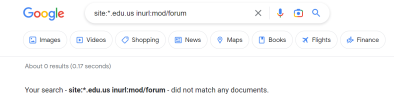
But when I search for queries with country codes such as US/CA/UK, 0 results are displayed, and only CN has tens of thousands of results. I'm confused if something is wrong with my search query.
(Note:Whether it is ①site:*.edu.us inurl:forum ②site:*.edu.us inurl:mod or ③site:*.edu.us inurl:mod/forum, all three forms show 0 results)

1682320300653.png

1682320320626.png

1682320341481.png
 
Thank you very much for your generous sharing, this is the best free guide on News site links I have seen so far.

But when I search for queries with country codes such as US/CA/UK, 0 results are displayed, and only CN has tens of thousands of results. I'm confused if something is wrong with my search query.
(Note:Whether it is ①site:*.edu.us inurl:forum ②site:*.edu.us inurl:mod or ③site:*.edu.us inurl:mod/forum, all three forms show 0 results)

View attachment 252003

View attachment 252004

View attachment 252005
Thank you very much.
 
Thank you very much for your generous sharing, this is the best free guide on News site links I have seen so far.

But when I search for queries with country codes such as US/CA/UK, 0 results are displayed, and only CN has tens of thousands of results. I'm confused if something is wrong with my search query.
(Note:Whether it is ①site:*.edu.us inurl:forum ②site:*.edu.us inurl:mod or ③site:*.edu.us inurl:mod/forum, all three forms show 0 results)

View attachment 252003

View attachment 252004

View attachment 252005
Your query template is right, but US uses just .edu instead of edu.us

That also goes for other countries as well. As an example, you can't find edu.de websites online because they use just .de TLD. So you must use the right TLD for your target country, and it may be confusing sometimes.
 
Your query template is right, but US uses just .edu instead of edu.us

That also goes for other countries as well. As an example, you can't find edu.de websites online because they use just .de TLD. So you must use the right TLD for your target country, and it may be confusing sometimes.
Sorry,sir.This is my first exposure to educational websites and links, so I don't have enough knowledge. After reading your reply, I searched for relevant information and summarized the search formulas for mainstream countries:

1)CA/DE/FR/US/ES/IE/IT/CH/FI:site:*.edu inurl:mod/forum

2)AU/CN/PT/PL/NO/NL/KR/JP/IN/BR/AR:site:*.edu.{country code} inurl:mod/forum

3)NZ/UK/DK/AT/BE:site:*.ac.{country code} inurl:mod/forum

Thanks again for your patience.
 
Last edited:
Sorry,sir.This is my first exposure to educational websites and links, so I don't have enough knowledge. After reading your reply, I searched for relevant information and summarized the search formulas for mainstream countries:

1)CA/DE/FR/US:site:*.edu inurl:mod/forum

2)AU/CN:site:*.edu.{country code} inurl:mod/forum

3)NZ/UK:site:*.ac.{country code} inurl:mod/forum

Thanks again for your patience.
Great info, you rock!
 
That's great .
Thanks for sharing bro .
 
This post is great. I hope I have the opportunity to read more beautiful posts like this one.
 
Hello BHW,

Last week, I shared my Free DR86 DF Backlink Method, and some of you successfully got your backlinks indexed.

Thread: https://www.blackhatworld.com/seo/method-free-easy-dr86-df-backlink-for-my-guys-youre-welcome.1490622/

Now, I'm leveling up my game one step ahead and showing you how to make the internet even more spammy.

Introducing: Your new DF .edu links.

So I was reverse-engineering some .edu websites and found this technique just now by myself. It felt like a great life hack and I'm sipping my victory whiskey as I write this thread. Cheers :D

Couldn't find another thread on BHW so I'm sharing it with you, believing that it's goodenough to share.

The topic explains itself, so let's skip the intro and begin with our steps.

Step 1: Find your Target .Edu Websites

Well, we will use our beloved Google for this step. We need to find Edu websites that use Moodle and have a forum or blog section.

Since most plain .edu sites are unavailable for this technique (they are spammed frequently so they fix those stuff), we will be using local TLDs for our search. You can find some .edu sites if you search well, but I want it to be easy for all of you so this guide will use country-specific .edu TLDs.

Your search query:


You will find some moodle sites with forum sections.

Step 2: Refine Your Search

We want a site that has a forum section and allows us to create topics.
If you don't understand the language, just use google translate.

Click the links you've found. And check/do the following:
  • Do they have a Create Topic button on the screen?
    • If they don't, the game is still not over. Navigate through the website and find an interactive section that allows users to engage in a public setting.
  • Does it have a signup button somewhere?
    • 99.99% of Moodle websites require you to log in before posting anything. Just find where you can sign up, and create an account with a fake e-mail.
    • You may use Protonmail for creating your burner mail.
    • Moodle requires verification so use a valid e-mail.
  • Can you see some public forum threads / blog posts within the site?
    • Some Moodle sites are private. Don't waste your time with the private ones.
  • Did you check the courses one by one?
    • Check them. They have blogs and forums inside.
  • Does it ask for your Student ID when signing up?
    • Just type random numbers.
  • Is it a hopeless case?
    • If so, rinse and repeat. Find another site, there are plenty of fish in the sea.
If the forum / blog requires you to enroll in a course, enroll. You got the main idea, you'll find your way through the website. Just navigate thoroughly and find a place where you can create your thread.

Step 3: Create Your Forum Thread / Blog Post

That's the easiest part. Just go ahead and create your post. Try to make it seem not spammy and don't create hundreds of posts in a single site as it may alert the Moodle admin. Go easy.

Create an article with chatgpt or spin some content.

Inject your backlinks into the text. Moodle has a strangely advanced settings panel for URLs so you can set every attribute of your <a> tag, including the rel="" attribute. But by default, all post URLs are DF.

Step 4: Send The Links to Your Favourite Indexer

That step may not be necessary as I have seen that such websites have 1000+ indexed pages already so your page will also be indexed as well in time. The pages have no "noindex" tag or robots exclusion so we may easily say that you have successfully generated a fair and square backlink.

But just to be sure, you may use an indexer. And please share your indexer preferences with me, too.

Step 5: Roast the OP for not providing pics

Guys, I am a lazy guy. But let me give you a sithy motivation speech to compensate for it:


That's all, folks.
helpful Info.. great
 
I've found many .cn sites with moodle.
the thing is those are chinese, and backlinks from them are not worth!
 
Amazing share @batu , book marking it.
One suggestion try to create this kinda thread in the "link building" section, it makes it easy to find when needed.
 
Amazing share buddy! I was looking for something like this..
 
Back
Top