You are assuming whales are a collective, they aren't, at least not any gigantic collective that's currently known about.
Not that they are a collective at all, but that they control the price by a large majority over it being some kind of natural occurrence relating to TA.
I guess the difference is you're saying something along the lines of TA's influencing institutionals, I'm saying it's the other way around.
let's take a huge institutional investor. $2billion worth of crypto. Not just bitcoin. But lets say for arguments sake the entire $2billion was in bitcoin.
Bitcoin reaches a market cap of 1 trillion, what do you think happens if that institutional investor sells their entire $2 billion? Not even a dent in the market cap. It's not enough to move the market. Thus very very little control.
Sure but that's just one hypothetical.
About 40% of all BTC was held by 1,000 accounts in 2017.. prior to a huge influx of institutional money. At that point in time there were 20M BTC wallets on Blockchain.com.
So out of 20,000,000+ (by quite a bit taking into account other BTC wallets) Bitcoin wallets, 1,000 individuals or groups held 40% of all BTC, and since then the situation would have become more centralized.
So yeah, one institutional holding $2B of BTC in a hypothetical situation where the MC is 1T doesn't have a huge impact, but 10% of the top 1,000 accounts all moving based on the same data certainly would.
it works with regulated markets where whales cannot manipulate it
I'm curious what you think a whale is? The entire traditional market is controlled by "whales" as well. It's not some random single guy that happens to have a lot of an asset - it's the trading companies and institutional investors that run the market.
You think mainstream financial markets aren't manipulated because they're regulated?
3 lower highs do not indicate a downtrend because some random dude spread the word and everyone followed it, it indicates a downtrend because the market is trying to push upwards, but it can't because there isn't enough buyers at that time.
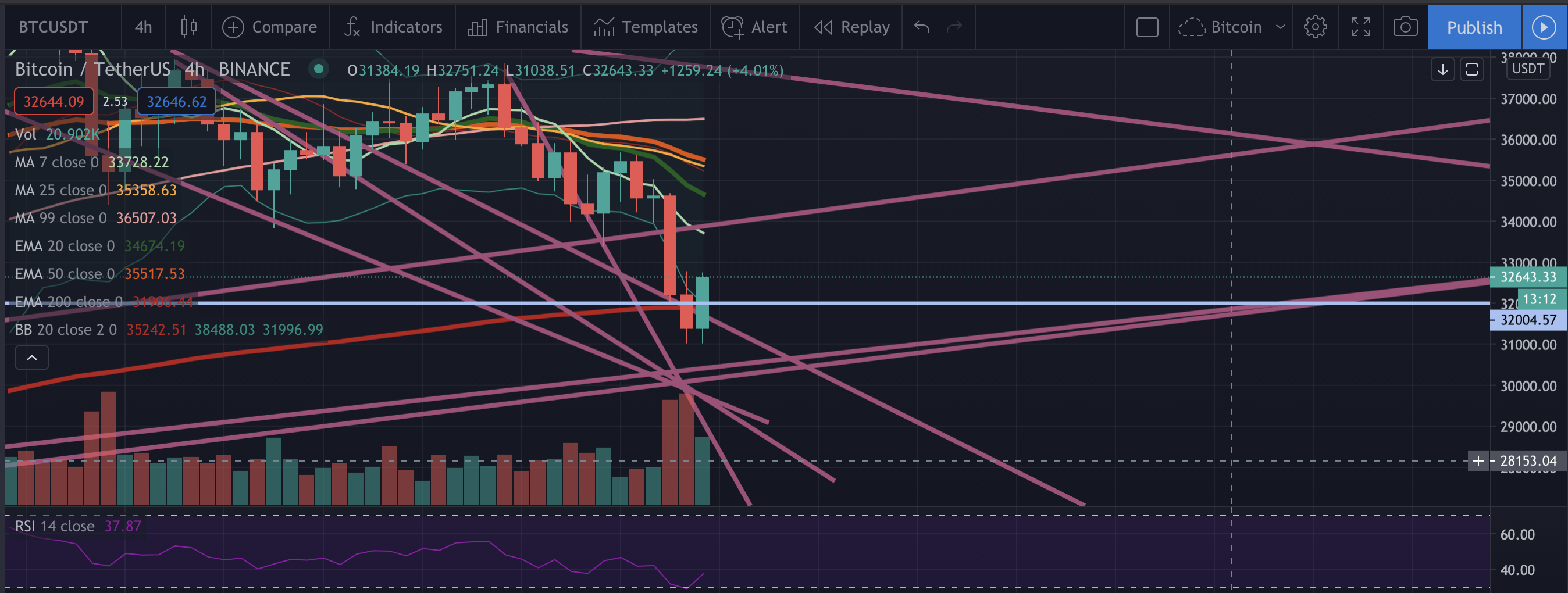
As an example that's a bit more concrete.. your original chart:
If the phenomenon you're seeing here is organic and just a case of bulls running out of steam, why are all 3 points perfectly aligned? Why does this always occur (or at least a majority of the time)?
Did bulls perfectly run out of stream just as the 3rd high met the trend line created by the first 2?
If it's organic and not orchestrated, these 3 points would be much more random, no?
So the exact points of these 3 highs are being controlled, we can see that obviously. In that case, how much of the position of these 3 points is based upon organic buying and selling, and how much is based on the control of market makers? It must be a large amount as a result of market makers, seeing as though the price is able to be aligned perfectly like that, right?
Really what's happening is that market makers (who are heavily tied to large institutional investors AND the exchanges themselves) control the creation of TA patterns, and they align the 3 lower highs like this, because it sends a message to all of the retail traders who are waiting to be told what to do next in order to make money.
This is the truth of the situation mate, not that bulls just ran out of steam 3 times and that happened to occur in a perfect straight line. It's basic logic tbh.
3 lower highs is a downtrend, this is a fact. A downtrend can last 1 hour, or 1 year, it depends on the time frames your using and the market. If bitcoin was to make a new ATH now, this still wouldn't be classed as a retracement, it would just mean a new uptrend has started.
This is a downtrend. It is a fact.
https://www.investopedia.com/terms/r/reversal.asp
"False signals are also a reality. A reversal may occur using an indicator or price action, but then the price immediately resumes to move in the prior trending direction again."
I'm not saying that in your course it didn't tell you that 3 lower highs is a downtrend and that on investo it doesn't say the same, I'm saying that it's not reliable to believe that's anything other than an artificially-created paradigm which the considerations of actual psychology (ie. we make lots of traders think it's a downtrend then beartrap them) trumps pure TA.
As you mentioned, these are just opinions mate.. there's a lot to trading and it takes a long time to understand it properly. I've found it's much more about being able to read between the lines than to memorise TA patterns and rigidly abide by them.
imo, you have better success when you think of us retail traders as sheep and institutional traders are shepards, and then imagine
why the shepards are telling the sheep to do things, instead of just
what they are telling them to do.