
- Mar 30, 2018
- 12,100
- 14,377
Interesting it's a bit to long will read it slowly looks promising so far.


One of the hardest parts of learning SEO for me was nailing down how many links to build to what page in order to rank.
After a lot of testing and links built, I am pretty comfortable with my process. Comfortable enough to share and answer common questions.
This guide will have a bit about SEO (what links and why) but mostly about your site size, what links are built to what page, and why.
Authority Website Vs Niche / Affiliate Website
Your SEO strategy is different depending on what size website you build. Also, how you build links. Most SEO guides are sharing how to rank a Niche Website.
Most SEO services are designed to rank a thin website as well. When you allow one URL per order, you can almost assure that the service is optimal for a thin site.
The main difference is that a larger website can rank easier if:
1. Some pages have a lot of links
2. Internal links is great
3. Home page is strong
4. Strong site architecture
It isnt just about having a lot of content. This is where the white hat guys mess up. You still need some external link juice to rank.
We all have seen Forbes rank for a keyword it has no business ranking for. A page with zero links and mediocre on page ranking for medium comp keywords, only because it is on Forbes.com.
Some people say it is because the root domain is so strong. This is partially true. But the rest needs to be right too. You still need some pages to have good links.
Your classic thin site can be ranked with enough good backlinks pointed directly to the page you want to rank - assuming that page is your home page.
Your classic large site requires a different approach.
The Large / Authority Site Difference
Let's assume you have a site with a super strong home page, great site structure, snd incredible incredible internal linking. White Hats say you can rank for anything, right? Lets dig into that.
You now want to rank a page for SEO.
Big keyword, some strong competition. I did a google search for SEO and got:
1. https://moz.com/beginners-guide-to-seo
2. https://searchengineland.com/guide/what-is-seo
Now, Forbes still did appear in my top ten. But number six. Wikipedia was number three.
Which domain is stronger? Moz / Search Engine Land or Forbes / Wikipedia?
Wikipedia is an internal link monster. Insane metrics, for those who follow metrics. Great site structure.
I can give thousands of big examples, but the fact is a page with strong external links will always rank higher if all else is the same.
That being said, a site can have worse or less links and rank better than a website with superior links if it has superior home page strength, internal linking and website structure.
But, backlinks are king.
Home Page Vs Inner Page Link Building
Let's stick with Search Engine Land.
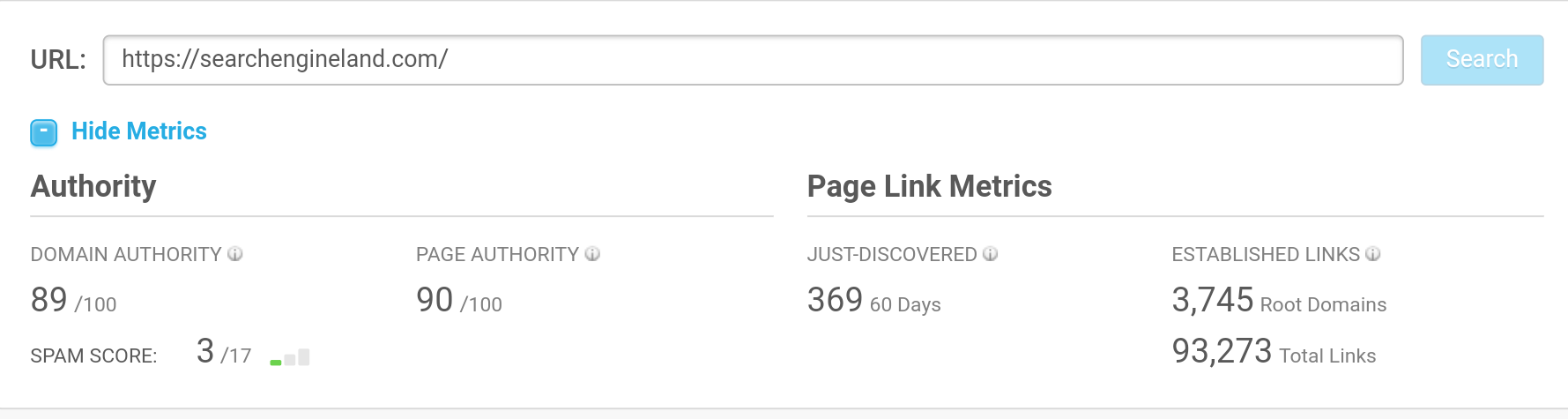
The home page has 93,000 links. Granted, Moz vastly underestimates the total links. For majestic, it shows 26,000,000.
Now, the page ranking for SEO.

This page has 5,600 links according to moz. Majestic 58,000 fresh.
Anchors are next for the inner page, according to majestic.

Interesting. Look at all of those anchors for SEO and Search Engine Optimization.
What does this tell us about link building to inner page vs home page?
A site ranking for a high comp keyword has vastly more links pointing to the home page than the inner page targeting the keyword.
The inner page has the majority of links targeting the keyword in some variation. While the home page has mostly branded anchors.
What does this mean for me?
You can rank an inner page of a large site with anchors that a thin website normally would not be able too.
This does not mean you can only blast exact match anchors, it means the ratios most peope throw out such as:
1. 1 or 2 percent exact match.
2. 5 percent long tail / lsi.
3. 93 percent branded, generic, naked.
Are not quite accurate. You have far more room to play with.
Should we be more aggressive?
This is not just about you, the reader. It is about SEOs in general. Lucky for us, a LOT of SEOs have tested this.
Disclaimer: Every niche is different.
We should be slightly more aggressive.
Ratios for an Authority Website
You home page should follow the general SEO advice.
1. About 90% brand, generic and naked anchors. I prefer at least 50% brand anchors is what I use.
2. About 5% to 7% partial, long tail and entire sentance linked containing keyword.
3. About 3% to 5% exact match anchors.
Inner Page is where we can be more aggressive.
1. About 50% brand, generic and naked anchor.
2. About 35% partial, long tail and entire sentance linked containing keyword.
3. About 15% exact match anchors.
Again, this entirely depends on niche. But in general, with a large website, you can more easily rank an inner page and you can be far more liberal with the anchors you use.
Why so many brand / naked / generic anchors for home page?
Well, I for a large site, you are building a brand.
Take a look at Amazon, Overstock, Best Buy, etc. Brands that sell good and are designed to turn a profit have a huge amount of branded anchors.
When working with a large site, this is exactly what you want.
And if you can't do it naturally, or do not want to wait, you need to fake it until you make it.
Linking to Home Page vs Inner Page
I start with a 90 - 10 split with a large site until it has at least 10 inner pages targeting keywords.
After that, I aim for 50 - 50 until I have several hundred inner pages targetting keywords.
After that, you get to be more liberal. I have seen successful sites as aggressive as 20 - 80. I normally suggest 30 - 70 for an aggressive website.
What links do I build?
This is why I suggest a Press Release and full social media set up with naked or branded anchors. You can get hundreds of backlinks right away in a natural way.
Since a few no follow links are ever a bad thing so the PR is fine.
After that you want the usual diversity backlinks pointed to the home page.
Plus, some contextual links.
If your home page is targetting a key word, you will need some Guest Posts / Web 2.0s / PBN links.
Inner Pages can have far LESS diversity.
LESS IS MORE.
A few web 2.0 links, an image sharing link, a PBN link or two, maybe a blog comment. You build only enough diversity to make your ratio correct. You build only enough power links to rank.
Enough about BIG sites, what about my MNS?
Ratios are a bit different. Your home page should be targetting a keyword for a MNS or thin Affiliate Site. That means links are pointed to the home page which are key word specific.
But my general guide lines remain the same. You just generally need MORE links to rank an inner page.
MNS / Affiliate Site Home Page vs Inner Page Ratios
This I have a hard 30 - 70 rule for. At least 30% of total links pointed to the home page.
At most 70% of links pointed to inner pages.
Some SEOs are too safe when it comes to this. Doing 50 - 50 splits. I prefer to go with 30 - 70 as it works and I build less links to the home page.
What links to build to the MNS / Affiliate Site?
This is the biggest difference between how I build links to the two types of sites. Why? You normally dont want to try a PR to a thin site. Sometimes the PR will not be accepted. Plus, it doesnt look natural.
Plus, you generally have less Guest Post opportunities for a thin site.
This means you follow my SEO guide. You build diversity links. You build Web 2.0s and PBN links.
Some links you can always get for any site. When not doing a PR, you still build social media profiles. If I can, I try business / local citations. Again, this is perfectly natural. Your Affiliate site is a business / review site after all.
That's all Folks!
After this you know the ratios to rank a site. This does depend on niche so ALWAYS look at the anchor ratios, link profile, and home page vs inner page ratios of the top ten.
Keep in mind that big sites and small sites SHOULD have different ratios.
Thank you @davids355. I think I got the image linking right this time. Uploaded to imugr and then linked imugr.


So when you say to maintain 50% home page ratio with :
About 35% partial, long tail and entire sentance linked containing keyword.
About 15% exact match anchors.
how do you maintain these ratio for a homepage if you dont point inner-page anchors ?
Also, is press-releases safe ( bought from marketplace in bhw) and powerful way to build homepage authority? or niche based PBNs better?
Thanks for this guide! Do you use the same anchor ratios for internal links?
Cheers
Those are ratios for an inner page.
Home page is;
"About 90% brand, generic and naked anchors. I prefer at least 50% brand anchors is what I use.
2. About 5% to 7% partial, long tail and entire sentance linked containing keyword.
3. About 3% to 5% exact match anchors."
Your exact match would be the big keyword of your niche or a larger term a static home lage is targeting.
For example, bhw.coms home page would have some anchors for black hat seo, black hat search engine optimization, etc. These are big terms an inner page wouldnt directly target.
If home page is not targeting any term, and you have no big niche term, you can just use more branded anchors.
As for a PR, apart from the couple do follow distribution links, it has very little direct seo value. It is about velocity and anchor text ratios.
It saves you from building dozens or hundreds of links.
No. Internal links are usually keyword right. Sometimes I will hyperlink a word like here to direct people, but it is normally a keyword.
For me, the internal linking is about user experience.

In general, yes. I never have had a problem ranking when I highly optimize internal links.
I would avoid things like site wide links such as a keyword rich footer. But aside from that, go crazy.
My first affiliate site was a clickbank one. It failed miserably. I always thought it was becasue i had a ton of internal links flowing with mostly exact or closely related anchors in content. I was also sold GSA type links by a seller here on BHW for a very high price, what can I say I was naive!
I have never tested this otherwise. But good to know you do heavy exact match internal linking. I usually do exact just on the menu. Others are partial sentences including the keyword.
I have tested this quite a bit. I normally wouldnt share this many details, but why not.
I first started testing this by adding a menu in the side bar with exact keyword anchors to a site with 1,000 pages. Rankings dropped. I then replicated the test on a dozen sites. Still a small sample, but each site dropped in rankings (read: tanked).
I then tested footer and top menu bars. Again, terms tanked.
I tried article titles in side bar. Tanked.
I tried article titles in footer, and I saw no negative impact as long as I used article title only.
For internal linking, I only saw a negative when it would negatively impact user experience.
If I shoehorn in the text or anchor into an article with exact match anchor, I would move back.
If I linked naturally in text, I at least didnt see a decrease. It wouldnt matter what text I used as long as it made sense.
Lets say I was ranking for Acne. I had a lot of internal linking with the term acne, but also terms like:
1. Here
2. Our acne guide
3. Help get rid of acne
4. "Article title"
And so on. It was heavily skewed to acne, but I included variety. A couple hundred internal links.
Again, someone else may know more or have a better answer. I tested a bit. Tanked some sites.
My on page is always done by:
1. Squirrly SEO
2. Yoast SEO
3. Grammarly
It works, and a lot of testing has been done. I find that squirrly and yoast do not always agree. When I used one or another, I would notice things were missed.
I try to not over thing onpage. I follow the script.
Do I understand that creating a sidebar widget of ( latest posts ) may have a negative impact on my site ranking?...
I then tested footer and top menu bars. Again, terms tanked.
I tried article titles in side bar. Tanked.
...
Thanks for the detailed response. I didn't know top menu bar would screw with rankings
I first started testing this by adding a menu in the side bar with exact keyword anchors to a site with 1,000 pages. Rankings dropped. I then replicated the test on a dozen sites. Still a small sample, but each site dropped in rankings (read: tanked).
I then tested footer and top menu bars. Again, terms tanked.


