Questions on local search

taketheride

Junior Member
Joined
Mar 3, 2015
Messages
143
Reaction score
19
Say you want to rank a company in organic search that does dog training in los angeles. If I would like to rank for just "dog training", instead of "dog training los angeles", but still only target searches from the los angeles area, how is this achieved?

I'm thinking that if the company already has some local ranking factors (like local citations and reviews), then it will automatically get higher priority/better ranking for the searches coming out of los angeles (after these have been targeted with usual SEO for organic search), even if they don't contain the city-specific syntax ("los angeles" in this case).

Or have I got this wrong?
 
I'm thinking that if the company already has some local ranking factors (like local citations and reviews), then it will automatically get higher priority/better ranking for the searches coming out of los angeles (after these have been targeted with usual SEO for organic search), even if they don't contain the city-specific syntax ("los angeles" in this case).

Or have I got this wrong?

No, I don't think you're wrong.

However, it seems like without that specific city/location specific context added to the search, Google goes a lot more broad when they're personalizing the results. Meaning, they're basically pulling in a lot more of the competition around you to see who competes for that 3/7 box when they search is made, so I think it's a bit more difficult to get in that box.
 
Optimize for "dog training los angeles" and you will show up for "dog training" when people search in los angeles area.
 
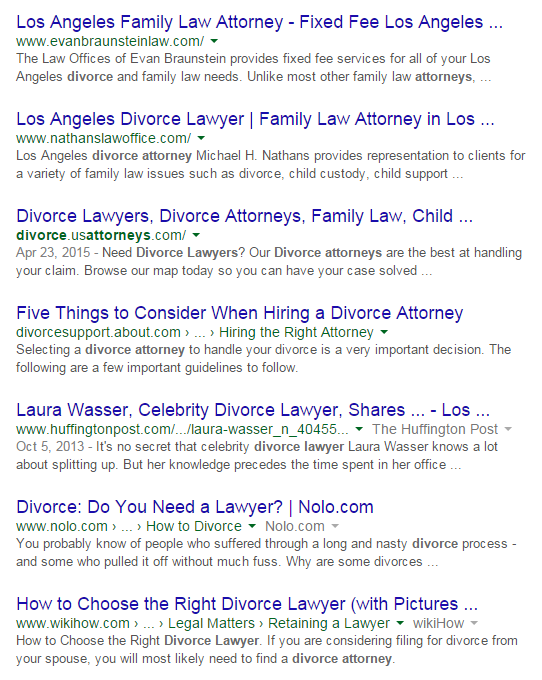
Citations, reviews, ratings (especially on Google Maps), a verified local Google+ page, mentions of the location, and other local factors will help you rank locally in the organic portion of the SERPs. To exemplify this, I want you to type in "Divorce Lawyer" in a Google search and tell me how many local divorce lawyers you see (exclude Google Maps for this example). If you have your location set to "Los Angeles, California" the SERPs would look something like this:
I633Q2m


As you can see, there are clearly people ranking locally (in Los Angeles) for "Divorce Lawyer" without "in Los Angeles" at the end of the query. But how did they achieve this position in the local SERPs?

It's simple: they focused on local factors. For this next part, I'm going to use Evan Braun's site in the image above as an example. Now, if you examine the local factors of Evan's business, you'll notice that he maintains a 4.8 Google+ rating, has 8 reviews, has thousands of citations (run a search query for "business address" and "business name" to find these manually), and he has the location in his site title and description on his website. If you compare the number of local factors he has over his competitors, then it's no wonder why he has a higher priority in the local SERPs than his competitors.
 
Last edited:
You're right OP. If you rank organically, but have a local business listing, mentioning the city will boost you up.
 
There is a huge difference between "organic" and "local search" with local search it is specifically to place your business on the maps and push pins to promote your business for people who are searching for services such as dog training (zip code). There are two completely different algorithms for these types of services. If you are willing to put in a full times worth of work into getting your business there start with these steps.

1) Claim your listing on Google, Bing, Yelp, Yahoo, and Facebook.
2) Be sure all of your business information and hours are all 100% accurate and all spelled exactly the same.
3) Be sure to put new content on those pages on a monthly basis.
4) Increase the amount of Google reviews you get.
5) Be sure your site is MOBILE FRIENDLY.

I work with an INC 500 company where local search is our bread and butter, if you are looking for more information feel free to reach out. Hope this helps.
 
Citations, reviews, ratings (especially on Google Maps), a verified local Google+ page, mentions of the location, and other local factors will help you rank locally in the organic portion of the SERPs. To exemplify this, I want you to type in "Divorce Lawyer" in a Google search and tell me how many local divorce lawyers you see (exclude Google Maps for this example). If you have your location set to "Los Angeles, California" the SERPs would look something like this:
I633Q2m


As you can see, there are clearly people ranking locally (in Los Angeles) for "Divorce Lawyer" without "in Los Angeles" at the end of the query. But how did they achieve this position in the local SERPs?

It's simple: they focused on local factors. For this next part, I'm going to use Evan Braun's site in the image above as an example. Now, if you examine the local factors of Evan's business, you'll notice that he maintains a 4.8 Google+ rating, has 8 reviews, has thousands of citations (run a search query for "business address" and "business name" to find these manually), and he has the location in his site title and description on his website. If you compare the number of local factors he has over his competitors, then it's no wonder why he has a higher priority in the local SERPs than his competitors.

Good info!
Thanks for posting!
 
local search was set up to give local operators their place in their local market.
So dog trainng los angeles should be just serving those in LA.
Google thinks that this provides a local service to local people and that you shoudl not have to compete with the whole of the country,which is a far harder task.
If you want to compete on dog training, then you dont get to appear in the six pack (local search results)
and you simply have to get much stronger links. On this term for the whole of the US, its going to cost you much more than local search.
 
There is a huge difference between "organic" and "local search" with local search it is specifically to place your business on the maps and push pins to promote your business for people who are searching for services such as dog training (zip code). There are two completely different algorithms for these types of services. If you are willing to put in a full times worth of work into getting your business there start with these steps.

1) Claim your listing on Google, Bing, Yelp, Yahoo, and Facebook.
2) Be sure all of your business information and hours are all 100% accurate and all spelled exactly the same.
3) Be sure to put new content on those pages on a monthly basis.
4) Increase the amount of Google reviews you get.
5) Be sure your site is MOBILE FRIENDLY.

I work with an INC 500 company where local search is our bread and butter, if you are looking for more information feel free to reach out. Hope this helps.

Really? INC 500?
 
Back
Top