
You are using an out of date browser. It may not display this or other websites correctly.
You should upgrade or use an alternative browser.
You should upgrade or use an alternative browser.
If you're targeting US and UK...
- Thread starter PulpF
- Start date

- Apr 27, 2017
- 4,308
- 793
Better you cover all such keywords in your SEO activity.

PulpF
Junior Member
- Sep 20, 2009
- 112
- 10
Are you saying to include both spellings throughout the content?Better you cover all such keywords in your SEO activity.

SEO
Senior Member
- Jan 6, 2017
- 942
- 754
You should localize the content, then serve up the localized version where necessary. Generally speaking, Google understands the regional differences in spellings.
Edit: sorry, I see that you also asked how to do that. If you use WordPress, plugins like WPML will do this.
Edit: sorry, I see that you also asked how to do that. If you use WordPress, plugins like WPML will do this.

NoDice
Newbie
- Nov 13, 2012
- 25
- 8
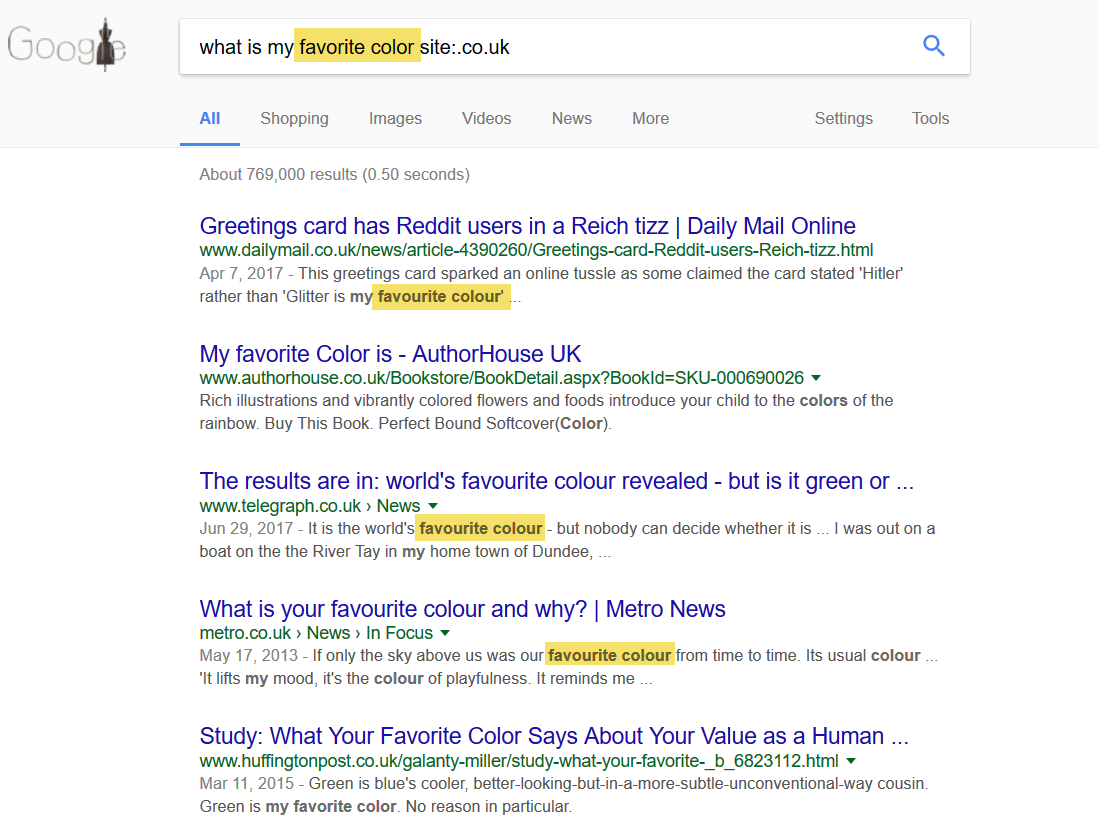
I did some testing for colour in my niche and saw a large google preference for UK, CA, AU, EU sites.
If you wanted to rank well for keyphrases that are competitive 2 and 3 word Ngrams you would need to setup a completely new site targeted specifically for the UK.
Just Google, "Color Ink" and "Colour Ink"
If you wanted to rank well for keyphrases that are competitive 2 and 3 word Ngrams you would need to setup a completely new site targeted specifically for the UK.
Just Google, "Color Ink" and "Colour Ink"
- Apr 27, 2017
- 4,308
- 793
Are you saying to include both spellings throughout the content?
In your keywords:
Buy grey color shirts online
Buy gray color shirts online
Buy grey colour shirts online
Buy gray colour shirts online
Hope, that helps.

PulpF
Junior Member
- Sep 20, 2009
- 112
- 10
You should localize the content, then serve up the localized version where necessary. Generally speaking, Google understands the regional differences in spellings.
Edit: sorry, I see that you also asked how to do that. If you use WordPress, plugins like WPML will do this.
Cheers for your help. Would this approach with WPML not just create extra webpages for the different spellings? So I'd end up with:
www.website.com/UK/colour
www.website.com/US/color
etc?
I do that Google recognises it as the same word though, thanks.
I did some testing for colour in my niche and saw a large google preference for UK, CA, AU, EU sites.
If you wanted to rank well for keyphrases that are competitive 2 and 3 word Ngrams you would need to setup a completely new site targeted specifically for the UK.
Just Google, "Color Ink" and "Colour Ink"
Thanks for sharing your results. I am not actually trying to rank for a word that is spelled differently, I have just been writing content for a launch where I am targeting all English speakers (hoping to rank in google.com/.co.uk) and then different spelling occurred to me.
Putting myself in a users perspective (I'm from the UK), if I was reading an article it spelled it as "color", I would probably notice and possibly assume the information isn't as relevant to the UK as it is to the US. Or perhaps I am too finicky.
In your keywords:
Buy grey color shirts online
Buy gray color shirts online
Buy grey colour shirts online
Buy gray colour shirts online
Hope, that helps.
This makes sense, I will bear this in mind for the future.
Doing both kinds of spelling throughout the content is absolutely awful from styling point of view. Pick one and stick with it, it absolutely does not matter from SEO perspective.
I agree. I wanted to stick to one spelling and I will if there's no alternative, but basically what I was looking for is a way for my website to register the user's geo position, and change spellings of just the individual words without having to create extra pages.
SEO
Senior Member
- Jan 6, 2017
- 942
- 754
Cheers for your help. Would this approach with WPML not just create extra webpages for the different spellings? So I'd end up with:
www.website.com/UK/colour
www.website.com/US/color
etc?
I do that Google recognises it as the same word though, thanks.
Yes, but the plugin puts in the code necessary so Google doesn't see the pages as duplicate content, and it tells Google which pages are for which languages and dialects. Then Google decides which page to serve up in the search results. At google.co.uk Google would use your /uk/ url., Etc.
PulpF
Junior Member
- Sep 20, 2009
- 112
- 10
Yes, but the plugin puts in the code necessary so Google doesn't see the pages as duplicate content, and it tells Google which pages are for which languages and dialects. Then Google decides which page to serve up in the search results. At google.co.uk Google would use your /uk/ url., Etc.
Ahh that's good to know although I don't think I need to take it this far as I am not trying to rank for such words, just wondering what to do within my content. But out of interest does that mean you'd have to individually build backlinks for each version?
SEO
Senior Member
- Jan 6, 2017
- 942
- 754
No, this is where canonicals and hreflangs come in. Here's a read-up should you want to go this path in the future. If you don't want to manage translations, then go for the spelling that makes most sense to your company. Google can figure out the restAhh that's good to know although I don't think I need to take it this far as I am not trying to rank for such words, just wondering what to do within my content. But out of interest does that mean you'd have to individually build backlinks for each version?

https://www.rebelytics.com/hreflang-canonical/
PulpF
Junior Member
- Sep 20, 2009
- 112
- 10
No, this is where canonicals and hreflangs come in. Here's a read-up should you want to go this path in the future. If you don't want to manage translations, then go for the spelling that makes most sense to your company. Google can figure out the rest
https://www.rebelytics.com/hreflang-canonical/
Thanks, you've been really helpful! Been a while for me.


- Jan 25, 2010
- 1,541
- 982
You can specify your geographical target(s) in Goog Search Console. G has confirmed they use this setting plus tld (.co.uk, etc) as the primary factors for ranking in given regions. And/or serve up tailored content depending on IP location of visitors as mentioned.