

- Dec 3, 2015
- 5,142
- 5,839
In today's post, I'm going to show the EXACT approach I used to grow AI citations for an app.
In fact,
This went from ZERO visibility in any AI platform to over 800+ citations across ChatGPT, Perplexity, Google AI Mode, Gemini and Grok.
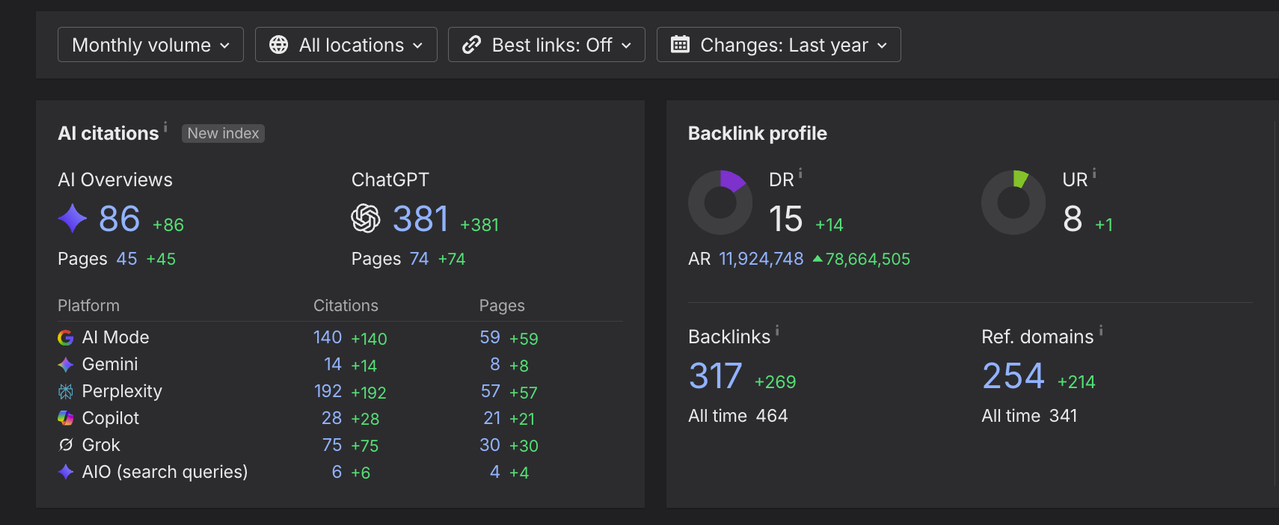
In less than 4 months.
MOST of all, this is NOT a backlink guide.
This is about getting LLMs to actually KNOW your product exists and RECOMMEND it.
Let's dive in;
Why AI citations matter NOW
Gone are the days where SEO rankings alone drive discovery.
REMEMBER,
When someone asks ChatGPT or Perplexity "what's a good app for X" your website traffic doesn't matter if the LLM has never read about you.
AI citations = AI recommendations = FREE top-of-funnel traffic you didn't have before.
If you're building a real product, you should stick around.
What LLMs actually read
This is the PHASE most people skip entirely.
LLMs don't crawl your homepage and think "great product."
They research from review-style content.
Why you ask?
Because review copies, listicles, roundups and FAQs are written the way humans research. Comparing options, listing features, answering questions.
That's exactly the format LLMs train on and cite from.
MOREOVER, if a dozen sources all mention your app in the same context, the model builds CONFIDENCE that your product belongs in that category.
Writing review copies that get cited
Here is the PHASE that actually moves the needle.
The format that worked best for me:
Listicles. "Top 10 [tools] for [use case]." I always made sure to cite 3-4 well-known competitors in the list first. Then our app in the top 3. That way even if a human reads it, they see recognizable names THEN discover ours.
Roundups. "Best [category] apps in 2026."Same competitor-first structure.
FAQs. "What is the best app for a [specific problem]?" These are gold because users TYPE these exact questions into AI.
The trick with listicles?
NEVER position a new product as number 1 cold.
Put the established names in the list. Then slide your product in top 3.
The LLM sees it surrounded by credible references. That's piggybacking done RIGHT.
Content distribution, the EXACT numbers I used
Here is where most people stop at "write some blog posts."
I didn't.
Apart from research articles on the main website, here's what I pushed:
50 Medium posts. Unique articles, each with a direct link and image from Pexels.
40 Facebook posts. Seeded across relevant groups and pages.
100 LinkedIn posts. The highest signal platform for AI citation research
Reddit Mentions - I'd say I was lucky to get on a free copies here on the platform worth xxxx to improve in these mentions. Diving a little deeper, I'd research posts that are already appearing on SERP for my niche, create a title variant, create posts and use your network for the comments to make it look natural
Total: 190+ pieces of distributed content in under 4 months.
REMEMBER,
All articles were UNIQUE.
Not spun. Not repurposed. Each one briefed individually. Title and direct link given to each writer.
Why?
Because duplicate content across 100 posts kills the whole strategy. LLMs detect signal diversity. If every post reads the same, it's noise.
Outsourcing it the RIGHT way
Here's the part no one talks about. I didn't write 190 posts myself.
GO AHEAD, you don't have to either.
I found someone with direct access to a network of university students. That made the process manageable AND affordable. The output was genuinely original because different people were actually writing.
A few things I learned the HARD way:
Do NOT work with writers who recycle other people's content. It wastes your budget and pollutes your citation profile.
Brief them with the title and URL. That's enough direction.
Free stock images from Pexels or Unsplash on every post. It signals legitimacy on platforms like Medium and LinkedIn.
The next phase you ask?
Rinse and repeat. If 190 posts got me here in 4 months, imagine a 12-month plan.
Tracking your results
The tool I used is Scrunch.
Is it expensive? Yes.
Does it get the job done? Absolutely.
It tells you:
Which AI platforms are citing your content.
How many citations and which pages are getting pulled.
Whether your citation count is growing or settling.
MOREOVER, expect fluctuation. My ChatGPT count hit close to 1,000 at peak before settling lower. That's normal. LLMs re-index and recalibrate. The trend line matters more than the daily number.
Which content types drove the MOST citations
Not all 190 posts performed equally.
FAQs consistently pulled the highest citation rates. Why? Because they mirror EXACTLY how people prompt AI tools. Question in, answer out. If your FAQ post answers "what is the best app for X" the LLM has a ready-made response to borrow from.
Listicles came second. Especially ones that named 5 or more products. The more reference points in one post, the more the LLM treats it as a credible source.
Roundups performed best when they had a clear verdict at the end. Not just a list. A conclusion. Something like "Overall, [App] is the best option for [use case] because..."
Plain promotional posts? Almost zero citation impact.
How to brief writers for AI-optimised structure
This is the PHASE that separates results from wasted budget.
Most people give writers full creative freedom. That's a mistake when writing for AI citations.
Here is what I sent every writer:
Title. One clear, keyword-rich title in the format "Best [X] for [Y]" or "Top [X] [tools] in 2026."
Direct URL. The product page they should link to.
Competitor names to include. At least 3 recognisable names in the same category.
Word count. 800 to 1200 words. Long enough to have depth, short enough to stay focused.
That was it.
No templates. No scripts. Just those four things. The variety in writing style across different people actually HELPED. It made the content pool look more organic to LLMs.
REMEMBER,
One brief. One writer. One unique post. Don't batch the same topic to the same person twice.
How to scale this to new products
The beauty of this strategy is it's repeatable.
Once you understand the system, launching a new product into AI visibility is just a production problem.
Here's how I'd approach a fresh launch:
PHASE 1. Publish 10 to 15 research-led articles on the main website. These are your foundation. Detailed, original, keyword-focused.
PHASE 2. Spin up 50 Medium posts in the first 6 weeks. Brief writers with the title and URL. Mix FAQs, listicles and roundups equally.
PHASE 3. Push 100 LinkedIn posts over 8 weeks. LinkedIn is heavily indexed by AI tools. Don't skip this.
PHASE 4. Seed 40 Facebook posts across niche groups. Lower citation return than LinkedIn but still adds to signal diversity.
PHASE 5. Set up Scrunch tracking from week 1 so you have a baseline. You can't improve what you don't measure.
Most of all, don't rush PHASE. 1. A weak website foundation means the distributed content has nowhere credible to point back to.
Rinse and repeat every quarter.
That's the full playbook.
Drop your questions below and I'll answer every single one.
In fact,
This went from ZERO visibility in any AI platform to over 800+ citations across ChatGPT, Perplexity, Google AI Mode, Gemini and Grok.
In less than 4 months.
MOST of all, this is NOT a backlink guide.
This is about getting LLMs to actually KNOW your product exists and RECOMMEND it.
Let's dive in;
- Why AI citations matter NOW
- Understanding what LLMs actually read
- Writing review copies that get cited
- Content distribution, the EXACT numbers I used
- Outsourcing it the RIGHT way
- Tracking your results
- Which content types drove the MOST citations
- How to brief writers for AI-optimised structure
- How to scale this to new products
Why AI citations matter NOW
Gone are the days where SEO rankings alone drive discovery.
REMEMBER,
When someone asks ChatGPT or Perplexity "what's a good app for X" your website traffic doesn't matter if the LLM has never read about you.
AI citations = AI recommendations = FREE top-of-funnel traffic you didn't have before.
If you're building a real product, you should stick around.
What LLMs actually read
This is the PHASE most people skip entirely.
LLMs don't crawl your homepage and think "great product."
They research from review-style content.
Why you ask?
Because review copies, listicles, roundups and FAQs are written the way humans research. Comparing options, listing features, answering questions.
That's exactly the format LLMs train on and cite from.
MOREOVER, if a dozen sources all mention your app in the same context, the model builds CONFIDENCE that your product belongs in that category.
Writing review copies that get cited
Here is the PHASE that actually moves the needle.
The format that worked best for me:
Listicles. "Top 10 [tools] for [use case]." I always made sure to cite 3-4 well-known competitors in the list first. Then our app in the top 3. That way even if a human reads it, they see recognizable names THEN discover ours.
Roundups. "Best [category] apps in 2026."Same competitor-first structure.
FAQs. "What is the best app for a [specific problem]?" These are gold because users TYPE these exact questions into AI.
The trick with listicles?
NEVER position a new product as number 1 cold.
Put the established names in the list. Then slide your product in top 3.
The LLM sees it surrounded by credible references. That's piggybacking done RIGHT.
Content distribution, the EXACT numbers I used
Here is where most people stop at "write some blog posts."
I didn't.
Apart from research articles on the main website, here's what I pushed:
50 Medium posts. Unique articles, each with a direct link and image from Pexels.
40 Facebook posts. Seeded across relevant groups and pages.
100 LinkedIn posts. The highest signal platform for AI citation research
Reddit Mentions - I'd say I was lucky to get on a free copies here on the platform worth xxxx to improve in these mentions. Diving a little deeper, I'd research posts that are already appearing on SERP for my niche, create a title variant, create posts and use your network for the comments to make it look natural
Total: 190+ pieces of distributed content in under 4 months.
REMEMBER,
All articles were UNIQUE.
Not spun. Not repurposed. Each one briefed individually. Title and direct link given to each writer.
Why?
Because duplicate content across 100 posts kills the whole strategy. LLMs detect signal diversity. If every post reads the same, it's noise.
Outsourcing it the RIGHT way
Here's the part no one talks about. I didn't write 190 posts myself.
GO AHEAD, you don't have to either.
I found someone with direct access to a network of university students. That made the process manageable AND affordable. The output was genuinely original because different people were actually writing.
A few things I learned the HARD way:
Do NOT work with writers who recycle other people's content. It wastes your budget and pollutes your citation profile.
Brief them with the title and URL. That's enough direction.
Free stock images from Pexels or Unsplash on every post. It signals legitimacy on platforms like Medium and LinkedIn.
The next phase you ask?
Rinse and repeat. If 190 posts got me here in 4 months, imagine a 12-month plan.
Tracking your results
The tool I used is Scrunch.
Is it expensive? Yes.
Does it get the job done? Absolutely.
It tells you:
Which AI platforms are citing your content.
How many citations and which pages are getting pulled.
Whether your citation count is growing or settling.
MOREOVER, expect fluctuation. My ChatGPT count hit close to 1,000 at peak before settling lower. That's normal. LLMs re-index and recalibrate. The trend line matters more than the daily number.
Which content types drove the MOST citations
Not all 190 posts performed equally.
FAQs consistently pulled the highest citation rates. Why? Because they mirror EXACTLY how people prompt AI tools. Question in, answer out. If your FAQ post answers "what is the best app for X" the LLM has a ready-made response to borrow from.
Listicles came second. Especially ones that named 5 or more products. The more reference points in one post, the more the LLM treats it as a credible source.
Roundups performed best when they had a clear verdict at the end. Not just a list. A conclusion. Something like "Overall, [App] is the best option for [use case] because..."
Plain promotional posts? Almost zero citation impact.
How to brief writers for AI-optimised structure
This is the PHASE that separates results from wasted budget.
Most people give writers full creative freedom. That's a mistake when writing for AI citations.
Here is what I sent every writer:
Title. One clear, keyword-rich title in the format "Best [X] for [Y]" or "Top [X] [tools] in 2026."
Direct URL. The product page they should link to.
Competitor names to include. At least 3 recognisable names in the same category.
Word count. 800 to 1200 words. Long enough to have depth, short enough to stay focused.
That was it.
No templates. No scripts. Just those four things. The variety in writing style across different people actually HELPED. It made the content pool look more organic to LLMs.
REMEMBER,
One brief. One writer. One unique post. Don't batch the same topic to the same person twice.
How to scale this to new products
The beauty of this strategy is it's repeatable.
Once you understand the system, launching a new product into AI visibility is just a production problem.
Here's how I'd approach a fresh launch:
PHASE 1. Publish 10 to 15 research-led articles on the main website. These are your foundation. Detailed, original, keyword-focused.
PHASE 2. Spin up 50 Medium posts in the first 6 weeks. Brief writers with the title and URL. Mix FAQs, listicles and roundups equally.
PHASE 3. Push 100 LinkedIn posts over 8 weeks. LinkedIn is heavily indexed by AI tools. Don't skip this.
PHASE 4. Seed 40 Facebook posts across niche groups. Lower citation return than LinkedIn but still adds to signal diversity.
PHASE 5. Set up Scrunch tracking from week 1 so you have a baseline. You can't improve what you don't measure.
Most of all, don't rush PHASE. 1. A weak website foundation means the distributed content has nowhere credible to point back to.
Rinse and repeat every quarter.
That's the full playbook.
Drop your questions below and I'll answer every single one.
Last edited:
