
You are using an out of date browser. It may not display this or other websites correctly.
You should upgrade or use an alternative browser.
You should upgrade or use an alternative browser.
Chess Puzzle
- Thread starter ScreamingMidget
- Start date

D
Deleted member 1399261
Guest
Appreciate that manWe're all good buddy.
Not trying to make you feel small or anything like that.
We're all equals here.
Sorry if I caused any trouble for you.

D
Deleted member 1399261
Guest
Doesn't the king have a move after knight check? D4 I thinkG5 to f4

redjebo
Regular Member
- Jul 18, 2015
- 243
- 321
I think there might be a misunderstanding in what a definition of "mate in 2" means.
A "move" in chess as we all know is one turn from white AND one turn from black. So basically a sequences like:
1. Kc4+ - Rxc4
2. Rd5+ - Bxd5
3. Qxd5#
or:
2. ... - Ke4
3. Qf5#
are mate in 2 since a third move is never completed over the board, the mating (half) move by white isn't counted as "move 3"
A "move" in chess as we all know is one turn from white AND one turn from black. So basically a sequences like:
1. Kc4+ - Rxc4
2. Rd5+ - Bxd5
3. Qxd5#
or:
2. ... - Ke4
3. Qf5#
are mate in 2 since a third move is never completed over the board, the mating (half) move by white isn't counted as "move 3"

Soucha
Elite Member
- Jul 31, 2017
- 1,959
- 1,311
are mate in 2 since a third move is never completed over the board, the mating (half) move by white isn't counted as "move 3"
You are probably right about this, but OP's wording isn't accurate then, or is at the very least confusing.
He said:
He didn't say "mate in 2", he said white makes 2 moves, and black makes "a" move "inbetween".White plays first, shooting upwards and it has to get checkmate in 2 moves (black obviously makes a move inbetween).
I bet you're right, but, it's a very confusing way to word it, because it sounds like he's saying black makes just 1 move.
By definition, to be inbetween something, there has to be barriers, categories, etc, to be in the middle of.
Last edited:
redjebo
Regular Member
- Jul 18, 2015
- 243
- 321
You are probably right about this, but OP's wording isn't accurate then, or is at the very least confusing.
He said:
He didn't say "mate in 2", he said white makes 2 moves, and black makes "a" move "inbetween".
I bet you're right, but, it's a very confusing way to word it, because it sounds like he's saying black makes just 1 move.
By definition, to be inbetween something, there has to be barriers, categories, etc, to be in the middle of.
Yes, you're right, if op wording is to be followed I don't think there is a solution, but just maybe he misunderstood the original description of the puzzle.
Btw my annotation from a above should read:
1. Nc4+
not
1. Kc4+
obviously
classictv613
Newbie
- Feb 1, 2016
- 0
- 0
Unless I'm missing something really obvious, it sure seems like Qe6, Kf5, Qf6 looks like mate in 2.

SamLewis
Supreme Member
- Oct 25, 2012
- 1,343
- 1,058
Cant move there because rook D3 will take.Doesn't the king have a move after knight check? D4 I think
D
Deleted member 1095690
Guest
G5 to f4
Won't work. Black rook will take white knight.
D
Deleted member 1333509
Guest
White Rook: d3 to e3
Black Rook: d4 to e4
White Queen: f7 to d5.. mate
** if knight or bishop used to block instead of moving rook, white bishop moves: g5 to f4... mate
Both solutions = mate in 2
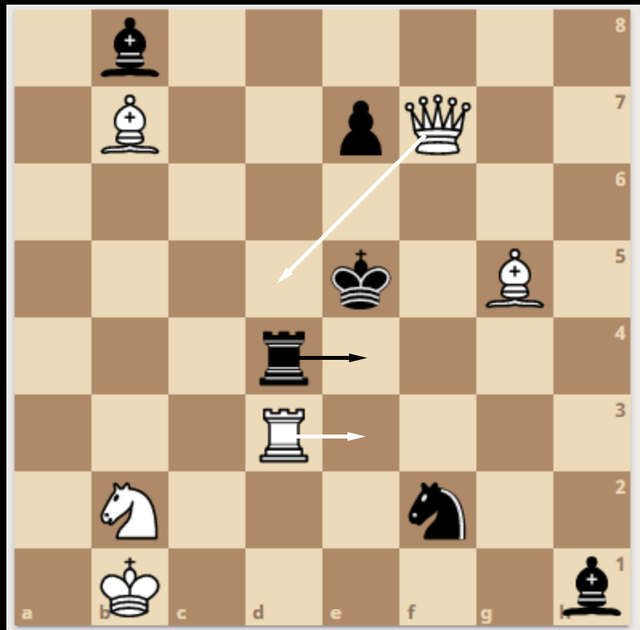
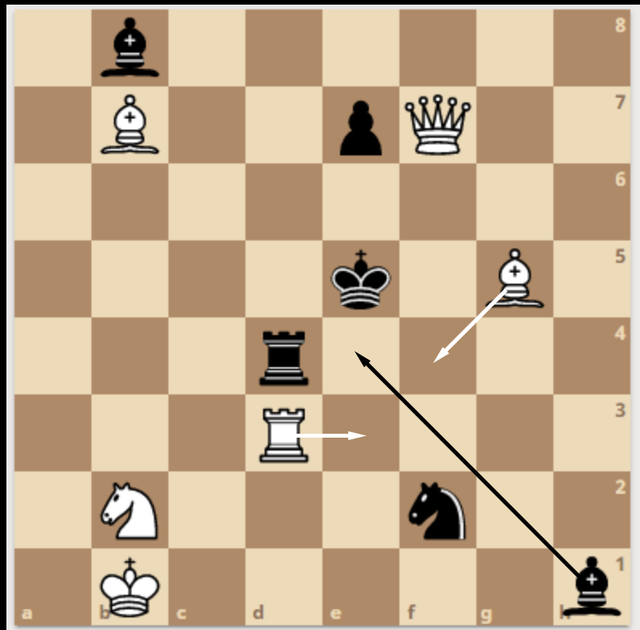
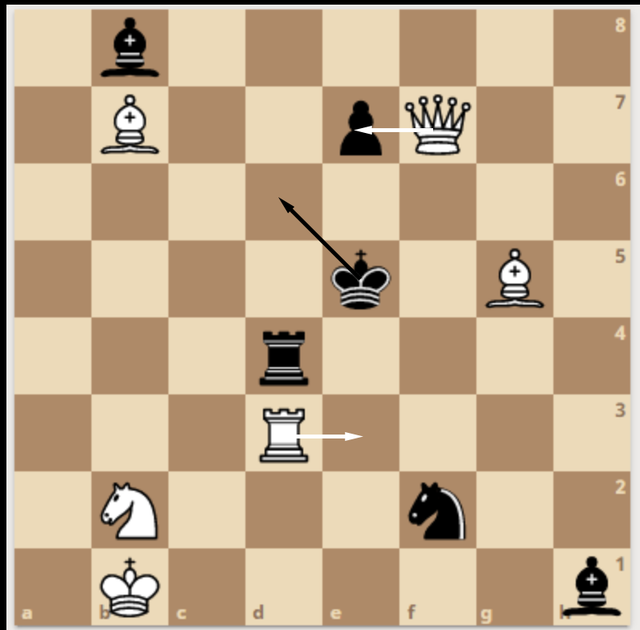
Edit: there is also a 3rd defence that black can try, but which is also mated in 2.
White Rook: d3 to e3
Black Queen: e5 to d6
White Queen: f7 to e7.. mate
Black Rook: d4 to e4
White Queen: f7 to d5.. mate
** if knight or bishop used to block instead of moving rook, white bishop moves: g5 to f4... mate
Both solutions = mate in 2
Edit: there is also a 3rd defence that black can try, but which is also mated in 2.
White Rook: d3 to e3
Black Queen: e5 to d6
White Queen: f7 to e7.. mate
Last edited by a moderator:
D
Deleted member 1095690
Guest
White Rook: d3 to e3
Black Rook: d4 to e4
White Queen: f7 to d5.. mate
Won't work. Black knight and black bishop can block first check.
That's not correct, king can move to E4White: Bishop F4
Black: Rook takes Bishop F4
White: Rook d5 Checkmate
D
Deleted member 1333509
Guest
Read the second solution for bishop or horse move. Mate in 2 as well.Won't work. Black knight and black bishop can block first check.
Either way, once rook places king in check, there is another move that can be made to mate, no matter the defence that black tries.
Last edited by a moderator:
redjebo
Regular Member
- Jul 18, 2015
- 243
- 321
White Rook: d3 to e3
Black Rook: d4 to e4
White Queen: f7 to d5.. mate
** if knight or bishop used to block instead of moving rook, white bishop moves: g5 to f4... mate
Both solutions = mate in 2
Doesn't work, Black can play Kd6 instead of blocking.
D
Deleted member 1095690
Guest
White Rook: d3 to e3
Black Rook: d4 to e4
White Queen: f7 to d5.. mate
** if knight or bishop used to block instead of moving rook, white bishop moves: g5 to f4... mate
Both solutions = mate in 2
First one won't work if black blocks first check with black bishop.
Second one won't work if black blocks first check with black rook.
D
Deleted member 1333509
Guest
Read what I've put.First one won't work if black blocks first check with black bishop.
Second one won't work if black blocks first check with black rook.
Option 1: rook checks, rook blocks, queen mates
Option 2: rook checks, bishop or horse blocks, bishop mate.
Option 3: rook checks, queen moves, queen mates.
All 2 turns each.
D
Deleted member 1333509
Guest
Yes, that's option 2. Mate with bishop.Doesn't work, Black can play Kd6 instead of blocking.
D
Deleted member 1095690
Guest
White plays first, shooting upwards and it has to get checkmate in 2 moves (black obviously makes a move inbetween).
View attachment 155871
Queen takes black pawn.
Black has to move king to f5
Queen move to f6 mate
D
Deleted member 1333509
Guest
Queens escapes by killing bishop.Queen takes black pawn.
Black has to move king to f5
Queen move to f6 mate
D
Deleted member 1095690
Guest
Queens escapes by killing bishop.
King cant, queen and bishop protect each other.