Can anyone help with some basic SEO questions?

openwallet

Junior Member
Joined
Jul 30, 2023
Messages
135
Reaction score
58
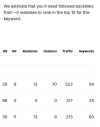
Using Ahrefs keyword difficulty tool, I found the below. I have some very novice questions I am hoping for help answering:

1. What does the domains column mean?
2. Row 1 is higher than row 3 despite being worse in DR, UR, and only equivalent in backlinks. Does this suggest that the domains value significantly trumps all the other values?
3. If I go to the marketplace and buy 14 backlinks, does that mean I immediately rank above these three?
4. Re: 3, I am assuming not, so what would realistically happen if I did buy 14 backlinks?
5. If I wanted to rank above row 3, what would be the recommended set of actions I should take?

Thank you for your time!

1724132534998.png
 
1) it means how many domains are giving you those backlinks. In your example, that's 13 backlinks coming from 10 domains. In SEO, having more domains linking to you is more important than having more backlinks from the same domain.

Example: you get 100 backlinks from blogger.com and 100 backlinks from wordpress.org. That's 200 backlinks, but from only 2 websites (blogger and wordpress). That's bad!

Ideally, you want all of those 200 backlinks to come from 200 domains (so, 1 backlink from each domain), or from as close to 200 domains as possible because 1:1 ratio is almost never possible with backlinks, so you need to get as close to this ratio as possible....

2) I'm not using Ahrefs, so I don't know how and why they're listing their results the way they are. But I think you're reading too much into this. All you need to take away from SEO tools is guidelines and rough ideas. Even the keyword difficulty scores are oftentimes inaccurate and should be treated as guidelines only, the real difficulty of a keyword can be assessed by actually analyzing the top 10 spots (sometimes the top 5 only as if you're not ranking in top 5 you're non-existent in some niches) and drawing your own conclusions based on experience and intuition, the data provided by Ahrefs being only there to confirm / infirm what you think of the results...

Moral of the story: don't get hung up on why Ahrefs lists whoever they list at the top and why they list whoever they list at the bottom, just glance over the stats to get a rough idea of what you're up against and what you need to do to beat your competition...

3) lol NO! SEO - while still a science of things you must do in order to rank - is also an art and, more importantly, not an EXACT science.

In theory, yes, that's what you need to do to rank. But theory and practice are different things because google looks at many ranking factors (over 200 of them) before deciding who they rank, where.

On top of this, they have all sorts of rules, filters and exceptions for lots of niches, keywords, and even sites individually. For example, if you're Reddit you're going to outrank a lot of sites even if your pages are not better than the other sites' pages. And the same happens with other big dogs in other niches.

You could have higher DR than Reddit all day long, you're not going to outrank Reddit on some keywords no matter what you do, Google have paid Reddit $60 million this year to allow Reddit to use their database to train its AI, so google are interested in having Reddit outrank everyone in order for Reddit to gather data from its users so they can give it to AI to train its retarded bot...

And that's just one example. If you'll be here for a while you will notice many more examples that don't play out by the known rules and which prove that SEO is a constantly moving goalpost. Just when you thought you got SEO by the balls and you're going to outrank everyone bam, a new google update shuffles up the rankings and sends everyone to the drawing board!

Your best bet to rank is to learn about SEO as much as possible (and there's a lot to learn, especially with google's constant updates, so buckle up and be ready for a long ride), then look at the data you have available to you, then use your gut feeling and experience you've accumulated thus far to get an idea of what you're up against, and then do the right SEO things (quality content, internal linking, site structure and topicality, mobile friendliness, technical SEO, backlinks, etc) until you rank.

4) depending on the links, you could either...

- nothing happens (if the backlinks are weak, or the niche / keywords are tough, or your site's SEO and authority are poor, or any mix of these 3 variables)
- rank better / rank somewhere (if the links, your site's SEO, and the niche + keywords are all good)
- lose rankings / get de-indexed from google (these are extreme cases and I've not seen anyone get deindexed because of 14 backlinks, even if they're the worst of the worst backlinks you could get, but it's still something that can theoretically happen).

But the point is that you might lose rankings if you have enough bad links, this does happen a lot actually. But what means "a lot" in this case is hard to say as - like with most of the things google-related - it depends on a lot of variables (your domain, your site and backlinking history and patterns, your site's niche and keywords, your luck, etc)

5) shot in the dark since we don't know anything about your site, niche, keywords and competition, but it usually comes down to one, or more of these....

- have better content than your competition
- have higher authority (DR) than your competition
- have better topical authority than your competition (ie, cover the main topic of your site in greater detail than your competition)
- have more and better links pointing both to your homepage, and to the page(s) you're trying to rank than your competition
- have your site's SEO on par with / better than your competition (make your site mobile friendly, make it fast, have no broken links / 404 pages, etc)

Additionally, being popular on social media sometimes can help boost your rankings...
 
Last edited:
1) it means how many domains are giving you those backlinks. In your example, that's 13 backlinks coming from 10 domains. In SEO, having more domains linking to you is more important than having more backlinks from the same domain.

Example: you get 100 backlinks from blogger.com and 100 backlinks from wordpress.org. That's 200 backlinks, but from only 2 websites (blogger and wordpress). That's bad!

Ideally, you want all of those 200 backlinks to come from 200 domains (so, 1 backlink from each domain), or from as close to 200 domains as possible because 1:1 ratio is almost never possible with backlinks, so you need to get as close to this ratio as possible....

2) I'm not using Ahrefs, so I don't know how and why they're listing their results the way they are. But I think you're reading too much into this. All you need to take away from SEO tools is guidelines and rough ideas. Even the keyword difficulty scores are oftentimes inaccurate and should be treated as guidelines only, the real difficulty of a keyword can be assessed by actually analyzing the top 10 spots (sometimes the top 5 only as if you're not ranking in top 5 you're non-existent in some niches) and drawing your own conclusions based on experience and intuition, the data provided by Ahrefs being only there to confirm / infirm what you think of the results...

Moral of the story: don't get hung up on why Ahrefs lists whoever they list at the top and why they list whoever they list at the bottom, just glance over the stats to get a rough idea of what you're up against and what you need to do to beat your competition...

3) lol NO! SEO - while still a science of things you must do in order to rank - is also an art and, more importantly, not an EXACT science.

In theory, yes, that's what you need to do to rank. But theory and practice are different things because google looks at many ranking factors (over 200 of them) before deciding who they rank, where.

On top of this, they have all sorts of rules, filters and exceptions for lots of niches, keywords, and even sites individually. For example, if you're Reddit you're going to outrank a lot of sites even if your pages are not better than the other sites' pages. And the same happens with other big dogs in other niches.

You could have higher DR than Reddit all day long, you're not going to outrank Reddit on some keywords no matter what you do, Google have paid Reddit $60 million this year to allow Reddit to use their database to train its AI, so google are interested in having Reddit outrank everyone in order for Reddit to gather data from its users so they can give it to AI to train its retarded bot...

And that's just one example. If you'll be here for a while you will notice many more examples that don't play out by the known rules and which prove that SEO is a constantly moving goalpost. Just when you thought you got SEO by the balls and you're going to outrank everyone bam, a new google update shuffles up the rankings and sends everyone to the drawing board!

Your best bet to rank is to learn about SEO as much as possible (and there's a lot to learn, especially with google's constant updates, so buckle up and be ready for a long ride), then look at the data you have available to you, then use your gut feeling and experience you've accumulated thus far to get an idea of what you're up against, and then do the right SEO things (quality content, internal linking, site structure and topicality, mobile friendliness, technical SEO, backlinks, etc) until you rank.

4) depending on the links, you could either...

- nothing happens (if the backlinks are weak, or the niche / keywords are tough, or your site's SEO and authority are poor, or any mix of these 3 variables)
- rank better / rank somewhere (if the links, your site's SEO, and the niche + keywords are all good)
- lose rankings / get de-indexed from google (these are extreme cases and I've not seen anyone get deindexed because of 14 backlinks, even if they're the worst of the worst backlinks you could get, but it's still something that can theoretically happen).

But the point is that you might lose rankings if you have enough bad links, this does happen a lot actually. But what means "a lot" in this case is hard to say as - like with most of the things google-related - it depends on a lot of variables (your domain, your site and backlinking history and patterns, your site's niche and keywords, your luck, etc)

5) shot in the dark since we don't know anything about your site, niche, keywords and competition, but it usually comes down to one, or more of these....

- have better content than your competition
- have higher authority (DR) than your competition
- have better topical authority than your competition (ie, cover the main topic of your site in greater detail than your competition)
- have more and better links pointing both to your homepage, and to the page(s) you're trying to rank than your competition
- have your site's SEO on par with / better than your competition (make your site mobile friendly, make it fast, have no broken links / 404 pages, etc)

Additionally, being popular on social media sometimes can help boost your rankings...

Thank you so much for taking the time to write all of this out!

I was hoping SEO would be more of a science, but it sounds like there is a ton of ever-changing rules and it isn't as simple as "I want to be in top 10 of SERP, here is my competition, now I know exactly what to do to get to top 10".

This also sounds like one could spend a lot of time generating a lot of content to try to boost SEO...but result in little impact. You are probably right that one needs to do it many times to get the hang of it, but man that sounds like it could also be a lot of wasted time.

Given how inexact of a science this is, are there good ways to evaluate who is good at SEO?
 
"I want to be in top 10 of SERP, here is my competition, now I know exactly what to do to get to top 10".
unfortunately, I'm not an expert SEO, I've never ranked in tough niches so I'm not the best person to answer this question.

But since you asked... probably the best way to get there that works most of the time is to get backlinks. It's stereotypical response, I know, but that's because backlinks are still one of the most crucial (if not the most crucial) ranking signals, so if everything else fails I guess that you could get into top 10 with good, strong backlinks...

This also sounds like one could spend a lot of time generating a lot of content to try to boost SEO...but result in little impact.
in tough niches you can have all the content you want, you won't rank without strong backlinks. In easier niches, however, you might rank mostly with content and some basic SEO (internal linking, topical authority, technical SEO, etc)

It depends on your situation really, that's why I said in the previous message that we don't know anything about your niche + keywords, site and competition to be able to give a better reply, so I blurted out general info...

You are probably right that one needs to do it many times to get the hang of it, but man that sounds like it could also be a lot of wasted time.
do what many times?? If you're going to have 100s of sites, then yeah you're going to do "it" many times, but you can automate most of the things, so in the end you don't have to do it many times.

Anyway, SEO is a long journey, this part is true. You want to rank in top 10 for a tough and profitable keyword and after 6 months you get there? Guess what! The next day / week / month someone will outrank you or google will change the rules and you need to start over: analyze what happened, figure out how to fix it, fix it and rank again, sit on the edge again in fear that google will change the rules again (which they always do), and so on...

Now bare in mind that I'm talking about the little guys here, people like you and me (or maybe just me, maybe you're filthy rich and can manipulate google to your liking), for people with deep pockets this is easier: just throw $100k / month at the best backlinks you can get and rank within 1 week!

This does happen, but if your SEO budget is limited and you're a newcomer to this industry (new domain, no content, no backlinking history, no SEO knowledge) you're going to go through ups and downs, this much I can guarantee :)

Given how inexact of a science this is, are there good ways to evaluate who is good at SEO?
I'm sure there are ways, but I don't know them... Before hiring someone in the past, I used to ask for guarantees that I'd get results and some of the providers were able to give guarantees but most of them weren't. But guaranteeing results was a good way of knowing who's good at SEO, at least for me it was, I always felt comfortable being guaranteed results because if things failed I had grounds for holding the providers accountable and demanding my money back.

But guaranteeing results nowadays is very tricky with google's endless updates that can screw you over, so I understand why most SEOs don't want to do it anymore...

Another way would be to check the testimonials and reviews they have, but these can (and oftentimes are) bought so I almost never trust them. I know that Amazon is not SEO provider so the comparison is not fair, but the point stands: Amazon are buying and faking reviews, so why wouldn't SEOs do it? Besides, I've been asked in the past (12-13 years ago)) for fake testimonials myself, so I know that these can be faked / bought :)

And lastly, another way I can think of off the top of my head to figure out their skill is to simply buy a test service from them and see how it fares. Although, this has its drawbacks too, because some sellers provide you a top quality service initially to hook you in, and then they expertly manipulate you through paying them more over the long run while providing only minimal results. So, this is not a 100% safe method either, but it's one way of doing it...
 
Back
Top