

warriorsam53
Elite Member
- Jan 15, 2016
- 2,221
- 2,639
You can easily bypass detection with a good prompt.
Here's an example. I used my rewriting script to rewrite an article using a regular rewriting prompt and then a prompt meant to bypass GTPZero detection. It took a few seconds to rewrite the entire article that bypasses GPTZero.
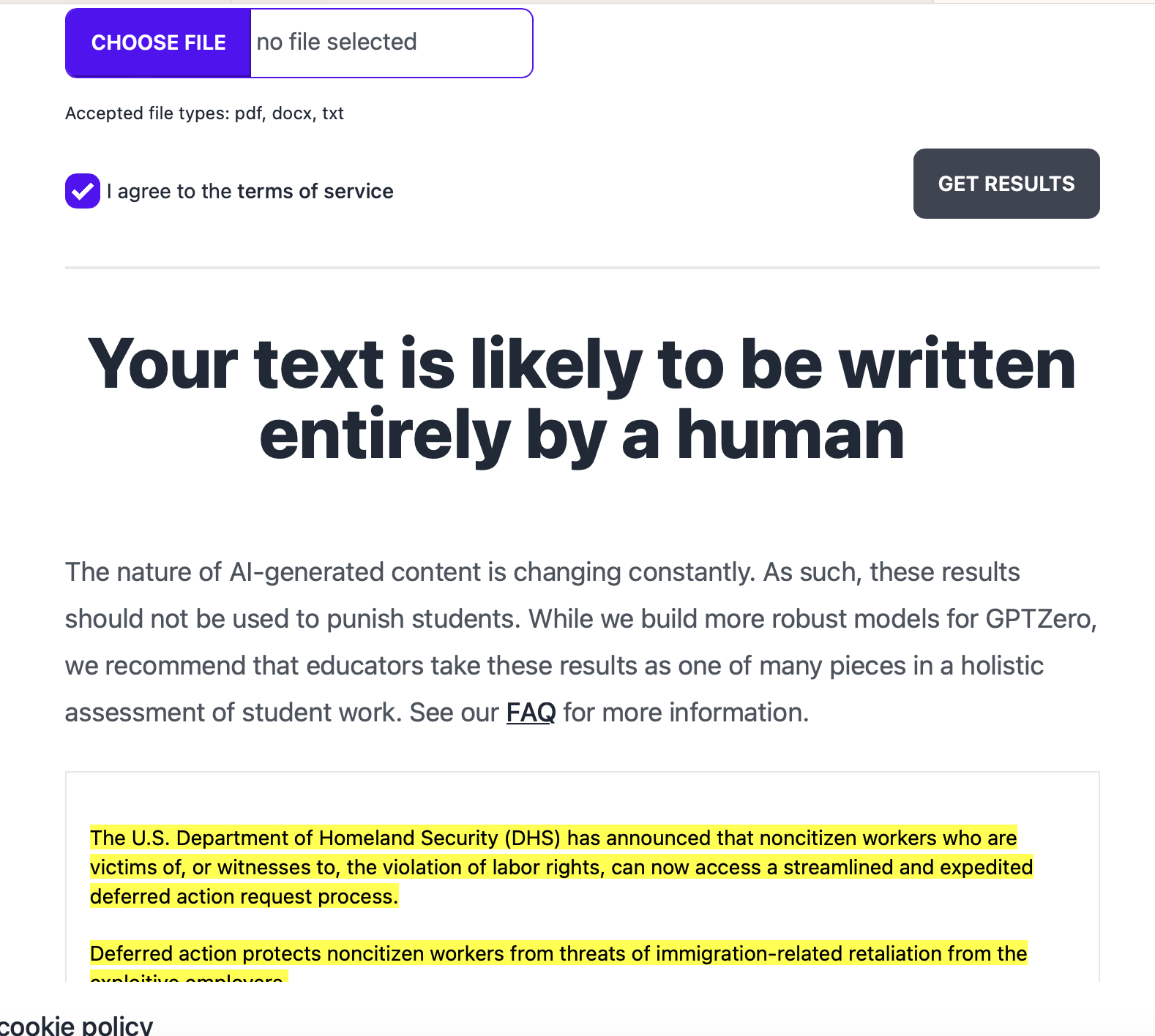
Original:
Results:
---
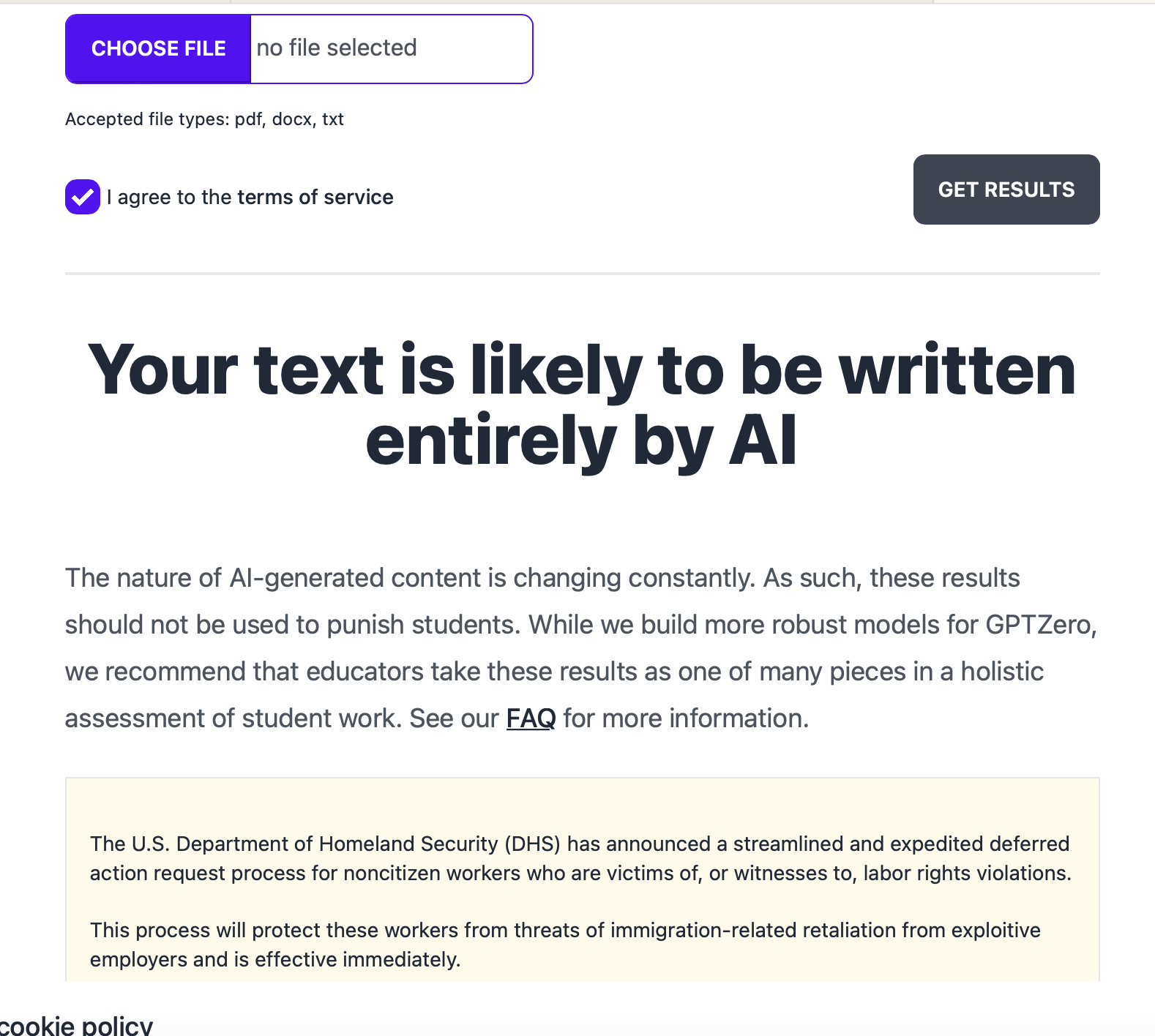
Simple rewrite:
---
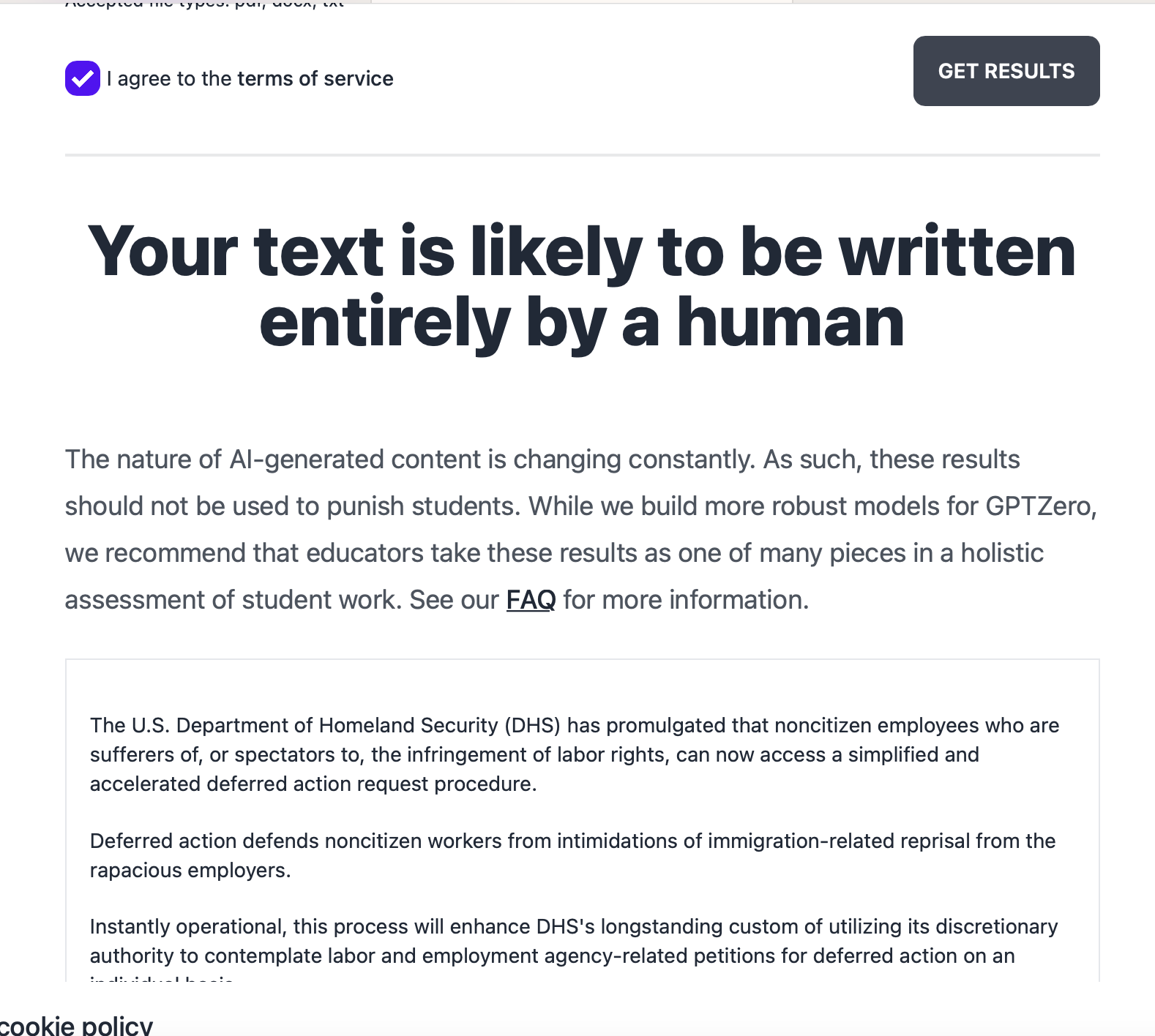
Rewrite to bypass GPTZero:
---
This was just a basic prompt and it can be enhanced to improve the output. This was just an example to show that it's very easy to bypass these detectors with smart prompts.
Here's an example. I used my rewriting script to rewrite an article using a regular rewriting prompt and then a prompt meant to bypass GTPZero detection. It took a few seconds to rewrite the entire article that bypasses GPTZero.
Original:
The U.S. Department of Homeland Security (DHS) has announced that noncitizen workers who are victims of, or witnesses to, the violation of labor rights, can now access a streamlined and expedited deferred action request process. Deferred action protects noncitizen workers from threats of immigration-related retaliation from the exploitive employers. Effective immediately, this process will improve DHS’s longstanding practice of using its discretionary authority to consider labor and employment agency-related requests for deferred action on a case-by-case basis. Workers will be able to visit DHS.gov for additional information in English and Spanish and to submit requests. These improvements advance the Biden-Harris Administration’s commitment to empowering workers and improving workplace conditions by enabling all workers, including noncitizens, to assert their legal rights.
“Unscrupulous employers who prey on the vulnerability of noncitizen workers harm all workers and disadvantage businesses who play by the rules,” said Secretary of Homeland Security Alejandro N. Mayorkas. “We will hold these predatory actors accountable by encouraging all workers to assert their rights, report violations they have suffered or observed, and cooperate in labor standards investigations. Through these efforts, and with our labor agency partners, we will effectively protect the American labor market, the conditions of the American worksite, and the dignity of the workers who power our economy.”
Workers are often afraid to report violations of law by exploitative employers or to cooperate in employment and labor standards investigations because they fear removal or other immigration-related retaliation by an abusive employer. Agencies tasked with enforcing labor and employment laws depend on the cooperation of these workers in their investigations. Refraining from reporting violations due to a fear of immigration-based retaliation creates unfair labor market conditions and perpetuates the commission of unlawful and inhumane acts by employers, including nonpayment of wages, the imposition of unsafe working conditions, and chilling workers’ ability to organize and collectively bargain to improve such conditions. DHS’s practice of offering discretionary protection on a case-by-case basis to noncitizen victims facilitates the ability of labor and employment agencies to more fully investigate worksite violations, supporting the agencies in fulfilling their mission and holding abusive employers accountable. By streamlining this process and helping to improve workplace conditions for all workers, today’s announcement is one of many ways in which DHS is taking action to fulfill its commitment to U.S. workers, pursuant to the White House Task Force on Worker Organizing and Empowerment.
In addition to providing new guidance to labor agencies regarding processes to seek deferred action for certain workers, DHS will also provide for a single intake point for deferred action requests from noncitizen workers that are supported by labor enforcement agencies. The centralized intake process will allow DHS to efficiently review these time-sensitive requests, provide additional security to eligible workers on a case-by-case basis, and more robustly support the mission of labor agencies. These process enhancements are consistent with Secretary Mayorkas’ October 2021 memorandum, which directed DHS offices and agencies to ensure that DHS fulfills its critical role supporting the important work of labor agencies to enforce wage protections, workplace safety, labor rights, and other laws and standards.
DHS has long considered requests for deferred action submitted by noncitizen workers who fall within the scope of a labor agency investigation and/or enforcement action. Noncitizens will now be able to submit such requests to U.S. Citizenship and Immigration Services (USCIS) through a central intake point established specifically to support labor agency investigative and enforcement efforts. For deferred action requests from noncitizens who are in removal proceedings or have a final order of removal, upon reviewing the submission for completeness, USCIS will forward such requests to U.S. Immigration and Customs Enforcement (ICE) to make a final determination on a case-by-case basis. USCIS will consider all other deferred action requests on a case-by-case basis. USCIS will also consider all related employment authorization applications, including those related to deferred action requests decided by ICE. Given the often time-sensitive labor agency enforcement interests, efficient processing of deferred action and related applications for employment authorization will reduce potential risks to workers and retaliation by their employers under investigation.
In addition to satisfying individual criteria to facilitate case-by-case determinations, requests for deferred action submitted through this centralized process must include a letter (a Statement of Interest) from a federal, state, or local labor agency asking DHS to consider exercising its discretion on behalf of workers employed by companies identified by the agency as having labor disputes related to laws that fall under its jurisdiction. In addition to other elements, as detailed in DHS’s Frequently Asked Questions (FAQs), the letter from the labor agency should include:
The enforcement or jurisdictional interest of the labor agency and how it relates to the mission of the labor agency;
The workers covered by the Statement of Interest;
Why DHS’s consideration of prosecutorial discretion with respect to these specific workers supports the labor agency’s interest.
Consistent with existing practice, discretionary grants of deferred action under this process will typically last for a period of two years, subject to termination at any time. Individuals granted deferred action may be eligible for employment authorization under existing regulations, which require that they demonstrate an economic necessity for employment. They may also be eligible for subsequent grants of deferred action if a labor agency has a continuing investigative or enforcement interest in the matter identified in their original letter supporting DHS use of prosecutorial discretion.
“Unscrupulous employers who prey on the vulnerability of noncitizen workers harm all workers and disadvantage businesses who play by the rules,” said Secretary of Homeland Security Alejandro N. Mayorkas. “We will hold these predatory actors accountable by encouraging all workers to assert their rights, report violations they have suffered or observed, and cooperate in labor standards investigations. Through these efforts, and with our labor agency partners, we will effectively protect the American labor market, the conditions of the American worksite, and the dignity of the workers who power our economy.”
Workers are often afraid to report violations of law by exploitative employers or to cooperate in employment and labor standards investigations because they fear removal or other immigration-related retaliation by an abusive employer. Agencies tasked with enforcing labor and employment laws depend on the cooperation of these workers in their investigations. Refraining from reporting violations due to a fear of immigration-based retaliation creates unfair labor market conditions and perpetuates the commission of unlawful and inhumane acts by employers, including nonpayment of wages, the imposition of unsafe working conditions, and chilling workers’ ability to organize and collectively bargain to improve such conditions. DHS’s practice of offering discretionary protection on a case-by-case basis to noncitizen victims facilitates the ability of labor and employment agencies to more fully investigate worksite violations, supporting the agencies in fulfilling their mission and holding abusive employers accountable. By streamlining this process and helping to improve workplace conditions for all workers, today’s announcement is one of many ways in which DHS is taking action to fulfill its commitment to U.S. workers, pursuant to the White House Task Force on Worker Organizing and Empowerment.
In addition to providing new guidance to labor agencies regarding processes to seek deferred action for certain workers, DHS will also provide for a single intake point for deferred action requests from noncitizen workers that are supported by labor enforcement agencies. The centralized intake process will allow DHS to efficiently review these time-sensitive requests, provide additional security to eligible workers on a case-by-case basis, and more robustly support the mission of labor agencies. These process enhancements are consistent with Secretary Mayorkas’ October 2021 memorandum, which directed DHS offices and agencies to ensure that DHS fulfills its critical role supporting the important work of labor agencies to enforce wage protections, workplace safety, labor rights, and other laws and standards.
DHS has long considered requests for deferred action submitted by noncitizen workers who fall within the scope of a labor agency investigation and/or enforcement action. Noncitizens will now be able to submit such requests to U.S. Citizenship and Immigration Services (USCIS) through a central intake point established specifically to support labor agency investigative and enforcement efforts. For deferred action requests from noncitizens who are in removal proceedings or have a final order of removal, upon reviewing the submission for completeness, USCIS will forward such requests to U.S. Immigration and Customs Enforcement (ICE) to make a final determination on a case-by-case basis. USCIS will consider all other deferred action requests on a case-by-case basis. USCIS will also consider all related employment authorization applications, including those related to deferred action requests decided by ICE. Given the often time-sensitive labor agency enforcement interests, efficient processing of deferred action and related applications for employment authorization will reduce potential risks to workers and retaliation by their employers under investigation.
In addition to satisfying individual criteria to facilitate case-by-case determinations, requests for deferred action submitted through this centralized process must include a letter (a Statement of Interest) from a federal, state, or local labor agency asking DHS to consider exercising its discretion on behalf of workers employed by companies identified by the agency as having labor disputes related to laws that fall under its jurisdiction. In addition to other elements, as detailed in DHS’s Frequently Asked Questions (FAQs), the letter from the labor agency should include:
The enforcement or jurisdictional interest of the labor agency and how it relates to the mission of the labor agency;
The workers covered by the Statement of Interest;
Why DHS’s consideration of prosecutorial discretion with respect to these specific workers supports the labor agency’s interest.
Consistent with existing practice, discretionary grants of deferred action under this process will typically last for a period of two years, subject to termination at any time. Individuals granted deferred action may be eligible for employment authorization under existing regulations, which require that they demonstrate an economic necessity for employment. They may also be eligible for subsequent grants of deferred action if a labor agency has a continuing investigative or enforcement interest in the matter identified in their original letter supporting DHS use of prosecutorial discretion.
Results:
---
Simple rewrite:
The U.S. Department of Homeland Security (DHS) has announced a streamlined and expedited deferred action request process for noncitizen workers who are victims of, or witnesses to, labor rights violations. This process will protect these workers from threats of immigration-related retaliation from exploitive employers and is effective immediately. DHS’s longstanding practice of considering labor and employment agency-related requests for deferred action on a case-by-case basis has been improved with this new process. Workers can visit DHS.gov for more information in English and Spanish, as well as to submit their requests. These improvements advance the Biden-Harris Administration’s commitment to empowering all workers, including noncitizens, by enabling them to assert their legal rights.
Secretary of Homeland Security Alejandro N. Mayorkas warned that unscrupulous employers who take advantage of noncitizen workers not only harm all workers, but also put honest businesses at a disadvantage. He encouraged all workers to stand up for their rights, report any violations they have experienced or witnessed, and cooperate with labor standards investigations. By doing so, he believes we can protect the American labor market, uphold the conditions of the American worksite, and safeguard the dignity of those who drive our economy.
Many workers are afraid to report violations of labor and employment laws by exploitative employers or cooperate in investigations due to fear of immigration-related retaliation. This creates an unfair labor market and allows employers to commit unlawful and inhumane acts, such as nonpayment of wages, unsafe working conditions, and preventing workers from organizing or bargaining collectively. To address this issue, the Department of Homeland Security (DHS) is taking action by offering discretionary protection on a case-by-case basis to noncitizen victims. This will help labor and employment agencies more fully investigate worksite violations, hold abusive employers accountable, improve workplace conditions for all workers, and fulfill the White House Task Force on Worker Organizing and Empowerment's commitment to U.S. workers.
DHS is taking steps to provide new guidance to labor agencies on how to seek deferred action for certain workers, as well as establishing a single intake point for these requests. This centralized process will help DHS quickly review and respond to time-sensitive requests, while also providing additional security for eligible workers on a case-by-case basis. These enhancements are in line with Secretary Mayorkas’ October 2021 memorandum, which directed DHS offices and agencies to ensure that DHS supports the important work of labor agencies in enforcing wage protections, workplace safety, labor rights, and other laws and standards.
The Department of Homeland Security (DHS) has long recognized the need to consider requests for deferred action submitted by noncitizen workers who are within the scope of a labor agency investigation and/or enforcement action. To support these labor agency efforts, U.S. Citizenship and Immigration Services (USCIS) has established a central intake point to receive such requests from noncitizens. Upon reviewing each submission for completeness, USCIS will forward requests from those in removal proceedings or with a final order of removal to U.S. Immigration and Customs Enforcement (ICE) for a case-by-case determination. All other deferred action requests will be considered on a case-by-case basis by USCIS, as well as any related employment authorization applications, including those related to deferred action decisions made by ICE. By efficiently processing deferred action and related applications for employment authorization, DHS is taking steps to reduce potential risks to workers and retaliation by their employers under investigation - an effort that is often time-sensitive given the nature of labor agency enforcement interests.
In order to be considered for deferred action through this centralized process, requests must include a Statement of Interest letter from a federal, state, or local labor agency. This letter should include various elements as detailed in DHS’s Frequently Asked Questions (FAQs), and should ask DHS to consider exercising its discretion on behalf of workers employed by companies identified by the agency as having labor disputes related to laws that fall under its jurisdiction. Furthermore, individual criteria must be met in order to facilitate case-by-case determinations.
The labor agency's enforcement and jurisdictional interests are integral to its mission. They ensure that the agency is able to carry out its goals of protecting workers' rights, promoting safe working conditions, and ensuring fair wages. By enforcing laws and regulations, the labor agency is able to hold employers accountable for their actions and ensure that workers are treated fairly.
The workers protected by this Statement of Interest are those who are employed in the workplace, and whose rights and interests are safeguarded by its provisions. They have a right to fair wages, safe working conditions, and respect for their labor. This Statement of Interest is an assurance that these rights will be upheld and that the employer will provide a secure environment for them to work in.
The Department of Homeland Security's (DHS) consideration of prosecutorial discretion for certain workers is in line with the agency's interests. This decision allows DHS to focus its resources on more pressing matters, while also recognizing the contributions these individuals have made to our economy and society.
Consistent with existing practice, discretionary grants of deferred action under this process will typically last for a period of two years, but may be terminated at any time. Individuals granted deferred action may be eligible for employment authorization if they can demonstrate an economic necessity for employment in accordance with existing regulations. Furthermore, they may be eligible for subsequent grants of deferred action if the Department of Homeland Security (DHS) has a continuing investigative or enforcement interest in the matter identified in their original letter supporting DHS use of prosecutorial discretion.
Secretary of Homeland Security Alejandro N. Mayorkas warned that unscrupulous employers who take advantage of noncitizen workers not only harm all workers, but also put honest businesses at a disadvantage. He encouraged all workers to stand up for their rights, report any violations they have experienced or witnessed, and cooperate with labor standards investigations. By doing so, he believes we can protect the American labor market, uphold the conditions of the American worksite, and safeguard the dignity of those who drive our economy.
Many workers are afraid to report violations of labor and employment laws by exploitative employers or cooperate in investigations due to fear of immigration-related retaliation. This creates an unfair labor market and allows employers to commit unlawful and inhumane acts, such as nonpayment of wages, unsafe working conditions, and preventing workers from organizing or bargaining collectively. To address this issue, the Department of Homeland Security (DHS) is taking action by offering discretionary protection on a case-by-case basis to noncitizen victims. This will help labor and employment agencies more fully investigate worksite violations, hold abusive employers accountable, improve workplace conditions for all workers, and fulfill the White House Task Force on Worker Organizing and Empowerment's commitment to U.S. workers.
DHS is taking steps to provide new guidance to labor agencies on how to seek deferred action for certain workers, as well as establishing a single intake point for these requests. This centralized process will help DHS quickly review and respond to time-sensitive requests, while also providing additional security for eligible workers on a case-by-case basis. These enhancements are in line with Secretary Mayorkas’ October 2021 memorandum, which directed DHS offices and agencies to ensure that DHS supports the important work of labor agencies in enforcing wage protections, workplace safety, labor rights, and other laws and standards.
The Department of Homeland Security (DHS) has long recognized the need to consider requests for deferred action submitted by noncitizen workers who are within the scope of a labor agency investigation and/or enforcement action. To support these labor agency efforts, U.S. Citizenship and Immigration Services (USCIS) has established a central intake point to receive such requests from noncitizens. Upon reviewing each submission for completeness, USCIS will forward requests from those in removal proceedings or with a final order of removal to U.S. Immigration and Customs Enforcement (ICE) for a case-by-case determination. All other deferred action requests will be considered on a case-by-case basis by USCIS, as well as any related employment authorization applications, including those related to deferred action decisions made by ICE. By efficiently processing deferred action and related applications for employment authorization, DHS is taking steps to reduce potential risks to workers and retaliation by their employers under investigation - an effort that is often time-sensitive given the nature of labor agency enforcement interests.
In order to be considered for deferred action through this centralized process, requests must include a Statement of Interest letter from a federal, state, or local labor agency. This letter should include various elements as detailed in DHS’s Frequently Asked Questions (FAQs), and should ask DHS to consider exercising its discretion on behalf of workers employed by companies identified by the agency as having labor disputes related to laws that fall under its jurisdiction. Furthermore, individual criteria must be met in order to facilitate case-by-case determinations.
The labor agency's enforcement and jurisdictional interests are integral to its mission. They ensure that the agency is able to carry out its goals of protecting workers' rights, promoting safe working conditions, and ensuring fair wages. By enforcing laws and regulations, the labor agency is able to hold employers accountable for their actions and ensure that workers are treated fairly.
The workers protected by this Statement of Interest are those who are employed in the workplace, and whose rights and interests are safeguarded by its provisions. They have a right to fair wages, safe working conditions, and respect for their labor. This Statement of Interest is an assurance that these rights will be upheld and that the employer will provide a secure environment for them to work in.
The Department of Homeland Security's (DHS) consideration of prosecutorial discretion for certain workers is in line with the agency's interests. This decision allows DHS to focus its resources on more pressing matters, while also recognizing the contributions these individuals have made to our economy and society.
Consistent with existing practice, discretionary grants of deferred action under this process will typically last for a period of two years, but may be terminated at any time. Individuals granted deferred action may be eligible for employment authorization if they can demonstrate an economic necessity for employment in accordance with existing regulations. Furthermore, they may be eligible for subsequent grants of deferred action if the Department of Homeland Security (DHS) has a continuing investigative or enforcement interest in the matter identified in their original letter supporting DHS use of prosecutorial discretion.
---
Rewrite to bypass GPTZero:
The U.S. Department of Homeland Security (DHS) has promulgated that noncitizen employees who are sufferers of, or spectators to, the infringement of labor rights, can now access a simplified and accelerated deferred action request procedure. Deferred action defends noncitizen workers from intimidations of immigration-related reprisal from the rapacious employers. Instantly operational, this process will enhance DHS’s longstanding custom of utilizing its discretionary authority to contemplate labor and employment agency-related petitions for deferred action on an individual basis. Employees will be able to visit DHS.gov for extra information in English and Spanish and to present requests. These improvements further the Biden-Harris Administration’s pledge to empowering workers and refining workplace conditions by permitting all workers, including noncitizens, to assert their legal rights.
"Unprincipled employers who exploit the susceptibleness of non-native workers detriment all laborers and put businesses who adhere to the regulations at a disadvantage," declared Secretary of Homeland Security Alejandro N. Mayorkas. "We will hold these rapacious actors answerable by inspiring all employees to assert their prerogatives, relate infringements they have endured or noticed, and collaborate in labor standards inquiries. Through these endeavors, and with our labor agency allies, we will effectively safeguard the American labor market, the conditions of the American worksite, and the self-respect of the personnel who drive our economy."
Workers are often averse to divulging infringements of the law by oppressive employers or to collaborate in employment and labor standards investigations due to their trepidation of expulsion or other immigration-related retribution by an oppressive employer. Agencies charged with upholding labor and employment laws rely on the collaboration of these workers in their probes. Abstaining from reporting violations out of fear of immigration-based retaliation engenders inequitable labor market conditions and sustains the perpetration of unlawful and cruel acts by employers, comprising nonpayment of wages, the imposition of perilous working conditions, and deterring workers’ capability to organize and collectively bargain to enhance such conditions. DHS’s practice of offering discretionary protection on a case-by-case basis to noncitizen victims facilitates the ability of labor and employment agencies to more completely investigate worksite violations, bolstering the agencies in accomplishing their mission and holding abusive employers accountable. By simplifying this process and aiding in ameliorating workplace conditions for all workers, today’s proclamation is one of many ways in which DHS is taking action to satisfy its commitment to U.S. workers, pursuant to the White House Task Force on Worker Organizing and Empowerment.
In consonance with Secretary Mayorkas’ October 2021 memorandum, which enjoined DHS offices and agencies to guarantee that DHS accomplishes its pivotal role sustaining the consequential work of labor agencies to enforce wage protections, workplace safety, labor rights, and other regulations and standards, DHS will also institute a single intake point for deferred action requests from noncitizen workers that are backed by labor enforcement agencies. This centralized intake process will enable DHS to expeditiously examine these urgent requests, bestow extra security to eligible workers on an individual basis, and more powerfully sustain the mission of labor agencies. These process improvements are congruous with the new guidance provided to labor agencies regarding procedures to seek deferred action for certain workers.
The Department of Homeland Security (DHS) has long been cognizant of requests for deferred action submitted by noncitizen workers who fall within the purview of a labor agency investigation and/or enforcement action. To this end, U.S. Citizenship and Immigration Services (USCIS) has established a centralized intake point to facilitate labor agency investigative and enforcement efforts. For deferred action requests from noncitizens who are in removal proceedings or have a final order of removal, USCIS will review the submission for completeness before forwarding it to U.S. Immigration and Customs Enforcement (ICE) for a case-by-case determination. Other deferred action requests will be considered on an individual basis by USCIS, as well as any related applications for employment authorization, including those adjudicated by ICE. This expeditious processing of deferred action and associated applications for employment authorization should mitigate potential risks to workers and preclude retaliatory measures by their employers under investigation.
In order to meet the prerequisites for case-specific adjudications, applications for deferred action submitted through this centralized system must include a missive (a Declaration of Interest) from a federal, state, or local labor agency imploring DHS to contemplate exercising its prerogative on behalf of employees employed by firms identified by the agency as having labor disputes related to laws that fall within its purview. In addition to other components, as elucidated in DHS’s Commonly Asked Questions (FAQs), the epistle from the labor agency should comprise:
The implementation or supervisory concern of the labor agency and how it pertains to the objective of the labor agency;
The toilers encompassed by the Manifesto of Intent;
The Department of Homeland Security's (DHS) contemplation of prosecutorial leniency towards these particular employees augments the labor agency's stake.
In consonance with extant custom, discretionary bestowals of abeyance under this procedure will generally persist for a span of two years, amenable to revocation at any juncture. Persons granted abeyance may be apt for remuneration authorization beneath extant regulations, which necessitate that they evidence an economic compulsion for gainfulness. They may also be eligible for subsequent grants of abeyance if a labor agency has a perpetual inquisitive or punitive interest in the issue identified in their initial epistle supporting DHS utilization of prosecutorial lenience.
"Unprincipled employers who exploit the susceptibleness of non-native workers detriment all laborers and put businesses who adhere to the regulations at a disadvantage," declared Secretary of Homeland Security Alejandro N. Mayorkas. "We will hold these rapacious actors answerable by inspiring all employees to assert their prerogatives, relate infringements they have endured or noticed, and collaborate in labor standards inquiries. Through these endeavors, and with our labor agency allies, we will effectively safeguard the American labor market, the conditions of the American worksite, and the self-respect of the personnel who drive our economy."
Workers are often averse to divulging infringements of the law by oppressive employers or to collaborate in employment and labor standards investigations due to their trepidation of expulsion or other immigration-related retribution by an oppressive employer. Agencies charged with upholding labor and employment laws rely on the collaboration of these workers in their probes. Abstaining from reporting violations out of fear of immigration-based retaliation engenders inequitable labor market conditions and sustains the perpetration of unlawful and cruel acts by employers, comprising nonpayment of wages, the imposition of perilous working conditions, and deterring workers’ capability to organize and collectively bargain to enhance such conditions. DHS’s practice of offering discretionary protection on a case-by-case basis to noncitizen victims facilitates the ability of labor and employment agencies to more completely investigate worksite violations, bolstering the agencies in accomplishing their mission and holding abusive employers accountable. By simplifying this process and aiding in ameliorating workplace conditions for all workers, today’s proclamation is one of many ways in which DHS is taking action to satisfy its commitment to U.S. workers, pursuant to the White House Task Force on Worker Organizing and Empowerment.
In consonance with Secretary Mayorkas’ October 2021 memorandum, which enjoined DHS offices and agencies to guarantee that DHS accomplishes its pivotal role sustaining the consequential work of labor agencies to enforce wage protections, workplace safety, labor rights, and other regulations and standards, DHS will also institute a single intake point for deferred action requests from noncitizen workers that are backed by labor enforcement agencies. This centralized intake process will enable DHS to expeditiously examine these urgent requests, bestow extra security to eligible workers on an individual basis, and more powerfully sustain the mission of labor agencies. These process improvements are congruous with the new guidance provided to labor agencies regarding procedures to seek deferred action for certain workers.
The Department of Homeland Security (DHS) has long been cognizant of requests for deferred action submitted by noncitizen workers who fall within the purview of a labor agency investigation and/or enforcement action. To this end, U.S. Citizenship and Immigration Services (USCIS) has established a centralized intake point to facilitate labor agency investigative and enforcement efforts. For deferred action requests from noncitizens who are in removal proceedings or have a final order of removal, USCIS will review the submission for completeness before forwarding it to U.S. Immigration and Customs Enforcement (ICE) for a case-by-case determination. Other deferred action requests will be considered on an individual basis by USCIS, as well as any related applications for employment authorization, including those adjudicated by ICE. This expeditious processing of deferred action and associated applications for employment authorization should mitigate potential risks to workers and preclude retaliatory measures by their employers under investigation.
In order to meet the prerequisites for case-specific adjudications, applications for deferred action submitted through this centralized system must include a missive (a Declaration of Interest) from a federal, state, or local labor agency imploring DHS to contemplate exercising its prerogative on behalf of employees employed by firms identified by the agency as having labor disputes related to laws that fall within its purview. In addition to other components, as elucidated in DHS’s Commonly Asked Questions (FAQs), the epistle from the labor agency should comprise:
The implementation or supervisory concern of the labor agency and how it pertains to the objective of the labor agency;
The toilers encompassed by the Manifesto of Intent;
The Department of Homeland Security's (DHS) contemplation of prosecutorial leniency towards these particular employees augments the labor agency's stake.
In consonance with extant custom, discretionary bestowals of abeyance under this procedure will generally persist for a span of two years, amenable to revocation at any juncture. Persons granted abeyance may be apt for remuneration authorization beneath extant regulations, which necessitate that they evidence an economic compulsion for gainfulness. They may also be eligible for subsequent grants of abeyance if a labor agency has a perpetual inquisitive or punitive interest in the issue identified in their initial epistle supporting DHS utilization of prosecutorial lenience.
---
This was just a basic prompt and it can be enhanced to improve the output. This was just an example to show that it's very easy to bypass these detectors with smart prompts.


