Kicking your ass with data.

validseo

Senior Member
Joined
Jul 17, 2013
Messages
928
Reaction score
551
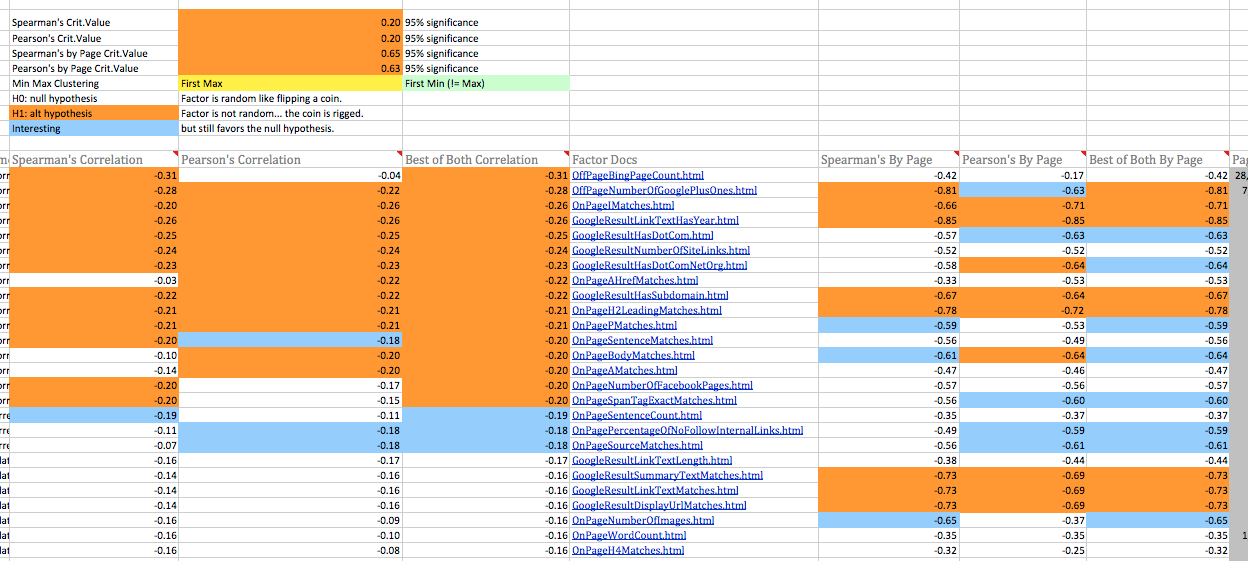
Before you complain about sample sizes... understand I measured and calculated over 50,000 data points to produce these charts by measuring over 300 factors from 100 web pages for the search term "SEO software" (So you can check my work and reproduce my results if you want to). The important part is that the correlations are statistically significant which I have demonstrated in the last image at the bottom. Obviously you need to redo the analysis for different search terms, but I anecdotally see these correlations for many different terms.

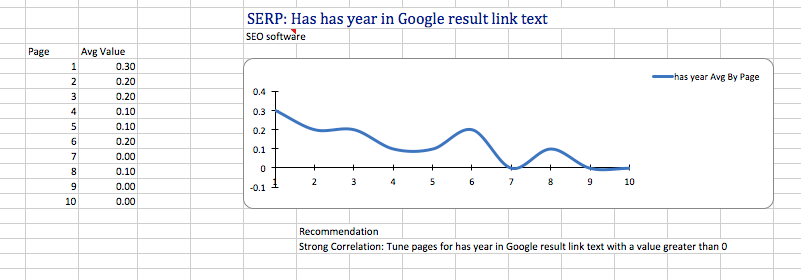
Having the year in your page title appears to pack a punch.
upload_2017-2-22_10-23-59.png


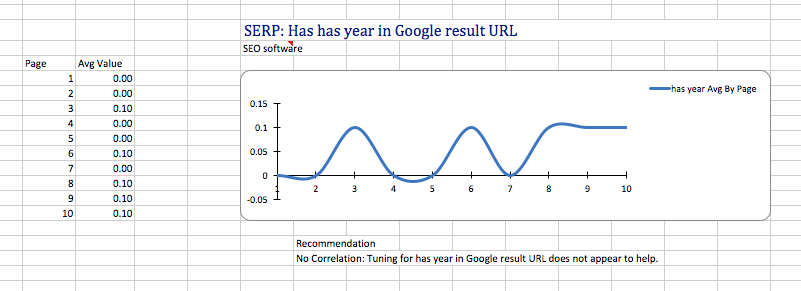
But having the year in your URL does not. Hmmmm...
upload_2017-2-22_10-24-5.png


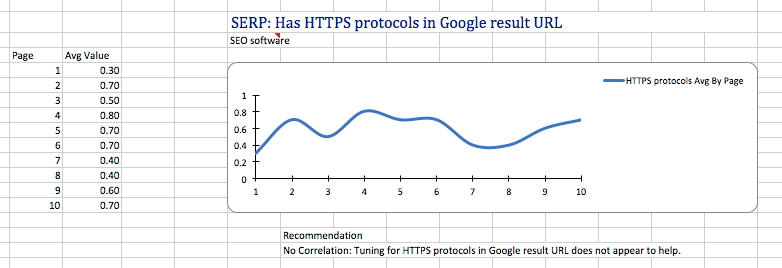
Despite Moz claiming that HTTPS is growing in usage in top results it still doesn't appear to correlate with rank position. As many have suspected HTTPS bonus appears to be dead.

upload_2017-2-22_10-24-12.png


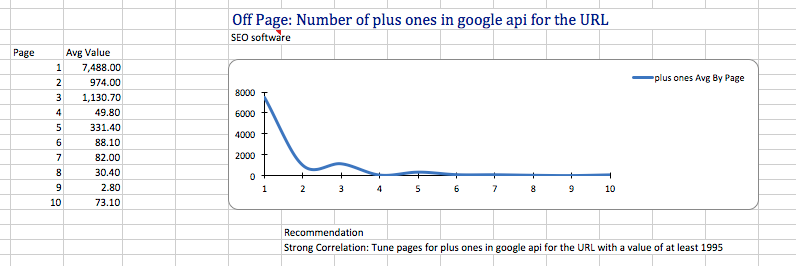
Who says Google doesn't play favorites? :)
upload_2017-2-22_10-24-20.png


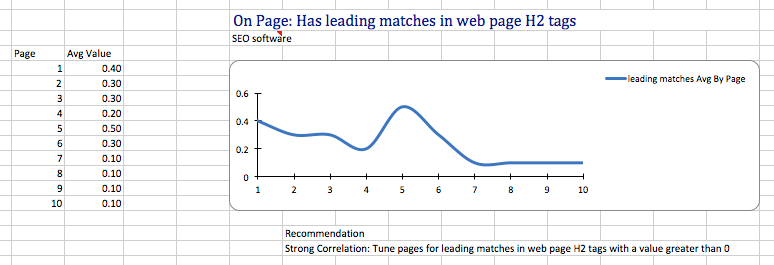
Matches in H1 tags don't correlate and matches in general in H2 tags don't correlate BUT leading matches in H2 tags pack a punch! :)
upload_2017-2-22_10-24-26.png


Just showing my work for the data police! :)
upload_2017-2-22_10-25-26.png
 
Last edited:
Great work! Data rules the world

What are "leading matches in h2" ?
 
Great work! Data rules the world

What are "leading matches in h2" ?

Anytime the content of the H2 tag begins with a match.

Leading Matches in H2 tags:
<h2>SEO software</h2>
<h2>SEO software is blah blah blah</h2>

Keep in mind the Google considers the following to be matches:

seo
seo software
seosoftware
software

Google tells us this by making matches bold in the search results:
upload_2017-2-22_10-52-34.png


An even better example of this is when you search Google for DUI lawyer los angeles
upload_2017-2-22_10-55-24.png
 
Anytime the content of the H2 tag begins with a match.

Leading Matches in H2 tags:
<h2>SEO software</h2>
<h2>SEO software is blah blah blah</h2>

Keep in mind the Google considers the following to be matches:

seo
seo software
seosoftware
software

Google tells us this by making matches bold in the search results:
View attachment 87650

An even better example of this is when you search Google for DUI lawyer los angelesView attachment 87652

Thanks! This is a really useful insight and makes sense from the common sense point of view as well.

I really wonder what would happen if one abandoned the usage of h1 completely. In some CMSs, h1 is used for a meaningless thing like site-wide title while article titles are encapsulated in H2s. Would they have an 'unfair advantage' over websites with standard composition or not...
Will try playing around with titles on my websites.
 
Thanks! This is a really useful insight and makes sense from the common sense point of view as well.

I really wonder what would happen if one abandoned the usage of h1 completely. In some CMSs, h1 is used for a meaningless thing like site-wide title while article titles are encapsulated in H2s. Would they have an 'unfair advantage' over websites with standard composition or not...
Will try playing around with titles on my websites.
H1 is very important in Bing. I don't recommend abandoning it.
 
Very nice findings, thank you for sharing these with us.

Did you find any correlations having to do with page DESCRIPTIONS by any chance??? Length, keyword contents, etc?

-ThopHayt
 
Very nice findings, thank you for sharing these with us.

Did you find any correlations having to do with page DESCRIPTIONS by any chance??? Length, keyword contents, etc?

-ThopHayt

I do measure those... no strong correlations. "Result Summary" refers to the description snippet that appears in the SERPs versus "Meta Description" which is the content put in the tag on page.

Their correlation coefficients range from 0 to -0.28 which favors the null hypothesis that they are not compelling ranking factors. They are critical for CTR though so don't mistake that for being unimportant. And I do see them correlate from time to time for other keywords so they may just be very weak factors which would require more samples to properly detect.

But weak factors aren't useful to me... I want things that have the best chance to move the needle. :)

CORRECTION: While they didn't have strong correlations over all top 100 results the Result Summary matches did correlate by average measure per page at -0.73 which IS significant... So match count in the description snippet in the SERPs does correlate with rank position.

upload_2017-2-22_13-50-30.png


upload_2017-2-22_13-50-42.png


upload_2017-2-22_13-50-52.png


upload_2017-2-22_13-51-2.png
 
Last edited:
Now this is a pretty awesome case study! Especially the h2 tag is very interesting. Thank you for sharing!
 
This is awesome. Would love to see more stuff like this. You got my gears turning.
 
Thank you so much! This is very useful keep up the good work with Case studies like this
 
Yeah. I guess desperate times call for desperate measures.

And yet they don't want to make Plus any easier to use.

I honestly can't understand how to use Google Plus. It's the most complicated thing in the history of complicated things.

Twitter is so simple to use.... But Google's goal is not a social network, but a personal identification system. That's their whole problem right there.
 
And yet they don't want to make Plus any easier to use.

I honestly can't understand how to use Google Plus. It's the most complicated thing in the history of complicated things.

Twitter is so simple to use.... But Google's goal is not a social network, but a personal identification system. That's their whole problem right there.
@bartosimpsonio in a nutshell:

1.Spread scary hat seo about Google dismantling your PBN's, and tracking your SEO clients/packages/strategies from their services like Gmail, Google docs/spreadsheets/adsense/analytics etc.

2.When confronted with facts, start the one liner frenzy comebacks going full-scary-retard on the assailants, because nothing could be further from the truth than the bullshit @bartosimpsonio spreads.

3.If attacks keep escalating, pull a @mickyfu esque reply , confronting the assailants with a dumb-enough question such as: "How many of you are there tonight, you must be {INSERT PREVIOUSLY BANNED USERNAME} with a brand new account"

4.Rinse and repeat spreading more scary hat seo


@bartosimpsonio intellect = protozoan
 
@validseo great stuff.

followup thoughts:

1) year in page title makes sense. i actually specifically avoid years in my urls so that they can be evergreen - wonder if thats connected at all, as something with 2016 in url probably started to drop in jan/feb of 2017 bc aint nobody searching for 2016 anymore

2) https - great confirmation here

3) h2s - i think bc many WP themes have the h1 automatically match the title tag (or the reverse), and h2s are deeper in the article, and indicate stronger density
 
Back
Top