
You are using an out of date browser. It may not display this or other websites correctly.
You should upgrade or use an alternative browser.
You should upgrade or use an alternative browser.
[Case Study] SearchMetrics 2013 Most Important Ranking Factors
- Thread starter oozyluce
- Start date


SkyrocketSEO
BANNED
- Nov 5, 2012
- 4,614
- 12,219
off-topic- I got a shotgun and rifle and 4-wheel drive, and country boy can survive....
on-topic- Why we see new thread about this every day?
on-topic- Why we see new thread about this every day?

oozyluce
Regular Member
- Jan 26, 2013
- 277
- 232
off-topic- I got a shotgun and rifle and 4-wheel drive, and country boy can survive....
on-topic- Why we see new thread about this every day?
I didn't see any other threads about it but i believe you. i didn't look that far.
This means one thing tho: it's worth sharing!

kelso
Regular Member
- Nov 30, 2009
- 479
- 276
Why we see new thread about this every day?
Because "this" changes every day

SkyrocketSEO
BANNED
- Nov 5, 2012
- 4,614
- 12,219
No, I ment, this graph is coming back each day.Because "this" changes every day

oozyluce
Regular Member
- Jan 26, 2013
- 277
- 232
Well I see it first time. Thank you oozluce, rep added.
You're welcome! It's quite nice to see some familiar faces around here
First time for me too thanks OP. Some quite surprising stats there.
Indeed, it's filled with surprises... In my opinion the on-page SEO data is as surprising as the off-page SEO
...BTW to those who actually read the full whitepaper, anybody understood the "WDF*P*IDF" formula?
It's supposed to bring a new way of looking at the keyword density as well as the page relevance for a certain keyword, and my slow, beer-fed brain is unable to process the information out of it.:albertein

crazedspyker
Senior Member
- Jan 5, 2010
- 1,004
- 661
I agree the on page data is what surprised me the most. Especially the lack of relevance for keyword in url, H1, H2, title and description. They are all at the bottom of the chart, that's amazing.
This data is *relative* to their 2012 analysis. (They mention this on their site)
This means social signals *has increased* in importance, but it's still quite negligible. At least this graph shows the trend Google is moving towards.
oozyluce
Regular Member
- Jan 26, 2013
- 277
- 232
This data is *relative* to their 2012 analysis. (They mention this on their site)
This means social signals *has increased* in importance, but it's still quite negligible. At least this graph shows the trend Google is moving towards.
Read the entire whitepaper dude, these are absolute metrics, not relative to last year. They actually do the comparison with last year's data inside the white paper, but the excerpt chart is not that one!
crazedspyker
Senior Member
- Jan 5, 2010
- 1,004
- 661
Read the entire whitepaper dude, these are absolute metrics, not relative to last year. They actually do the comparison with last year's data inside the white paper, but the excerpt chart is not that one!
"In addition to providing an overview of the changes in correlation since last year, we have extended our analysis in 2013 to include many relevant new factors."
They are focusing on the changes in correlation, not the absolute values. H1 is still very relevant, but it has decreased slightly.
I don't use any social signals at all for my main sites and they rank just fine, especially post penguin 2.0.
If I followed this graph assuming they were absolute values, I probably wouldn't even be on page 1. Sites don't rank on social signal yet. Maybe it will in the future, but right now it barely makes a difference. A lot of other people have tested this already and can tell you the same.
Then again, even if they were absolute values, they are still just correlations. Correlation does not equal or imply causation. For all we know, sites with social signals might also have another factor in common (with high correlation, not mentioned in this graph, as an example) which is responsible for 95% of the initial correlation (Again this is just an example).
But rep to you because it does show an overview and direction google is moving towards.
Last edited:

Petko
Regular Member
- Mar 9, 2011
- 246
- 108
Then please hit the 'thanks' button, not just trying to increase your post count
Cheers
Petko
Cheers
Petko
nice one,thanks for share
oozyluce
Regular Member
- Jan 26, 2013
- 277
- 232
"In addition to providing an overview of the changes in correlation since last year, we have extended our analysis in 2013 to include many relevant new factors."
They are focusing on the changes in correlation, not the absolute values. H1 is still very relevant, but it has decreased slightly.
I don't use any social signals at all for my main sites and they rank just fine, especially post penguin 2.0.
If I followed this graph assuming they were absolute values, I probably wouldn't even be on page 1. Sites don't rank on social signal yet. Maybe it will in the future, but right now it barely makes a difference. A lot of other people have tested this already and can tell you the same.
Then again, even if they were absolute values, they are still just correlations. Correlation does not equal or imply causation. For all we know, sites with social signals might also have another factor in common (with high correlation, not mentioned in this graph, as an example) which is responsible for 95% of the initial correlation (Again this is just an example).
But rep to you because it does show an overview and direction google is moving towards.
Thank you for the rep
But i must rehiterate to you, that those are absolute values and not relative to last year's changes.In your quote "In addition to providing an overview of the changes in correlation since last year, we have extended our analysis in 2013 to include many relevant new factors." The overview of the changes since last year is in fact present, but it is an addition.
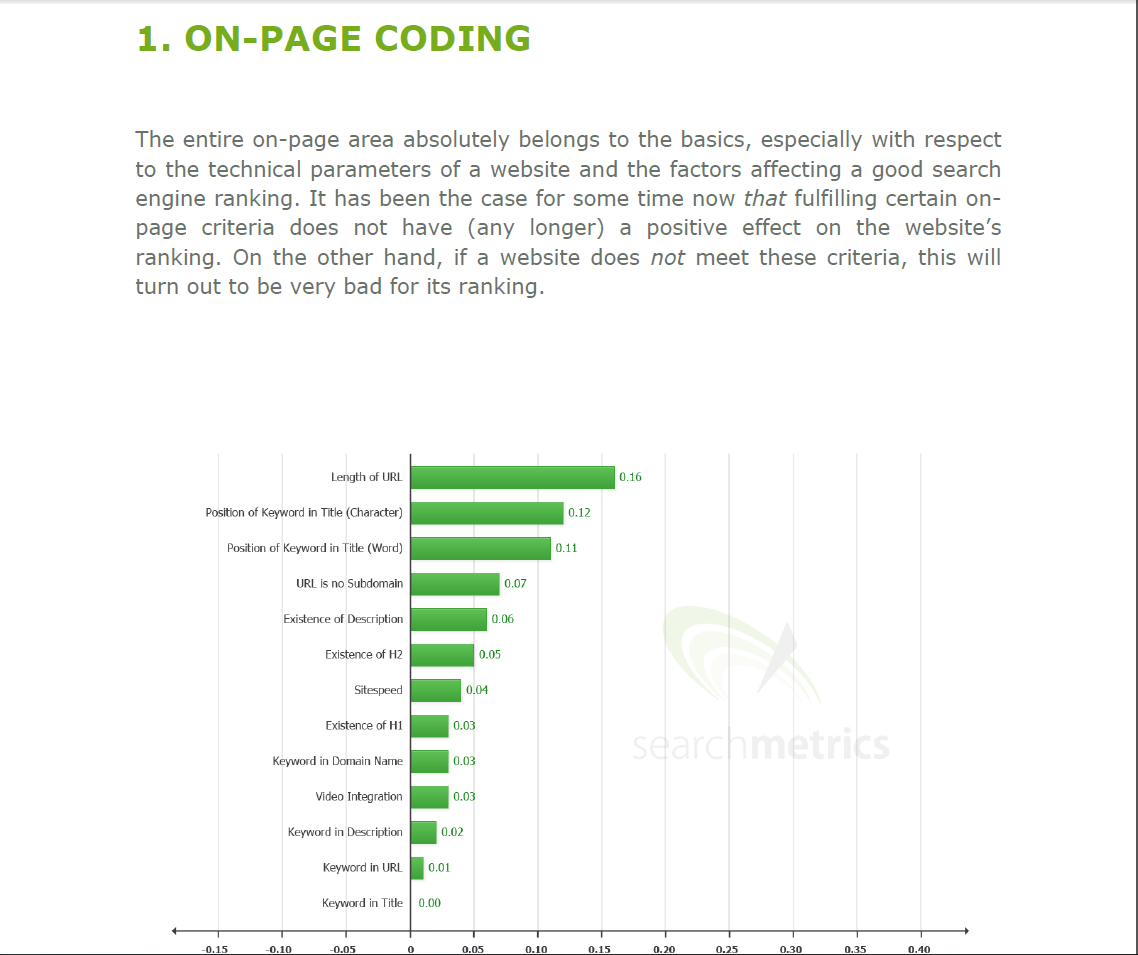
Here's a typical absolute ranking factor graph that they present during the entirety of the whitepaper:
Now, here's the "overview of the changes in correlation since last year" that they're speaking of, for the same data:

As you can see, some bars are greener one one side, meaning that they have observed that this ranking factor has increased in correlation since last year, and some bars are empty with a green border, meaning that they have observed that this particular ranking factor has decreased in correlation since last year.
They are focusing on the changes in correlation, not the absolute values. H1 is still very relevant, but it has decreased slightly.
I don't use any social signals at all for my main sites and they rank just fine, especially post penguin 2.0.
I was surprised at this data too at first glance, but the answer relies in a fact that you have stated yourself: "Correlation does not equal causation"! The reason behind the H1 tag having such a low value is because almost EVERY website from top 1 to top 30 had the keyword in the H1 tag, and therefore there is almost NO correlation with ranking #1 and having the keyword in H1 tag, because everyone is doing it! If every one is doing it from keyword #1 to keyword #30, how can there be a Spearman correlation between the keyword in h1 tag and good rankings? (quite trivial, isn't it!)
Point is, the keyword in h1 is not only very important, it is CRUCIAL:
If you omit to put it, it will have a NEGATIVE impact on your rankings.
If you do put it, the impact will not be positive, but rather neutral, as it is a decisional factor as wether you do get placed into the SERP for this keyword or not.
I hope that made sense
