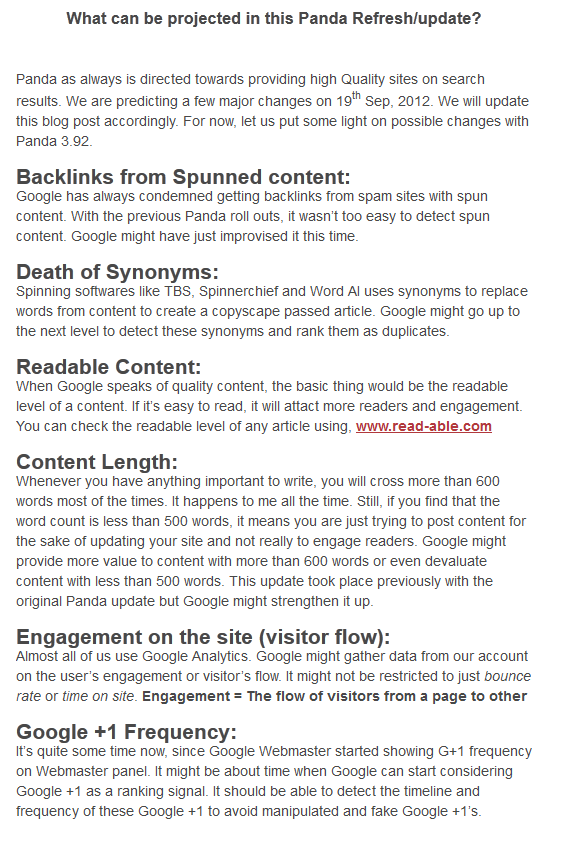
What can be predicted in this Panda update/Refresh (19th Sep)?

jr_sci

Senior Member
Joined
Jan 30, 2010
Messages
937
Reaction score
741
I wrote a blog post today and I would like further inputs from others. What can be predicted in this Panda Update/Refresh that was suppose to roll out today (19th Sep) ? I can't copy paste the content directly as it will be terms as duplicate. I will have a screenshot instead.

I will appreciate some further input from others. It will be great to hear how we should protect ourselves from getting hammered by Panda again.


nlSXD

 
Just write your own articles and build quality links, you'll be fine at the end. Panda and Penguin "Come at me, bro!"
 
Yeah I don't really have a problem with these updates because they definitely are killing a lot of the spammy backlinks and the sites that utilize them, but they're definitely rewarding people like me who use high quality backlinks in lesser amounts...the people who "don't try" I guess you could say.
 
The spinning thing is tightening, but in reality plagirism will always exist in one form or another. And obfuscating your sources will always be high on the plagirist agenda.

Given the "one point whatever-it-is-now trillion" URL's on the internet and millions of new ones created every day - coupled with Googles finite resources - we can be pretty sure they do not (and in all likelihood never will in the future) micro analyse every one of these URL's in the way that some paranoid people suggest they can.

They are getting better at the macro approach for sure. They are studying metrics such as sentence length, noun/verb relationships, stop word frequency, average word length. and more.

But all of this stuff is statistics based on counting some pretty generic key performance indicators. The idea of haviong the kind of resource to micro analyse several trillion URLS - their linking relationship with each other (imagine THAT diagram!!) the dating of content to ascertain "who was first", the logical reduction of every article to in a sense "read it with human eyes" and test logic...

Well, that's not going to happen.

Not saying they couldn't do it at some point, but despite their protestations to the contrary Google are NOT in the business of giving people a "good experience on the internet" - they are in the business of "making money".

As soon as the cost of micro analysing every URL on the net outweights the profitability of a marginally better index order - you can bet your sweet ass they will stop. So would you or I if we were in their shoes.

They are a business not a public library or the internet police.

Scritty
 
Content length: One of my competitors in a site has no more than 200 words per article and is targeting almost 3 keywords per page and he is still sitting right there on 1st-2nd spot, so I guess that with the content lenght is just bull. I ahve almost 1000 words articles and struggling to get up there
 
Content length: One of my competitors in a site has no more than 200 words per article and is targeting almost 3 keywords per page and he is still sitting right there on 1st-2nd spot, so I guess that with the content lenght is just bull. I ahve almost 1000 words articles and struggling to get up there

It depnds on the niche.

Some niches seem to benefit from a lot of content, others don't.

I suspect it depends on the size of the already established canon in the index and how complex google considers the issues in the niche to be.

Everything is context. Unless you know a site inside out, its niche, its onsite SEO, offsite linking, keyword targets, competition, navigation, on site linking, server speed, age, content length...then you cannot really make a judgement on exactly what factor is making the most difference.

That's why generic advice on internet forums is normally a crock of shit.

Scritty
 
Given the "one point whatever-it-is-now trillion" URL's on the internet and millions of new ones created every day - coupled with Googles finite resources - we can be pretty sure they do not (and in all likelihood never will in the future) micro analyse every one of these URL's in the way that some paranoid people suggest they can.

+1

The internet is growing faster than Google is growing. And Google doesn't put all their resources into their search department; they're trying to make driverless cars, broadband, augmented reality glasses, etc.. and run the risk of spreading themselves too thin.

On microanalysis of content, what seems more practical to me, is that if a URL is ranking and sets off enough red flags, only then would microanalysis be triggered. In the same way that a manual review is triggered.
 
Back
Top