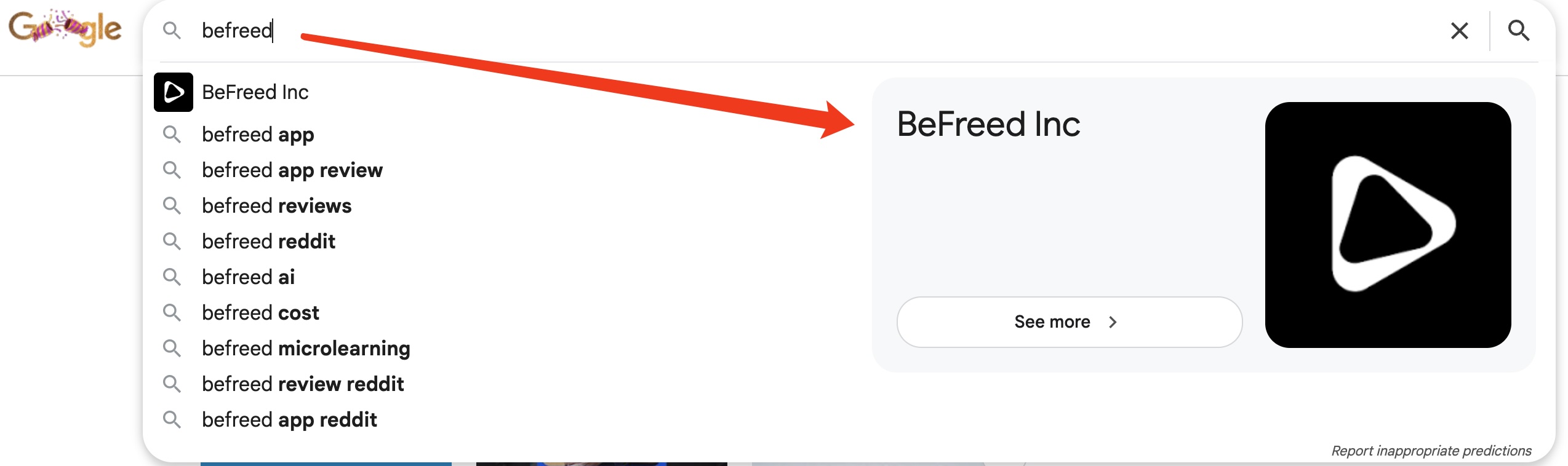
Method to display the large icon on Google Autocomplete - Prediction?

john_doe_

Junior Member
Joined
Feb 22, 2022
Messages
161
Reaction score
35
Hi there,

Just wanted to ask what are the ways or give stronger signals to be displayed in Google's Autocomplete with large icon?
google-prediction.jpg


Recently I find some "brands" are also get the position though they are not that "famous", some set Google Merchant, some not, some set GMB, some not.
I tried to do some research but find not too much ideas, so I wanted to ask if there are certain known methods to trigger this?

Thanks!
 
You mean the knowledge panel....random and hard to get for small brands..HQ citations on authority websites it's your best bet....other option is to find high ranking local guides and pay them to add your brand on Gmaps and on that gay forum they use.
 
You mean the knowledge panel....random and hard to get for small brands..HQ citations on authority websites it's your best bet....other option is to find high ranking local guides and pay them to add your brand on Gmaps and on that gay forum they use.
Maybe not the knowledge panel,
knowledge panel, google business profile are the sections display at the right hand side of the SERP, but what is asking is in the auto-complete dropdown list of Google search, there is a large icon. Not in SERP.
 
Mostly entity-based. Consistent brand signals (schema, brand searches, mentions) matter more than GMB or Merchant. Google seems to reward clear entities not just authority.
 
Even if some don't use GMB, having a verified Merchant Center with high-quality product feeds often triggers those icons. Google pulls data from wherever they find high-trust brand signals.
 
Autocomplete shows when Google recognizes strong brand signals. Make sure your brand name, logo and info are same across your landing, socials and GMB (if you have one). Adding structured data (Organization, Logo, and SameAs) helps too.
 
Even if some don't use GMB, having a verified Merchant Center with high-quality product feeds often triggers those icons. Google pulls data from wherever they find high-trust brand signals.
Understood, the situation is that we are not a product-based website, but provide just a tool, as a result, Merchant Center looks like not something we can use. Thanks.

Autocomplete shows when Google recognizes strong brand signals. Make sure your brand name, logo and info are same across your landing, socials and GMB (if you have one). Adding structured data (Organization, Logo, and SameAs) helps too.
Material point, this is what I've been discussed to the marketing team, we are now commonly calling 3-4 different names by our users. The name in our structured data is different to other channels :weep:

Triggered by strong brand entity signals, app listings, Knowledge Graph—no direct control.
Thanks for reply~
 
You have to have really really good ranking. That's probably the only way.
not really, my client (was) has been in declining imp & clks in GSC in the past months, their product page, catalogue page, content page all dropped from 5-10 to now out out of 25-40, but they do a lot off-page actions and get the position in Google autocomlete large icon.
On the other hand, some of my clients have great result in GSC, get google knowledge panel (now brand profile section), but dont' have position in the large icon of Google autocomplete.
 
That large icon in Google autocomplete next to brand names is not a separate feature you can apply for or request. It appears automatically when Google recognises your brand as a verified entity in its Knowledge Graph.
So the real question is not "how do I get the icon" but "how do I get my brand into Google's Knowledge Graph." The icon is just the result.
Here is what actually works based on research and testing.
The most important step is Organization Schema Markup on your homepage.
This is a small piece of code you add to the head section of your website. It tells Google your brand name, logo, social profiles, app store links, and Wikidata entry all in one place.
I can share the exact code format as an example if you would like.

Why each part matters:
The @id line is the most important. It gives your brand a permanent unique ID. Google uses this to connect your website, your app, your social profiles, and your Wikidata entry as one single entity. Without this line Google may see all those profiles as separate unrelated things.
The logo width and height fields tell Google your logo dimensions. Google's autocomplete prefers square images at 512 x 512 pixels. If you just put a URL without dimensions Google has to guess. Specify the dimensions and you remove that uncertainty.
The sameAs app store links are the secret that brands like BeFreed Inc used. Adding Google Play and Apple App Store links tells Google directly that your website and your app are the same entity. This combined presence across web and app platforms accelerates Knowledge Graph recognition significantly.
The Wikidata link is the strongest trust signal of all. If your brand does not have a Wikidata entry yet create one. It is free and takes about 30 minutes. Then add the link here.
Beyond the schema code:
Make sure your brand name and logo are identical across every social profile. Inconsistency confuses Google's entity recognition.
Encourage real branded searches from your existing audience. Real human searches accelerate Knowledge Graph recognition faster than any technical fix.
Once a Knowledge Panel appears for your brand claim it immediately through Google Search Console.
How long does this take?
Typically four to eight weeks after implementing everything before you see results. It is not instant. Google needs time to crawl the schema, verify your entity signals, and update the Knowledge Graph. Be patient and consistent.
Test your schema using Google's free Rich Results Test at search.google.com/test/rich-results before going live to make sure everything is implemented correctly.
Hope this helps everyone who has been wondering about this feature.
 
From what I’ve noticed, it’s mostly about strong brand signals and people actually searching for you. GMB and schema help, but real search demand seems to matter the most.
 
From what I’ve noticed, it’s mostly about strong brand signals and people actually searching for you. GMB and schema help, but real search demand seems to matter the most.
You are right about the search demand. It is definitely the fuel. But think of the schema and entity setup as the engine.

Here is the easiest way to look at it: If a thousand people search for your brand, but Google cannot clearly connect your website, your socials, and your app together behind the scenes, Google gets confused. It doesn't know exactly who is getting all that attention.

Setting up the technical side simply connects all the dots for Google. Without those dots connected, all that great search volume just scatters and won't trigger the icon.
 
Back
Top