Optimizing Website Structure for SEO

rox94

Registered Member
Joined
Nov 6, 2024
Messages
70
Reaction score
34
Hello everyone,

I am working on creating a website, and I would appreciate some feedback on the structure I am implementing.

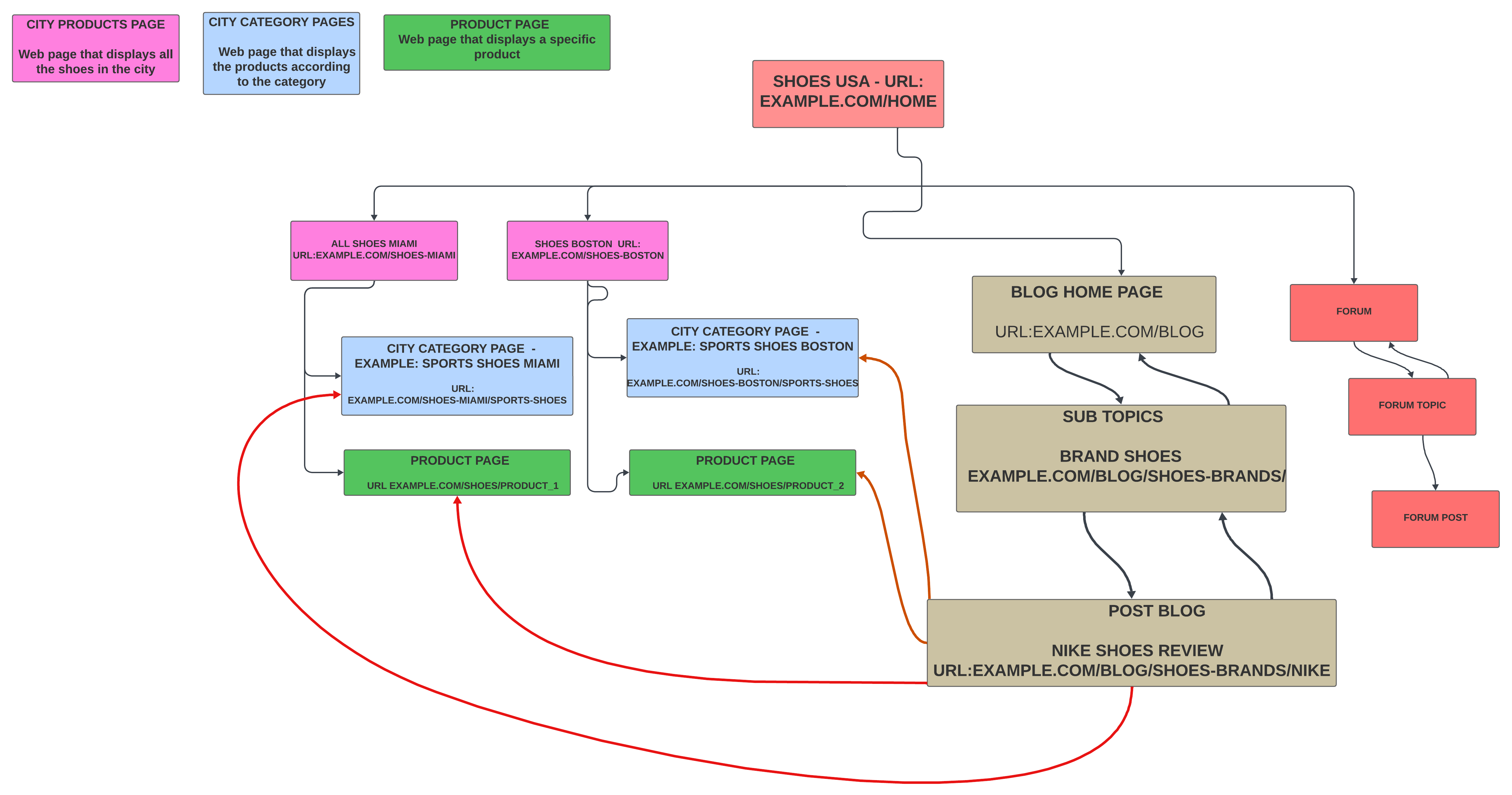
The structure I am thinking of is as follows:

1732145347571.png


Homepage (Home)

The main URL would be: example.com/home. This page will not display products but will have links to the different cities and key sections of the website. I’m including just two cities in the schema for now (Miami and Boston) to keep it simple.

City Pages

Each city will have its own page, with URLs like:
example.com/shoes-boston or example.com/shoes-miami. These pages will show all the sneakers in that city (though sneakers are just an example here; this could apply to any product). There will also be options to filter by brand, price, etc.

Navigation within Each City

Within each city, there will be navigational links for selecting specific product categories. For example:
example.com/shoes-boston/sports-shoes. Clicking these categories will show all the products in that category for the selected city.

Product Pages

When clicking on a product, whether from the city page or category page, it will lead to the specific product page:
example.com/shoes/product_1.

Blog and Forum

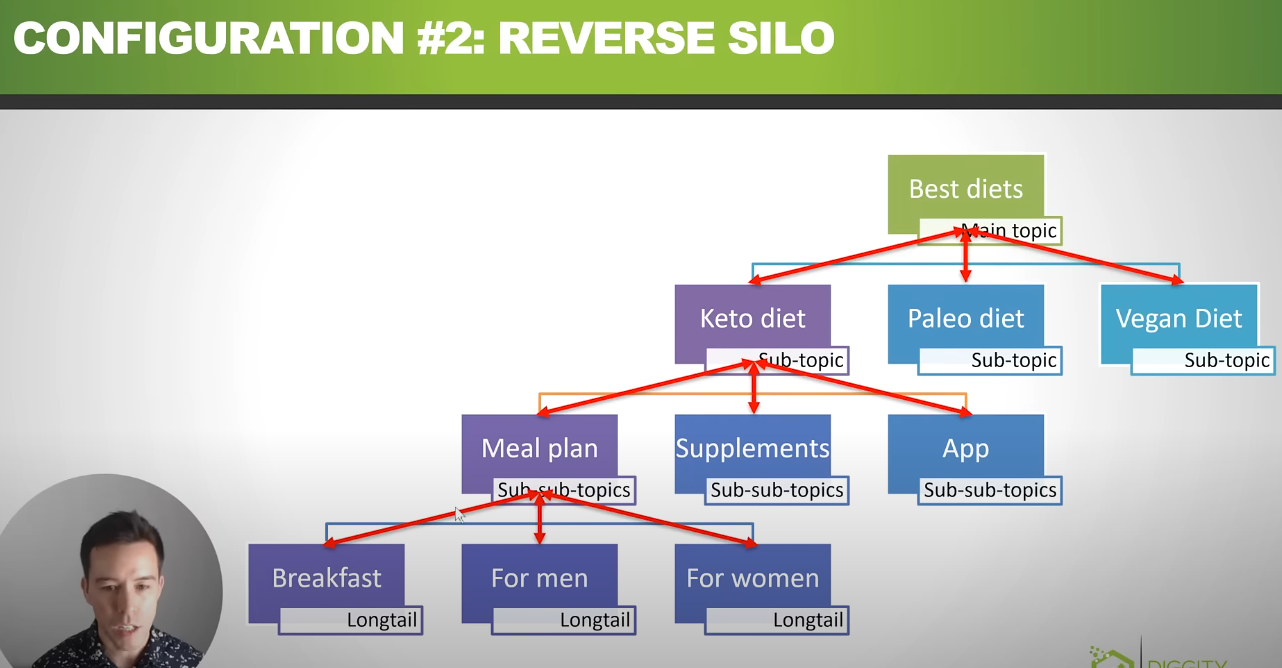
Within each city, there will be sections connecting to the forum and blog, where users can read posts or blogs related to the city and sneakers. I want to ensure that the blog is organized with an inverse SILO structure, with thematic sections that generate authority on different brands, product types, and cities, linking them to corresponding products or categories. This way, I hope to improve both relevance and thematic authority across the site.

What do you think of this structure?

A few things to keep in mind:

  • I’m trying to leverage city-specific URLs (like example.com/shoes-boston) to improve local SEO. My idea is that these URLs will be useful for ranking terms like "Miami Shoes" or "Boston Sneakers".
  • For the blog, I’m using the inverse SILO structure that I learned from a Matt Diggity video, and I’ve also been following some great SEO advice from @splishsplash
  • I want to know if this structure will make navigation easy for users and if it’s suitable for SEO, especially for local SEO.

My main question:

I am thinking of creating a homepage for the blog with the URL:
example.com/blog, where the main topics of the blog will be displayed, such as shoe brands, types of shoes, and cities. For example, one of the links could be:
example.com/blog/shoes-brands, which would show all the shoe brands. (No content will be displayed here, it is a "home page" of the topic)

When clicking on a brand like Nike(EXAMPLE), the URL would be:

I HAVE TWO OPTIONS

When you click on a brand, for example Nike, I have two options. The first option is to create a main page for each brand with the following URL, example.com/blog/shoes-brands/Nike, which will be a home page that will display and group the posts of the selected brand. And when you select a post you will go to the following URL: example.com/blog/shoes-brands/Nike/Best-nike-shoes


Or is it better to create pillar content on the brand, which serves as the main page for everything related to that brand, and then link related blog posts within that pillar? This could look like:
example.com/blog/shoes-brands/guide-nike-shoes (PILAR CONTENT) with links to other posts about the same brand, such as:
example.com/blog/shoes-brands/nike-soccer-shoes.


Additionally, does it make sense to include contextual links in blog posts to specific city or product pages? For example, when writing a post about a specific brand, should I link to product pages or city pages where users can find those products or the relevant city?


Any recommendations on how to structure this blog section and whether you prefer a hub or pillar content would be really helpful.

Thank you for your help, and a special thank you to Splishsplash for their excellent advice in this forum!


Any suggestions or comments on the overall structure would be helpful! Does the way I'm organizing the page make sense?


1732145384609.png
 
What do you think of this structure?
I don't like it

I want to know if this structure will make navigation easy for users...
not really...

I am thinking of creating a homepage for the blog with the URL:
example.com/blog, where the main topics of the blog will be displayed, such as shoe brands, types of shoes, and cities. For example, one of the links could be:
example.com/blog/shoes-brands, which would show all the shoe brands. (No content will be displayed here, it is a "home page" of the topic)
that's not what blogs are for. A blog is to educate and inform people, or to keep them up-to-date with your business / hobby / whatever you're blogging about.

What you are trying to do with your blog is what you should be doing with your store and I don't think it will work

example.com/blog/shoes-brands/Nike
example.com/blog/shoes-brands/Nike/Best-nike-shoes
example.com/blog/shoes-brands/guide-nike-shoes
example.com/blog/shoes-brands/nike-soccer-shoes
such... long.... useless.... confusing URLs.... Unnecessarily complicated...

Just put the store on your homepage (at example.com) and let people search and filter your products by category, brand, price, location or whatever else you want to include in your filtering, you don't have to make blog posts that are actually not blog posts and link to store instead of talking about stuff...

Open up a few ecom sites in your niche and check out their design and layout and mimic those if you're unsure how to structure your site....

Also, unless you have offline (as in, brick and mortar) stores in all of the locations you wish to feature on your site (and even then you still don't need to complicate things) you don't have to create dozens of URLs (shoes-miami, shoes-boston, etc) that are duplicate of each other anyway and will most likely confuse the retarded googlebot even more than it's already confused which can end up not ranking any of those URLs in the first place because of keyword cannibalization or duplicate content...

As I said, link your store to the homepage, and have several other pages (Blog, Forum, etc) that are their own thing (so, not mixed and interlinked with anything from the store) and be done with it! Simple, quick, easy to navigate and to understand both by people and google :)

Additionally, does it make sense to include contextual links in blog posts to specific city or product pages? For example, when writing a post about a specific brand, should I link to product pages or city pages where users can find those products or the relevant city?
again, if you DO OWN real brick and mortar stores in all of these cities (which I highly doubt because this would mean you're full of money, in which case your site would be built by a company that knows what they're doing instead of you being here asking for help), there is absolutely no reason to stress yourself with locations.

I get it, you want to do local SEO, but local SEO is best left to REAL stores. If you don't have any store in real life you are complicating yourself with unnecessary pages and I'm not even sure that google will rank you in those locations anyway as you'd need to do real local SEO (put the location, contact details and working hours of your local store on your local pages, get real reviews for your store, build NAPs, etc... way too much unnecessary work if you don't own real life stores...)

Maybe you do have stores in each location, in which case please mention it because this can change everything (your site's structure I mean)...

But if you don't own stores in all of those cities you mentioned keep it simple!

Any recommendations on how to structure this blog section and whether you prefer a hub or pillar content would be really helpful.
when I started reading your post I had a few ideas, but the more I read the more you confused me, so I forgot them :D

But I might have recommendations later, but first let us know if you operate real life stores (with real stock, real employees, etc), or it's only this website, because there's a difference in how you approach site structure for local vs global (which I assume it's actually what you want)...

Thank you for your help, and a special thank you to Splishsplash for their excellent advice in this forum!
yeah, Splishsplash is good at this stuff, but I don't think he told you to structure your site like this... Maybe you've misunderstood him, or you didn't give him enough info so he gave you a general idea... whatever the case may be, I have doubts that this was his idea, but feel free to correct me as I've not done SEO in years so I might be out of touch, who knows!
 
Last edited:
Thank you very much for the comments, they are very useful.

The store is 100% online. The decision to use URLs for each city, such as /shoes-miami or /shoes-boston, is due to the high flow of searches per city. Therefore, having a unique page for each city can take the traffic from each city. On the other hand, there is the option of having a unique page, where all the filters are made (city, price, brand, etc.), however, in this case I would have a URL parameterized by cities, similar to this: home/?location=boston.

I still don't have much knowledge in SEO, so it is likely that I won't be able to explain some doubts well.

Regarding the blog, I was thinking of creating a content library type blog, where there will be a Hub Page, with the sections and some important posts. When entering the section, only the posts of the section will be seen.

1732222876588.png
 
To build topical authority between a pillar content page and its supporting articles, should these posts follow the same URL structure? For example, if the blog is organized by sections and the section is about shoes: mywebsite.com/blog/shoes. This URL would act as a hub, showing the most important and recent posts but without displaying actual content.

To build topical authority for the sneakers section of the blog, should the posts be under the /blog/shoes URL (e.g., /blog/shoes/types-of-shoes), or can topical authority be established by linking related posts together, even if they use a flat structure like /blog/types-of-shoes?
 
Review Semrush and Hubspot for Topical Clusters, bud.

It's best to make things simple, and that's the simplest way. You want your posts to rank, so they can gather links, and send the link juice to the pillar page.

The pillar connects your supporting topics and sends a link to your product category page.

Nice and simple.

You can also add a grain of salt by adding related articles at the bottom of your posts, which helps people stay more on topic. At least this way you don't have anchors with certain keywords, and don't disrupt your topic clusters.
 
hey, man!

Sorry for the delayed reply but I nearly forgot about you... you need to learn how to use quotes, or else the people you're waiting replies from will not be able to see your comments, the only reason I am able to reply again is because I remembered that I've posted on this thread :) ... but yeah, you gotta use quotes next time...

Now, to your questions...

The decision to use URLs for each city, such as /shoes-miami or /shoes-boston, is due to the high flow of searches per city. Therefore, having a unique page for each city can take the traffic from each city. On the other hand, there is the option of having a unique page, where all the filters are made (city, price, brand, etc.), however, in this case I would have a URL parameterized by cities, similar to this: home/?location=boston.
I hear you (and I heard you from the first time) but my question to you is what are you going to populate those pages with since the products are the same? Because each URL represents 1 page and since the products are the same this means you will end up with dozens of pages that display the exact same content which - as you probably know by now - is never a good idea if you're trying to rank in google as google weeds out duplicated content. So, in the end, you will still rank only 1 of these pages while the clones get buried beneath the surface and will never see any traffic (not from google anyway) which might actually harm your site since you're ending up with both duplicate and orphaned pages...

So, again, you are overcomplicating things unnecessarily....

I still don't have much knowledge in SEO, so it is likely that I won't be able to explain some doubts well.
I think you've explained well, it's the way in which you're trying to implement this that makes me scratch my head :)

Regarding the blog, I was thinking of creating a content library type blog, where there will be a Hub Page
the hub page can easily be the blog's main page (example.com/blog)

with the sections and some important posts. When entering the section, only the posts of the section will be seen.
yep, that's how blogs work.... that's also how proper site structuring works (splitting the site / blog into unique sections, with each section addressing only topics relevant to the section they're in). In this regard you've thought well :)

To build topical authority between a pillar content page and its supporting articles,
if your entire site is about one topic only (shoes, in your example) you don't need to stress about building topical authority within the different categories as the entire site is centered around one topic, and one topic only.

So, as long as you'll keep the content about shoes (or whatever the product you sell is) and as long as all / most of the backlinks you get for this site come from related pages you are fine, you don't have to stress about topical authority too much as you will build this naturally over time.

When I say "related pages" I don't mean other sites that are also about shoes, just like your site. Of course, this would be ideal, but we're not living in ideal world, so I can guarantee you with 1000% certainty that your backlink profile will NOT have backlinks only from shoes-related sites, that's why I said "related pages" instead of "related sites".

Also, the reason I said "related" instead of "exact same" is because you don't have to get links from pages / sites that are about shoes only, you can have links coming from anything that's related to shoes (footwear, clothes and apparel stores in general, jogging / outdoor related sites, etc) and you'll still acquire topical authority, so - once again - don't stress about it!

Now, if the shoes part was just an example but - in reality - your site sells many different products (shoes, colouring books, apple pies, car tires, etc... a bad idea, by the way, but hey, it's your site, you can do with it whatever you want :) )... so, if you have these multiple and diverse categories on your site than I can understand why you're thinking of building topical authority within each silo (category), so in this case you are right: you should address each silo separately...

However, this...

should these posts follow the same URL structure? For example, if the blog is organized by sections and the section is about shoes: mywebsite.com/blog/shoes. This URL would act as a hub, showing the most important and recent posts but without displaying actual content.
... is NOT how you do it.

First of all, if you have a page with the URL mywebsite.com/blog/shoes it means that people will EXPECT to find shoes for sale on that page, in which case selling shoes on a blog is not how to do it as products need to be sold in a store, not directly inside of your blog post LOL

And secondly, you can't have empty pages on your site... I mean, OK, if you're a big shot guru that knows how to rank empty pages (there was a guy some years ago that's managed to rank a page that only had placeholder content on it, but that person really did know how to do this) you can probably do it.

But it will still serve no purpose to anyone because when people click though to that page (mywebsite.com/blog/shoes) they expect - like I said - to find shoes for sale there, or some information / content about shoes at the very least.

So you can't have a completely empty page as this will do you more harm than good in the long run...

To build topical authority for the sneakers section of the blog, should the posts be under the /blog/shoes URL (e.g., /blog/shoes/types-of-shoes), or can topical authority be established by linking related posts together, even if they use a flat structure like /blog/types-of-shoes?
NO, man!

I already told you (few times already) that...

1) topical authority simply means the site and backlinks being relevant to each other, topical authority is just a fancy term for "niche website", so don't stress too much about it because if you only sell shoes on your site (and assuming that your backlinks are only / mostly related to shoes / footwear / clothing in general) you will have acquired topical authority automatically, so don't screw up the structure of your site chasing TA because site structure is as important as TA...

Here's more info on TA since you already seem to be familiar with SS's takes:
https://www.blackhatworld.com/seo/a...e-question-what-is-topical-authority.1450324/

And here's another guide that discusses TA in more depth:
https://www.oncrawl.com/technical-seo/importance-topical-authority-semantic-seo/

2) if you want to SELL shoes on your site you can sell them from whichever URL you want, how you name your URL is not very important (it can help people remember the URL if it's short and clean, but otherwise there's no much ranking power in the name of a URL, so don't stress about it)

The problem is that you want to sell shoes by putting the store inside of your blog (/blog/shoes/), this is so backwards and so weird, almost no one ever does this (and for good reason): blogs are for information, products are for purchase, so you gotta keep these 2 separate.

I told you in the my initial reply that the best way for you to structure this site (especially since you just confirmed that it's 100% online store, so you won't be managing stocks, personnel, etc) is to put the store on the front page of your site (mywebsite.com, or mywebsite.com/home, or mywebsite.com/store or whatever you wish to name the URL of your store, it doesn't really matter) and keep the other sections of your site (blog, forum, etc) separate from each other, like this...

mywebsite.com ... mywebsite.com/home ... mywebsite.com/store ... (any of these can / should be your store)
mywebsite.com/blog
mywebsite.com/forum
mywebsite.com/services (in case you are also offering services along with the purchase of your products, otherwise you don't need to make this page)
mywebsite.com/privacy .... mywebsite.com/privacy-policy (any of these URL slugs will work for your Privacy Policy page, which you MUST have anyway)
mywebsite.com/tos ... mywebsite.com/terms-of-service... mywebsite.com/termsofservice ... etc (any of these slugs can be your ToS page which, again, you MUST have as it gives credibility to your site, both in the eyes of google and in the eyes of your visitors)
mywebsite.com/refunds .... mywebsite.com/refunds-policy ... etc (your Refunds page. Again, very important for online stores, so you should definitely have this page too)
mywebsite.com/shipping ... etc (the page where you explain your shipping conditions, taxes, etc... you don't need to make this page if you don't want to, but - again - it helps with establishing credibility, so it's a good page to have for ecom sites, generally speaking)
...
etc

So, these are the pages that people AND google expect to see on ecom sites. Like I said, if you're unsure to structure your site simply pull the sites of 5-6 of your competitors to see how they designed their stores and take inspirations from those, you don't have to reinvent the wheel by screwing up your site right from the start as then you will never figure out why you're not ranking and when / if your site grows big and - somehow, miraculously - gets traction (traffic and sales from google) you will have a harder time restructuring it when you're ranking than if you do it properly from the beginning...

And regarding the sorting and filtering of your products, you can use a plugin for this (good ecommerce plugins will automatically create the important pages and URLs for you anyway, so you don't have to scratch your head trying to figure out how to name the URLs because these are usually generated dynamically by the ecom plugins / platforms you use).

Unfortunately, I've not dealt with ecom sites too much (only administered 1 for 6 months around 2015), so I can't walk you through all of the steps, but nowadays it's not that complicated (especially if you have a small store with only a few dozens / 100s of products) as good ecom platforms (Woocommerce for example if you're using Wordpress) create, integrate, and manage all of the little annoying things of your ecom business automatically. They create the pages, the URL slugs, the sorting and filtering capabilities, etc... you just have to specify the product's details (title, description, price, categories + tags, images, etc) and the software creates and manages the page and its related functions automatically...
 
Last edited:
Thank you very much, my friend. I will carefully read the post during the day so I can respond more effectively.
 
Back
Top