

Zwielicht
Elite Member
- Aug 31, 2013
- 21,128
- 40,601
I've been asked by e-book sellers in the past about how they can protect their e-book from being stolen. The concerns often stem from past experiences where the seller previous released an e-book on the internet, got a few sales for a while, only to stop receiving any sales because some guy decided he was going to leak the e-book, or worse, resell it elsewhere and pretend they wrote it.
I'm going to say that there's currently no real way to prevent someone from leaking or reselling your e-book. However, you can discourage the behaviour through a variety of methods.
None of these strategies are particularly difficult to implement and could end up saving you some money and a headache along the way.
Put a Warning Message at the Beginning of Each E-Book
It's not the friendliest greeting to genuine readers, although it can act as a deterrent to those who are considering reselling or resharing your content.
I've shared an example of a warning message you could use below, but I highly recommend coming up with something better.
Steganography Is Your Friend

What's with the apple?
Simply put, steganography is a way to add hidden messages into an image. Unlike the previous suggestion, steganography is a great practice if you want to discreetly make each e-book unique without tipping anyone off. This practice can also be useful if someone tries to resell your e-book since you can prove you're the original owner by leaving, let's say, a copyright message crediting yourself for the content. Sure, it won't act as a deterrent by itself, but if finding who leaked your e-book is important to you, then know that your average lazy leaker isn't going to be checking for hidden messages in the images.
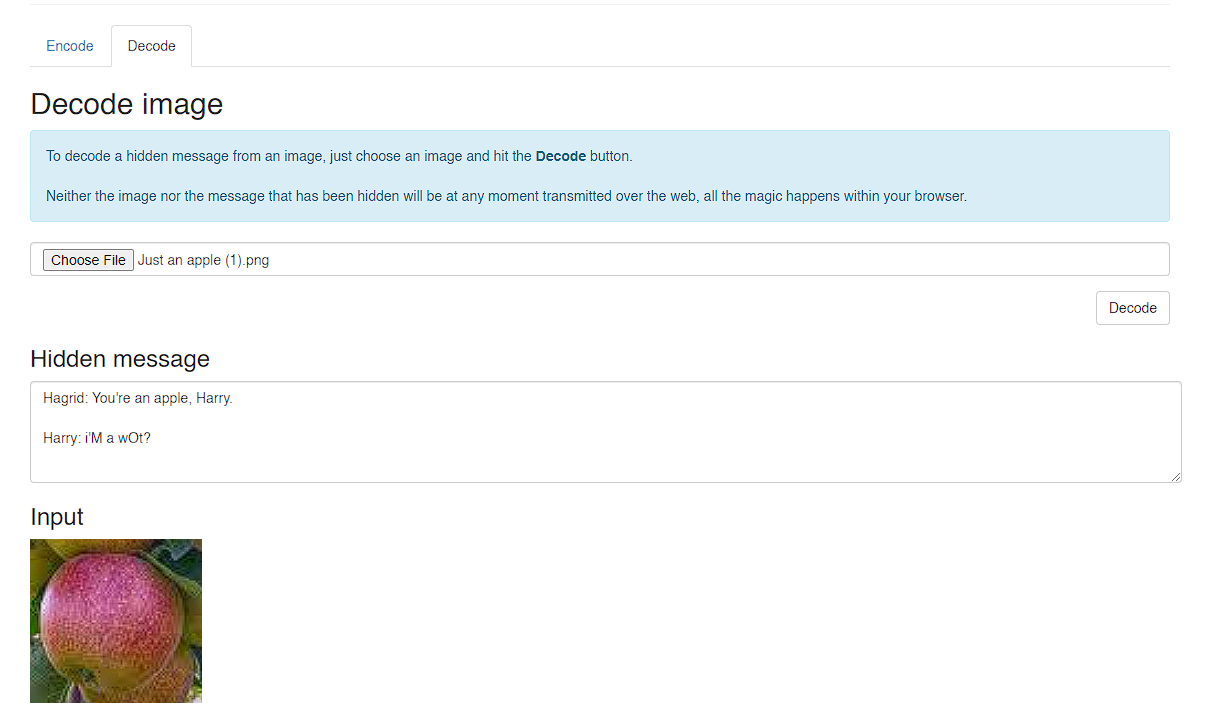
As an example of how it works, look at the image of the apple that I've attached above. It just looks like an ordinary image, but if you download the image, upload it to this decoder, you'll see that there's a hidden message.
Go on, give it a try! If you're too lazy to do it, here's what happens when you decode the message in the image.
Make Each Copy Unique
Do you remember that warning message from earlier and how it mentioned that each e-book had a unique identifier? Well, you don't have to include a unique identifier just through steganography. I've seen e-book authors use a variety of methods to make each e-book them send out unique such as:
No Text, Just Images
Instead of sending a text copy of your e-book to customers, you can just send images of the text in a PDF.
It's not the greatest thing in terms user experience since some users highlight text as they read, and sure, they can still reupload the images. However, those looking to just copy/paste the content on to a forum or their own e-book will have a harder time getting around this. Do bear in mind that OCR software does exist, though.
Do All of the Above
You don't need to just stop at one of these. You can do all of them if you really want to!
Conclusion
This guide is written for those of you who want to deter people from leaking your e-book. If it's important to you to reprimand whoever leaks your e-book, then that's another topic entirely.
I'm going to say that there's currently no real way to prevent someone from leaking or reselling your e-book. However, you can discourage the behaviour through a variety of methods.
None of these strategies are particularly difficult to implement and could end up saving you some money and a headache along the way.
Put a Warning Message at the Beginning of Each E-Book
It's not the friendliest greeting to genuine readers, although it can act as a deterrent to those who are considering reselling or resharing your content.
I've shared an example of a warning message you could use below, but I highly recommend coming up with something better.
WARNINGUPON PURCHASING THIS E-BOOK, YOU AGREE TO ALL OF THE TERMS SET FORTH IN THIS MESSAGE. ALL CONTENT IN THIS E-BOOK IS UNIQUE, ORIGINAL, AND PRODUCED BY __________. YOU MAY NOT RESELL OR RESHARE ANY CONTENT IN THIS E-BOOK WITHOUT THE EXPRESS WRITTEN PERMISSION OF THE AUTHOR, ___________. FURTHERMORE, EACH E-BOOK COMES WITH A UNIQUE IDENTIFIER THAT TIES THE PURCHASER TO THIS WORK. ANYONE CAUGHT RESELLING OR RESHARING THIS CONTENT WITHOUT PERMISSION WILL BE IN VIOLATION OF THE TERMS SET FORTH IN THIS MESSAGE AND BE IN VIOLATION OF US COPYRIGHT LAW.
Steganography Is Your Friend
What's with the apple?
Simply put, steganography is a way to add hidden messages into an image. Unlike the previous suggestion, steganography is a great practice if you want to discreetly make each e-book unique without tipping anyone off. This practice can also be useful if someone tries to resell your e-book since you can prove you're the original owner by leaving, let's say, a copyright message crediting yourself for the content. Sure, it won't act as a deterrent by itself, but if finding who leaked your e-book is important to you, then know that your average lazy leaker isn't going to be checking for hidden messages in the images.
As an example of how it works, look at the image of the apple that I've attached above. It just looks like an ordinary image, but if you download the image, upload it to this decoder, you'll see that there's a hidden message.
Go on, give it a try! If you're too lazy to do it, here's what happens when you decode the message in the image.
Make Each Copy Unique
Do you remember that warning message from earlier and how it mentioned that each e-book had a unique identifier? Well, you don't have to include a unique identifier just through steganography. I've seen e-book authors use a variety of methods to make each e-book them send out unique such as:
- Putting a unique code for each buyers in small text at the bottom of each page.
- Writing the buyer's information on a unique "purchased by" page.
- This one requires more work to keep track of, but you can change some sentences with on each e-book you send out. They won't know you did this unless they've read multiple copies of your e-book and noticed this.
No Text, Just Images
Instead of sending a text copy of your e-book to customers, you can just send images of the text in a PDF.
It's not the greatest thing in terms user experience since some users highlight text as they read, and sure, they can still reupload the images. However, those looking to just copy/paste the content on to a forum or their own e-book will have a harder time getting around this. Do bear in mind that OCR software does exist, though.
Do All of the Above
You don't need to just stop at one of these. You can do all of them if you really want to!
Conclusion
This guide is written for those of you who want to deter people from leaking your e-book. If it's important to you to reprimand whoever leaks your e-book, then that's another topic entirely.
Last edited:


