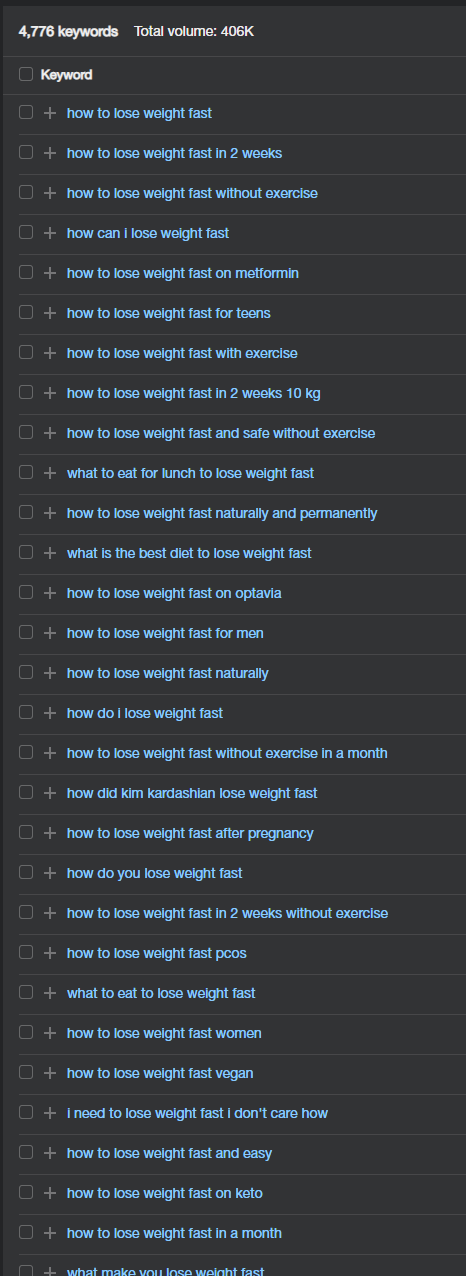
If the content that you produce for each of those titles are very specific, you wouldn't have to worry about keyword cannibalization.
You have to understand that those topics are actually very specific.
We're not just talking about how to lose weight fast.
But there's a timeline.
There are also restrictions like for example how to lose weight fast without exercise.
There are some duplicates that for example, "How to lose weight fast" and "How can I lose weight fast" are seen very similar to each other.
But the "How can I lose weight fast" is actually a little bit different because you can talk about metabolism.
You can talk about differences in a person's physiology, and body chemistry that would impact their ability to lose weight.
Generally speaking, those questions are different enough from each other.
The key to success here though, is to comply with Google's E-A-T guidelines as well as their YMYL restrictions.
You have to have some sort of "expert" write your stuff or at least have an expert profile that shows up with nutritional information that you post, that kind of thing.
But for the most part, your approach of taking "inch wide" topics and drilling down is definitely correct.
This is the right way to go.
This is my content philosophy.
If you're trying to dominate a specific topic vertical, go an inch wide, but drill down miles deep.
So if you're talking about how to lose weight fast for teens, you might want to focus on teen metabolism and go into diet and nutrition issues that are specific for teens.
And then break down the specific weight loss techniques, methods and options available for teens on a year by year basis.
What I mean by this is advice for 13 years old, 14 years old, 15 years old, you get what I'm saying.
When you drill down deep, there's a good chance your content will be the most authoritative than if you will just basically "sniping" the keyword in mentioning "How to lose weight fast for teens" in strategic places, that's not going to cut it.
You have to deliver solid value and your content has to be accurate and backed with actual citations to scientific studies or peer reviewed journals.