Cryptocurrency analysis and predictions using AI and big data

Hey OP,

Thanks for this awesome journey really impressive what you do and I will sign up for your app within the next few days. However (and sorry if this was asked before I did not read through all the questions here from other users) I was wondering if your app will have similar results with Bitmex as you have with Binance. The reason I ask is that Bitmex allows you to use leverage therefore a 1% profit would be way more lucrative and it would give me also the opportunity to go short on your sell signals.
 
Hey OP,

Thanks for this awesome journey really impressive what you do and I will sign up for your app within the next few days

What app dude? I could not find any. App that helps on the trade, predictions, etc for that 1%/day? (with some risks ofc)
 
I would like to understand more about the core mathematics behind the trend analysis
I cannot go into more detail with these post since the core mathematics is our sole competitive advantage.

Hey OP,

Thanks for this awesome journey really impressive what you do and I will sign up for your app within the next few days. However (and sorry if this was asked before I did not read through all the questions here from other users) I was wondering if your app will have similar results with Bitmex as you have with Binance. The reason I ask is that Bitmex allows you to use leverage therefore a 1% profit would be way more lucrative and it would give me also the opportunity to go short on your sell signals.

Thanks :) We have not yet analyzed Bitmex, only Binance now.
In the coming weeks we'll be adding more exchanges and coins.

What app dude? I could not find any. App that helps on the trade, predictions, etc for that 1%/day? (with some risks ofc)
The app is in beta and only a few selected people know about it.
In the coming days we'll be announcing it to the public.
PS: I think you are confused, 1%/day is a LOT.
 
Being in IM, some of my friends have encouraged me to invest on cryptocurrency, but I'm still unsure about it. Frankly, I'm not really a big risk taker and I'm uncomfortable shelling out my money for something I haven't learned yet. l still need more time to study it. Thank you for posting this thread, I will try to follow up.
 
Last edited:
Now I am really confused :|
Our conversation has been moved to Skype, you're no longer confused :)

Being in IM, some of my friends have encouraged me to invest on cryptocurrency, but I'm still unsure about it. Frankly, I'm not really a big risk taker and I'm uncomfortable shelling out my money for something I haven't learned yet. l still need more time to study it. Thank you for posting this thread, I will try to follow up.
Thanks for the input.
I actually started this project because many of my friends invested and lost a lot. That is true for the general public, most people who invest into crypto end up not making a ton of money. Most of them lose more than what they started with. My mission is to bring certainty to this uncertain world. So I encourage you to read and learn as much as you can about trading, forget ICO investments and all that crowd-funding (aka ponzi) stuff.
 
Profitable Crypto trading strategies part 9: Predic 1.0
Until now we have only analyzed simple yet powerful trading strategies. Most of these used mathematical formulas and followed predefined heuristics. Eventually we optimized the hyper-parameters to improve their ROIs. In this post we are introducing a totally new strategy developed using machine learning and A.I. neural networks.

1*sWQSJsslwm4BkwMYBNrfDw.jpeg


Many months ago we started applying machine learning and artificial intelligence to generate price predictions. Ever since we were primarily looking for ways to improve these short-term predictions. But in the back of our mind we were also thinking of ways to trade based on these predictions.

A few weeks ago we came up with a simple yet powerful algorithm that uses these predictions. And we successfully back tested the algorithm on historical data, quickly and efficiently. In the next section I’ll first explain what these predictions are, and then we’ll analyze our algorithm.

Artificial Intelligence
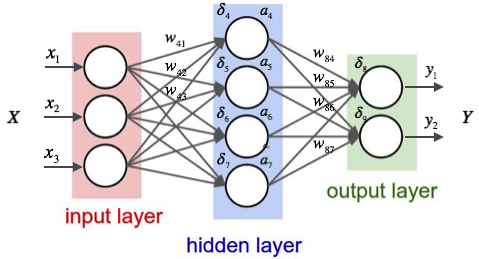
Several months ago we began using machine learning tools (Tensorflow and Keras) to create artificially intelligent systems. The systems are called “neural networks”, which try to emulate the way a human brain works.

1*NIOcHiCiGejigjGvq1iuUQ.png

Neural network example (source)

These neural networks are nothing more than mathematical concepts implemented in software. Usually they are very low-weight (small in size) and can compute outputs really fast. But they are extremely slow during the “training” or “learning” process. During training we feed raw data into the network, making it “learn” the output from the given input. This way we can teach it to approximate complex environments. Neural networks are powerful but only in narrow tasks; these systems only do what we train them to do. They are used for self-driving cars, pattern recognition, object detection, language translation and a lot more.

Neural networks are wonderful tools for helping us solve complex problems. That’s why we are using them to help us make better trade decisions. Stock markets, especially the cryptocurrency industry is highly complex, so we need these systems to help us out.

Predictions
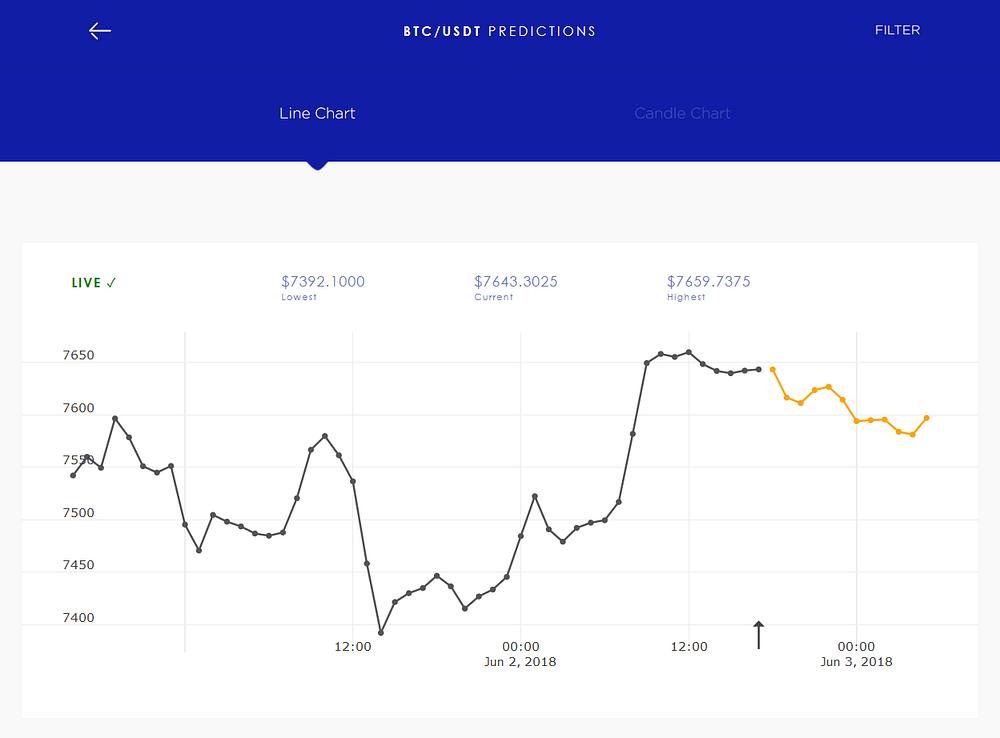
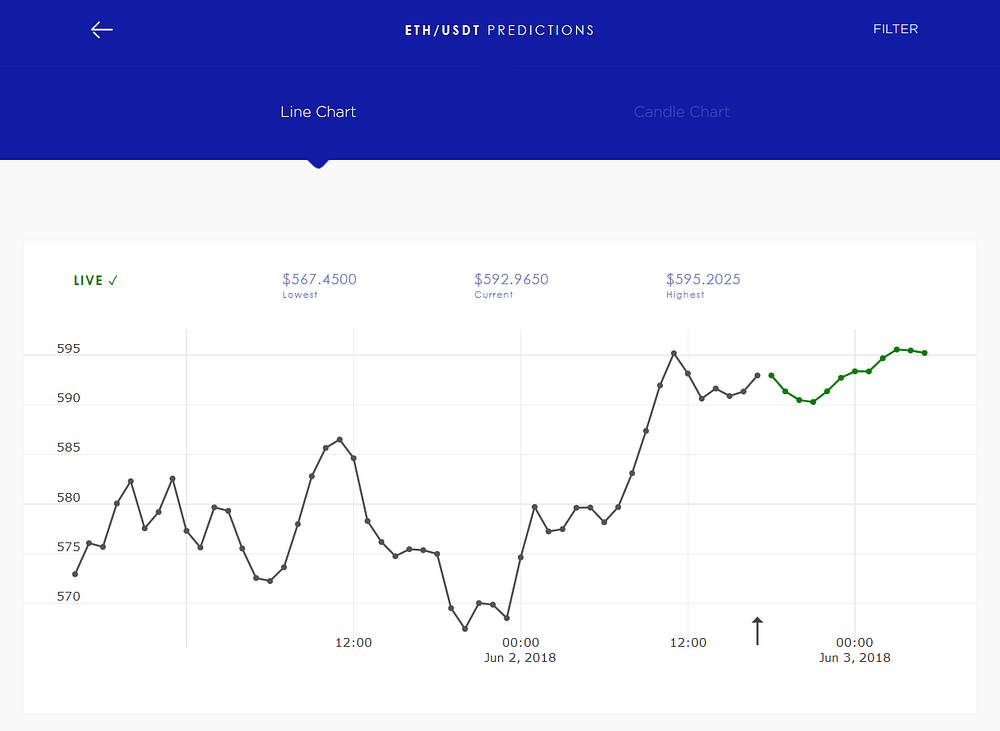
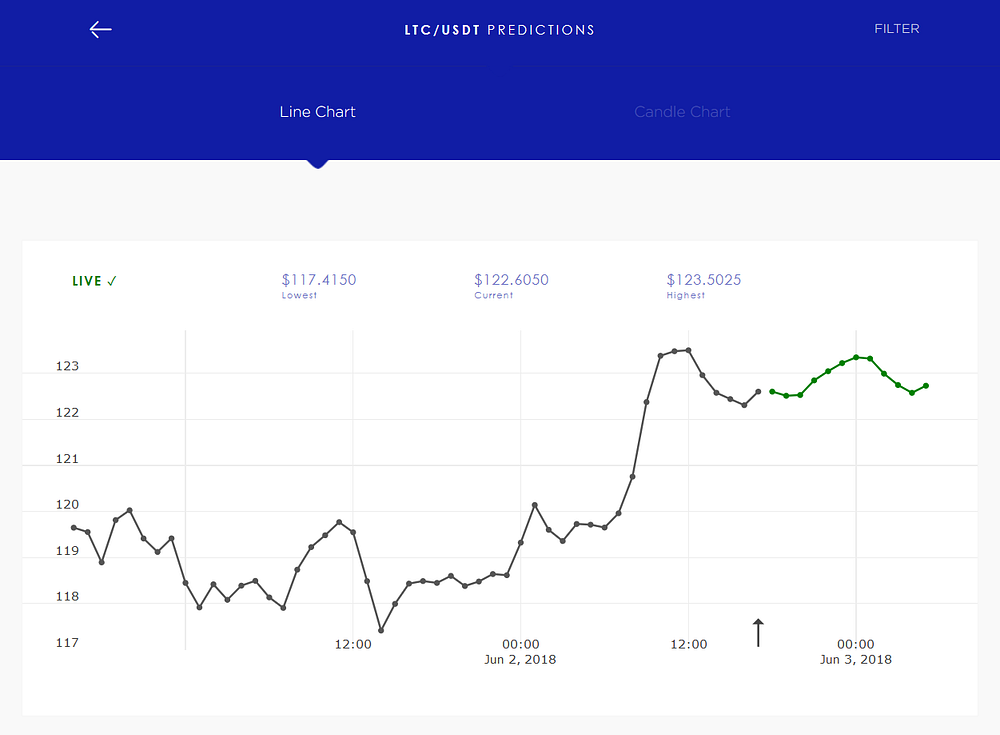
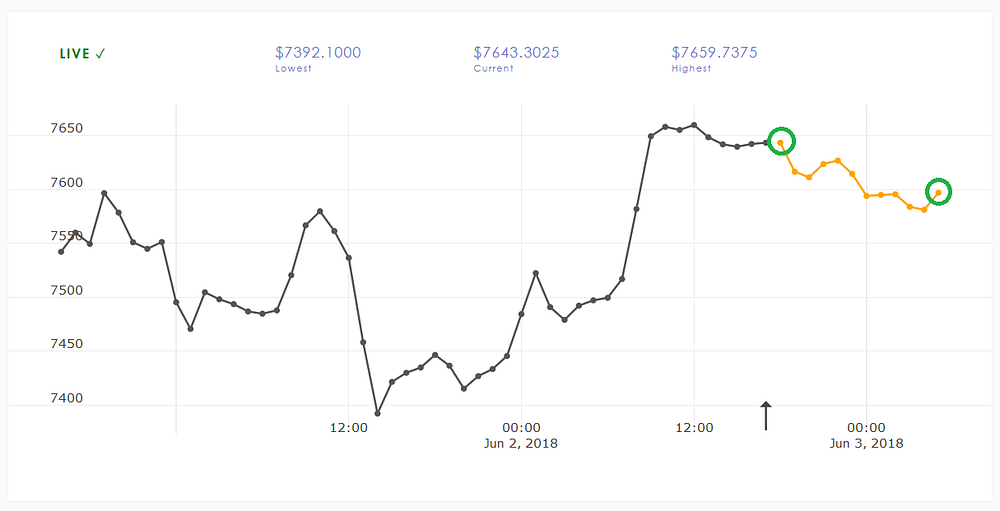
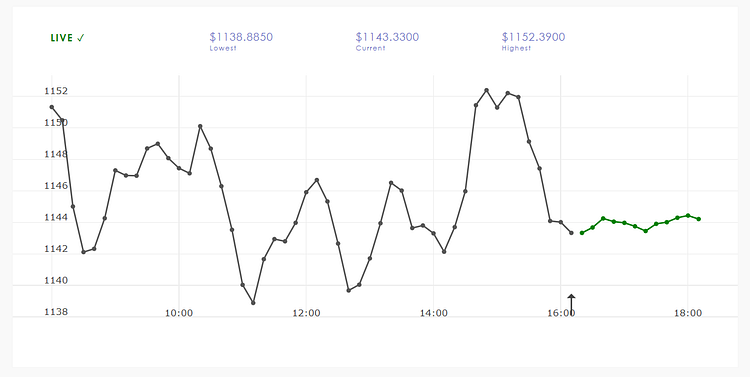
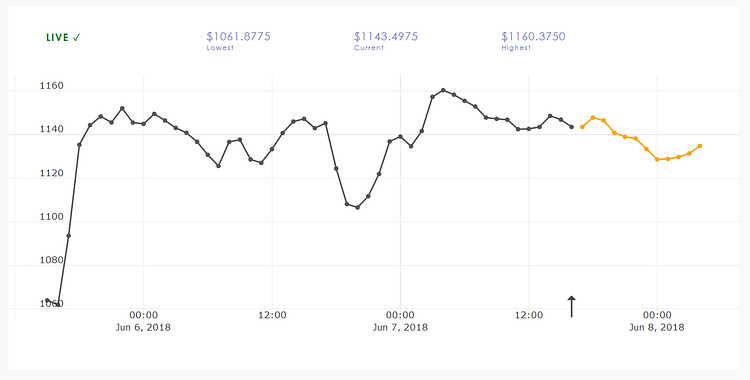
Below you’ll find three screenshots of our predictions. These predictions show a 12-hour forecast for a specified market (on the Binance exchange).

1*iwJoLNRIt7cE98El9SiVgw.png

1*dWgJV6gAzYZObnzT5lspKQ.png

1*UDil1x5O4Ix2w5TyQdEfPw.png


For quite a while our predictions weren’t useful in a direct sense, other than giving a probabilistic prognosis. At some point we measured their accuracy, using its absolute values and comparing it against reality. The accuracy from these tests was over 99.9% — simply because of the absolute value problem.

On the other hand, measuring the accuracy is a complex problem because of the nature of the predictions. We’ve learned that the predictions indicate what “might” happen in the near future. It cannot exactly predict when “something” will happen. So in a nutshell, if it indicates the price to go up (or down), it is likely to happen, but this might only happen several minutes or hours down the line.

Predic 1.0
Right now the predictions are generated and updated every two minutes. There are two different type of predictions: 10-minute and 60-minute interval ones. Both make 12-step predictions, thus 120min and 12 hours respectively.

The Predic algorithm makes a buy, sell or hold decision at every interval (every hour). In the algorithm we compare the first prediction value with another. The first question is: which value should we compare against? In our first attempt we compared the first prediction against the last one (as indicated on the screenshot below).

1*rc53ZDs5zfGHf18B7WiSfw.png

Comparing first against last predicted value.

The above proved to be a bad decision. Actually, our results proved that the further down we went in the predictions the worse our ROI became. The most optimal variant was to compare the first prediction against the second one. This makes a lot of sense actually, this system is much better at making predictions of one hour into the future than longer ones.

The second question is what should the buy/sell criteria be? This is can be solved by checking whether the second value exceeds a certain threshold. For instance, if the second prediction is 0.2% larger than the first prediction then we can tell it to “buy”. For the “sell” part we instead opt for ROI margins: if we can make a 1% profit we “sell”, otherwise we hold unless our ROI drops below 98% or so.

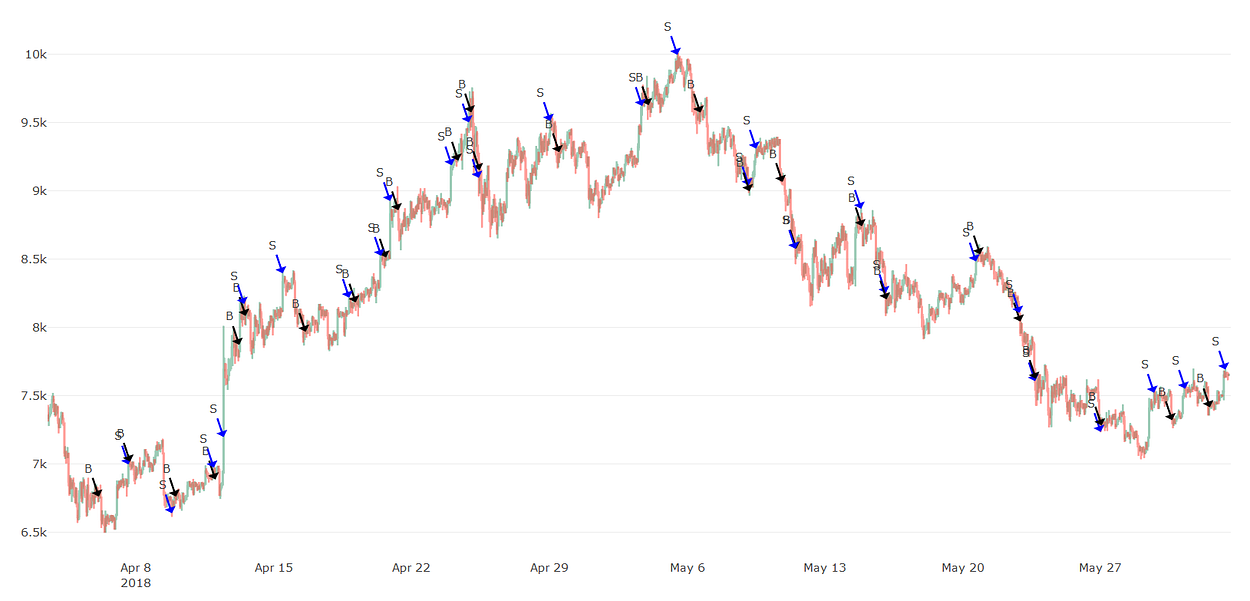
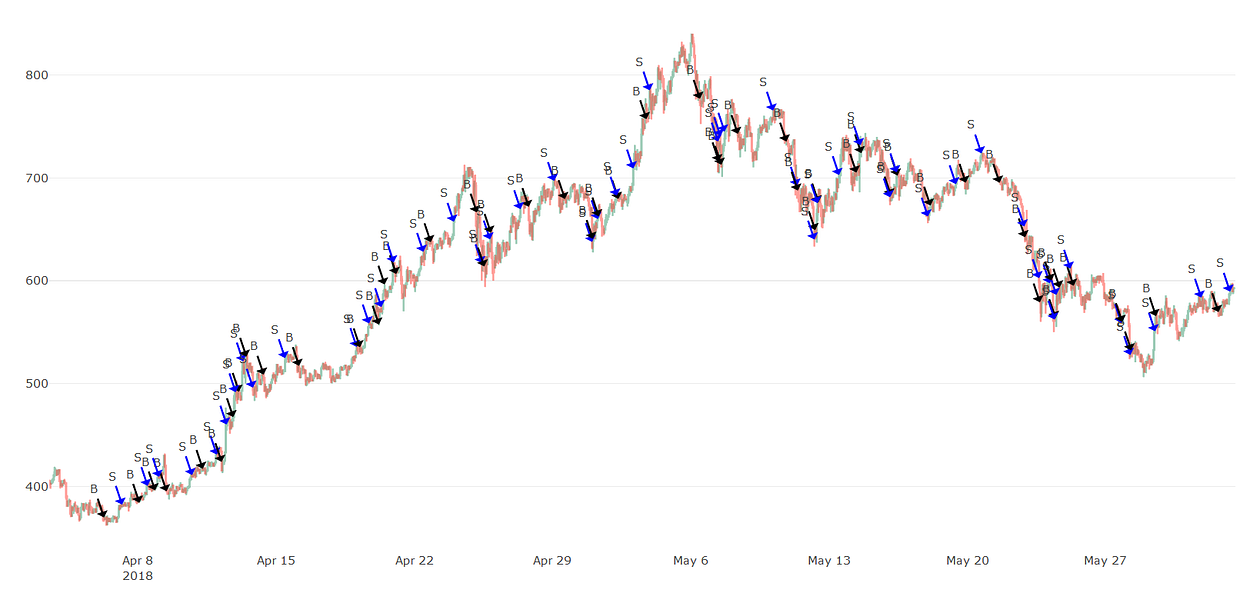
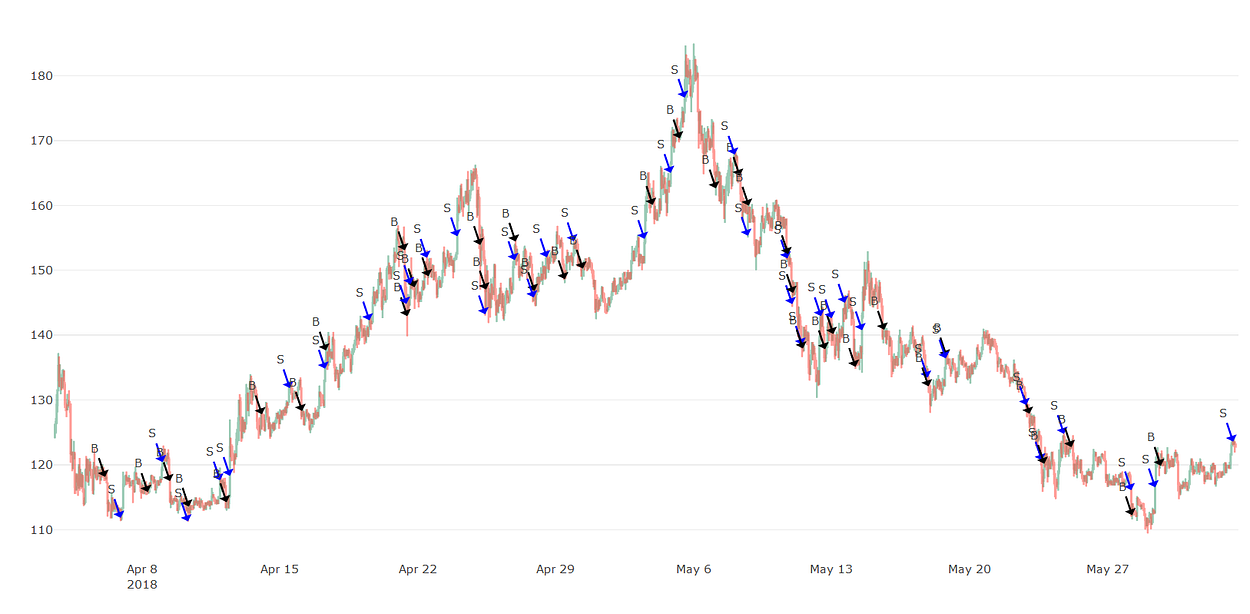
Now is the time for back testing and simulating this strategy. Let us compute a 60-day ROI (3 April to 2 June, 2018) for our three distinct cryptocurrencies:

BTC-USDT
ROI: 15.19% (±6.75)

1*BxrqfhDCZ75zTI5SPTLn_Q.png


ETH-USDT

ROI: 36.36% (±15.45)

1*bYh9mSnyskbsiSBPTWgT2A.png


LTC-USDT
ROI: 10.27% (±12.24)

1*Xqb6q56qgeim-vZTtw1HtQ.png


Discussion
I was quite amazed that such a simple heuristic would yield reasonable returns. But it could do so much better. By looking at the buy/sell signals on the charts, we see that some are sub-optimal. During uptrend regions it executes too many conservative trades (play it safe), because of the “sell” heuristic. While during downtrend periods it’s trading too much, resulting in many losing trades. The latter could be solved by our bearish detection code (a topic for another time).

Another phenomenon which is sub-optimal can be seen on the chart with BTC-USDT trades. Because of the algorithm the sell-buy signals follow each other closely. This means it buys immediately after selling. This can be prevented by not selling if a buy criteria is met. But it also induces risk into the strategy, because we are making it more “greedy”.

Conclusion
The Predic 1.0 algorithm definitely deserves to be on our signals list, and in the weeks to come we’ll integrate it. There’s still a ton we can improve and tweak to make this algorithm yield higher returns, it’s just a matter of time and resources.

Thank you for reading, if you enjoy our posts make sure to subscribe. And stay tuned for the next part!
- Ilya
 
if you guys are interested in this, look into Cindicator (CND) they do similar research
 
if you guys are interested in this, look into Cindicator (CND) they do similar research
Thanks, we are aware of Cindicator, but we are doing slightly different things.
 
Profitable Crypto trading strategies part 10: Kratos 1.0
Cryptocurrencies are well known for their volatility and uncertainty. But they are so easily manipulated by crypto whales which have the resources to manipulate the markets as they please, a concept called pump & dump. Ordinary traders like you and me don’t have access to these insider trading groups, but we can use our own intellect to develop trading algorithms that detect these pump & dump scenarios.

1*1uqYSHrWExFXAnsdogYn4A.jpeg


Machine learning and A.I. is extremely useful to model complex problems, detect patterns and so forth. But they are not able to help us predict pump & dumps (P&D) —because these are rare and orchestrated events, it makes them highly unpredictable.

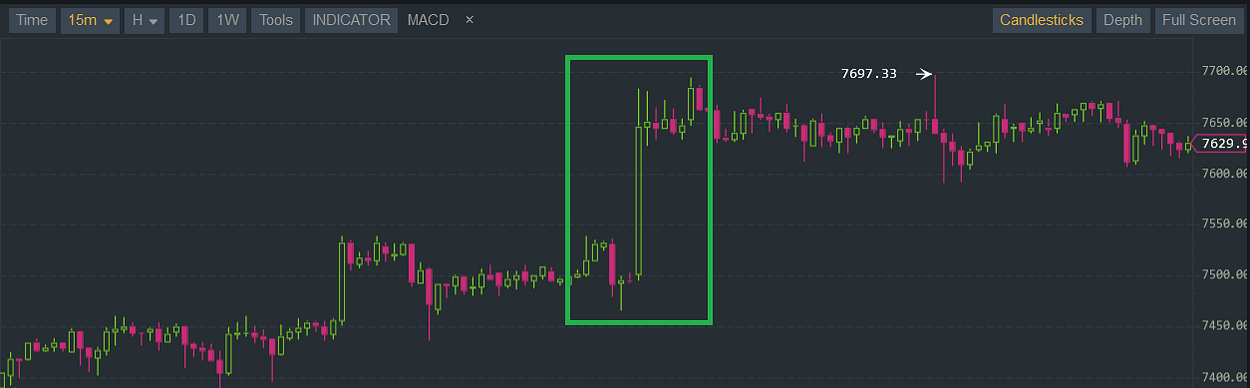
Instead of trying to predict the next P&D, we can instead try to detect it. If we can detect a pump early on, we can then initiate a buy order. The pump can move the price quite a lot in just a matter of minutes (or hours), usually anywhere between 1% and 5%, sometimes even more.

1*4vzdpxxL0AW2RXYROY1Nvw.png

A random “pump” scenario in the BTC/USDT market.

The detecting of pump & dump events can be categorized as anomaly detection (AD). Anomalies in statistics are referred to as outliers in the data, and there is a whole science around AD systems. If you want to know more about the technical specifications of AD systems, how they work and how you can make your own: Pavel Tiunov’s has a few good articles and tutorials to help you get started.

One can use basic mathematical/statistical formulas to create AD systems for simple problems, but these won’t work for complex problems. For the latter case one can use neural networks, or similar A.I. systems to detect anomalies in highly complex datasets.

Anomaly detection for crypto isn’t the most complex problem, but it’s far from the easiest one. For quite some time we have been trying to come up with trading algorithms that make use of P&D scenarios. The challenge is to detect them in a very early stage, because if it’s too late then you won’t make any profit. Detecting P&D’s is child’s play in terms of formulas, but the challenge is to categorize and react to them accordingly. Sometimes a small pump can evolve into a bullish uptrend market; or result in a long-term bearish downtrend market. Pumps also occur during bearish conditions, but these are very risky and we should try to avoid them. These additional complexities are just a handful of the total, in reality there are way more possible scenarios to take into account.

Kratos 1.0
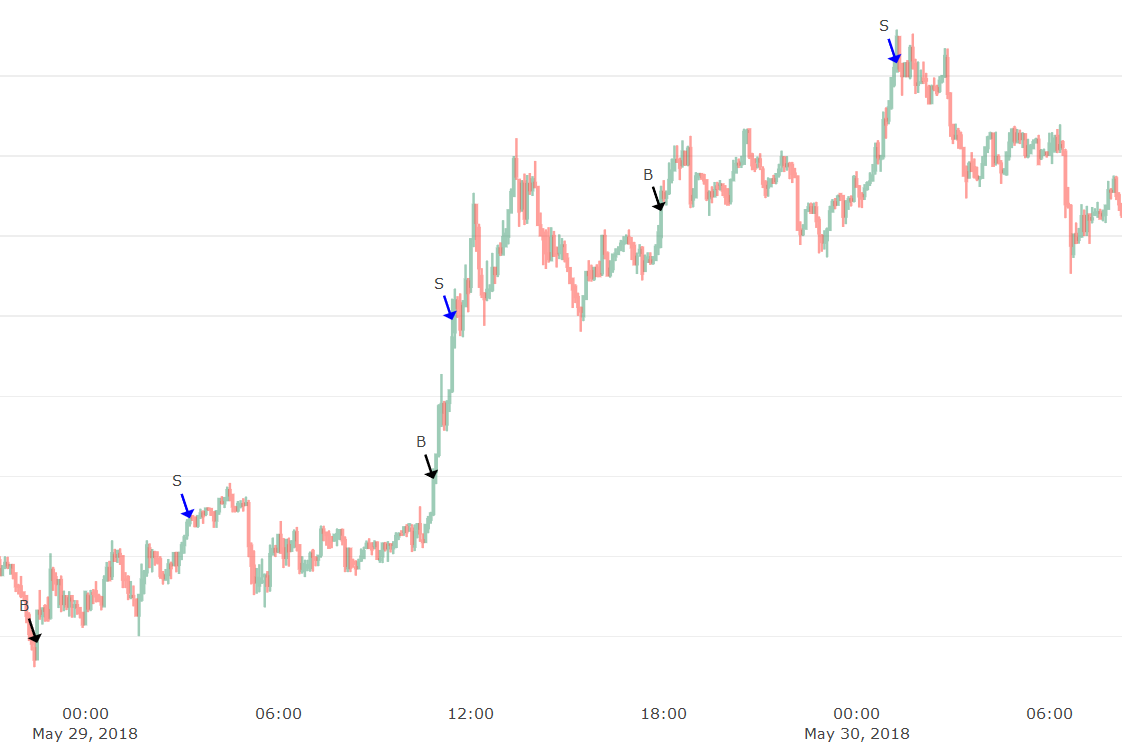
As I was developing new trading algos, I stumbled upon a method for detecting P&Ds quite well. Out of this code the Kratos trading strategy was born, it remains an early stage strategy but has great potential. Matter of fact it outperforms many of our other strategies in the ETH/USDT market. On the chart below you can see a few of its buy and sell signals.

1*LNkMDl1xQgCxNiWjP4vw_A.png

A portion of signals in ETH/USDT market.
By looking at the signals on the chart above we learn two things:
  1. The Buy signals are pretty good, they occur pretty early during a pump. Maybe we can improve them even more in future revisions.
  2. The sell signals are sub-optimal, and this is an important point. The ROI from this strategy can be greatly improved by improving the Sell signals. In this version we make the algorithm sell when a 3% profit margin is guaranteed. In practice, especially if you’re trading manually, you may want to follow the price until it reaches a peak. Peak detection is yet another complex problem, since we can never know for certain whether the price has reached a local maximum or not. In this case you’ll have to either speculate and take the risk of waiting longer, or play safe and exit after making a certain profit margin (e.g. 3% as in our case).
Backtesting “Kratos 1.0”
In the simulations below we’ll run this algorithm over a 60 day period (1 April to 30 May, 2018) for three different cryptocurrencies from Binance exchange.

Keep in mind that our ROIs incorporates the exchange trading fees and take additional slippage into account. Finally we run the backtesting simulation 100 times whereby the buy and sell prices are randomly selected from the interval’s [Low, High] range. As a result the final average ROI is very realistic and serves as a lower-bound expected return.

  • BTC/USDT yields an average ROI: 14.33% (±8.56)
  • LTC/USDT yields an average ROI: 16.04% (±9.35)
  • ETH/USDT yields an average ROI: 75.80% (±15.59)

Analysis and discussion
These are some great ROIs, and by improving the “sell” positions we could improve these by another 30%. But what’s fascinating is that this strategy works way better for ETH than for BTC and LTC combined.

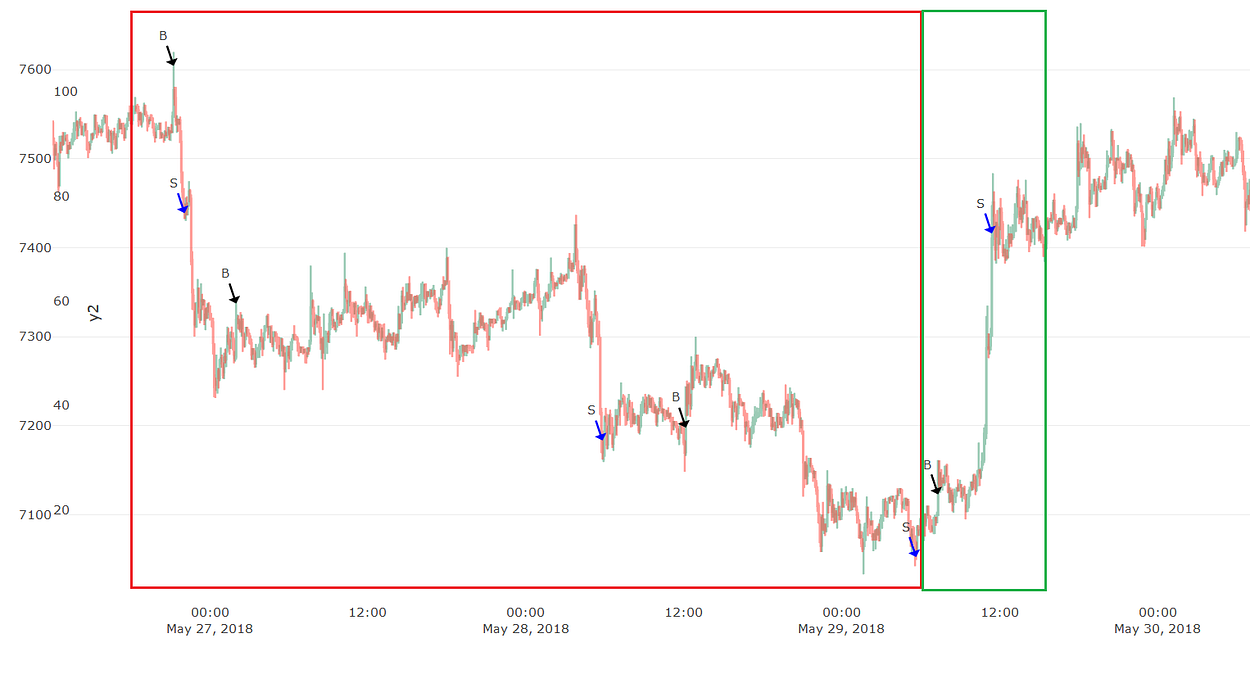
There are many reasons why this algo resonates so well with the ETH market, but its explanation is very mathematical and out of the scope of this article. But to visually illustrate why it performed relatively poor for BTC/USDT have a look at the next chart:

1*DRXlK-U0q4JM2qoJHP6_eg.png

A portion of buy/sell signals for BTC/USDT.

From the chart above we see that the algorithm generated quite a few unfavorable “buy” signals, most of these were at the end of a pump’s lifetime (thus too late). While some of these buy signals were pretty “okay”, in the end it had to sell at a loss (to reduce even more losses). This is a problem because we use a very basic heuristic: sell when a 3% profit is made or upon a 2% loss. So in BTC and LTC markets a pump rarely goes beyond 3%, as a result we rarely have the opportunity to sell at 3% profit. We can improve these algorithms by optimizing their hyper-parameters, as a result their ROIs could potentially double.

Conclusion
We learned that these buy signals are very good positioned. This means you can make a great profit by following the signals. But to improve our returns we shouldn’t put all our faith into the “sell” signals. We can make even better profits by manually monitoring the price ourselves, and increase our chances of selling at a profit.

If you enjoy our work and free articles, make sure to subscribe and follow. Have a great day and stay tuned for the next.
- Ilya
 
Hello. First of all, I mean it's a great project. For a few days I have been studying this project and it seems that all the work done is fruitful.
I have some questions:
1. I want to play this game. 300 euros are enough for the beginning?
2. How can I get 1% ROI per day? Or can I get more than 1% with Intra-Day Trading?
And the last question.
3. I would test your predictive system. Which price intervals is better? 10 minutes or one hour?
 
Hello. First of all, I mean it's a great project. For a few days I have been studying this project and it seems that all the work done is fruitful.
I have some questions:
1. I want to play this game. 300 euros are enough for the beginning?
2. How can I get 1% ROI per day? Or can I get more than 1% with Intra-Day Trading?
And the last question.
3. I would test your predictive system. Which price intervals is better? 10 minutes or one hour?
Hey man :) Thanks for the kind words.
  1. You can start with any amount actually, but I would say $50 is the bare minimum you need. The more you money you have the more money you'll make, but if you're a starter then start small and scale up.
  2. Getting an absolute 1% per day isn't easy, but an average 1% per day is more realistic. Trading is all about finding a good entry (buy) position where the price is low and about to go up. As the saying goes: "if you know when to buy, selling is easy."

    Intra-day trading (in the narrow sense) didn't prove to be very profitable in our analyses (yet). Usually we make a trade today and sell it 6 to 36 hours later. Because it takes time before the market's price goes up by 1% to 5%. You could however try to make 0.3% to 0.9% per trade, this is possible in relatively shorter intervals.

  3. Before using the predictive system, make sure you've read and understood our "Predic 1.0" algorithm, which explains how the prediction system actually works. Because if you are going to use the predictions in the direct sense, you won't get far.
Trading is risky because it has a steep learning curve. Unless you're lucky, you won't make a lot of money -- that's why most people lose. You need to educate yourself and learn a lot, and then create your own style that works for you. That's also part of our business plan, we put all this information and analyses out there, others can learn, but it also forces us to learn from it (making our systems better).

I hope this answered your question(s), if anything is still unclear let me know :)
 
Hey man, I want to try it,
Which "prediction" do you suggest me to follow?
ETH/USDT is the best using Kratos 1.0?
do the trial version provide any tutorials?
 
Hey man, I want to try it,
Which "prediction" do you suggest me to follow?
ETH/USDT is the best using Kratos 1.0?
do the trial version provide any tutorials?
Hey hey :)
Right now we only made five trading strategies available.
The recent ones such as Predic and Kratos are not yet included.

We do have a short FAQs page, but the best source for tutorials/guides is the blog on medium.
The app itself really needs to tutorials because it's self explanatory: you simply wait for a signal notification and act accordingly.

I hope this answers your question?
 
Yeah thank you,
Which strategy works best for you? Or the one that you suggest me to try :)
 
Yeah thank you,
Which strategy works best for you? Or the one that you suggest me to try :)
As the saying goes: if you know how/when to buy, selling is easy.
The thing is that almost all strategies have very good entry (buy) positions, usually afterwards the price goes up.
You can see this on the signals chart.

What affects the ROI the most (as I explained in my previous post), are the selling positions.
Our algos (until now) have been programmed to obey simple heuristics, so they are pretty "dumb" systems.
Our job is try to optimize the heuristics and make them yield positive returns.
However, a human trader could make better sells than indicated by the algos.

To choose a good algo, look at the signals generated by various different strategies.
Try to understand/analyze the "buy" and "sell" signals for each algorithm, then make up your mind whether those type of signals align with your plan.
For instance, some algos generate signals while most people are asleep, making the strategy somewhat useless for them.
So you have to take several factors into consideration for choosing a strategy.

To give you a practical example, let's look at the "worst" strategy in our system (i.e. lowest ROI):

FYKwKwK


The first red rectangle contains a good "buy" signal, but the sell exited too soon, the price was going up quickly -- however due to the heuristic it obeyed to sell. When you receive such a "sell" signal, you should be able to see that the price keeps going up, thus wait longer and profit more.

The second red rectangle is a missed opportunity because of the heuristic. It could've increased our ROI a lot had it sold somewhere around the peak. This is because the algorithm/strategy had a heuristic to sell at (example) "3% profit", but what if the profit was only 2.9% and then started going down (as observed here), then this is a bad thing right?
** On a side note: the voltra and pistis algorithms don't sell for profit, they instead use a different criteria for making buy/sell decisions. This needs a rework in the near future imo.

The third red rectangle: this area contains several bad buy & sell signals because of the bearish market (this all were losses), but if you look closely, a couple of the buy signals were pretty good and could've generated a small profit -- or at least minimized the loss much more (e.g. to break-even).

Conclusion
Using "only" the ROI as indicator whether a strategy is good or not, isn't a good decision. We've learned that most buy signals are quite good and can make you a profit. The major difference between these algorithms lies in the "sell". It's a quite complex task to make a computer program decide when it's time to sell (usually it sells too early or too late).

Does this make more sense? :)
 
The impact and analysis of Bitcoin Cash (BCH)
Every few days and weeks we add new features, currencies and create more tools for our users. Today we added Bitcoin Cash (BCC or BCH) into our systems. In what follows I will present a brief analysis and discussion of this cryptocurrency.

1*pwZjlN0waYw24R3rDrfPTg.png


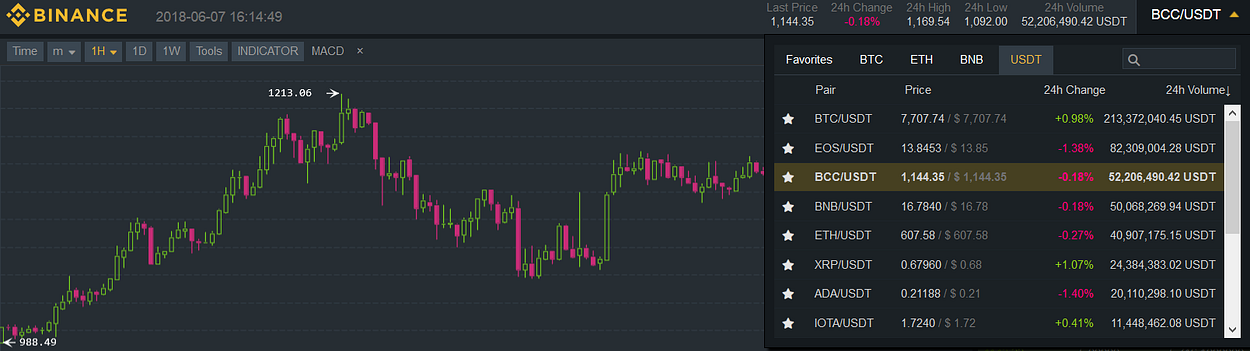
Bitcoin Cash usually abbreviated by BCH and previously known as BCC, is one of the largest and most traded cryptocurrencies in the world (by volume). Due to the BitConnect ponzi scandal the market decided to abbreviate it as BCH instead of BCC, but many exchanges still use the original notation.

Price predictions
The integration with our artificially intelligent (A.I.) prediction system was successful. BCH caused no problems and the forecasting works flawlessly.

1*lt-dIBBahJS-XP784gKCIw.png


1*K9CDI6sowepGSIrosc614g.png

AI generated price predictions for BCH using 10-min and 60-min candlestick intervals.
Trade signals
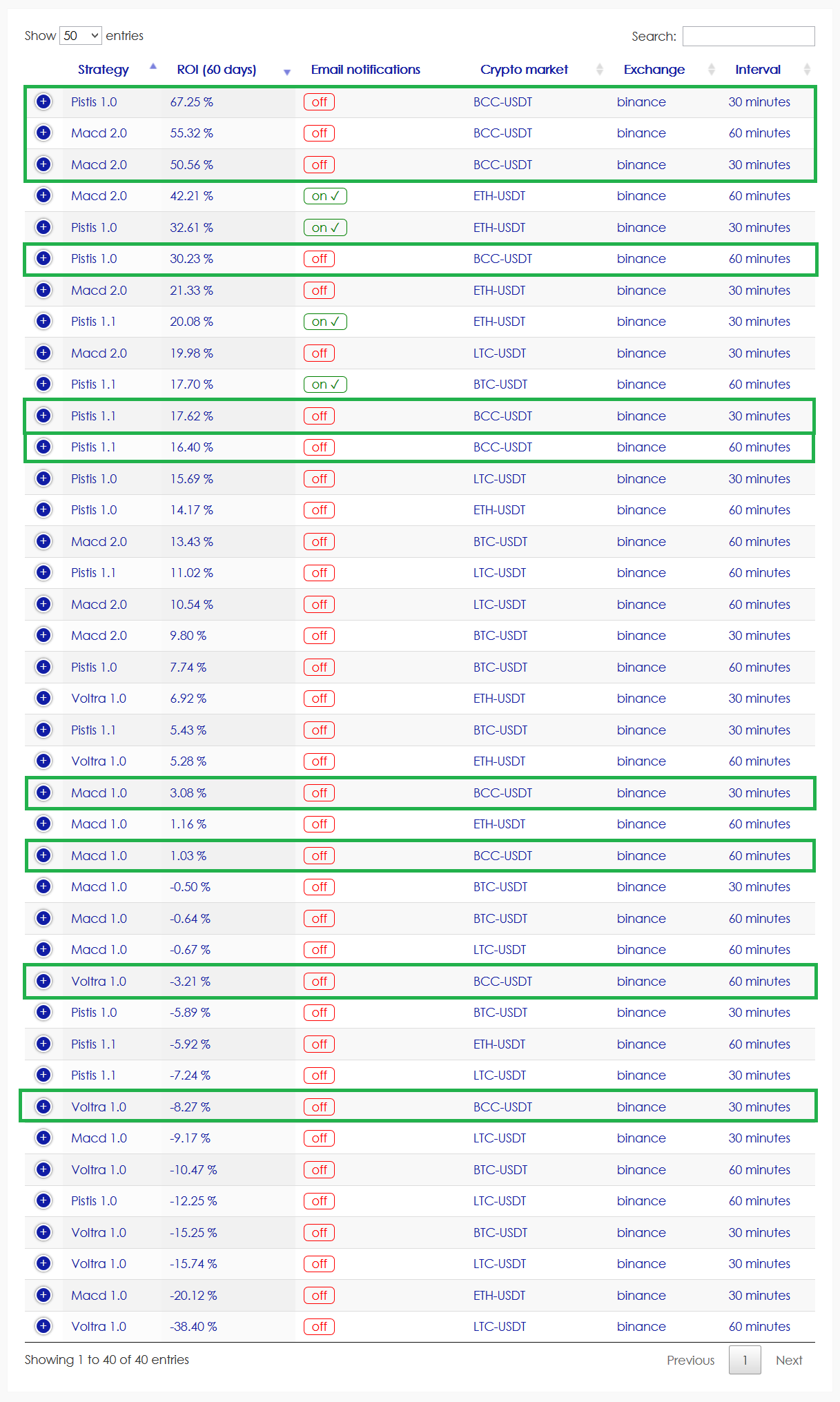
Since our trading algorithms are general purpose they should work with many existing cryptocurrencies, so without adding any new algorithms we simply plugged BCH into the system. We did not except this, but BCH dominates and outperforms many of our other cryptocurrencies (BTC, ETH and LTC) by returns (ROI). On the image below I’ve indicated (green rectangles) all new BCC-USDT entries so you can compare them against the existing ones.

1*eIUN1f0k2TzW58wXZfYpCQ.png


Let us dive a bit deeper and analyze the individual buy & sell signals. I won’t be going over every single entry, so let us only look at the best and worst performing ones.

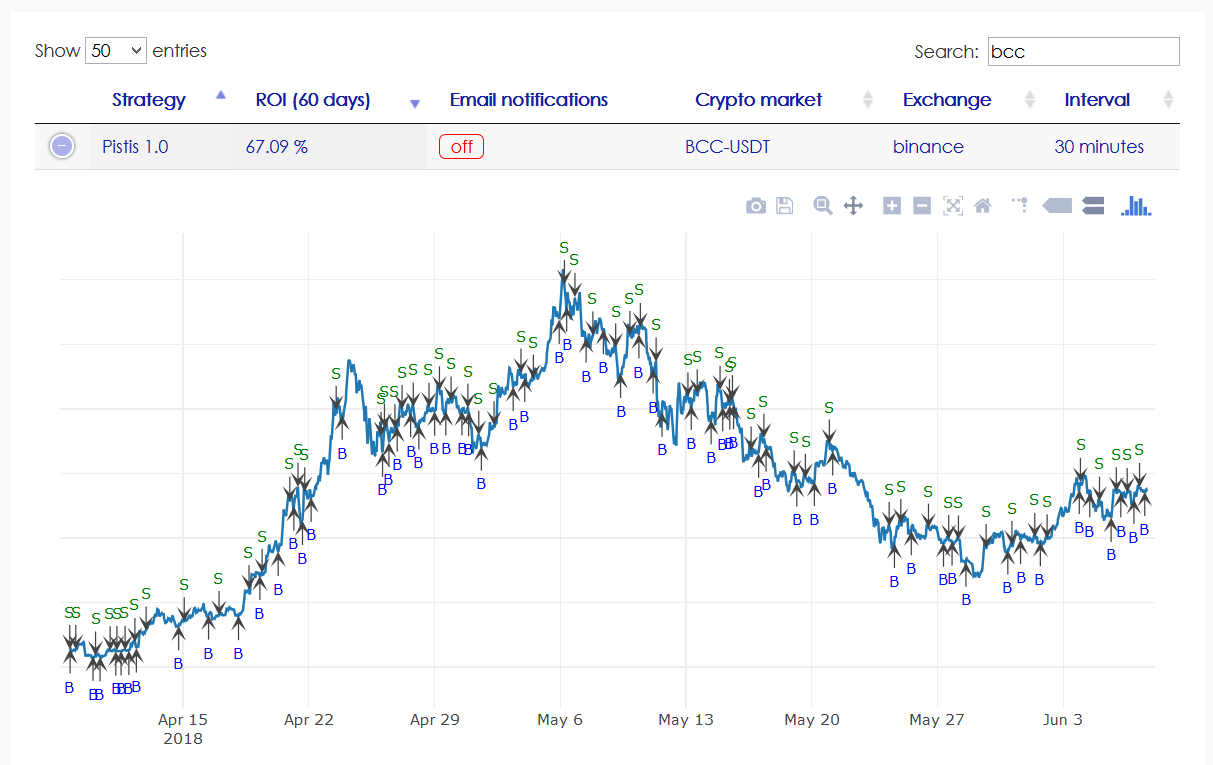
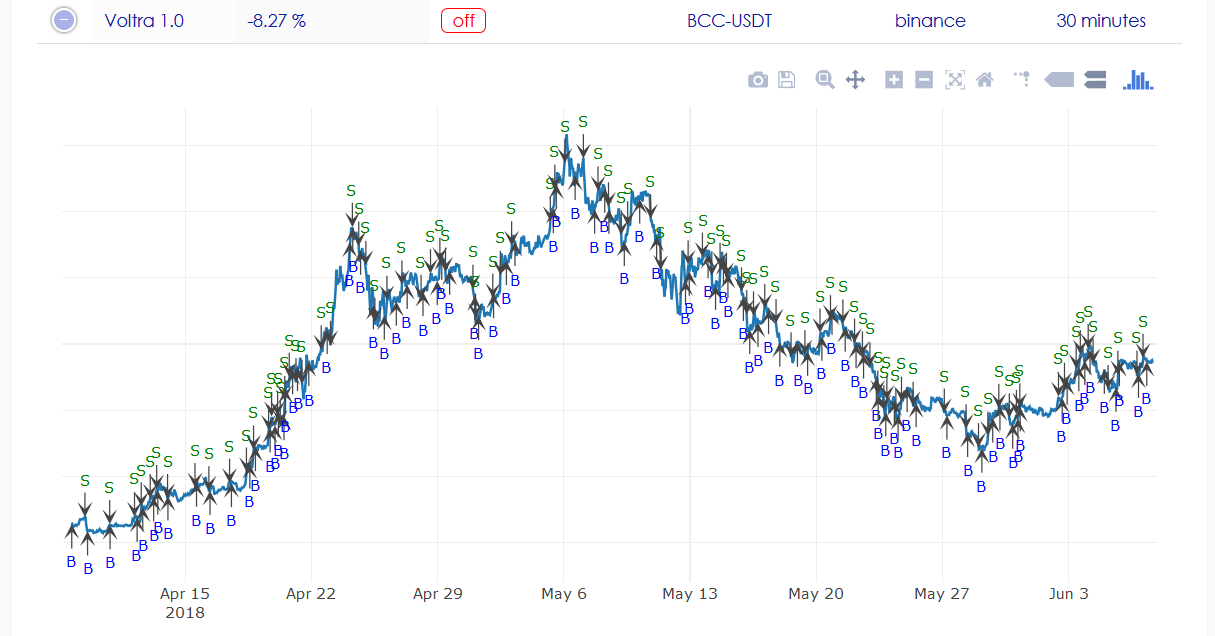
The best performing algorithm for BCC-USDT is Pistis 1.0 using 30-min candlestick intervals:

1*vN4HVbvBHFpJU76_A6OX_g.png


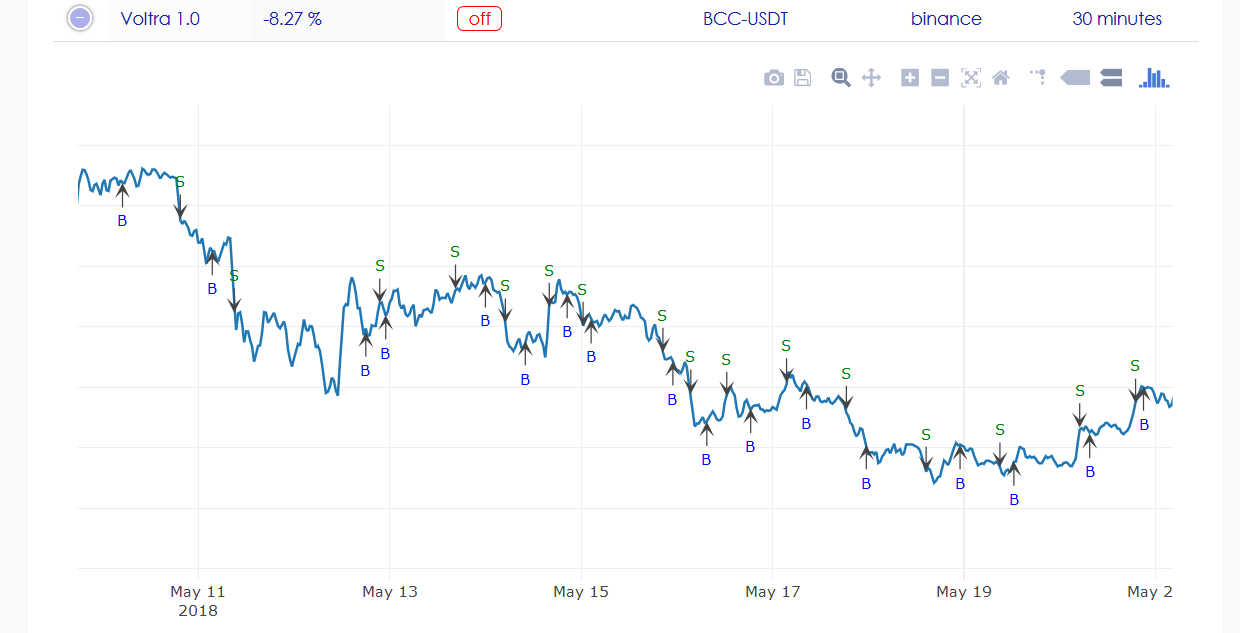
While the lowest performing one is Voltra 1.0 using 30-min intervals:

1*LfL6idgzgKe8E8YQ06ph4w.png


As mentioned in my previous post(s); the least performing algorithms are only measured by ROI, but this does not mean they are useless or worthless. The major difference between all these algorithms/strategies lies in their “sell” heuristic. To illustrate that the “Voltra 1.0" is a decent algorithm but just needs some tweaking, have a look at the screenshot below. I zoomed-in to a randomly chosen region so we can better analyze the buy & sell signals.

1*EvXpXoijRNb1uWcj8ILqlw.png


We see that most of its “buy” positions are very decent, usually located in a valley. But the timing and position of the “sell” signals is mediocre at best, that’s why the ROI is negative.

Some of our traders may find the Voltra algorithm more useful than the other ones, in particular for its decent “buy” positions. But keep in mind that you shouldn’t rely on the “sell” signal but decide for yourself when to exit.

Conclusion
If you’re not trading Bitcoin Cash, maybe this is a call to get started. Either way, I thank you for all your support and feedback. Make sure to subscribe if you wish to stay tuned for the next episode.

Have a great day!
- Ilya
 
You are doing a great job man, keep it up!!!

Is the app meanwhile available to us users?
Or did you create a new website where we can find those trade signals etc like above ? :)
 
The NEO-USDT pair on CryptoPredicted
In the past week the crypto markets have been, and still are in free fall. Claims are made this is because a crypto exchange has been hacked and thousands of Bitcoins were sold. Since Bitcoin has a major effect on all other cryptocurrencies, these consequently were effected and dropped in value in matter of hours.

But we also have some good news. Today we added the NEO-USDT pair into CryptoPredicted. NEO is now available on both the predictions as well as integrated with all our trading strategies.

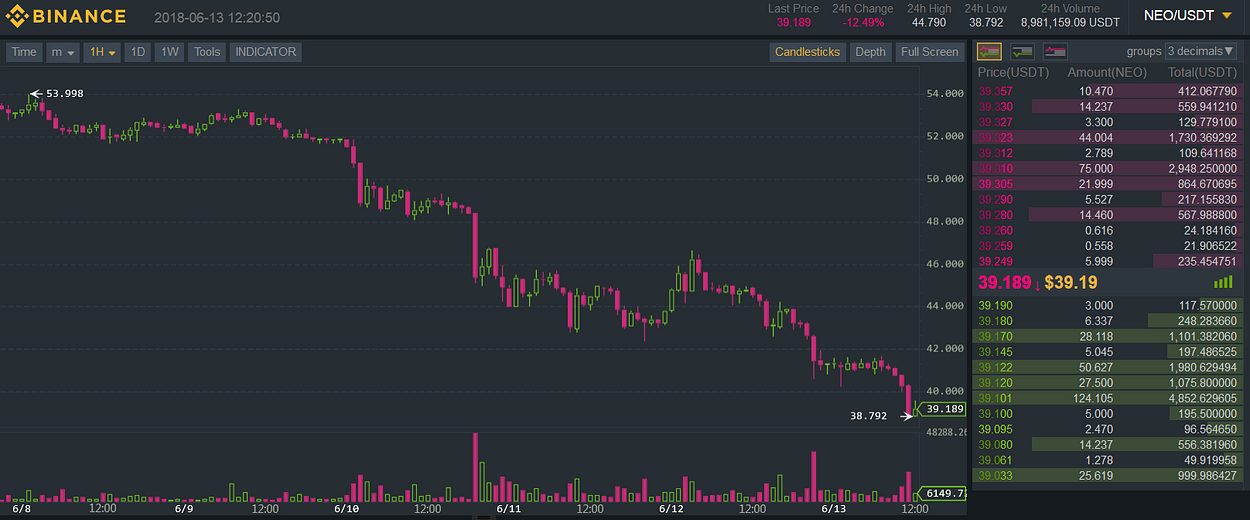
1*0yb-7t8BQRXYkh5vEYNegQ.png

NEO/USDT on Binance
In the next two sections we’ll analyze NEO’s performance from the standpoint of our algorithmic trading strategies as well as the predictions.

Trade signals
Some of our users asked the question whether our trade signals are short or long positions. The answer is that they are all longs, because not all exchanges allow trading shorts. And longs are more intuitive and more accessible to less experienced traders.

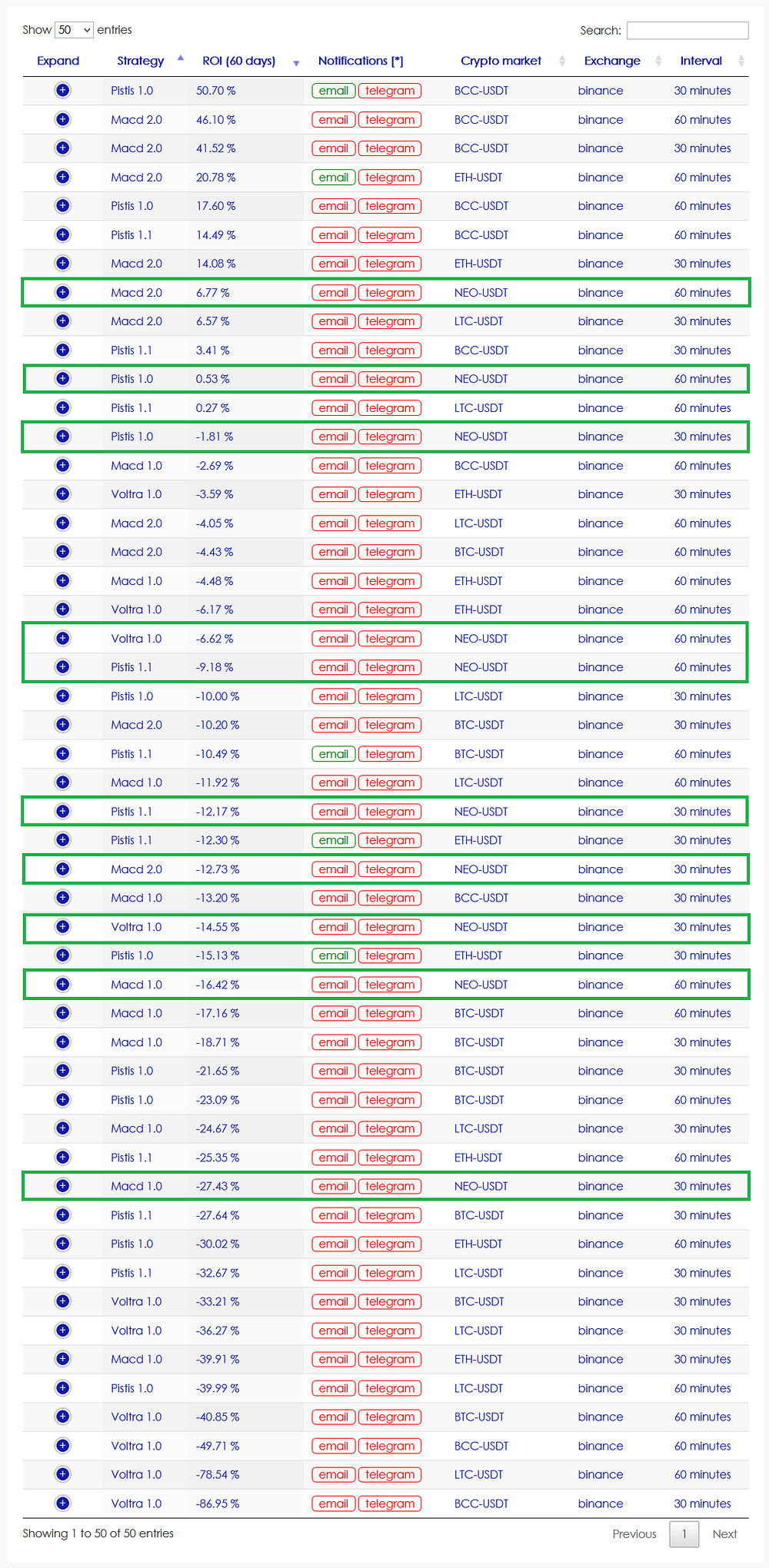
On the screenshot below you’ll see all our trading strategies with their respective ROIs as of 13 June 2018 (12:30 CEST). Because of the bearish conditions past few days the ROIs literally decreased by more than 20%. But more importantly, I indicated with green rectangles all NEO-USDT entries. This allows us to put NEO in perspective and compare it with the other currencies.

1*-WNqI34JQleCVYbONRHISg.png


We learn that NEO falls in somewhat the same category as LTC or ETH in terms of profitability in combination with our trading strategies. But it’s performing slightly better than BTC which is good news. But BCC (aka BCH) is still far ahead compared to all the other coins.

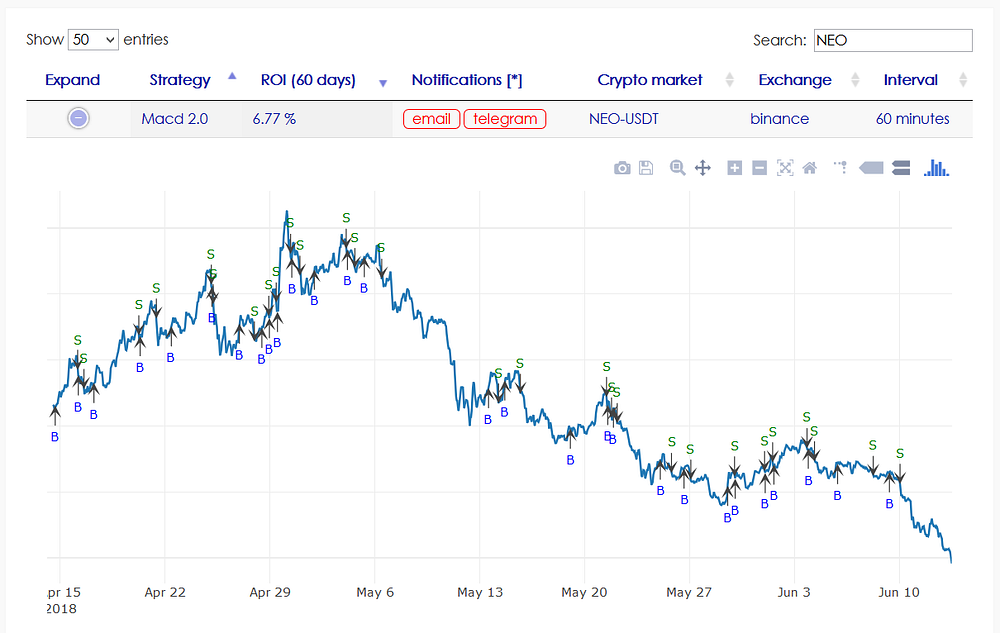
1*YCEiM2elKOATymS79Hqa0w.png


For instance, the Macd 2.0 (60min) strategy yields the highest returns for NEO. Most Buy signals as shown above are pretty solid and well positioned. But the bearish conditions make it much harder to make a profit, which again results in a pretty low ROI.

Price predictions
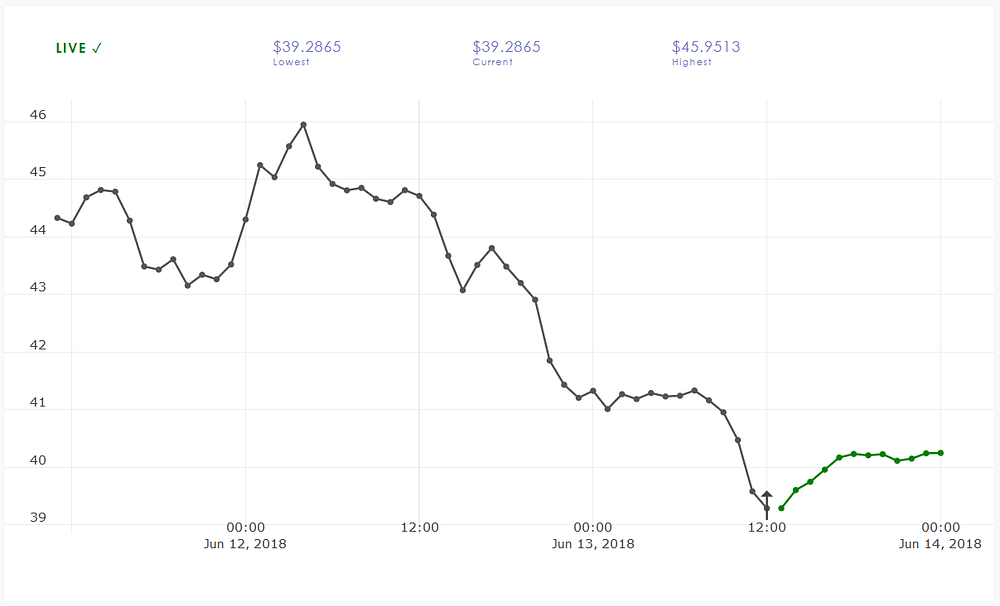
The price predictions are well integrated and work flawlessly, using both the 10 minute and 60 minute intervals.

1*u-FKtqIkks8UHQ10c41e5g.png

NEO-USDT predictions at 60minute intervals
Conclusion
It would be nice to see how NEO will perform with our trading strategies during bull market conditions. We’ll have to wait to make that analysis. Overall NEO is pretty solid and falls in the league of LTC and ETH in terms of ROI, so it’s definitely a coin worth trading. Make sure to subscribe if you wish to stay tuned for the next episode.

Have a great day!
- Ilya
 
Awesome thread and information @healzer

I've just signed up for the trial, and am looking forward to seeing your predictions in action.

I'll move some funds to USDT to actively test, and compare with my own chart reading.

Keep it up dude!
 
Back
Top