What is the difference between sticky IP and rotating IP?

Sticky session allows you to keep your proxy the same throughout your session. Sticky sessions involve the session parameter, which dictates how long the same proxy should be maintained. If it is necessary to rotate the proxy IP in advance, the value of the session parameter must also be changed. Otherwise, the IP address will not rotate within the session time.

Rotating sessions provide you with a new proxy for each request. This means that every time you make a request, it will come from a different IP address. This method is ideal for tasks that require a high level of anonymity and reduced traceability, such as web scraping or accessing content without revealing the same identity.
 
Basically, a sticky IP assigns a consistent IP to a user for the duration of a session. Useful for when the server needs to remember the client's identity throughout interactions. Meanwhile rotating IPs change frequently based on request, timer, etc., to prevent detection or blocking, that sort of thing. Particularly useful in for anonymity or when multiple requests need to be made without triggering restrictions. That's the broad strokes of it, anyway.
 
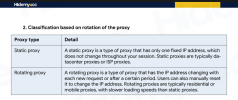
Static proxy will keep the same IP address throughout your session, while rotating one has IP address changing with each new request or after a certain period

1737083247746.png
 
which one is good for acocunt creation with different api
In terms of the two: use sticky IPs for detailed or high-value accounts (your main account) and rotating IPs for large-scale single-step account creation. Rotating IPs have particular mileage when it comes to mass account creation and if you plan to automate that process.
 
Rotating proxies rotate on a predetermined interval and sticky proxies attempt to keep the same IP for a specific amount of time. The nature of residential proxies means that it's sometimes not possible to keep the proxy sticky for that amount of time but it tries to
 
Back
Top