

- Oct 9, 2013
- 3,481
- 14,518
Really, it's actually dead.
And my promise to you here is that by the end of this article, you'll have learned something that will allow you to go away and improve the rankings of any site.
Ok, well. Before I teach you about how Google actually ranks pages I'll quickly introduce myself and tell you why you should listen to me. (If you don't already know me.)
I've been in online marketing since 2007 and started analysing sites to learn SEO in 2014.
My philosophy is that you don't learn SEO from reading(Except my guides of course!)
Why?
Because 99% of the people out there writing about SEO get their knowledge from each other. They read the same articles, learn from the same sources and then re-iterate the same dated ideas to each other.
How I learned SEO from the start was through the scientific method.
Observation → Question → Hypothesis → Experiment → Analysis → Conclusion
I read almost nothing about SEO. I mean that quite literally. I don't even know or care who the "gurus" in the scene are.
All my knowledge comes from the above process. You'll find deep guides dating back to 2015-2016 that I wrote here, where my first experiments were reverse engineering how siloing really worked.
My first authority site back in 2017 that put that knowledge to work..
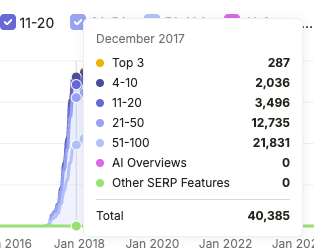
It was an Amazon review site in the parenting niche. Exploded.
So what you're about to learn here isn't some fluff written by AI, or something an "SEO writer" put together after researching a few blogs.
This is entirely from my brain. In my words, without a single external page used to as reference.
They MIGHT use them directly in h2's, although I suspect it's something a little different that I'll explain below.
Either way, you definitely want to be using keyword variations in your h2's across your page. Just don't make it repetitive and focus on the balance of keyword phrases and a reader-friendly heading.
The title and h1 (And domain and url too) they are directly weighing the keyword. This means you still get a VERY strong boost based on keywords in the title, h1, domain and url.
And this makes sense. These are natural signals. If a book is called "How to Run", you know what it's about. If the book just contains a bunch of keywords about running, then it's useless, but the title of the book SHOULD be keyword focused.
When we say 'search term' or 'search phrase' -- we are specifically referring to the keyword when it's typed into the search box.
(Yes, humans use em-dashes too.)
That's the best way I can describe to you in a way you'll understand unless you're a mathematician and understand vector algebra.
But you know what the best way to teach is? By example.
No one, including me likes to learn from really dense theoretical language.
Let's take a real keyword and I'll talk you through it so that at the end of this article you have an actual understanding that you can go away with and improve every single page on your own web site to rank better.
"persian cats" is a good one, because it's very broad.
For the search phrase, Google builds a picture, or an "intent map" of what the searchers want.
For this one, people want:
We don't need to identify them all for this.
Now, in order to rank for persian cats, your page has to be a match for what people are looking for.
Google isn't checking to see if you have keywords like "persian cat health issues" and "caring for a persian cat"
They used to, which is why in the past you could rank with thin content targeting question style keywords.
AI made this really easy to abuse, and in 2023 the "Helpful Content Update" was actually Google moving from keywords to "page shape".
This is actually why there's so many updates. They have to retrain based on fresh data to get fresh representations of the ideal page for every search term.
This is why you see variety in broader serps.
Google pulls in pages based on how well the serp satisfies the search term.
It won't ever just pull in pages of the same type because that would not satisfy the term.
They are actually treating page 1 as the entire thing that satisfies the search term.
A combination of their AI snippet, shopping snippets, local map packs, organic rankings, PAA(people also ask) and other rich snippets.
There is a shape for satisfaction of a search term. That shape is made up of a combination of things the searcher wants:
I don't know if Google have static buckets like this. I don't think so. It's likely that the way the machine learning works just naturally lumps things into buckets.
But for us, as page creators, it helps to identify buckets like this.
For persian cats searchers want to:
These are broad buckets that I've created, but you can make up your own buckets depending on your niche or the search term.
Ecom for example you can clearly see many broad keywords have combinations of people wanting to understand the product, verify trust of the site/page, decide which one is right for them, act and make the purchase.
For a pure informational article, it's mostly understanding. For ecom it's a combination of all.
For local service keywords it's a combination of all.
This is why you can't just rank by slapping some keywords on the page and expecting to hit page 1.
You have to actually understand the searcher, the intent map (the intent atlas!) which you can then translate into a page that resolves the intent for that searcher.
Google tries to capture everything through the whole serp. Let's take a look at persian cats..

Here, we see exactly. Pictures. Lifespan. Temperament. It's FULL of pictures. That shows a strong visual intent.
We see the people also ask questions. "how much does it cost" - you see?
What color is rare(visual/understanding)
comparisons: persian vs ragdoll.
Notice what they bold on the top 2 results: "long-haired traditional breed of cat"
People want to understand "what is it visually."
"solidly built with broad chests and muscular bodies" - Again. VISUAL. This isn't about keywords.
You don't rank by having keywords like "How does a persian cat look?"
Google are using machine learning. It isn't looking at keywords. It understands what the page covers from the text, to the images to the layout and rich structures on the page(Tables, forms).

If we go down a little to mid page 1, we find :
A page discussing health and care
A page with facts.

The "what people are saying" - health challenges, grooming..
Then a broader page with breed info.

A page about temperament, personality and care.
Look at the people also search:
for sale - you see the BOLD? Google is TELLING you what the searcher wants. Everyone is blindly focusing on keyword spam or just "lots of content"
"disadvantages" - bolded. People want to know if it's a good fit for their home. Again..
You don't rank by writing "Disadvantages of persian cats" like it's 2018
You rank by UNDERSTANDING that one of the shapes is tied to the question "Is the persian cat a good fit for my home?"
It's all shapes. For sale, care, health, visuals.
A quick look at the top of page 2

We all know Google loves reddit, but they aren't just picking RANDOM posts.
Look carefully.. What's bolded? "will need grooming daily" -- What did I just say above? "Is it a good fit for my home". They are literally showing the searcher up front things that help them DECIDE.
A video "101 - learn all about them".
"breed & adoption info" - how to get one
But the "for sale" part is a SMALLER shape. That's why it's page 2. That page will never rank top 5 unless suddenly everyone searching for "persian cats" wants to buy.
It's a smaller shape. The fact you see this page on page 2 isn't because it's a weak page, or it's not relevant. Google is showing you that a small part of the shape is buying the persian cat.
They will never show you 15 pages all "Persian Cats: Breed Info"
Notice how all the pages are complimentary.
NOW..
And this applies to everything from ecom to info to local service.
If you want the best chance at ranking as high as possible, you need to capture all the shapes on your page AND do it in the right proportions.
If you have TOO MUCH of one shape, and not enough of another, you rank worse.
If you have too many shapes that aren't part of the intent, you don't rank.
Now, you know how Google ranks pages in 2026 and beyond.
The next time someone talks about keywords on the page being a ranking factor you will know that person doesn't understand SEO.
And of course.. Any agency you want to hire to do your work. You can now spot straight away how knowledgeable they are. If they're still talking about keywords and "writing lots of content" then you know their knowledge is dated.
P.S. This of course helps you get more visibility on chatgpt and other AI's. The more your page actually resolves the needs of the searcher, the more AIs will show your pages to people.
And my promise to you here is that by the end of this article, you'll have learned something that will allow you to go away and improve the rankings of any site.
Ok, well. Before I teach you about how Google actually ranks pages I'll quickly introduce myself and tell you why you should listen to me. (If you don't already know me.)
I've been in online marketing since 2007 and started analysing sites to learn SEO in 2014.
My philosophy is that you don't learn SEO from reading(Except my guides of course!)
Why?
Because 99% of the people out there writing about SEO get their knowledge from each other. They read the same articles, learn from the same sources and then re-iterate the same dated ideas to each other.
How I learned SEO from the start was through the scientific method.
Observation → Question → Hypothesis → Experiment → Analysis → Conclusion
I read almost nothing about SEO. I mean that quite literally. I don't even know or care who the "gurus" in the scene are.
All my knowledge comes from the above process. You'll find deep guides dating back to 2015-2016 that I wrote here, where my first experiments were reverse engineering how siloing really worked.
My first authority site back in 2017 that put that knowledge to work..
It was an Amazon review site in the parenting niche. Exploded.
So what you're about to learn here isn't some fluff written by AI, or something an "SEO writer" put together after researching a few blogs.
This is entirely from my brain. In my words, without a single external page used to as reference.
The One Area Google Still Uses Keywords Directly
One caveat that's important. Google still directly uses keyword matching in the title and h1.They MIGHT use them directly in h2's, although I suspect it's something a little different that I'll explain below.
Either way, you definitely want to be using keyword variations in your h2's across your page. Just don't make it repetitive and focus on the balance of keyword phrases and a reader-friendly heading.
The title and h1 (And domain and url too) they are directly weighing the keyword. This means you still get a VERY strong boost based on keywords in the title, h1, domain and url.
And this makes sense. These are natural signals. If a book is called "How to Run", you know what it's about. If the book just contains a bunch of keywords about running, then it's useless, but the title of the book SHOULD be keyword focused.
Terminology: Keywords vs Search Term or Search Phrase
When we say keyword, we are talking generally about a keyword. It's just describing the keyword itself.When we say 'search term' or 'search phrase' -- we are specifically referring to the keyword when it's typed into the search box.
(Yes, humans use em-dashes too.)
What Replaced Keywords then?
Shapes.That's the best way I can describe to you in a way you'll understand unless you're a mathematician and understand vector algebra.
But you know what the best way to teach is? By example.
No one, including me likes to learn from really dense theoretical language.
Let's take a real keyword and I'll talk you through it so that at the end of this article you have an actual understanding that you can go away with and improve every single page on your own web site to rank better.
"persian cats" is a good one, because it's very broad.
For the search phrase, Google builds a picture, or an "intent map" of what the searchers want.
For this one, people want:
- What different types of persian cats look like
- Health issues
- Caring
- What's it like to own
- Where can I buy a persian cat/kitten
- + more
We don't need to identify them all for this.
Now, in order to rank for persian cats, your page has to be a match for what people are looking for.
Google isn't checking to see if you have keywords like "persian cat health issues" and "caring for a persian cat"
They used to, which is why in the past you could rank with thin content targeting question style keywords.
AI made this really easy to abuse, and in 2023 the "Helpful Content Update" was actually Google moving from keywords to "page shape".
What do you mean by page shape?
Google creates vector representations of your page and they compare it to what the vector representation for the "perfect page" that completely satisfies the users want.This is actually why there's so many updates. They have to retrain based on fresh data to get fresh representations of the ideal page for every search term.
This is why you see variety in broader serps.
Google pulls in pages based on how well the serp satisfies the search term.
It won't ever just pull in pages of the same type because that would not satisfy the term.
They are actually treating page 1 as the entire thing that satisfies the search term.
A combination of their AI snippet, shopping snippets, local map packs, organic rankings, PAA(people also ask) and other rich snippets.
There is a shape for satisfaction of a search term. That shape is made up of a combination of things the searcher wants:
- Understand: Things to understand. Topics, advice, answers to questions.
- Decide: They have a decision to make and need help deciding.
- Act: They need to take an action. Buy, sign up, find
- Verify: They need to confirm something
I don't know if Google have static buckets like this. I don't think so. It's likely that the way the machine learning works just naturally lumps things into buckets.
But for us, as page creators, it helps to identify buckets like this.
For persian cats searchers want to:
- Understand: Is a persian cat right for me?
- Understand: What do persian cats look like: x type vs y type
- Decide: Should I get a persian cat?
- Act: Where can I actually get one
- Verify: What do they cost and are they hard to look after
These are broad buckets that I've created, but you can make up your own buckets depending on your niche or the search term.
Ecom for example you can clearly see many broad keywords have combinations of people wanting to understand the product, verify trust of the site/page, decide which one is right for them, act and make the purchase.
For a pure informational article, it's mostly understanding. For ecom it's a combination of all.
For local service keywords it's a combination of all.
This is why you can't just rank by slapping some keywords on the page and expecting to hit page 1.
You have to actually understand the searcher, the intent map (the intent atlas!) which you can then translate into a page that resolves the intent for that searcher.
Google tries to capture everything through the whole serp. Let's take a look at persian cats..
Here, we see exactly. Pictures. Lifespan. Temperament. It's FULL of pictures. That shows a strong visual intent.
We see the people also ask questions. "how much does it cost" - you see?
What color is rare(visual/understanding)
comparisons: persian vs ragdoll.
Notice what they bold on the top 2 results: "long-haired traditional breed of cat"
People want to understand "what is it visually."
"solidly built with broad chests and muscular bodies" - Again. VISUAL. This isn't about keywords.
You don't rank by having keywords like "How does a persian cat look?"
Google are using machine learning. It isn't looking at keywords. It understands what the page covers from the text, to the images to the layout and rich structures on the page(Tables, forms).
If we go down a little to mid page 1, we find :
A page discussing health and care
A page with facts.
The "what people are saying" - health challenges, grooming..
Then a broader page with breed info.
A page about temperament, personality and care.
Look at the people also search:
for sale - you see the BOLD? Google is TELLING you what the searcher wants. Everyone is blindly focusing on keyword spam or just "lots of content"
"disadvantages" - bolded. People want to know if it's a good fit for their home. Again..
You don't rank by writing "Disadvantages of persian cats" like it's 2018
You rank by UNDERSTANDING that one of the shapes is tied to the question "Is the persian cat a good fit for my home?"
It's all shapes. For sale, care, health, visuals.
A quick look at the top of page 2
We all know Google loves reddit, but they aren't just picking RANDOM posts.
Look carefully.. What's bolded? "will need grooming daily" -- What did I just say above? "Is it a good fit for my home". They are literally showing the searcher up front things that help them DECIDE.
A video "101 - learn all about them".
"breed & adoption info" - how to get one
But the "for sale" part is a SMALLER shape. That's why it's page 2. That page will never rank top 5 unless suddenly everyone searching for "persian cats" wants to buy.
It's a smaller shape. The fact you see this page on page 2 isn't because it's a weak page, or it's not relevant. Google is showing you that a small part of the shape is buying the persian cat.
They will never show you 15 pages all "Persian Cats: Breed Info"
Notice how all the pages are complimentary.
NOW..
And this applies to everything from ecom to info to local service.
If you want the best chance at ranking as high as possible, you need to capture all the shapes on your page AND do it in the right proportions.
If you have TOO MUCH of one shape, and not enough of another, you rank worse.
If you have too many shapes that aren't part of the intent, you don't rank.
Now, you know how Google ranks pages in 2026 and beyond.
The next time someone talks about keywords on the page being a ranking factor you will know that person doesn't understand SEO.
And of course.. Any agency you want to hire to do your work. You can now spot straight away how knowledgeable they are. If they're still talking about keywords and "writing lots of content" then you know their knowledge is dated.
P.S. This of course helps you get more visibility on chatgpt and other AI's. The more your page actually resolves the needs of the searcher, the more AIs will show your pages to people.


