Unity Ads in Argentina: 2,099 FTDs and 88% ROI in 4 weeks. A Godlike Partners case study
Billions of people open mobile apps every day, and a large share of that inventory still sees very little gambling advertising. While most teams compete for the same audience on Facebook, a huge volume of traffic sits right next to them with almost no one buying it.
Facebook remains the main source for most teams. But it comes with a well-known cost: cloaking, antidetect, proxies, and account farming eat into the budget before a single conversion. In-app is different — gambling is a permitted category, no cloaking is required, and traffic often runs at a lower cost based on our internal buying data.
A team entering in-app for the first time usually takes its proven creatives, runs them, and can't figure out why conversions aren't landing. In this article we break down a campaign run by our partner GPM agency: Unity Ads, Argentina, four weeks,
2,099 FTDs, and 88% ROI. The case is based on a talk by
Stepan, Head of Affiliate Program at Godlike Partners, at G GATE CONF 2026.
Why in-app
One of the core advantages of the source is simple: gambling is a permitted category. No cloaking, no antidetect, and no need to check every morning whether accounts are still alive. You run traffic without constantly wondering when you'll get shut down.
Advantages:
- Typically fewer account issues. Gambling is a permitted category, which reduces the amount of work needed on cloaking, account farming, and antidetect setups.
- Lower CPMs. Based on our internal buying data, in-app CPMs are typically lower than Facebook's.
- Full control over source apps. You see which apps the traffic comes from and manage them through whitelists and blacklists. If an app delivers registrations without deposits, you disable it manually. Google UAC doesn't offer this level of control — you set the budget and hope the algorithm doesn't spend it on low-quality inventory.
- Scale. In-app inventory generates a very large volume of daily impressions, and the gambling vertical currently uses only a small share of it.
Drawbacks:
- Lower intent. The user was busy playing a game when the ad appeared. This is addressed through the funnel and a strong pre-lander.
- Not every publisher fits iGaming. Part of the supply delivers non-targeted traffic that doesn't convert, so cleaning the placements is mandatory.
- LTV is lower than on Facebook. At the same time, the cost per deposit is several times lower, which often results in a higher overall ROI.
There are several networks on the market: Unity, Mintegral, Moloco, AppLovin. Each has its own supply, GEO coverage, and rules around gambling. We'll cover this in detail in a separate article. Here we focus on Unity Ads, which is one of the more accessible entry points into in-app. Gambling is allowed through a managed account, whitelists are configured manually, and GEO coverage is worldwide. This is the network our partner used in the case below.
Case setup
The partner entered Argentina shortly after we opened the GEO. The market is still fresh, the auction isn't overheated, and players haven't developed ad fatigue toward casino creatives.
Campaign details:
- Source: Unity Ads
- GEO: Argentina
- Period: May 17 – June 17, 2026 (four weeks)
- Offer: Olymp Casino, CPA model
- Payout in this case: $15 per FTD (individual terms agreed with the partner for this test campaign; the current public rate for Argentina in our opening post is from $18 per FTD)
An agency account with gambling approval is required — the vertical isn't accepted on a standard self-serve account. Traffic must be sent to WebView applications. The available formats on Unity are Video and Playable Ads.
What didn't work
The team didn't enter Argentina from scratch: it already had working campaign setups in Europe. The source was the same, the offer was similar, so it seemed the creatives should perform. In practice, they didn't — impressions came in, but no conversions followed.
Plain gameplay
The first creatives showed the game directly: reels spinning, symbols landing, a win occurring. No hook, no emotion, no bonus mention. On Facebook, that type of creative can still convert on warm audiences. In in-app, the user wasn't looking for a casino — they were playing their own game when an ad block appeared. There was nothing to hold their attention.
Slots unfamiliar to the GEO
Shining Crown and Black Clover were used — European classics. The Argentine audience doesn't recognize them. Based on our internal data, the local market gravitates toward Pragmatic Play and the Joker's Jewels family, so an unfamiliar slot fails to register on first impression.
Crash games
Many media buyers, out of habit, build LATAM funnels around crash games. In the buying, they were priced at slot rates. However, the traffic quality was lower, which resulted in lower LTV and a negative ROI impact at scale.
Takeaway from the first phase: a creative that pays off on Facebook can't simply be moved to Unity with the expectation of the same result. On Facebook, the algorithm delivers a warmed-up audience — you get cheap impressions that need to be pushed toward installs, and a hook, emotion, and a clear offer do that job. Without them, you're simply buying cheap reach.

What worked
After the first tests, the team rebuilt the creatives from scratch, adapted to in-app conditions.
Joker-themed slots with Big Win moments
The main volume came from creatives built around joker-themed slots: Joker's Jewels and similar titles. The frame shows a large win, multipliers, and vivid animation of the payout.
This aligns with our internal data on the GEO. The Argentine market favors Pragmatic Play and Playson, and the Joker's Jewels family remains among the most-played slot titles. Players recognize the familiar visual within a fraction of a second — and this is the key difference from the European slots used in the first phase.
UGC with a win demonstration
The second working approach was local UGC. The frame shows a woman with her phone demonstrating the game and her reaction to a win. No studio lighting, no staging — an ordinary person in an ordinary setting. Genuine emotion works as the hook, followed by gameplay and the offer.
Payout proof at the end
A common element in all the working creatives was withdrawal proof. The creatives included a push notification from Banco Nación showing an ARS credit and the caption "retiro instantáneo a tarjeta" (instant withdrawal to card).
The logo of a familiar bank on the screen acts as a trust signal: the money is real and being withdrawn. For an Argentine dealing with inflation and distrust of offshore products, this removes one of the main barriers before making a deposit.
Localization
All creatives were produced in Argentine Spanish, amounts were shown in ARS, and the welcome bonus was placed directly on the screen. A small detail — but the one that separates "just another ad" from a product speaking the player's language.
Funnel, optimization, and unit economics
Cheap traffic alone doesn't close the loop. What matters is whether it reaches a deposit and whether the economics hold up over time. Below we break down the funnel from impression to repeat deposit.
Funnel
The first thing we look at in in-app is the drop-off from install to registration. This is where cheap traffic most often falls apart: the user installs the app on the emotion of the creative, opens it, and leaves before reaching the form.

According to our internal metrics for this campaign,
Install-to-Registration reached 60.57%. More than half of installers reach registration, which is a direct result of Olymp's simple funnel: minimal fields, no long forms, and the player lands in the cashier right away.
The second important metric is the cost per acquired deposit of
$7.96, against a $15 payout per FTD in this specific case. That's roughly a 2x margin on the economics, which is what allows scaling without operating near break-even.
Overall results
Below are the figures pulled from our partner statistics for the full campaign period, May 17 to June 17. Numbers are shown as they are, without rounding in our favor. All figures are based on our internal data.
Why an average deposit of $3.55 still works
At first glance, the numbers look concerning: the average first deposit in the case was only
$3.55 (7,457.61 / 2,099). A media buyer used to Facebook will look at that number and assume the traffic is low-quality.
In reality, this reflects our minimum deposit of
5,000 ARS (around $3.50). The player enters at the lowest possible threshold. On Facebook, teams compete for average deposits in the tens of dollars, but the cost per deposit there also runs higher. Here it came in at $7.96 based on our internal metrics. The economics balance out through the low acquisition cost.
Against
2,099 FTDs there were
4,485 deposits — that's 2.14 deposits per player within the first month based on our internal data. Repeat deposits are coming in, the funnel is working, and the player doesn't drop off after the first spin.
We paid the partner $31,485 at their individually agreed rate for this campaign, and collected
$22,024 in deposits. CPA is an investment on our side: we pay upfront and work to recover the cost over time through retention. The affiliate takes their ROI immediately, and we take on the LTV work.

Why the traffic paid off: the product side
The partner delivered a player with a $3.55 average deposit. In this case, that produced 2.14 deposits per player within the first month.
- Cashier adapted to the GEO. Mercado Pago is one of the widely used e-wallets in Argentina, and deposits and withdrawals go through in a single click. Bank transfers and crypto are also supported. We keep the minimum deposit at 5,000 ARS (around $3.50). The low entry threshold produces a solid registration-to-deposit conversion for this campaign, as reflected in our internal metrics.
- Local retention team. In each GEO, Olymp Casino has dedicated staff who work with the player base after the first deposit: multi-channel messaging, calls, cohort segmentation, and personalized offers per segment. This isn't a shared support desk covering every market — each GEO is handled by people who speak the player's language.
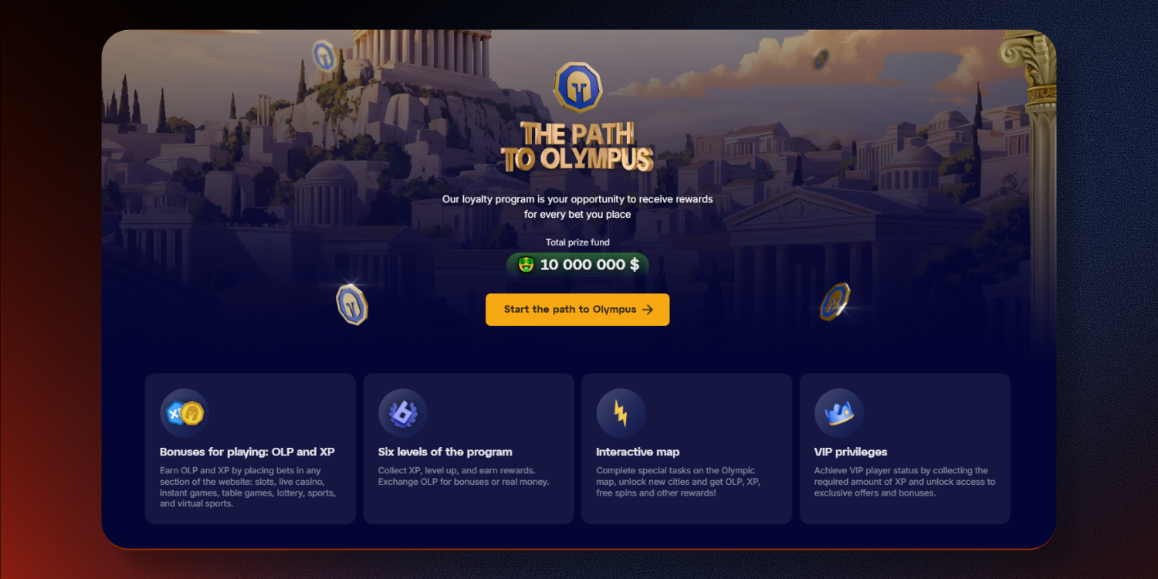
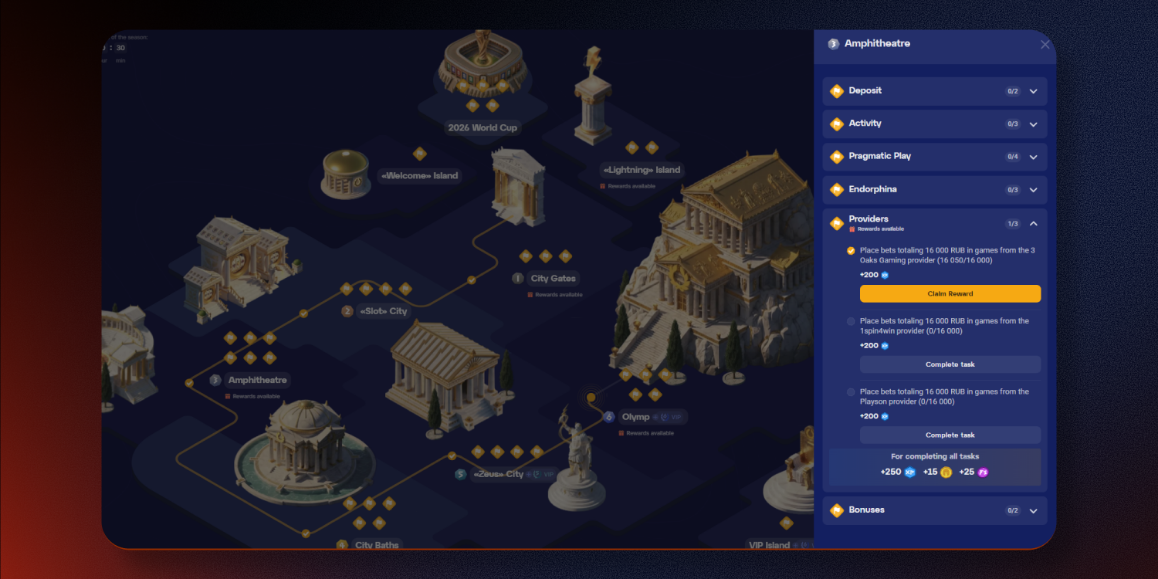
- "Path to Olympus" loyalty program. The player unlocks cities on a map, completes quests, and receives rewards. While chasing progression, they make deposits — which helps hit the repeat-deposit KPI.
This is what turns cheap in-app traffic into a long-term audience: acquisition stays on the media buyer's side, and retention is handled by the product.

Unity launch strategy
Payouts, bid prices, and auction behavior differ by GEO. The underlying launch logic, however, stays the same, and the partner followed it step by step:
- Start on installs. Not on revenue, not on events. At launch, you don't know which placements are worthwhile and which are empty, or which creatives will land. The algorithm doesn't know either — there's no data to optimize on. Use the simplest format and gather the first batch of statistics.
- Creative selection. Run 3–5 creatives per campaign — any more and the data becomes hard to read. If the budget isn't spending, raise the bid in small increments, not sharply.
- Publisher cleanup. As soon as deposit data has accumulated, clean placements based on it. Registrations but zero deposits — blacklist. Both present — keep. Over time you're left with proven supply only.
- Event passing. Registration, deposit, deposit amount. Without these events the algorithm is blind, and the next step has no meaning.
- Relaunch on ROAS. Only now, when you have clean placements, working creatives, and events flowing. The mechanics are the same — bids, budget, cleanup. What changes is the objective: the algorithm stops buying everyone and starts choosing whom to pay more for.
- Scaling spend. You scale only on what's already been selected and validated.
The main rule: don't switch to revenue-based optimization until you have data. Otherwise you spend the budget on training the algorithm without ever seeing the result.

Summary
In-app delivers cheap impressions at volumes that are difficult to match on Facebook. With the right approach, campaigns can move into profit. Creatives have to be rebuilt for the audience, cost per deposit has to be monitored, and events have to be passed to the algorithm. From there, the product works on unlocking the LTV that isn't visible on a $3.55 first deposit. We opened Argentina in Olymp Casino recently, prepared the product for the local market, and are ready to work with your traffic. Reach out to your affiliate manager for in-app terms and start testing on a fresh GEO.
Contacts: