
You are using an out of date browser. It may not display this or other websites correctly.
You should upgrade or use an alternative browser.
You should upgrade or use an alternative browser.
Take Back Control of Your Links → Living Links™ by Hetneo's Links
- Thread starter Hetneo
- Start date


- Apr 3, 2009
- 624
- 327
Someone PM'd me this week asking what I'd actually do first with a 6-month-old site, decent content, zero links. Not a sales answer, just the order I'd run it in.
Most people run this backwards -> buy power links week one, fire them at an unindexed page, then blame the links when nothing moves. If you want the homepage-link part of that handled, "Give Me Back Control" in the OP gets you the code.
- Confirm the money pages are actually indexed and internally linked. Half the "my links do nothing" cases are pages Google hasn't committed to yet. Fix that before you spend a dollar on links.
- Foundational pass -> brand mentions, a few citations, the boring entity signals that tell Google the site is a real thing. Cheap, fast, makes every later link land softer.
- Pick ONE money page and one primary term. A 6-month site can't spread equity across a dozen targets. Concentrate the firepower.
- Only then, a few strong topical links to that one page, dripped not dumped. Homepage links on real sites in the same lane are what I'd use here -> the page never goes stale and it soaks up every internal link on the domain.
- Wait. Young sites move slower than aged ones. Judge it at 8-12 weeks, not 8-12 days.
Most people run this backwards -> buy power links week one, fire them at an unindexed page, then blame the links when nothing moves. If you want the homepage-link part of that handled, "Give Me Back Control" in the OP gets you the code.
- Apr 3, 2009
- 624
- 327
The part people overlook until they need it: these links stay editable after they go live.
Most links you buy are a photograph. You set the anchor and the target once, and if your strategy moves, that link is frozen pointing at whatever used to matter. Six months on, half your anchors aim at pages you have reworked or keywords you have dropped, and your only fix is buying replacements.
Living Links are API-connected, so they do not freeze. From the dashboard:
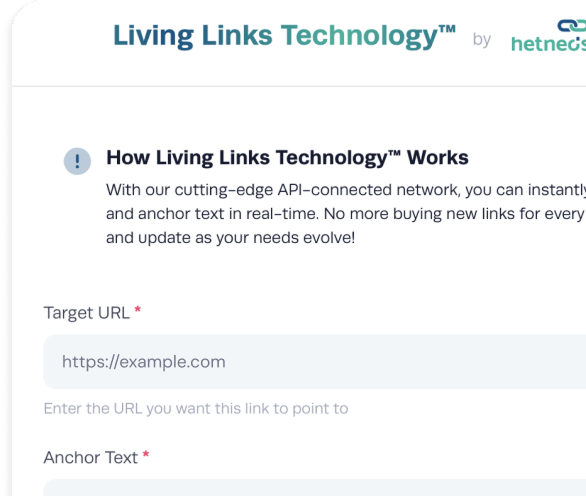
Where it earns its keep: a core update lands and the anchor ratios that worked last quarter suddenly look over-optimised. On a normal link you eat it or pay to replace it. Here you rebalance the whole profile in an afternoon, same links, no new spend. One purchase, unlimited optimisations.
Anyone else treating post-placement editing as an ongoing optimisation lever, or still buying links set-and-forget?
Most links you buy are a photograph. You set the anchor and the target once, and if your strategy moves, that link is frozen pointing at whatever used to matter. Six months on, half your anchors aim at pages you have reworked or keywords you have dropped, and your only fix is buying replacements.
Living Links are API-connected, so they do not freeze. From the dashboard:
- Change the anchor text (test exact-match vs branded vs partial without buying anything new)
- Switch the target URL (launched a new money page? re-point the equity in a click)
- Edit the surrounding content, and the AI re-flows the paragraph so the new anchor still reads natural
Where it earns its keep: a core update lands and the anchor ratios that worked last quarter suddenly look over-optimised. On a normal link you eat it or pay to replace it. Here you rebalance the whole profile in an afternoon, same links, no new spend. One purchase, unlimited optimisations.
Anyone else treating post-placement editing as an ongoing optimisation lever, or still buying links set-and-forget?
- Apr 3, 2009
- 624
- 327
Most asked question in my PMs by a distance: how fast do these index?
Honest answer first. Nobody can tell you, and anyone who hands you a number is guessing. Google's own documentation is blunt about it:
"In general, we cannot make predictions or guarantees about when or if your URLs will be crawled or indexed."
They say the same thing again elsewhere, that indexing is not guaranteed even for a page following every rule they publish. I am not going to pretend I have a workaround, because I do not, and neither does anyone selling you one.
What actually moves it is the boring stuff. Does the article genuinely fit the site's niche, is it worth reading, does Google decide it wants the page. Same as anything else you publish.
But here is why it is slightly the wrong question, and this is worth understanding before you buy a link anywhere.
What matters for your link is not whether the article's own URL gets indexed. It is whether the page carrying the link gets crawled. On a homepage placement those are two different pages. Your link sits inside an article that runs on the homepage. So even if that article's own permalink never gets indexed at all, the link is still sitting on the homepage, and the homepage is the most crawled URL on any site. Google again:
"URLs that are more popular on the Internet tend to be crawled more often to keep them fresher in our systems."
Compare that to a link dropped on a fresh deep post, four clicks from the homepage of a site nobody visits. That page has to get discovered, then crawled, then kept, before your link does anything at all. That is the bet most people are making without realising it.
Still not a guarantee and I will not dress it up as one. Google indexes what Google wants. You are just not depending on a brand new deep URL getting noticed first.
The editable part then handles the rest. Once GSC shows you which query the page is actually earning impressions for, you swing the anchor onto it instead of buying another link.
Honest answer first. Nobody can tell you, and anyone who hands you a number is guessing. Google's own documentation is blunt about it:
"In general, we cannot make predictions or guarantees about when or if your URLs will be crawled or indexed."
They say the same thing again elsewhere, that indexing is not guaranteed even for a page following every rule they publish. I am not going to pretend I have a workaround, because I do not, and neither does anyone selling you one.
What actually moves it is the boring stuff. Does the article genuinely fit the site's niche, is it worth reading, does Google decide it wants the page. Same as anything else you publish.
But here is why it is slightly the wrong question, and this is worth understanding before you buy a link anywhere.
What matters for your link is not whether the article's own URL gets indexed. It is whether the page carrying the link gets crawled. On a homepage placement those are two different pages. Your link sits inside an article that runs on the homepage. So even if that article's own permalink never gets indexed at all, the link is still sitting on the homepage, and the homepage is the most crawled URL on any site. Google again:
"URLs that are more popular on the Internet tend to be crawled more often to keep them fresher in our systems."
Compare that to a link dropped on a fresh deep post, four clicks from the homepage of a site nobody visits. That page has to get discovered, then crawled, then kept, before your link does anything at all. That is the bet most people are making without realising it.
Still not a guarantee and I will not dress it up as one. Google indexes what Google wants. You are just not depending on a brand new deep URL getting noticed first.
The editable part then handles the rest. Once GSC shows you which query the page is actually earning impressions for, you swing the anchor onto it instead of buying another link.
- Apr 3, 2009
- 624
- 327
Selling posts always tell you what a product is for. Quicker filter: what it is not for. Saves us both a PM chain.
Living Links is the wrong tool if:
If none of that scared you off, the OP covers what it IS for, and "Give Me Back Control" still gets you the discount code by PM.
Living Links is the wrong tool if:
- You need to rank by the end of the month. Homepage links compound over months, they do not sprint. If the deadline is 30 days, put the money into ads and come back for the next site.
- The project is burn and churn. A placement that stays live for years is wasted on a domain you plan to abandon by Christmas.
- Your client signs off links by DR screenshot. We sell real sites with real traffic histories, not badge numbers. Plenty of sellers for the badge, no hard feelings.
- The site itself is broken. A homepage link amplifies pages that deserve to rank. It cannot fix thin content, cannibalized keywords or a 6 second LCP. Fix that first, then link.
- You want an indexing or ranking guarantee. Permanence I guarantee and stand behind. What Google does with it, nobody honestly guarantees, and anyone who does is lying to you.
If none of that scared you off, the OP covers what it IS for, and "Give Me Back Control" still gets you the discount code by PM.
- Apr 3, 2009
- 624
- 327
Something I keep explaining on calls, so it may as well live here.
Source class diversity matters nearly as much as the volume number. Fifty guest posts is one pattern repeated fifty times, and Google has had years to learn that pattern. The profiles that hold up are mixed: a few homepage links on real sites, some editorial mentions, a directory or two that actually sends traffic, the odd forum post someone genuinely read. Real businesses pick up links in more than one shape, so a profile that looks accumulated ages better than one that looks bought.
Numbers I can share: a vape shop we have been working with since 2021 sits at DR 21 with 9,666 organic visits a month and 313 keywords in the top 3. DR 21. Five years, nothing dramatic, nothing that looks manufactured.
If everything you own came from one supplier in one format, that is worth a look before you buy anything else. Happy to say what a sane mix looks like if anyone wants to post their breakdown.
Source class diversity matters nearly as much as the volume number. Fifty guest posts is one pattern repeated fifty times, and Google has had years to learn that pattern. The profiles that hold up are mixed: a few homepage links on real sites, some editorial mentions, a directory or two that actually sends traffic, the odd forum post someone genuinely read. Real businesses pick up links in more than one shape, so a profile that looks accumulated ages better than one that looks bought.
Numbers I can share: a vape shop we have been working with since 2021 sits at DR 21 with 9,666 organic visits a month and 313 keywords in the top 3. DR 21. Five years, nothing dramatic, nothing that looks manufactured.
If everything you own came from one supplier in one format, that is worth a look before you buy anything else. Happy to say what a sane mix looks like if anyone wants to post their breakdown.
- Apr 3, 2009
- 624
- 327
Good question, and worth answering in public because the packages page is not as clear as it should be.With this ond ► STARTER (from $48/mo) -> i will get 5 new link per month?
Starter is 5 homepage links for $48/mo, dripped in at roughly one per day when your subscription starts. After that the monthly fee keeps those same 5 links live and under your control: change anchors, switch target URLs, edit the surrounding copy from the dashboard whenever you like. It is not 5 more links every month, that would be $10 a link on real sites and the network would have sold out by Tuesday.
If you want the profile to keep growing month on month, that is what Growth and Scale are sized for, or you add individual links on top whenever a site in the dashboard fits your niche.
PM me your niche and I will tell you what is actually available in your lane before you spend anything.
- Apr 3, 2009
- 624
- 327
DR is the most gamed number in this industry. You can pump a fresh domain to DR 50 with redirect stacking and seller-to-seller swaps for less than a decent dinner, which is why every cheap list is stuffed with DR 50 sites holding zero keywords in the top 100. The number is set dressing. Rankings are the audit.
Guest posts vs niche edits, the short version. A niche edit wins when the page is aged, indexed and already ranking, you are borrowing trust that exists today. A guest post wins when you need control: your anchor, your context, your internal links, on a page that starts at zero and takes months to mature. Buying a niche edit on a page with no rankings is paying aged prices for a newborn.
Homepage links are the third door most people never price up. Sitewide trust, nothing to age, and the link sits where the domain's authority actually lives. That is the corner we build in. PM if you want to sanity-check whether it fits your project, and I will tell you straight if it does not.
Guest posts vs niche edits, the short version. A niche edit wins when the page is aged, indexed and already ranking, you are borrowing trust that exists today. A guest post wins when you need control: your anchor, your context, your internal links, on a page that starts at zero and takes months to mature. Buying a niche edit on a page with no rankings is paying aged prices for a newborn.
Homepage links are the third door most people never price up. Sitewide trust, nothing to age, and the link sits where the domain's authority actually lives. That is the corner we build in. PM if you want to sanity-check whether it fits your project, and I will tell you straight if it does not.
- Apr 3, 2009
- 624
- 327
Longevity check, since the question I get most in PMs is whether homepage links keep working or quietly fade out.
A vape and e-juice site we started placing on back in 2021. Same links, same homepages, nobody touched them since. Where that site sits today: DR 21, 9,666 organic visits a month, 313 keywords in the top 3.
Look at the DR again. It is 21. That is the part people argue with -> the traffic and the top-3 count are not falling out of a big number in a tool, they are falling out of links that stayed put on real pages for five years.
Most campaigns never find out whether their links last. The site gets sold, the page gets rebuilt, an editor decides the post is stale, and the link is gone inside 18 months. You do not get an email about it. You just stop seeing the effect and blame the algorithm.
That is the entire argument for homepage placements on a network someone actually owns. Nothing to renew, nobody to talk back into it, no editor with an opinion about your anchor. Leave it alone and it compounds.
Code is still Give Me Back Control if you want it, PM me.
A vape and e-juice site we started placing on back in 2021. Same links, same homepages, nobody touched them since. Where that site sits today: DR 21, 9,666 organic visits a month, 313 keywords in the top 3.
Look at the DR again. It is 21. That is the part people argue with -> the traffic and the top-3 count are not falling out of a big number in a tool, they are falling out of links that stayed put on real pages for five years.
Most campaigns never find out whether their links last. The site gets sold, the page gets rebuilt, an editor decides the post is stale, and the link is gone inside 18 months. You do not get an email about it. You just stop seeing the effect and blame the algorithm.
That is the entire argument for homepage placements on a network someone actually owns. Nothing to renew, nobody to talk back into it, no editor with an opinion about your anchor. Leave it alone and it compounds.
Code is still Give Me Back Control if you want it, PM me.
- Apr 3, 2009
- 624
- 327
A thread over in Black Hat SEO this week: brand new site, zero links, total beginner, what would you actually do. I answered there, but the fuller version belongs in here.
What I would do for a young site with no links, in order:
What I would do for a young site with no links, in order:
- Fix the target pages first. A link into a page that gets merged or rewritten next month is money burned. Wait until the money pages have settled.
- First links go to the homepage, not deep pages. A young site needs the domain trusted before individual URLs can compete, and homepage links from real sites are the cheapest trust there is.
- Velocity stays boring: a few links a month, every month. Ten links in week one and then silence is the classic new-site footprint.
- Anchors change as the site ages. Brand and URL anchors early, keyword anchors later once there is something to defend. This is exactly why editable links matter -> the anchor you need in month 2 is not the anchor you need in month 8, and with these you change it from the dashboard instead of buying the link twice.
- Apr 3, 2009
- 624
- 327
What Living Links is not for. Saves us both a PM.
It is not for a brand new site with nothing on it. Links pointed at a site with no content and no indexation are money set on fire, and the editable part does not rescue that. Build pages worth ranking first.
It is not a recovery tool. If you have taken a manual action or a spam-update hit, more links is the wrong lever and it usually makes the pattern louder rather than quieter. Fix the cause first, then come back.
It is not a substitute for relevance. I can point a link at any page you want and swap the anchor whenever you want. I cannot make a link from an unrelated niche mean something to Google that it does not already mean.
Where it does earn its keep is the middle case -> a real site, indexed, already ranking for something, where you are still working out which anchors and which target pages actually move, and you would rather not re-buy the link every time you change your mind.
It is not for a brand new site with nothing on it. Links pointed at a site with no content and no indexation are money set on fire, and the editable part does not rescue that. Build pages worth ranking first.
It is not a recovery tool. If you have taken a manual action or a spam-update hit, more links is the wrong lever and it usually makes the pattern louder rather than quieter. Fix the cause first, then come back.
It is not a substitute for relevance. I can point a link at any page you want and swap the anchor whenever you want. I cannot make a link from an unrelated niche mean something to Google that it does not already mean.
Where it does earn its keep is the middle case -> a real site, indexed, already ranking for something, where you are still working out which anchors and which target pages actually move, and you would rather not re-buy the link every time you change your mind.
- Apr 3, 2009
- 624
- 327
Nobody asks this before they buy, and everybody asks it around month four: which rented placements do you keep paying for, and which do you let lapse.
How I tell clients to run it.
Judge on rankings, not on tool metrics. These placements are cloaked, so a third party crawler is not going to hand you a neat before-and-after row to point at. What you have is your own ranking and impression data, which is the honest scoreboard anyway. Pick the target page, note where it sat the week the link went live, and look again at 8 to 12 weeks. Sooner than that and you are reading noise.
Do not kill a placement the month a core update lands. Everything wobbles for a few weeks, including the things that are working. Wait for it to settle before you decide anything is dead weight.
Cut the ones aimed at pages you no longer care about, but re-point before you cut. Changing the target costs nothing, and a placement that looked flat on an abandoned page often does fine once it is aimed at something you are actually pushing.
What stays: the ones sitting in the same lane as your site. Relevance is the one part I cannot fix from the dashboard. Anchor, target URL, the wording around it, all adjustable. The niche of the site it lives on is fixed the day you pick it, so spend your thinking there and let the rest stay flexible.
Rough rule -> a fair target, three months, and your money page has not moved at all, that placement is not the one carrying you. Drop it and move the budget onto the sites that did move.
PM me with the OP phrase, "Give Me Back Control", for the code.
How I tell clients to run it.
Judge on rankings, not on tool metrics. These placements are cloaked, so a third party crawler is not going to hand you a neat before-and-after row to point at. What you have is your own ranking and impression data, which is the honest scoreboard anyway. Pick the target page, note where it sat the week the link went live, and look again at 8 to 12 weeks. Sooner than that and you are reading noise.
Do not kill a placement the month a core update lands. Everything wobbles for a few weeks, including the things that are working. Wait for it to settle before you decide anything is dead weight.
Cut the ones aimed at pages you no longer care about, but re-point before you cut. Changing the target costs nothing, and a placement that looked flat on an abandoned page often does fine once it is aimed at something you are actually pushing.
What stays: the ones sitting in the same lane as your site. Relevance is the one part I cannot fix from the dashboard. Anchor, target URL, the wording around it, all adjustable. The niche of the site it lives on is fixed the day you pick it, so spend your thinking there and let the rest stay flexible.
Rough rule -> a fair target, three months, and your money page has not moved at all, that placement is not the one carrying you. Drop it and move the budget onto the sites that did move.
PM me with the OP phrase, "Give Me Back Control", for the code.
- Apr 3, 2009
- 624
- 327
Question that keeps landing in my PMs: what is actually different between a homepage link and a guest post? The wording on my own site invites the confusion, so here it is plainly.
Both are the same starting point. A written article, matched to your niche and to the niche of the site it goes on, with your link inside it. Neither product is a bare link dropped somewhere.
Why anyone pays a rent instead of once: the homepage is the page every internal link on that domain points back to, so it has something to pass the day your link goes up. A fresh inner page starts at zero and has to earn its own standing first. Same domain, very different footing. On both, anchor and target URL stay editable from the dashboard, which is the bit that makes the rented version worth re-evaluating rather than just renewing.
Where it is not the right call: if your budget only stretches to a couple of months, buy the guest post. A rental you cancel in week six leaves you with nothing, and I would rather say that here than take the two payments.
Code phrase is in the OP -> Give Me Back Control, PM me and I will send it over.
Both are the same starting point. A written article, matched to your niche and to the niche of the site it goes on, with your link inside it. Neither product is a bare link dropped somewhere.
- Homepage: that article gets stickied to the front page, and it is cloaked -> search engines and chatbots read it, human visitors do not. Rented monthly, comes down when you stop paying.
- Guest post: the same kind of article, left as a normal post on an inner page, not cloaked. One-time, stays put.
Why anyone pays a rent instead of once: the homepage is the page every internal link on that domain points back to, so it has something to pass the day your link goes up. A fresh inner page starts at zero and has to earn its own standing first. Same domain, very different footing. On both, anchor and target URL stay editable from the dashboard, which is the bit that makes the rented version worth re-evaluating rather than just renewing.
Where it is not the right call: if your budget only stretches to a couple of months, buy the guest post. A rental you cancel in week six leaves you with nothing, and I would rather say that here than take the two payments.
Code phrase is in the OP -> Give Me Back Control, PM me and I will send it over.
- Apr 3, 2009
- 624
- 327
There is a thread over in Link Building this morning from a guy watching his pages slide every time he points a keyword heavy anchor at them, three links in, and asking if exact and partial match are safe at all now. I did not want to call a cause over there off one post, and I still don't. But part of his question is really a buying question, so I will answer that part here.
Think about how you normally buy an anchor. You pick it once, on order day, going off whatever you believed about ratios that week. Then it is welded on. If you change your mind in March you are emailing a webmaster you have never met, or you are paying for the link twice.
On mine you can edit the anchor text and the target URL after it is live. No charge for it, no ticket. If a page gets jumpy and the anchor is your suspect, go dial it back to brand or generic yourself and leave the link exactly where it is. Want it keyword heavy again in six months? Fine, do that too. The paragraph around it gets rewritten to suit the new anchor, so you are not left with an obvious swap sitting in the middle of a sentence.
I would rather sell you that than something cheaper and welded shut. The one thing I genuinely cannot fix for you later is whether the host site sits in your lane, which is why I nag people about relevance and not about anchors.
Anonymised, so no names: US apparel store on this network, DR 30, 5,627 monthly traffic, 336 keywords in the top 3, and yes, we moved its anchors around more than once getting there.
If you already buy from me the edit panel is sitting in your dashboard, go play with it. Otherwise PM me with Give Me Back Control and I will send the discount over.
Think about how you normally buy an anchor. You pick it once, on order day, going off whatever you believed about ratios that week. Then it is welded on. If you change your mind in March you are emailing a webmaster you have never met, or you are paying for the link twice.
On mine you can edit the anchor text and the target URL after it is live. No charge for it, no ticket. If a page gets jumpy and the anchor is your suspect, go dial it back to brand or generic yourself and leave the link exactly where it is. Want it keyword heavy again in six months? Fine, do that too. The paragraph around it gets rewritten to suit the new anchor, so you are not left with an obvious swap sitting in the middle of a sentence.
I would rather sell you that than something cheaper and welded shut. The one thing I genuinely cannot fix for you later is whether the host site sits in your lane, which is why I nag people about relevance and not about anchors.
Anonymised, so no names: US apparel store on this network, DR 30, 5,627 monthly traffic, 336 keywords in the top 3, and yes, we moved its anchors around more than once getting there.
If you already buy from me the edit panel is sitting in your dashboard, go play with it. Otherwise PM me with Give Me Back Control and I will send the discount over.
- Apr 3, 2009
- 624
- 327
Something buyers here keep getting wrong about how a bad link dies in 2026. It does not get you penalised. It gets ignored.
SpamBrain handles most low-quality link stuff algorithmically now. No message in Search Console, no manual action, nothing to appeal, no notice that anything changed. Your rankings just flatten and you assume the campaign needs more volume. Search Engine Land covered this under link devaluation earlier in the year and Google's own spam documentation says the same thing in drier words: the usual outcome is the link stops counting, not that your site gets hit.
Two consequences for anyone buying links, mine or anyone else's.
Which is why I keep repeating the boring criteria instead of promising metrics. Real content, real topic match, a homepage that has reason to be crawled. I would rather lose an order than put your money somewhere I think gets quietly discounted in six months.
Anyone actually measured a flattening like this on their own targets, or is everyone still reading "no penalty" as "it worked"?
For the discount on this one, quote Give Me Back Control in a PM.
SpamBrain handles most low-quality link stuff algorithmically now. No message in Search Console, no manual action, nothing to appeal, no notice that anything changed. Your rankings just flatten and you assume the campaign needs more volume. Search Engine Land covered this under link devaluation earlier in the year and Google's own spam documentation says the same thing in drier words: the usual outcome is the link stops counting, not that your site gets hit.
Two consequences for anyone buying links, mine or anyone else's.
- "I bought links and never got penalised" proves nothing. That was never the risk.
- Footprint paranoia from 2019 is aiming at the wrong target. Nobody is hunting your network by WHOIS. The question is simpler: does the host look like a real site to an algorithm trained on real sites.
Which is why I keep repeating the boring criteria instead of promising metrics. Real content, real topic match, a homepage that has reason to be crawled. I would rather lose an order than put your money somewhere I think gets quietly discounted in six months.
Anyone actually measured a flattening like this on their own targets, or is everyone still reading "no penalty" as "it worked"?
For the discount on this one, quote Give Me Back Control in a PM.
- Apr 3, 2009
- 624
- 327
The question that lands in my PMs more than any other, and the fairest one anybody asks me: if the homepage placements are cloaked, how does a buyer know the link is really there?
It is a reasonable thing to be suspicious about. You open the host site in your browser, you see nothing, and all you have is my word. So here is how I tell people to check me, in the order I would do it myself.
Worth being blunt about the trade you are making: I do not issue placement reports on cloaked homepage links, and the reason is the same reason you are buying them. A report is a list of exactly where your links live, sitting in an inbox, and that list is the asset worth protecting. You are trading paperwork for the fact that nobody can go and find them.
If you want paperwork, buy the guest posts instead. Visible article, inner page, URL in your hand on day one. That is a legitimate preference and I will not talk anyone out of it.
Anonymised, legal niche, UK: DR 78 up to 84 and organic traffic from roughly 11k to 25k a month, built across years without a single placement URL ever leaving the dashboard.
PM me Give Me Back Control for the discount.
It is a reasonable thing to be suspicious about. You open the host site in your browser, you see nothing, and all you have is my word. So here is how I tell people to check me, in the order I would do it myself.
- Switch your user agent to Googlebot and load the host page. If you can see it this way, fine, it is there. If you cannot see it, that does not mean it is missing -> proper cloaking verifies the crawler by IP and reverse DNS, and a spoofed user agent fails that check the same way a nosy competitor does. Half the people who run this test come back thinking they were robbed.
- Search Console, Links report, top linking sites. This is the one that actually settles it, because it is Google telling you, not me. In my experience the referring domain takes a few weeks to show up there after placement, and the report never lists everything, so treat it as confirmation when it appears rather than proof of absence while it has not.
- Then judge the placement on the only thing that matters anyway. Movement on the target page, not the existence of the link.
Worth being blunt about the trade you are making: I do not issue placement reports on cloaked homepage links, and the reason is the same reason you are buying them. A report is a list of exactly where your links live, sitting in an inbox, and that list is the asset worth protecting. You are trading paperwork for the fact that nobody can go and find them.
If you want paperwork, buy the guest posts instead. Visible article, inner page, URL in your hand on day one. That is a legitimate preference and I will not talk anyone out of it.
Anonymised, legal niche, UK: DR 78 up to 84 and organic traffic from roughly 11k to 25k a month, built across years without a single placement URL ever leaving the dashboard.
PM me Give Me Back Control for the discount.
- Apr 3, 2009
- 624
- 327
Someone in Link Building this week asked where outbound link count stops being worth it on a guest post page. It is the one number almost nobody checks before paying, so here is how I look at it.
Two things get mixed up in that question. The site-wide link count, and the count on the exact page your link sits on -> only the second one is yours. You can read it in about thirty seconds by opening the article and counting external links that are not navigation.
The honest version for what I sell:
So "fewer links is better" is too blunt a rule. A tight article full of paid links next to yours is worse than a busy homepage that only links out where it makes sense.
If you are vetting me, or anyone else, ask for the outbound link band on the actual placement page rather than a site average. I will give bands. I will not give domains, which I imagine you already guessed.
PM me "Give Me Back Control" if you want the discount code with it.
Two things get mixed up in that question. The site-wide link count, and the count on the exact page your link sits on -> only the second one is yours. You can read it in about thirty seconds by opening the article and counting external links that are not navigation.
The honest version for what I sell:
- On a guest post you are sharing an article with whatever else that site sold that month. If there are fifteen external links in the body and three of them are unrelated junk, the count is not really your problem, the neighbours are.
- On a homepage placement the page is a homepage. It carries the site's internal links by design, and that is exactly why it passes what it passes. What I watch there is the external outbound links, and whether they have any business being on a site about that topic.
So "fewer links is better" is too blunt a rule. A tight article full of paid links next to yours is worse than a busy homepage that only links out where it makes sense.
If you are vetting me, or anyone else, ask for the outbound link band on the actual placement page rather than a site average. I will give bands. I will not give domains, which I imagine you already guessed.
PM me "Give Me Back Control" if you want the discount code with it.
