A-Parser: Data Collection & Automation Software for SEO

seanfoster

Junior Member
Jr. VIP
Joined
Dec 17, 2017
Messages
195
Reaction score
61

Let’s be real: scaling in SEO or Affiliate Marketing is difficult if you’re still doing everything by hand. If you're stuck using a bunch of separate tools that don’t work well together, you're not growing as efficiently as you could be - you're just busy.

A-Parser changes that. It's a professional-grade engine designed to turn your data research into a 24/7 automated machine. Instead of jumping between 5 different apps, you can handle your workflow from one clean interface.

Why it’s useful:
Insane Speed & Scalability:
This is built for serious workflows. A-Parser supports multi-threaded processing, letting you work through large URL lists and data sets without your machine freezing up.

110+ Built-in Scrapers:
Start immediately. We’ve already built parsers for Google, Bing, DuckDuckGo, Amazon, and dozens more. No coding is needed to start pulling keywords, SERP data, or contact lists today.

Custom JavaScript Scrapers:
Need something specific? You can write your own custom logic in JavaScript directly inside the app. The software handles the complex networking and proxy rotation; you just tell it what data you want.

Captcha & Proxy Integration:
Natively supports XEvil, CapMonster, Anti-Captcha, etc. Plus, full HTTP/SOCKS4/SOCKS5 proxy rotation to support scraping workflows and reduce common access issues.

Full API Automation: Enterprise feature
Want to build your own SaaS or plug the data directly into your backend? Use the API and Redis integration to run your extraction completely headless.

Whether you're a complete beginner setting up your first PBN, or a data-focused user feeding large data sets into a custom app - A-Parser helps you turn hours of manual grind into a faster, automated workflow.

Stop overcomplicating your data collection. Get A-Parser, set your presets on autopilot, and let the software do the heavy lifting.

full


How can I see all product details?
You can find full details, features, and documentation on the official A-Parser website - https://en.a-parser.com

What is A-Parser used for?
A-Parser is used for collecting and processing data from search engines, websites, SEO services, keyword sources, URLs, content pages, and other online data sources.

Who is A-Parser suitable for?
A-Parser is suitable for SEO specialists, affiliate marketers, lead generation teams, researchers, agencies, SaaS projects, and anyone who works with large-scale data collection.

Do I need coding skills to use A-Parser?
No coding is required for standard tasks. Advanced users can create custom JS and NodeJS parsers for more specific workflows.

How do I purchase?
Choose the package you need - https://en.a-parser.com/pages/buy/ , click the purchase button, and follow the checkout steps.

Do you offer a BHW exclusive discount?
Yes, we may offer special deals for BHW members - 20% OFF. Please check the current offer in this thread before purchasing.

What payment methods do you accept?
We accept the payment methods available on the checkout page - VISA/Mastercard, Apple Pay, GPay, PayPal, UnionPay, ETH, etc.

Can I get a refund?
Yes. We offer a 3-day refund period if the product quality is significantly different from what was promised.

How can I contact you?
You can contact us through website support, email - [email protected], Telegram - https://telegram.me/aparser_bot , or direct message on BHW.
 
Marketplace Thread Approved

Summary
This software has been tested by the Marketplace team to ensure that it meets the standards for the Marketplace. We cannot guarantee any satisfaction for the software you receive. Please do your own due diligence in looking into the seller and seeing if this software is what you are looking for.

Service Information
  • The software delivered for the review did contain the advertised features for the top-level plan of this software.
  • The software and its GUI were functional with little to no errors.
  • The software was able to carry out the tasks given to it for the purpose of the review.
Thread Edit Log
  • The 5 most recent thread edits will appear here
With anything more than 5 going in here
Information For Buyers:
  • Service Quality: The quality of the product or service that we receive is what you should expect, or better. If you feel that the quality of the service has dropped significantly, please let us know via the report button.
  • Disputes: If you do not receive a product or service as advertised, or at all in the event of a dispute, do not be afraid of a "no refunds" refund policy as you are allowed to request a refund through the Dispute Resolution process. For more information and to see whether or not your dispute qualifies, refer to the dispute rules and procedures.
    IMPORTANT: To initiate a dispute, all orders must be started on BHW, and proof of that will be required.
  • Review Copies: Per the Marketplace rules, if a seller does not offer trials or review copies, please do not request them in the sales thread, otherwise your post will be removed and further action may be taken.
 
A-Parser Digest: Extra Scrapers Updated

A-Parser published a new digest with updates for several additional scrapers.

Updated scrapers include SimilarWeb, MailValidator, Expireddomains.net, X/Twitter Posts, and YouTube Channel Videos.

Highlights:

  • SimilarWeb: improved compatibility with current protection mechanisms, bypass module moved from Puppeteer to Playwright
  • MailValidator: fixes for Outlook/Hotmail, Mail.ru, Yandex, Rambler + Yahoo/AOL support added
  • Expireddomains.net: rewritten as a JS scraper with MFA support and XHR table loading
  • X/Twitter: updated for the new API structure, pagination fixes, better Post ID export
  • YouTube: support for the new lockupViewModel format, fixed duration parsing, added video descriptions
Useful for SEO, scraping, expired domain research, and social media data collection.

Full post: https://a-parser.com/threads/18599/
 
I didn't realise you guys had a sales thread! A-Parser has been my scraper of choice for years now - keep up the good work and good luck with sales!
 
I didn't realise you guys had a sales thread! A-Parser has been my scraper of choice for years now - keep up the good work and good luck with sales!
Thanks a lot for the support! Feedback like this speaks louder than any sales pitch.

And if anyone has questions or needs help getting started, our support team is always happy to assist.
 
NextGen UI — The New Interface for A-Parser In the new update, we've completed our transition to NextGen UI — it is now used by default in A-Parser for Windows and Linux. The interface has been completely rebuilt from the ground up on a new architecture. It runs in a browser and as a desktop application, supports dark mode, and retains the familiar capabilities of A-Parser. Since its initial test release, NextGen UI has received major improvements: enhanced log management, built-in testing and debugging tools, improved task and preset management, a scheduler, batch operations, and automatic crash recovery. Key Features of NextGen UI
  • Expanded Log Management. You can search, filter, select, copy, and download log entries. Logs are displayed directly during task testing in the editor, and debug output can be quickly toggled on and off.
  • Visual Debugging. JS dumps, HTTP requests, and responses are displayed as expandable JSON trees, with images previewed right inside the logs. Quick access to the built-in Regex Tester has also been added.
  • Improved Parser Test. A scraper configured in Parser Test can be transferred directly into the task editor. When swapping scrapers, you are prompted to retain compatible overridden settings.
  • Informative Task Queue. The queue displays the preset in use, scraper settings, exact start time, and estimated time to completion. Batch task selection and group actions have also been added.
  • Convenient Preset Management. Presets can be renamed, searched, and sorted. When importing, a preset opens in the editor first so you can inspect and modify it before saving. For post-completion actions, separate selectors have been added for task presets and thread configurations.
  • Built-in Tools. NextGen UI features a task scheduler, Regex Tester, tools.js editor, advanced settings, and an API Request dialog with a code editor.
  • Workspace State Persistence. The interface remembers open sections, selected tabs, queue pages, scroll position, window placement and sizing, as well as the JS scraper editor state.
  • Updated Dark Theme. Redesigned color scheme with higher contrast and improved visual accents in the task editor.
  • Handling Large Volumes of Data. Faster log loading times with reduced disk load. Large file lists load gradually via a "Load More" button.
  • Automated Maintenance. The core host and port can be configured directly in the interface, and a free port is selected automatically. After a core failure, the core restarts automatically; A-Parser also restarts automatically after an update.
Google Fully Restored The second key change in this update is the full restoration of Google. In recent weeks, Google has steadily strengthened its protections and changed how it generates search results, making result collection considerably more difficult. Work on adapting the scraper continued almost nonstop. As a result:
  • fully restored Google in Browser mode on Windows and Linux for desktop and mobile profiles;
  • fully restored HTTP mode across all platforms and profiles;
  • improved pagination handling;
  • added detection of incomplete search results — one of Google's protection mechanisms;
  • added detection of the new "Verifying your request" CAPTCHA screen;
  • fixed browser tasks being mixed up when using the Redis API;
  • restored Google Images;
  • fixed Google Translate in desktop mode;
  • restored review collection in Google Reviews;
  • fixed total review count output ($totalcount);
  • fixed $claim variable extraction in Google;
  • added extraction of an organization's overall rating ($avgrating).
New Scraper: Rutube Added a new scraper, Rutube, for collecting video search results from Rutube. Improvements
  • Whois - Added support for RDAP servers and the $rdapserver variable. Added support for the `.gr` and `.ελ` TLDs.
  • Wildberries ProductInfo - Added WB Wallet price extraction to $walletPrice.
  • Turnstile - Added support for processing Cloudflare Turnstile challenges via XEvil.
  • GroupScraper - Added new variables and arrays, date filtering, and an option to skip forwarded messages.
  • TikTok Profile - The scraper was migrated to Puppeteer to work around Akamai blocking HTTP requests; restored collection of links to accounts followed by the profile.
  • Kimi - Restored functionality and added Bearer token authentication.
  • Brave - Added CAPTCHA handling.
Fixes for Source-Side Changes
  • Bing - Fixed scraping in Browser and HTTP modes.
  • You.com - Restored scraper functionality.
  • Startpage - Restored scraping of the main search results.
  • Startpage Videos and Startpage Images - Restored both scrapers.
  • DuckDuckGo and DuckDuckGo Images - Restored both scrapers.
  • Instagram Search - Restored operation and fixed 403 Forbidden errors.
  • Instagram Tag - Eliminated duplicate post entries in results.
  • Instagram Profile - Restored operation and fixed proxy switching during follower collection.
  • Wildberries ProductsList - Restored operation and fixed unstable data collection.
  • Wildberries ProductInfo - Restored operation and fixed errors on specific queries.
  • Amazon - Fixed an issue that prevented some results from being collected.
  • Domain - Restored Cloudflare bypass.
  • Turnstile - Fixed operation in Browser and Auto modes.
  • Whois - Fixed support for the `.direct`, `.insure`, `.global`, `.services`, `.travel`, and `.co` TLDs.
  • ChatGPT - Fixed list parsing.
  • Perplexity, DeepAI, and Translator - Restored functionality.
  • Radar, LastPrice, and Mustat - Restored functionality.
 
gptvspp-short.png


Monitoring Domain Visibility in ChatGPT and Perplexity Using A-Parser

Executive Summary

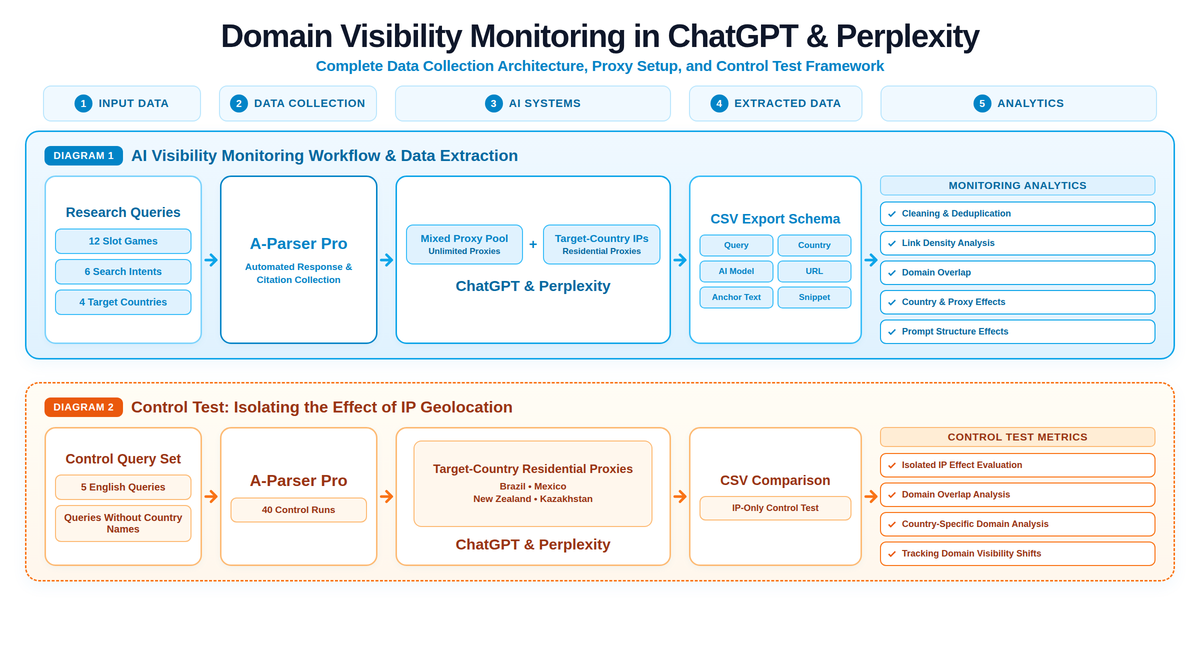
We collected and analyzed 17,873 citation records from ChatGPT and Perplexity responses across 12 slot games, 6 commercial intents, and 4 target countries. The overlap of cited websites between the two AI systems was only 16.12%: ChatGPT prioritizes official providers and Reddit, while Perplexity heavily favors traditional affiliate review platforms. In this study, we highlight which types of sites gain visibility in AI search, how proxy routing reshuffles citations among competitors, and how to automate regular AI visibility monitoring with A-Parser while keeping AI API costs near zero.

A single manual check of ChatGPT and Perplexity responses fails to provide an accurate picture: AI search outputs fluctuate from session to session. For affiliates, operators, and SEO specialists, tracking how citation patterns change over time is critical—identifying which domains enter or drop out of AI responses, and how their citation share changes. In this article, we examine how target countries and proxy routing impact citation sources and explain how to automate regular data extraction.


Methodology: How We Measured

Open Dataset: The complete raw data from both the primary audit and the control test is available in our public archive so the study can be reproduced.

For our experiment, we selected 12 slot titles with the most likes on Casino Guru at the time of sampling: Gates of Olympus, Sweet Bonanza, Sugar Rush, Joker's Jewels, Wanted Dead or a Wild, Le Bandit, Book of Dead, Sizzling Hot Deluxe, 40 Super Hot, Hot Hot Fruit, Cleopatra, and Fruit Cocktail.

For each slot game, we defined six commercial and conversational search intents:

  1. Real-Money Casino Search: Finding a place to play for real money (Where to play for real money).
  2. Affiliate Review Sites: Sites with casino ratings and reviews (Casino review sites).
  3. Crypto Casino Query (Explicit Source-Link Prompt): Crypto casinos with fast withdrawals + an explicit request for source links (Crypto casinos + Include source links).
  4. Crypto Casino Query (Standard Prompt): The same crypto query without a request for source links.
  5. Demo Mode: Free demo play without signing up (Free demo without signing up).
  6. Cross-Selection: Similar slots and the casinos where they are available (Similar slots & hosting casinos).

Queries were formatted using the template [intent] + [game] + [country] in localized versions across four target regions:

  • New Zealand: English (en-NZ) — e.g., Where to play Sweet Bonanza for real money in New Zealand.
  • Brazil: Portuguese (pt-BR) — e.g., Onde jogar Sweet Bonanza com dinheiro real no Brasil.
  • Mexico: Spanish (es-MX) — e.g., Dónde jugar Sweet Bonanza con dinero real en México.
  • Kazakhstan: Russian (ru-KZ) — e.g., Где играть в Sweet Bonanza на реальные деньги в Казахстане.

We collected data from ChatGPT and Perplexity through two distinct proxy setups: target-country residential proxies and a mixed proxy pool (unlimited proxies with a random country assigned per request).

Additionally, we conducted a Control Test: to isolate the effect of IP geolocation without geographic cues in the prompt, we ran 40 control runs (the same five English-language queries × 2 AI systems × 4 target countries). In this control test, queries were phrased strictly in English without mentioning country names (e.g., Where to play Sweet Bonanza for real money or Best crypto casinos for slots), but were routed sequentially through residential proxies located in New Zealand, Brazil, Mexico, and Kazakhstan.

Before analysis, all extracted URLs were normalized and deduplicated based on unique query + URL pairs. The final dataset comprised 17,873 citation records (7,571 for ChatGPT and 10,302 for Perplexity). We extracted six key fields:
Query | Country | AI Model | URL | Anchor Text | Snippet

article1-info-en-1200.png


Perplexity: Substantially Higher Citation Density

Comparing the average number of citations per response revealed a marked difference in model behavior:

Code:
13.14
ChatGPT (Average citations per response)
Range: 12.38 – 14.00 links

Code:
17.95
Perplexity (Average citations per response)
Range: 15.10 – 22.58 links
Average: 36.6% higher than ChatGPT

What This Means for iGaming Marketing: Perplexity returns an average of 36.6% more citation links per response (17.95 vs. 13.14 in ChatGPT), resulting in a higher citation density in the extracted data.


Countries and Proxies: How IP Routing Reshuffles Affiliate Citations

Comparing data runs performed via target-country residential proxies against those using a randomized proxy pool yielded two key findings:

1. Linguistic Context Keeps Country-Specific Domains Visible

Including local language phrasing and country names in the prompt text correlates with maintaining a high share of country-specific domain extensions (.br, .mx, .co.nz, .kz) in AI outputs, even when requests are routed through randomized global IPs:

  • ChatGPT BR (.br): 34.49% (target-country residential proxies) → 36.14% (randomly selected country).
  • Perplexity BR (.br): 33.89% (target-country residential proxies) → 33.60% (randomly selected country).
  • ChatGPT NZ (.nz): 37.60% (target-country residential proxies) → 35.69% (randomly selected country).
  • Perplexity MX (.mx): 18.43% (target-country residential proxies) → 18.77% (randomly selected country).

2. The Mix of Specific Domains Changes Significantly

While the overall share of local domain extensions remains relatively stable, the mix of competing domains shifts substantially:

  • Brazil (Perplexity): On targeted Brazilian residential IPs, niche crypto affiliate criptocassinosbr.com leads with 4.46%. However, switching to randomized IPs from a mixed pool cuts its share by more than half—down to 1.99%. The displaced share goes to larger sports and general gambling portals such as guiacassino.com (growing from 0.80% to 1.75%) and umdoisesportes.com.br (growing from 1.35% to 2.07%).
  • Mexico (Perplexity): Local review site estafa.info accounts for 4.56% of citations in runs using Mexican residential proxies. On a mixed proxy pool, its share drops to 2.85%, losing ground to global operator stake.com (rising from 0.46% to 1.20%).
  • Kazakhstan (ChatGPT): On Kazakh residential IPs, ChatGPT frequently cites official state portals gov.kz (+1.0%) and egov.kz (+0.8%). On random IPs, their share declines, with German site novoline.de gaining ground (reaching 1.3%).
  • New Zealand (ChatGPT): Official portals such as dia.govt.nz (Department of Internal Affairs) and tourism.net.nz drop from 11 to 5 appearances when switching from target-country proxies to a randomized mixed pool.

IP-Only Control Test:
When country names were stripped from the prompts and identical English queries were routed through proxies in 4 countries, domain overlap in ChatGPT dropped to just 16.28%. Through Brazilian IPs, the model returned local 3z.com pages featuring PIX payment options, whereas New Zealand IPs returned country-specific directory paths like /nz/.

Key Takeaway: Proxy mode was associated with noticeable shifts in which competitor domains were cited. To extract an accurate regional snapshot, we recommend using target-country residential proxies.


Crypto Intents Have the Highest Citation Density

We evaluated how prompt structure and commercial intent affect citation volume.

1. Prompts Explicitly Asking for Source Links

Comparing two otherwise identical crypto-casino queries—one explicitly asking for source links and one without that request:

AI SystemWith Source-Link RequestWithout Source-Link RequestDensity Change
ChatGPT15.2313.31+14.4%
Perplexity24.0627.19-11.5%

In our dataset, explicitly instructing the model to provide source links was associated with a 14.4% increase in citation density for ChatGPT, but an 11.5% decrease for Perplexity.

2. Crypto Queries vs. Other Search Intents

Aggregating crypto queries (fast crypto withdrawals) and comparing them with all other search intents (demo play, real-money play, affiliate reviews, and slot alternatives):

  • ChatGPT: 14.27 (Crypto) vs. 12.58 (Others) — a +13.4% increase.
  • Perplexity: 25.63 (Crypto) vs. 14.09 (Others) — an 81.9% increase.

Conclusion: Transactional crypto queries were associated with the highest link density across both platforms, with Perplexity nearly doubling its link density (+81.9%).


303 Citations Don't Make a Site a Leader: Where AI Places Its Sources

Six Categories of Source Domains: From Industry Pillars to Parasite SEO
Classifying extracted URLs by domain type reveals that the entire citation ecosystem of AI search breaks down into 6 distinct categories:

1. Parasite SEO, Doorway Pages, and Low-Quality Long-Tail Pages (53.9% ChatGPT / 60.7% Perplexity)

  • Volume: 810 unique domains from ChatGPT, 1,444 from Perplexity.
  • Composition: Random blogs, doorway pages, irrelevant forums, and e-commerce sites (e.g., pukekohetraders.co.nz, kurortysaryagash.kz, 3z.com).
  • Takeaway: These domains make up over 40% of unique domains but account for only 6–8% of total link volume.

2. Country-Specific Affiliates and Media (24.1% ChatGPT / 21.2% Perplexity)

  • Volume: 293 domains from ChatGPT, 395 from Perplexity.
  • Composition: Regional review portals and news outlets using country-code domain extensions (.br, .mx, .co.nz, .kz).
  • Examples: criptocassinosbr.com, estafa.info, casino.co.nz, brasil247.com.
  • Effect: These sources are more likely to appear when using target-country residential proxies.

3. Global Pillars and Major Affiliate Sites (10.4% ChatGPT / 11.7% Perplexity)

  • Volume: 61 domains from ChatGPT, 106 from Perplexity.
  • Composition: International affiliate sites with established SEO track records.
  • Examples: casino.org, gambling.com, askgamblers.com, guru.casino.
  • Behavior: Perplexity places 90% of these citations in footnotes at the end of the answer (positions 12–13).

4. Official Game Providers and Developers (6.0% ChatGPT / 0.9% Perplexity)

  • Volume: 28 domains from ChatGPT, 11 from Perplexity.
  • Examples: pragmaticplay.com, spribe.co, hacksawgaming.com.
  • Control Test Insight: Prompts lacking country context were associated with ChatGPT defaulting to a single provider (pragmaticplay.com surges to 14.3% of all links).

5. Direct Operators and Crypto Platforms (1.6% ChatGPT / 4.0% Perplexity)

  • Volume: 22 domains from ChatGPT, 55 from Perplexity.
  • Examples: stake.com, bc.game, roobet.com, flush.com.
  • Behavior: In Perplexity, stake.com is the most prominent domain in the source list (41.8% of its links appear in the Top 3).

6. Forums and UGC Platforms (2.4% ChatGPT / 1.3% Perplexity)

  • Examples: reddit.com, quora.com.
  • Fact: reddit.com has the strongest Top 3 presence in ChatGPT: 68.7% of its links appear in the top three positions.

Citation count is only the first layer of analysis. After normalizing www, ChatGPT had 1,223 domains, while Perplexity had 2,019. Only 450 domains were shared: the similarity coefficient was 16.12%.

But citation frequency alone does not show how high a source appears in the list. Therefore, for each domain, we compared three metrics: citation count, average position in the source array, and the share of links appearing in the Top 3.

⚠️ How to Interpret Source Position
Position here refers to the order of sources in the array saved by the parser. It does not show whether a link appeared in the first paragraph of the answer and cannot be used to infer CTR. In addition, Perplexity returns more links on average, so absolute position comparisons between the two systems should be made cautiously. The share of links in the Top 3 better reflects a source's relative prominence within the list.

DomainChatGPT: Citations / Avg Pos / Top 3 SharePerplexity: Citations / Avg Pos / Top 3 Share
reddit.com182 / 3.01 / 68.7%14 / 15.07 / 14.3%
askgamblers.com156 / 6.01 / 39.7%25 / 15.32 / 28.0%
pragmaticplay.com303 / 5.90 / 23.1%46 / 14.65 / 2.2%
casino.org36 / 9.89 / 16.7%216 / 12.17 / 10.6%
gambling.com141 / 6.51 / 29.1%207 / 12.52 / 13.5%
stake.com46 / 8.57 / 32.6%134 / 10.57 / 41.8%

Three Metrics, Three Different Leaders

In ChatGPT, pragmaticplay.com led in citation count, with 303 citations, but only 23.1% of its links appeared in the Top 3, and the domain held the top spot in the list 31 times. reddit.com had 182 citations, but 68.7% of its links appeared in the first three positions. askgamblers.com ranked first most often, with 38 first-place appearances. Thus, Pragmatic Play led in overall frequency, Reddit in Top 3 share, and AskGamblers in first-place appearances.

In Perplexity, casino.org and gambling.com led in citation count, with 216 and 207 citations. But only 10.6% and 13.5% of their links appeared in the Top 3. stake.com had only 134 citations, but 41.8% of its links appeared in the first three positions, and the domain held the top spot 24 times, compared with 15 for gambling.com. Citation count, Top 3 share, and first-place appearances answer different questions, so they cannot be reduced to a single ranking.

Citation Counts Alone Aren't Enough for a Report

To see the underlying structure of the sources, we need to count citation volume, Top 3 share, and first-place appearances at the same time, and split the results by country and proxy mode. For example, casino.org led in the overall Perplexity sample, while local sites received a notable share in country-level segments: criptocassinosbr.com in Brazil, estafa.info in Mexico, and casino.co.nz in New Zealand. Even after the country was removed from the prompt text, identical English questions routed through IP addresses in different countries produced only 16.28% domain overlap in ChatGPT. A standard report based only on link counts would mix three different phenomena: overall frequency, position in the source list, and changes between countries.

The Long Tail Is Broad, But Its Weight Is Small

In ChatGPT, 478 out of 1,223 unique domains appeared only once (39.1%). In Perplexity, single-appearance domains accounted for 821 out of 2,019 (40.7%). However, these single-citation domains accounted for only 6.3% of total links in ChatGPT and 8.0% in Perplexity. Thus, the 40% figure represents the share of domain names, not the share of the entire output: recurring sources still provide most of the links.

At the same time, an unfamiliar domain name alone does not make a site low-quality. pukekohetraders.co.nz received 43 links in ChatGPT, 29 of them in the Top 3. The Kazakhstan-based domain kurortysaryagash.kz appeared five times in Perplexity and reached the Top 3 four times. Both domains look unexpected for an iGaming sample, but the pages themselves matched the queries. Therefore, long-tail domains should be evaluated based on page content rather than discarded only because the domain is unfamiliar.


️ Transitioning from One-Off Studies to Continuous AI Visibility Monitoring

A single data run captures a temporary snapshot of AI search results today. Only systematic, scheduled data collection enables marketers to track which domains remain visible, gain visibility, disappear, or appear for the first time in a given country. Continuous tracking turns one-off scraping into your own competitive intelligence system.

The A-Parser Scheduler enables complete automation of this workflow: upload your slot and brand lists, configure proxy parameters, and generate CSV reports on any schedule. Built-in FreeAI parsers also eliminate the need to pay for official AI API tokens.

A-Parser & Proxy Stack for ChatGPT & Perplexity Monitoring

A-Parser Pro


The Pro license costs $299 as a one-time purchase. It includes the complete parser suite (featuring FreeAI::ChatGPT and FreeAI:: Perplexity), 6 months of updates, and 50 proxy threads for the first month. Once the update period expires, the software continues to work indefinitely.

A-Parser Unlimited Proxies

This is a practical solution for daily data collection. Pricing is based on the number of threads, not gigabytes of traffic. The pool includes more than 100,000 IPs and supports up to 2,000 threads, making it suitable for high-volume scraping with a fixed, predictable budget.

A-Parser Premium Residential Proxies

The pool contains more than 10 million residential IPs with country- and city-level targeting. It is used for precise country checks and control tests where reliable country-level geolocation is critical. Pricing is based on actual traffic consumed.

For day-to-day monitoring, Unlimited Proxies handle routine scraping, while Premium Residential Proxies are used for precise country-specific audits.

How to Launch AI Search Visibility Monitoring in Your Niche

  1. Install and launch A-Parser Pro or Enterprise.
  2. Build your query list: include target brands, products, competitors, or top games in your niche.
  3. Configure proxy routing: use Unlimited Proxies for routine monitoring and Premium Residential Proxies for target-country audits.
  4. Import pre-configured presets: download and import preset files for Perplexity or ChatGPT.
  5. Define CSV export schema: set output fields to query, geo, model, link, anchor, snippet.
  6. Schedule recurring tasks: set your desired scraping frequency (e.g., daily) in the Scheduler to track which domains appear and disappear over time.

After a few scheduled runs, you'll have your own AI visibility database for monitoring, evaluating, and optimizing your site's presence in generative AI search outputs.

This material is published strictly for analytical and educational purposes and does not constitute gambling advertising.
 
aparseryoutube.jpg


YouTube Scraping with A-Parser: Where Do Small Channels Succeed?

Executive Summary

Consider a paradox: a video from a creator with 700 subscribers pulled in 2.7 million views and ranked #3 in YouTube search results for iPhone queries, while in commercial topics – crypto and dropshipping – not a single one of the 59 videos from small channels reached 20,000 views. Yet, in crypto exchange reviews, small-channel videos account for one-third of the TOP-10 results: 45 out of 136, or 33.09%.

The key distinction is between search ranking and actual view counts. In narrow commercial topics, a small channel can secure a high position but gather very few views. Meanwhile, in visual niches – like unboxings and fitness – successful videos in our sample generated hundreds of thousands of views.
For iPhone unboxings, breakout videos from small channels accounted for 25 out of 108 unique videos in the TOP-10 (23.15%), with views ranging from 20,000 to 2.7M. In commercial topics, their share of the search results reached as high as 33–35%, but not a single one of the 59 videos from small channels reached 20,000 views.

To test this with actual search data, we used A-Parser to collect 34,070 rows of YouTube search results across 28 topics and 343 search suggestions. Here's what we'll break down:
  • Why Search Volume alone is not enough for YouTube;
  • How to evaluate competition based on channel sizes in the TOP-10;
  • Which three topic groups we identified and where view counts remained low;
  • Why a single video appears across 21 search suggestions;
  • How to set up niche scraping and creator audits for marketers and media buyers.

⚠️ If you want to explore the methodology or replicate the experiment yourself, download the keywords, preset, and scraping results (CSV).


1. WHY SEARCH VOLUME ALONE IS NOT ENOUGH FOR YOUTUBE

In traditional SEO, topic research often starts with Search Volume: the higher the monthly search volume, the more attractive a keyword appears.

On YouTube, this metric is insufficient for two main reasons:

1. YouTube combines search and recommendations

Viewers come from their subscriptions, recommendations, search, and Shorts. Our dataset reflects only search results, so it cannot be used to gauge overall viewer interest in a topic.

2. Search Volume does not show how easy it is for a small channel to rank in the top 10

A popular search query does not guarantee a small channel a spot in the TOP-10. If the results are dominated by large channels, high demand alone won't help. However, specific narrow topics can still deliver tens of thousands of views.

A simple baseline for evaluating competition:

Look at the size of the channels already ranking in the top ten. If the top spots are dominated by channels with 1M+ subscribers, entering the topic will be harder. If creators with under 10,000 subscribers appear regularly, the topic is worth testing for a small channel.

Our core practical question: in which topics are small channels already breaking into the top 10 of our scraped search results and generating tens of thousands of views?


2. EXPERIMENT SCALE AND DATASET STRUCTURE

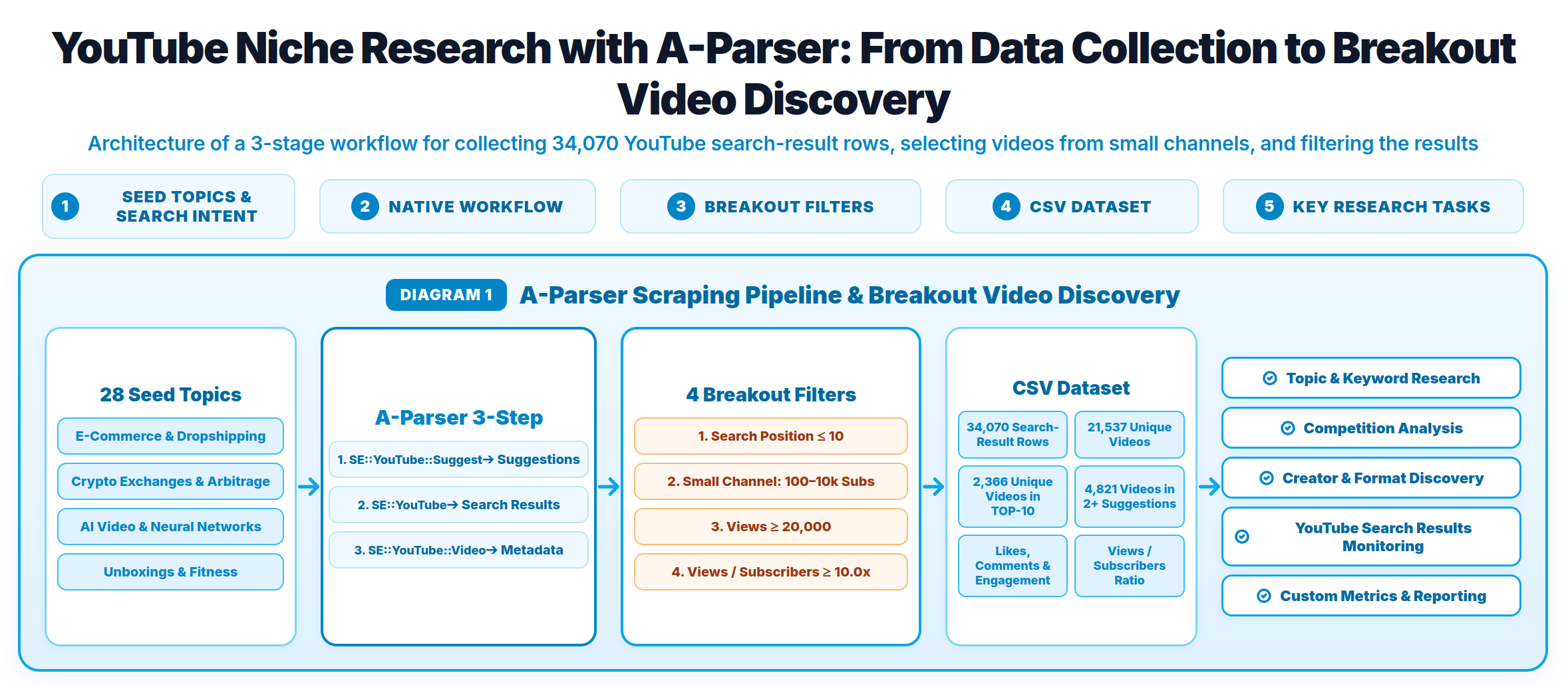
The study began with 28 seed phrases across e-commerce, crypto, fitness, beauty, AI tools, and content creation. For each keyword, A-Parser gathered search suggestions, search results, and metadata on the retrieved videos and channels.

Dataset Overview:
  • 28 seed topics;
  • 343 "seed keyword + suggestion" pairs;
  • 34,070 search result rows;
  • 21,537 unique videos (duplicates removed via Video ID v=...);
  • 2,366 unique videos in the top 10 of our scraped dataset;
  • 4,821 videos (22.38%) found across at least two distinct suggestions.
How we identified breakout videos for small channels: 4 filters

Out of 34,070 search result rows, we isolated exceptionally successful videos from small channels using four criteria:
  1. Ranking position: positions 1 through 10 in our export.
  2. Small channel: 100 to 10,000 subscribers.
  3. At least 20,000 views: 20,000 views or more.
  4. Views significantly exceeding audience size: Views/Subscribers = Views / Subscribers ≥ 10.0x.
We refer to these videos as breakout candidates. This metric doesn't prove virality, but it helps quickly surface high-performing breakout videos for manual analysis. Exactly 127 out of 2,366 unique videos (5.37%) in the top 10 positions met these conditions.


3. THREE TOPIC GROUPS: WHERE SMALL CHANNELS GET MILLIONS VS. WHERE VIEWS REMAIN LOW

Topics vary significantly by the number of high-performing videos and overall view counts.

Share of breakout videos in each topic:

Seed TopicUnique Videos in Top 10 PositionsBreakout VideosShare of Breakout Videos
iphone unboxing1082523.15%
weight loss transformation841416.67%
home decor aesthetic921213.04%
fitness transformation931010.75%
neural networks for video6169.84%
viral shorts tutorial8988.99%
dropshipping 20264336.98%
best sneakers10176.93%
travel vlog12554.00%
how to make money on YouTube7933.80%
parcel unboxing11043.64%
amazon finds11643.45%
faceless youtube channel6922.90%
youtube automation7522.67%
ai video generator8722.30%
smartphone review13321.50%
affiliate marketing10910.92%
crypto exchange review13600.00%
shopify dropshipping8800.00%
crypto bots arbitrage2000.00%

The topics fall into three distinct groups.

Group 1: Visual Topics (up to 23.15% breakout videos)

At the top of the table are topics where the video's subject is immediately clear to the viewer:
  • Gadget unboxings and aesthetic reviews;
  • "Before and after" body transformations;
  • Home makeovers and DIY;
  • Short demonstrations of AI video creation tools.
Here, viewers often care more about the specific device, an unusual moment, or aesthetic appeal than the channel's subscriber count or creator authority.

Examples from our dataset:
  • Tech POP channel (727 subscribers):
    • Video: “First iPhone 6 Sold in Perth Dropped by Kid”
    • Position: #3 for the suggestion iphone unboxing gone wrong
    • Result: 2,721,906 views (Views/Subscribers ratio: 3,744x).
  • ipikk channel (374 subscribers):
    • Video: “IPHONE 17 Black Aesthetic unboxing (256gb)”
    • Position: #4 for the suggestion iphone unboxing aesthetic
    • Result: 175,325 views (Views/Subscribers ratio: 468x).
  • TikTok Boom channel (729 subscribers):
    • Video: “Weight Loss Check Tik Tok Compilation | Motivation”
    • Position: #2 for the suggestion weight loss transformation tiktok
    • Result: 673,532 views (Views/Subscribers ratio: 923x).
Takeaway: in our sample, niches offering immediate visual appeal proved to be the most favorable for small channels.
Group 2: Ranking in search is possible – but it doesn't guarantee reach

We expected search results for crypto exchanges, dropshipping, and crypto bots to be dominated almost exclusively by large channels. Surprisingly, videos from small channels made up roughly one in three results in certain topics. But ranking was only half the story: none of those 59 videos reached 20,000 views. In other words, ranking highly in search and actually generating views are two different things. In our study, a video qualified as a breakout only if it reached at least 20,000 views and achieved a views-to-subscribers ratio of at least 10:1.

Group 3: Automated filters lack contextual awareness

Numeric filters alone are not enough. For the query online casino big win, the filter identified matching candidates, but several of the top videos were actually about the virtual casino in GTA 5 Online rather than real-world online casinos.

The filter correctly selected videos based on numeric thresholds, but it did not account for search intent. Therefore, automated filtering is ideal for surfacing potential opportunities, but titles and context must be validated manually.


4. HOW A SINGLE VIDEO APPEARS ACROSS 21 SEARCH SUGGESTIONS

Out of 21,537 unique videos, 4,821 videos (22.38%) appeared across two or more search suggestions.

Several videos appeared for multiple query variants:
  • “The 20 Most Profitable Faceless AI Niches Right Now 2026” (Steffen Miro) – appeared for 21 suggestions in the faceless youtube channel cluster.
  • “How To Start a Faceless YouTube Channel That Makes Money in 2026” (Joshua Mayo) – also appeared for 21 suggestions.
  • “How to Start Shopify Dropshipping in 2026” (Ac Hampton) – appeared for 20 suggestions.
This does not mean the video was optimized for 20–21 independent topics. Rather, related query variants form a single search cluster, and a single comprehensive video satisfies different aspects of user search intent.

Practical rule for creators:
Do not restrict a video to a single keyword. First gather related search suggestions to understand the broader search topic they collectively represent.


5. FINDING UNDERRATED CREATORS AND BUILDING CONTENT BRIEFS

A-Parser helps build an initial shortlist of micro-creators (1k–50k subscribers) in a target niche for subsequent auditing of pricing, engagement, and audience quality:
  1. Export search results for a product-focused search suggestion;
  2. Filter channels with 1k to 50k subscribers;
  3. Calculate median engagement rate: (Likes + Comments) / Views × 100%;
  4. Highlight unusually high view-to-subscriber ratios: Views / Subscribers.

How to find ideas and build creative briefs

Successful videos from small channels often answer specific user questions that larger channels overlooked in generic overviews. You can search the data for recurring patterns and translate them into actionable video concepts.

Recurring elements do not prove that a specific tag or title formula directly drove view growth. Instead, they provide data-backed hypotheses that can be tested on relevant videos and manually verified within the niche context.

1. Recurring Tags

In the Tags field of the 127 selected breakout videos, recurring terms described not only the core topic, but also the content format and delivery style:
  • aesthetic and roomdecor – visual style in interior design and unboxings;
  • unboxingasmr and compilation – video format in tech reviews and fitness transformations;
  • makemoneyonline and youtubeautomation – monetization intent in AI tool topics;
  • tiktokmemes and motivation – content type and emotional delivery style.
Treat these combinations as a niche language: use them to expand search suggestions and include target topics, formats, and presentation in your creative briefs. Recurring tags should not be treated as a formula for success; they reflect the language of a niche rather than the primary cause of high view counts.

2. Title Modifiers

A generic title like “iPhone 15 Unboxing” competes directly against dozens of identical reviews from major channels. Specifying the exact model, setup, or format helps the video match specific viewing situations.

For instance, the channel Eljohn Reformado Aquino with 951 subscribers amassed 436,704 views and entered the TOP-10 by specifying ASMR format, device setup, and no background music in the title:

Code:
iPhone 15 Unboxing & Setup ASMR (2025) | No Background Music

Translating data into content briefs:

Instead of vague assignments like "film a product review," leverage the identified formatting patterns:
  1. Filming format: unboxing with no background music (No Background Music);
  2. Title structure: exact model + format (Setup & Accessories or Clean ASMR);
  3. Topic tags: unboxingasmr, aesthetic.
This enables small channels to target specific viewing preferences where audiences seek a precise visual or audio format.


6. NATIVE WORKFLOW IN A-PARSER AND DATA CLEANING

Data is collected in A-Parser through three sequential tasks without writing any code:

infographic_5_en.png


⚠️ Critical Deduplication Rule:

During Task B, do not enable URL-only deduplication (Uniq). A single video can appear across dozens of search suggestions. Deduplicating by URL alone will destroy the critical Suggestion ➔ Position ➔ VideoURL mapping.

Data Cleaning and Normalization:

Prior to analysis, raw data was standardized:

  • Suffixes K, M, and B were converted to plain integer values;
  • Hidden metrics – such as disabled likes, comments, or subscriber counts – were converted to N/A instead of 0 to avoid distorting niche averages;
  • Canonical URLs: clean video IDs (v=...) were extracted from URLs while trailing YouTube tracking parameters (&pp=...) were stripped.


7. STEP-BY-STEP CHECKLIST FOR MARKETERS AND CONTENT CREATORS

Before committing budget to video production or sponsorships, run a full niche audit:
  1. Collect 10–30 core keywords for your topic.
  2. Expand keywords into search suggestions using SE::YouTube::Suggest.
  3. Scrape search results for suggestions using SE::YouTube, without enabling URL-only deduplication.
  4. Enrich with video and channel metrics using SE::YouTube::Video.
  5. Compare channel sizes in the top 10 positions.
  6. Apply the 4 breakout filters:
    • Search position ≤ 10
    • 100 ≤ Subscribers ≤ 10,000
    • Views ≥ 20,000
    • Views / Subscribers ≥ 10.0x
  7. Manually verify search intent and video relevance, filtering out false positives like GTA.
  8. Draft content briefs incorporating high-performing formats (ASMR, Aesthetic, Compilation).


8. LIMITATIONS OF THE DATASET AND STUDY

This study has three notable limitations:
  • Data type: public YouTube search results lack internal analytics, such as CTR, retention curves, audience geography, or exact traffic sources.
  • Point-in-time snapshot: data captures video rankings at the exact moment of scraping without historical tracking.
  • Hypotheses: recurring tags and title patterns provide testable insights, but do not guarantee results.


9. KEY FINDINGS OF THE STUDY

Across 34,070 search results, there is no universal niche where every new channel automatically gets millions of views. However, niches vary in search result composition and the number of breakout videos:
  • Visual niches: breakout videos from small channels accounted for up to 23.15% of unique videos in the top 10 positions, with individual videos generating between 20,000 and 2.7 million views;
  • Commercial topics: videos from small channels made up 33–35% of unique videos in the top 10 positions in select niches, but none of the 59 identified videos hit 20,000 views; the underlying causes fall outside the scope of this study;
  • Related suggestions: 4,821 videos (22.38%) appeared across multiple suggestions, with individual videos appearing for up to 21 query variants;
  • Limits of automated filtering: metric filters surface high-performing outliers effectively, but examples like GTA 5 highlight why manual intent verification remains essential.


10. HOW A-PARSER REPLACES PORTIONS OF VIDIQ AND SIMILAR TOOLS

Tools like vidIQ help with topic research, video and channel analysis, and competitor monitoring. For analyzing public YouTube search results, many of these workflows can be handled in A-Parser, allowing you to build a custom research setup tailored to your target market rather than relying on standardized reports.

The primary output of A-Parser is not merely a CSV export or a collection of trending videos. A-Parser transforms manual YouTube browsing into a repeatable, structured market research workflow.

Instead of manually entering hundreds of queries, tracking rankings, copying links, and checking subscriber counts, you can preserve the full chain:

Code:
Seed Topic ➔ Search Suggestion ➔ Position ➔ Video ➔ Channel Metadata ➔ Filters & Report

Key research tasks you can bring in-house
  • Topic & Keyword Research: collect YouTube search suggestions for seed terms and map the niche's query structure;
  • Competition Analysis: analyze search rankings, channel sizes, views, and Views/Subscribers ratios;
  • Creator & Format Discovery: discover small channels, top-performing videos, recurring tags, and title modifiers;
  • YouTube Search Results Monitoring: run periodic data pulls to compare snapshots and track how rankings and TOP-10 composition change over time;
  • Custom Metrics & Reporting: apply tailored thresholds, filters, and export formats aligned with your product, niche, or media buying hypotheses.

You retain full control over key terms, collection schedules, filter logic, and export formats – giving you a YouTube research system tailored to your niche, product, or media buying strategy.

For analyzing public YouTube search results, this framework can replace equivalent features in vidIQ or similar tools while using your own filters, thresholds, and metrics.

Core Takeaway: A-Parser doesn't predict viral hits. It gathers data that allows you to evaluate how accessible YouTube search is to smaller channels in a given niche before investing in content production, promotion, or advertising.

⚠️ If you want to explore the methodology or replicate the experiment yourself, download the keywords, preset, and scraping results (CSV).

Study Materials & Resources:

You can use these files directly to examine the dataset, replicate the study, or build your own research workflow.
 
hero.png


Scrape the Wayback Machine with A-Parser: CDX API, Clean HTML, and Markdown

Old articles, prices, and product pages disappear from the live web after redesigns and content removals. According to Pew Research Center, 38% of sampled web pages from 2013 were unavailable by October 2023. Wayback Machine snapshots can recover that historical content, but browsing the archive page by page is slow and often adds toolbars and archive scripts to the pages you fetch.

A-Parser provides two practical workflows for the job:

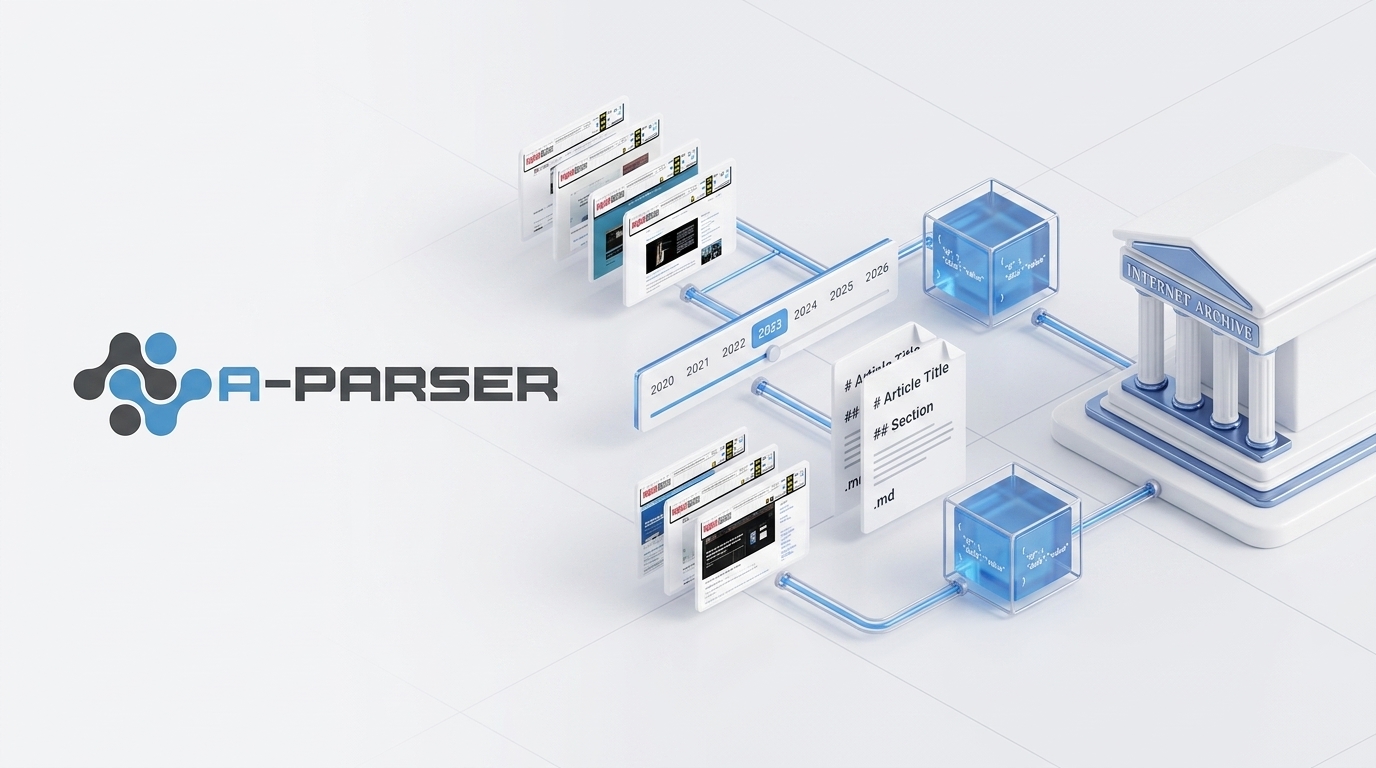
  • No-code pipeline: Net::HTTP -> HTML::ArticleExtractor finds URLs through the CDX API, downloads clean snapshots, and exports the results to JSONL.
  • The JS::WaybackCDX TypeScript scraper: discovers snapshots, normalizes and deduplicates URLs, extracts the main content with Mozilla Readability, and saves individual Markdown files with YAML Frontmatter.
  • id_ mode: add id_ to a snapshot URL to remove the Wayback toolbar and injected archive scripts, so the export contains the page's original HTML.

Open the guide, download the scraper, and get the presets
 
aplogo_1788174938523.png

A-Parser 1.2.3593: Google /goto Bypass, Restored SE::Yandex HTTP Mode & Rewritten Google Trends

A new update for A-Parser (v1.2.3593) is live. Here are the key highlights:

  • Google /goto & Anti-Bot Bypass: Added a bypass for Google's new /goto redirect layer (which masks real destination URLs in SERPs) and updated general anti-bot mechanisms.
  • SE::Yandex: Restored stable scraping in HTTP mode.
  • SE::Google::Trends Rebuilt: Completely rewritten from scratch to restore stability, plus added the Parse to level option for deep related-query scraping.
  • FreeAI::ChatGPT Fixes: Resolved memory leaks during long scraping sessions, fixed "Waiting for selector" timeouts, and eliminated truncated responses.
  • Yandex Maps & Whois: Fixed speed throttling/stalls and pagination retries in Maps::Yandex; added 12 new ccTLDs to Net::Whois.
  • Plus various other improvements and bug fixes.
 
Back
Top