

- Aug 23, 2022
- 915
- 910

SEOMANTIK'S INTERACTIVE COURSE
Build your topical map from real data, get the gaps, the architecture and a drafted cluster, then run the rest of your SEO from the same setup. No need for other expensive tools
THIS REPLACES EVERYTHING!!
Here is my honest review about this course.
This is the best course ever published here.
The six-phase pipeline structure is the part that actually matters. Most people treat topical authority like a keyword list. This maps it as a universe (subtopics, entities, questions, gaps) and sequences the build in waves. That's the difference between publishing random clusters and actually closing coverage.
The WordPress integration bonusat the end is a nice touch too, that's exactly where these workflows usually fall apart, getting from plan to CMS.
Running the whole thing for $3–5 in data vs. $400/month across tools is a real number. I've done the math on my own setups and the margin is embarrassing once you cut the subscriptions. You can build complet topical map and everything using this in 3 hours instead of days doing it manualy.
Will be running this on a niche build this week. Already started it on a new site and already ranking good on a fresh domain. Here is the stats.:
Thanks once again, good luck with sales.
Click to expand...

My honest review : This is the real deal. No fluff. No theory. Just a pipeline that works.
I've been in SEO since 2016. Bought all the tools, taken all the courses, built a few sites that actually make money. This is the first time in years I've felt genuinely ahead instead of just keeping up.
What you actually get: A six-phase engine inside Claude Code that turns any domain + seed keyword into a complete topical authority plan. Not a PDF. Not a video. Actual JSON files on your disk: universe.json (every subtopic and entity), entity-map.json (your site crawled and graded), architecture.json (hub-and-spoke with exact internal links), build-list.json. Then Module 6 generates content briefs and drafts. The WordPress bonus pushes it all live.
The WordPress bonus is not a gimmick. I connected the plugin to my site (took 20 minutes, following the screenshots. Ran Playbook 1 from the bonus: one prompt, 47 internal links added across 16 existing posts. That's 4+ hours of manual clicking done in 90 seconds. Then Playbook 4 validated every link post-publish and caught three broken redirects. This alone saved me a full weekend of work.
Cost breakdown (real): "SEO data source" trial credit covered my first domain completely. After that, I topped up $10 and have run four more sites. Claude Pro is $20/month, I was already paying it. Compare to my old stack: Ahrefs ($129), Surfer ($89), Frase ($45), and a content brief tool ($30) = $293/month. The pipeline replaces all of them for topical planning, content briefs, internal linking, and GEO gap analysis. The margin is genuinely embarrassing.
The bottom line: For $99 this is the best value you can get from BHW in years. At full price, still worth it. If you run content sites and you're still renting four dashboards and doing internal links by hand, you're leaving money on the table. This is the shift everyone will be doing in a year. Get in early.
Thanks @dvc for building this.
Click to expand...
I was kindly given a review copy to try out the service.
As @dvc has mentioned, you do have a small outlay for the course, and an ongoing one as well if you decide to use this for every site you have. On the flipside of this, it is so much cheaper than having to outlay the funds for several tools.
The guide is extremely well laid out, and what I like about it is that there are screenshots for each step, too.
More importantly, it actually works. I've given Claude Code several different seed keywords on different domains I have and it is creating excellent entity maps. These can be used to completely rebuild a website so that it ranks like a boss on Google. It is also great for sites that are brand new and you're looking to turn it into an authority.
It does take time to go through the process of setting everything up, but this is well worth the time investment. This has been well thought out and provides as much information as possible, in a cost effective way. I actually like that it took time for this, it means that it's not just some 2 step process that promises the Earth, but delivers bugger all.
This is a tool that can be used by those that are new to setting up a site. I would actively encourage those that are new to SEO and site building to use this as it will be the quickest way for them to get everything they need to know on how to structure their site.
Likewise, for those that are making sites for others, this tool is a no brainer. This is the perfect way to secure a happy customer.
The Wordpress bonus tool is also a great piece of kit. I was really impressed with how well this performed, and overall is one of ( if not the ) the best things I've seen sold on this forum for a long time.
This is that most comprehensive way to properly build your site out, and following these steps put you in a great position to be able to make a success of it.
It should be noted though that you will need links down the line, but without a professional and correct layout of the site, the links are useless anyway.
The biggest question is, would I buy this using my own money?
The answer is yes. This is going to save me a lot of time (and money) going forward and is something that I will continue to use.
I like as well that the price of this is modest, considering how well it works. Even when the discount period is over, it is still underpriced for what you're getting, in my opinion.
I've had some messages going back and forth with @dvc, and I heard back really quickly with some insights regarding my questions.
A lot of the sellers on here could learn a lot from dvc on how to A) Run a service and B) Create a product that offers true value to the customer.
Best of luck with the sales and thank you for the review copy.
Click to expand...
I bought this - a few hrs back and just finished reading it. One word - excellent. I was doing something similar - but this book has changed my process to a more simpler and better way of building a Topical Map.
The Wordpress tool is a great addition.
Great Value for the price.
Got lucky and grabbed a review copy of this one, so figured I'd leave honest feedback after putting it through its paces.
Funny thing is, while I was poking at it for a test run I caught myself thinking "all these steps could just be automated start to finish"... and I think something pretty interesting comes out of that idea. But that's a story for another post.
On the course itself:
The entity stuff is the real value here. Most topical authority guides are vague hand-waving. This one actually shows you how to pull the entities Google ties to your topic and make your content cover them. That's the part worth the money on its own, and it lines up with how rankings work right now, not five years ago.
Steps are clear too. Every phase has a defined input and a JSON output, so you never lose track of where you are. Easy to follow even if the tooling is new to you.
The WP bonus is a nice touch on top, not the main event. It takes the plan and pushes content to your site. Handy, but the value is in the method, not the bonus.
Bottom line, the info is solid and it's current, which is rare for an SEO course. Worth the value. If you want a methodical entity-driven system you can actually ship from instead of just reading, this delivers.
@dvc did a great job here with this course - thank you and GLWS!
I got a review copy and have been using it on one of my sites for a few days, so here are my thoughts.
The first thing worth mentioning is that this is not a one click solution that does everything for you. You're heavily involved in the process. You paste the prompts, review the output, confirm executions and make decisions based on what comes back. It handles a lot of the heavy work, but you're still the one responsible for overseeing stuff.
Once I got into it, it gave me a really useful overview of my website already by the third module. The biggest benefit was seeing my topic coverage mapped out clearly and being able to spot gaps I hadn't fully identified before. It highlighted areas I should be focusing on if I want to grow traffic (based on how easy/difficult it is, and what is most important to focus firstly), having that laid out in a structured way makes it much easier to plan what to work on next.
One thing I would mention is that there were a few occasions where the output didn't quite match what that particular step was supposed to produce. I had to let Claude correct itself before moving on (for ex. when crawling my website sitemap and analyzing results). It always got back on track, but I'm not completely sure whether it did anything unwanted behind the scenes while fixing the issue. Nothing looked wrong in the final results, but I'd still recommend keeping an eye on each stage instead of letting it run unattended and just copy-pasting blocks of prompts.
Overall, I'm very happy with it. The process is easy to follow, the structure makes sense, and the final output is genuinely useful rather than just another list of keywords. If you approach it as a tool that helps guide your decisions rather than something that does everything automatically, you'll get a lot of value from it. @dvc really put a lot of thought and work into this, and it all makes sense.
Thanks for the review copy, and sorry it took me a bit longer to write it, but I wanted to be thorough with it.
REVIEW:
Received a review copy of the course from @dvc.
I've gone through a fair number of SEO courses over the years, and this one stands out because it's focused on a repeatable workflow rather than random SEO tips. It shows how to go from a seed keyword to a complete topical map and site structure without feeling overwhelming.
The guide is easy to follow, with screenshots throughout, and the WordPress automation is a nice bonus that saves a lot of manual work later on.
I also like that the workflow doesn't rely on a stack of expensive SEO tools. Once everything is set up, it becomes much easier to plan and organize content for both new and existing sites.
Overall, if you're planning to build authority sites or improve the structure of an existing one, this course is definitely worth a look.
Good luck with sales, @dvc.
I was lucky enough to get a Review copy from OP, and it turned out to be an Epic Course for anyone looking to get in-depth data in their niche! Now that the " Content " Module has been added to the course, it has a total of 6 Sections!
Process --> Step-by-Step Setup, and very simple to implement. Everything is written as an explanation alongside the prompt, which will make you aware of what is happening with Claude and the DFS combination.
You need a DoneforSEO subscription, but after using it on 2 sites, I can say it delivers great value for the $1-2 spent on each project! Think of 4 Team members working for you on collecting the data to build Topical Authority for your website, 4 Different Tools to crawl each corner of your website, and ensuring the whole website is structured nicely according to the Top 10 Competitors. Think of 4 Expert Researcher collecting data after analysing Page 1 competitors, and any valuable on-page GEM that most of the tools and Expert eyes may miss will be reported to you!
It is simply a Great SEO tool, and I am yet to experience the results, but imo it will most likely put you ahead of 99% of your competitors!
Will leave another Review for the content section in a few days and implement everything from 0-100% on a single project and get back with Results and Data!
Good Luck OP -> I am really glad I found this!
You picked the topic. Wrote the pillar page. Wrote the supporting posts under it, linked them into a tidy silo, and waited. Two months later the rankings hadn't moved.
Or you went the other way, fell into entity relationships and salience scores, and burned a week on theory before you'd published a single post.
That's not an effort problem. It's the map.
A topical map built on what you reckon the topic covers is a guess in a tidy shape. Aim twenty good posts at the wrong gaps and you go nowhere, no matter how clean the silo.
Here is what I do instead now,
I open Claude Code (Codex, Gemini, Deepseek, you choose yours), tell it the domain and the seed keyword in plain English, and it goes and does the work. It pulls the live search data, reads my site, finds the gaps, lays out the architecture, sequences the build and drafts the first cluster. No dashboards. No CSV exports. No tab-switching between four tools. The whole plan lands as real files on my disk, in an afternoon, for a few dollars of data.
Claude Code is just the program you run it in. You don't configure anything and you don't write code. You paste prompts I hand you, hit enter, and watch the work happen step by step. The skill you're buying is what to tell it and in what order, which is the part that took me months to get right.
Straight talk before the demo,
Topical authority decides where you're allowed to compete. Links and quality still decide how high you climb. I'm not telling you links stopped mattering or that this ranks you on its own. It handles the part people waste the months on, the on-site coverage and the content plan, built on data instead of a hunch. The rest is still on you.
A REAL RUN, ON A REAL SITE,
One site. Seed keyword: home espresso machine. Here is what came back in one sitting, for a few dollars of data:
- 225 keywords pulled and clustered
- 16 subtopics mapped
- 104 entities the topic expects you to cover
- 70 questions worth answering, ranked
- 1.65M monthly searches across the whole map
That is not a chart you read and forget. It is a set of files on your disk you open, edit and re-run.
PS on the screenshots below: they're cleaned up for readability, not raw grabs of the terminal, so they won't look exactly like your Claude Code window.
The topic universe
Every subtopic, entity and question the topic spans, pulled from live data into one file. This is where the 225 keywords and 104 entities above come from.

Your coverage, graded
Your site mapped against the full topic. Each gap is a page you're missing, named one by one, so you stop guessing where you're thin.

The question queue
Every question worth answering across the topic, ranked by priority, so you write in the order that builds the topic instead of at random.

The architecture
A hub-and-spoke layout with the exact internal links that need to exist, so the cluster reinforces itself instead of sitting as loose posts.

The build order
The whole plan sequenced into waves: what to write this week, this month and later, so you always know the next move.

The first drafts
Your first cluster written from the briefs, sitting on your disk, ready for you to edit and publish.

>>> THE CONTENT ENGINE <<<
Those drafts are a starting point and I am not going to pretend otherwise. A first draft reads like AI, and it can state a number with complete confidence and nothing at all behind it. The second one is what gets people in trouble, because it is the part you do not catch by reading it back.
So the course does not stop at the draft.
A second engine takes it the rest of the way and runs itself. It locks a spec for the page, rewrites the draft to hit that spec, then hands it to a separate reader that grades it before you ever see it.
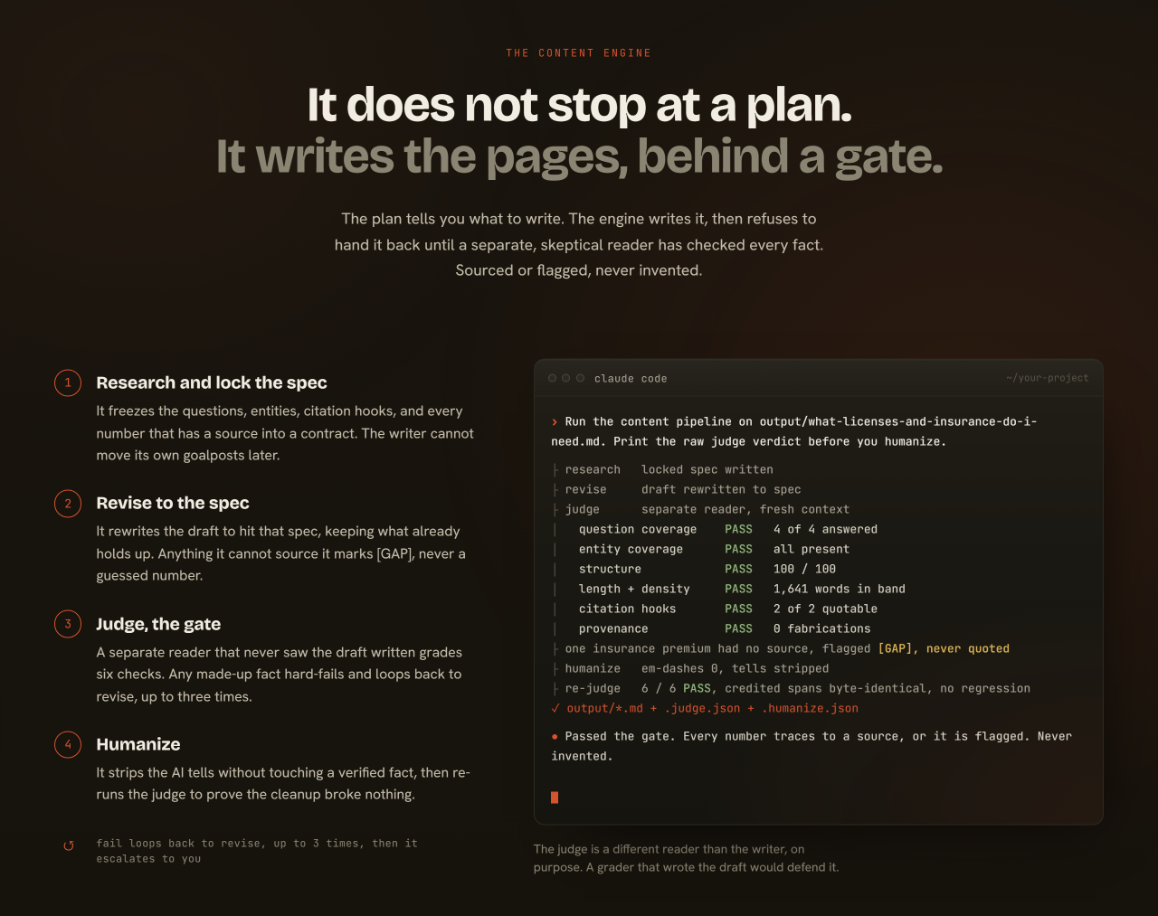
Four stages and a gate. Anything it cannot source gets flagged instead of guessed.
The engine ships in all four editions.
NOW THE PART THAT MAKES IT PAY FOR ITSELF...
 Keyword research across hundreds of terms at once.
- A competitor's whole footprint, pulled and lined up against yours.
- On-page audits in one pass.
- Rank checks, SERP pulls, the gaps, whatever you can describe.
You buy this once and you own the setup. Point it at a new site next week, re-run it next quarter, it is yours and it does not bill you again.
That is the actual offer here. Not a PDF. A tool stack you own instead of rent.
One honest line about what it doesn't do
It drafts, you edit. It does the research, the map and the first draft. You still read the map, cut what doesn't fit your site, and put your own judgment on the writing. It needs a small pay-as-you-go data balance to run.
And it makes no promise about your rankings, because your niche, your links and your execution decide that, not me. The coverage, the structure and the plan, the part you control, is what it builds right.
Before you call it !!
I have read the same threads you have, so let me get ahead of it.
"Another rehashed PDF." The run above is real and the files are real. You cannot google a finished pipeline that produces them.
"Proof is easy to fake." Then drop a domain and a seed keyword in the thread and I will run it and post the output back here, where everyone can see it. Real ones, as I get to them, on my own data balance.
"Why not just google how to do this for free." You can google what topical authority is. You cannot google a setup that turns one domain and one keyword into a finished map, a gap list and a drafted cluster in an afternoon, and then runs the rest of your SEO from the same place. The concept is free. The setup and the hours it saves are the product.
"Is this the overcomplicated semantic SEO stuff." No video maze, no jargon wall, and no step held back to upsell you later. You run prompts I hand you, the setup does the heavy lifting behind them, and you watch the files build. Simple to run, serious underneath.
>>> THE BUILD, PHASE BY PHASE <<<

1 - Universe. Every subtopic, entity and question the topic spans, in one map.
2 - Entity Map. Your site crawled and graded against it. Where you're strong, where you're missing.
3 - Questions. The questions worth answering, ranked by priority.
4 - Architecture. Hub and spoke, with the internal links that actually move things.
5 - Build list. The whole thing sequenced into this week, this month, later.
6 - Content. Your first cluster drafted and ready to edit.
Plus a 30 minute setup, a bonus that pushes the build live to WordPress in one session, and an annex so you never lose your place. 11 chapters, and every edition below gets all of them.
>>> FOUR EDITIONS, PICK YOUR SITE <<<
A blog covers a subject. A software site has to cover the way people shop for software. A store has to cover the way people shop for products. A service business has to cover what it does and everywhere it does it.
Different pages, different order, different finish line. So the course comes in four editions and you take the one that matches your site.
1. Topical Authority
Blogs, niche sites, affiliate sites, publishers.
You have a subject and you want to own it, so the map is the topic itself and the job is covering it properly, in the right order, with the internal linking that makes it hold together.
2. Product-led SEO
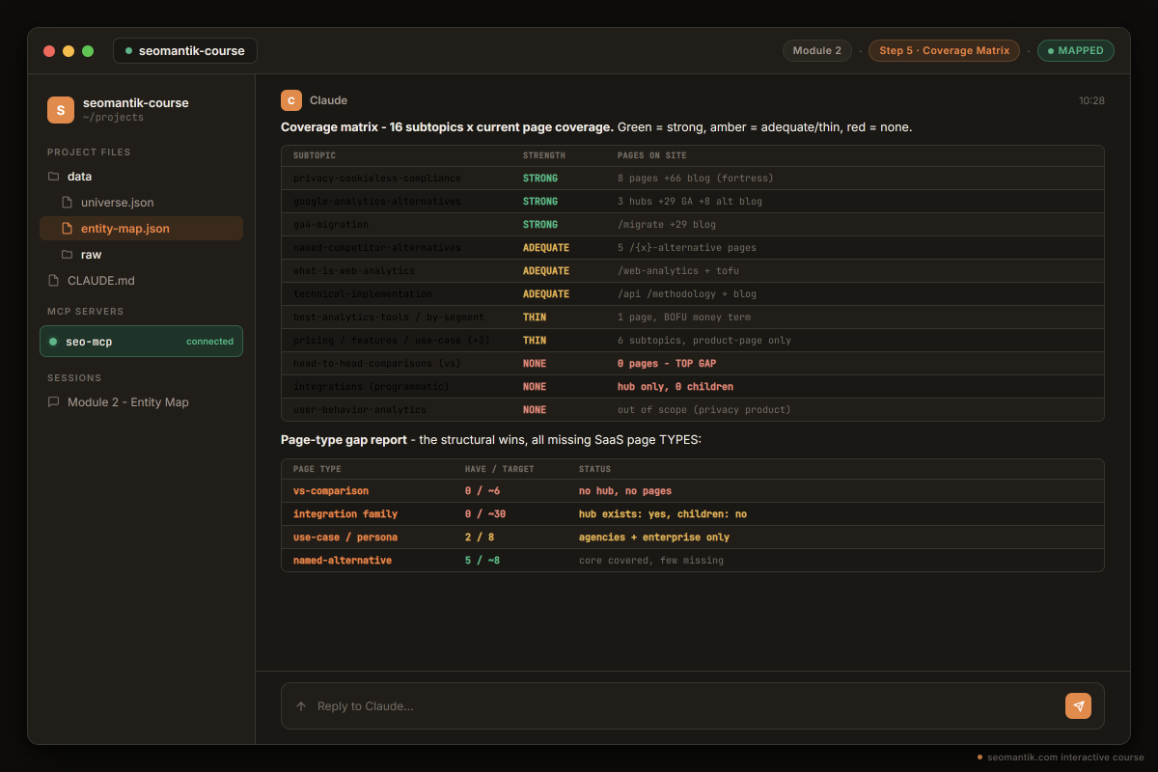
Software and SaaS.
The trap here is a blog full of readers who are never going to sign up. People shopping for software search in a way a blog map does not see.
They compare you against named rivals. They go looking for an alternative to the tool they are already sick of. They check whether you plug into the rest of their stack. They want their own situation spelled out on the page before they trust you with it. Plenty of SaaS sites have a hundred articles and not one of those pages.
This edition maps your category by what people are trying to do, not by subject, so you can see which pages sit near a signup and which ones are just traffic, and it builds those first. The blog stops sitting next to the product and starts feeding it.
The site read back page type by page type. Everything the funnel needs, marked present or missing, so the argument is over before it starts.
3. Category + Product
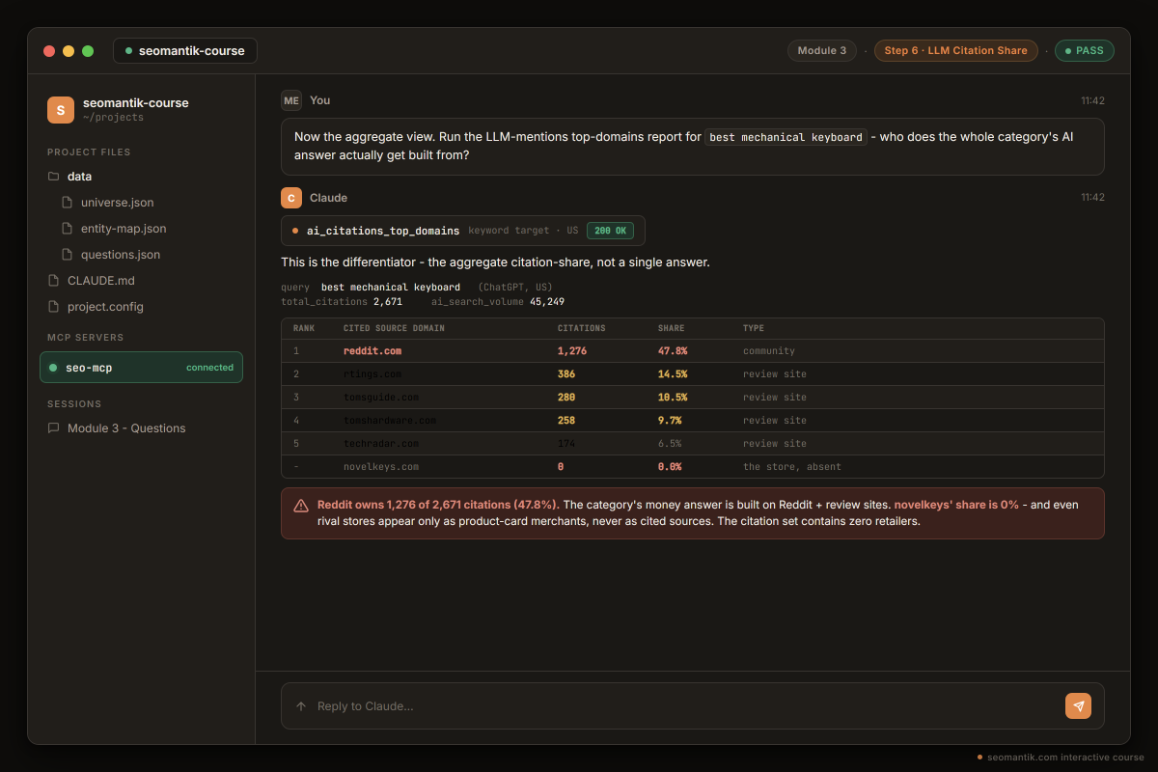
Online stores.
A store has products and usually nothing else. So every search a shopper makes before they are ready to buy, which type do I need, which one suits a beginner, this one against that one, gets answered by a review site, a forum thread or a competitor.
Your store turns up at the very end, if it turns up at all, and by then the choice is made.
This edition maps the category the way a shopper actually moves through it, grades your catalog honestly against that, then lays out the guides, comparisons and collection pages that catch people earlier and feed them down into the pages that take the money.
Who the AI answer credits when a shopper asks what to buy, and where the store that actually sells the things sits on that list.
4. Map Pack + Geo
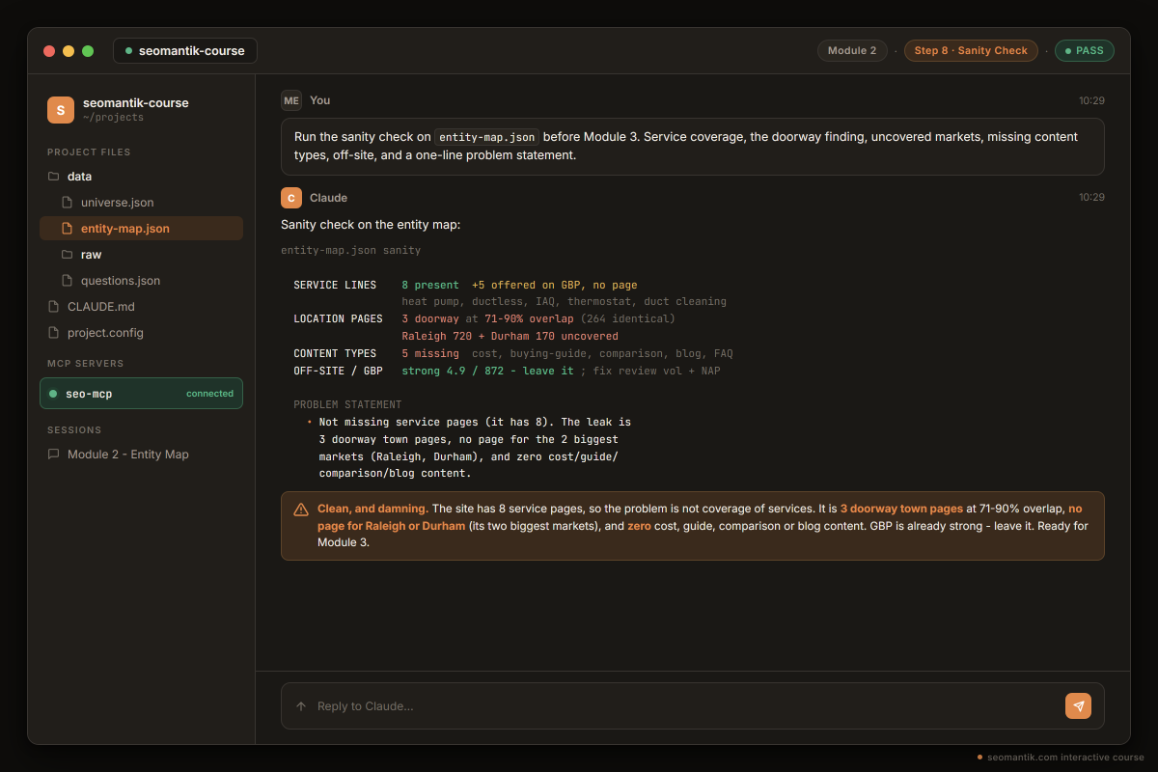
Local and service businesses.
Your market is not one topic. It is what you do multiplied by everywhere you do it, and that changes every decision after it. Which town earns a real page and which one does not.
How to build those pages so they are genuinely different instead of the same page with the name swapped, which is the thing quietly leaving a lot of local sites ranking for nothing.
What people read before they pick up the phone, which is prices, comparisons and who is any good around here. And where you stand in the map pack and in the answer someone gets when they ask an AI instead of searching.
The site read back to you straight: which pages are real, which are near-copies of each other, and which markets you have nothing for at all.
WHICH ONE IS YOURS
- You publish articles: Topical Authority
- You sell software: Product-led SEO
- You sell products: Category + Product
- You serve customers in an area: Map Pack + Geo
Each edition is the whole thing. Six phases, its own prompts, its own worked example, the WordPress bonus, the annex. Not a chapter bolted onto the blog course.
Working on more than one kind of site? Take all four for $399, which is less than buying three.
WHAT IT COSTS TO RUN:
- The data feed: pay-as-you-go, the raw data the big tools resell before they mark it up. $1 gets you testing. The minimum top-up is $50, but it is refundable and never expires, and a run is only a few dollars, so $50 lasts months across many sites.
- Claude: about $20/month for Claude Pro, or API credits. The free tier won't run it.
Who it's for
You run or build sites and you want them found. A content site, a software product, a store, or a business serving an area. You have done keyword research and felt the wall right after it, where you don't know what to actually publish or in what order.
You would rather own a system than rent four tools and guess. A few dollars of data per site and about $20/month for Claude don't put you off.
Not for you if you want a push button money machine, you're here for links or PBNs, or you won't touch a paid data feed.
Frequently asked questions
Do I need to code? No. You paste prompts and Claude Code does the work. If you can paste into a chat box, you can run this.
Is this just a ChatGPT wrapper? No. It runs on real, live search data through a wholesale feed and writes real files. The chat is the interface; the data and the method are the substance.
Does it only do topical maps? No. That is the first job. The same setup runs keyword research, competitor pulls, on-page audits and rank checks. It replaces the stack you're renting.
There are four now. Which one do I buy? The one that matches the site in front of you. They are separate courses, not levels, so one site needs one course. If you work across a few kinds of site, the four together saves you money.
Is the software or store or local edition just the blog course reworded? No. Same six phases, but the map, the page types and the order you build in are all different, and each edition was built on its own run against a real site of that kind. A blog course would tell a store owner to write more articles. That is the wrong answer, and it is why these are separate.
Will it work in my niche? If the seed keyword is broad enough to have a topic around it, yes. Narrow and B2B niches lean more on the entity layer than on raw volume.
What am I paying for if the data is third party? The setup and the method. The data is a cheap commodity you connect to and pay per call. You're buying how to run your SEO from one place, in the right order, and own it.
Refund policy: This is a Digital product, access is granted instantly right after you buy (or a couple of hours if you order via crypto and I wasn't next to my computer), so sales are final once you're in. What you get is support: if a step won't run, message me and I'll get it working with you. If you don't get your access in 24 hours then you'll receive a full refund.
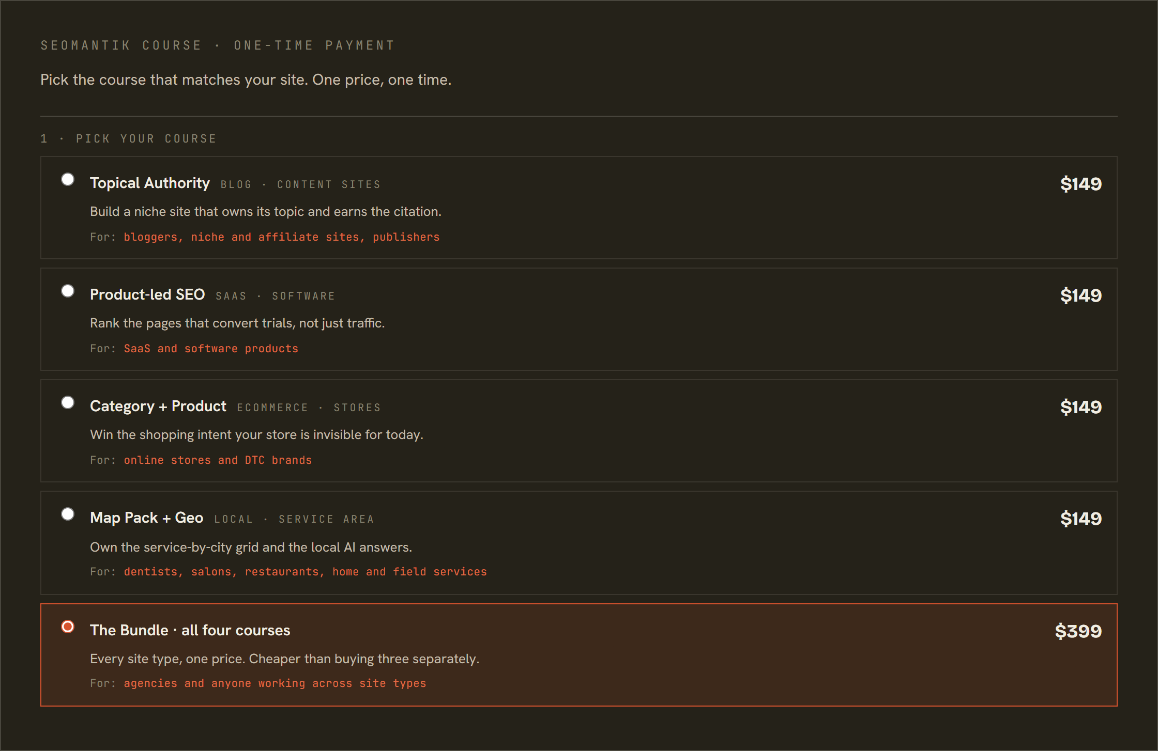
GET IT NOW! ONE COURSE $149 (one time).
Two courses $298. All four $399.
You pick your course at checkout:
How to Order/Contact
Order directly via the website or by sending me a PM here.
Website: https://seomantik.com
E-mail: [email protected]
Telegram: @Kaymakay (only for presale questions, I will never ask you to buy from telegram directly, always order either from the website or via PM)
ALWAYS ASK ABOUT THE NEW DISCOUNT CODES IN THE THREAD.
Accepted payment methods:
Credit Card / Paypal / USDT (via the website, access is set up automatically)
BTC: Via PM
Payoneer: Via PM
Two courses $298. All four $399.
You pick your course at checkout:
How to Order/Contact
Order directly via the website or by sending me a PM here.
Website: https://seomantik.com
E-mail: [email protected]
Telegram: @Kaymakay (only for presale questions, I will never ask you to buy from telegram directly, always order either from the website or via PM)
ALWAYS ASK ABOUT THE NEW DISCOUNT CODES IN THE THREAD.
Accepted payment methods:
Credit Card / Paypal / USDT (via the website, access is set up automatically)
BTC: Via PM
Payoneer: Via PM
Last edited by a moderator:


